Hi all!
Just a very short post to remind you that the cutoff for our Winter Lore Contest is tonight at midnight (Central Time).
So if you want to enter, please email us with your lore before then!
Thanks!
-Cory
New World Witchery – The Search for American Traditional Witchcraft
A show about magic and witchcraft in North America
Hi all!
Just a very short post to remind you that the cutoff for our Winter Lore Contest is tonight at midnight (Central Time).
So if you want to enter, please email us with your lore before then!
Thanks!
-Cory
In an effort to blend the subjects of recent blog posts, I thought today I’d start to look at a few of the key magical texts which would have had an influence on the American Colonies. Much of this entry will be directed by a reading of Owen Davies’ Grimoires: A History of Magic Books and Witchcraft, Magic, & Religion in 17th-Century Massachusetts by Richard Weisman, both of which I highly recommend reading. I am also pulling from The Silver Bullet by Hubert J. Davis and Witches, Ghosts, & Signs by Patrick Gainer. I’ll mostly be looking at the English colonies, but the French and Spanish colonies will also enter into the discussion a bit during later articles.
In general, the magical books of the early colonies came in three flavors: devil’s books, witch-hunting manuals, and grimoires. The Devil’s Book was frequently thought by Puritan settlers to be the ultimate embodiment of human sin—a willful signing away of one’s soul to infernal powers. By simply signing one’s name to such a book, a witch gained all her power and lost all her salvation (I use “her” because the popular conception of a witch tended towards the feminine, though male witches were not uncommon either). Some of the key features of a Devil’s Book and its accompanying rituals were:
The Profaning of the Bible – The witch would have to stamp upon a Bible or otherwise deface it before being allowed to sign. In some cases, a Bible itself was used to sign the witch into the Devil’s service. Several Appalachian tales record instances of witches simply making an “X” in a marred Bible to indicate their pact. In The Silver Bullet, witch Rindy Sue Gose performs this sort of ritual to seal her contract with the Devil:
“Fust, Rinday Sue cut her finger with a knife, and when hit started to bleed, she opened a little Bible and ‘peared to write sumpthin’ in hit with the blood from her finger. The Devil then nipped her on the left shoulder to give her a witchmark so’s she could suckle her familiar. Rindy Sue swore to give her soul to the Devil and to work for him the rest of her born days. Then, the Devil danced with her, and then went into the woods behindst thet tree” (Davis 17).
This action echoes the profaning of the Lord’s name or the recitation of a reversed “Our Father” as a way of breaking the bonds of Christianity for a witch. Not that you should read much into that, of course.
The Use of Blood as Ink – When witches made their mark, they often didn’t actually sign their name. In a time when general literacy was still low (though it should be noted that literacy among Puritan men was quite high for the era), not everyone would be expected to have a “signature.” Instead, they would have a “mark,” often an “X” which they used as an indication of their agreement to a contract. To personalize this mark in the rituals of witchcraft, a witch wouldn’t simply take an inked quill and make a fancy “X,” though. Instead, her blood was an indication that the pact bound her body and soul to the Devil. Puritan minister William Perkins described the process (most business-like) as follows:
“The express and manifest compact is so termed, because it is made by solemn words on both parties. For the satisfying hereof, he [the future witch] gives to the devil for the present, either his own handwriting, or some part of his blood as a pledge and earnest penny to bind the bargain” (Weisman 36).
The Devil sometimes used a great iron pen to draw the blood from the witch before having him sign his name, and in cases where the book was not a defaced Bible, the great book contained hundreds of other blood signatures from other witches.
Owen Davies observes in his book that the drawing up of a pact between a witch or sorcerer and an infernal representative was nothing new—look at the legend of Faust for example. What made these New World magical compacts unique was that the witch did not draw up the document herself, but rather was lured into signing a book which she would not take possession of, but rather which remained in the custody of her magical Master. All her magic, then, would be learned without the aid of books, at least in this model of New England Colonial witchcraft. Indeed, the Devil presented himself or his imps to the witch as her means for accomplishing malefic magic rather than gifting her the use of dusty tomes of magical lore and spells. In short, the Devil’s Book was merely a roster of the souls won to his service, and possessed little magical power in and of itself, at least superficially. However, many witches might claim that a deeper reading of the Devil’s Book phenomenon reveals that the act of writing in blood on a sacred object in fact demonstrates a type of very old and powerful magic. Thus, such a book, if it could be wrested from the Devil, would be very powerful, indeed, perhaps containing the magic of all those who had signed before.
Next time we pick up this thread, we’ll be looking at the witch-hunting books, and why they may have actually helped more witches in their spellcrafting than they actually hurt by “revealing” them.
Thanks for reading!
-Cory
Hello everybody!
This is just a quick reminder that we’ve got our Winter Lore Contest on right now, but time is running out to get your entry in. We’re looking for information centered around the winter holidays, specifically local or family:
Please make sure you tell us what area you are from (generally), and if you would like us to use your name on the blog/podcast.
You have until midnight (Central Time) on Monday, December 6th to submit your lore via blog comment or email, so don’t delay! You can still get an additional entry if you tweet, blog, or otherwise spread the word about the contest and send us the link.
The prizes are:
Two Runner-up Prizes – Signed copy of Judika Illes’ latest book, The Weiser Field Guide to Witches
One Grand Prize – A Compass & Key Hoodoo Starter Kit, with a selection of oils, botanicals, curios, and other products for budding rootworkers.
We’ve gotten a number of excellent entries, but we still would love to get some more, so please submit before time runs out!
Thanks for reading (and sharing)!
-Cory

I thought in honor of the recent Thanksgiving festivities—at least those here in the US (and with a belated bow to the harvest feasting in Canada), I would take a brief look at some of the magical practices circulating around the time of that “first Thanksgiving.” The people who arrived in places like Plymouth and Massachusetts Bay to settle the New World—never mind it was already quite settled by its native inhabitants—are commonly referred to as Pilgrims, and contemporarily would have been known as Separatists. Thinking about that late autumn gathering, when the local Pawtuxet tribe and the Separatists who had survived the harsh New England winter and managed to put together enough bounty for the coming cold season gathered at the table, is a sort of fond romance or fantasy. Often we imagine the Indians in their deerskins and the Pilgrims in their blackest hats with the shiniest buckles on them. The staunch Calvinism of the Separatists contrasts with the “noble savage” imagery of the Natives, their shared meal demonstrating two very different worlds breaking bread together. Yet both groups shared many things in common, including a set of magical practices aimed at protecting their homes and blessing themselves with prosperity.
The fear of malefic witchcraft—which would eventually go on to spawn the famous “witch hunts” of Colonial America—stirred hearts on both sides of the table. Each group had its own charms, talismans, prayers, and formulas for dealing with the dangers of spiteful magic. The Pilgrims, drawing on their English heritage, had all sorts of magical tricks up their black-and-white sleeves for defeating evil witches and devils:
“Legal actions against malefic witchcraft merely represented the final point of defense against what were perceived as destructive magical powers. Prior to entering his complaint into the legal domain, the colonial villager could draw upon a variety of protective magical formulas to maintain some sort of equilibrium between good and evil mystical forces. Several of these techniques—by no means an exhaustive list—were mentioned in a sermon delivered by Deodat Lawson…’The Sieve and Scyssers [Scissors]; the Bible and Key; the white of an Egge in the Glass; the Horse-shoe nailed on the threshold; a stone hung over a rack in the Stable.’” (Weisman 40)
Looking at these specific examples, we can see a few things which indicate that magic among the Pilgrims was not so uncommon.
The Sieve & Scissors – These items were commonly used in fortune telling games by young girls, particularly on exciting nights like Halloween. They could also be used to confuse or cut a witch, magically speaking. The Sieve and Shears appear in Aggripa’s Three Books of Occult Philosophy, as well.
The Bible & Key – The Bible was considered to have inherent magical and protective abilities, and the key likely held the symbolism of “locking away” or “locking out” any harmful witchcraft. The use of the two together also formed the basis of a spell recounted in Reginald Scot’s Discoverie of Witchcraft: “Popish preests …doo practice with a psalter and a keie fastned upon the 49[th] psalme, to discover a theefe” (Scot, Chapter V).
The Egg White in a Glass – This is another method of divination involving cracking an egg into a clear glass or jar of water, then reading the resulting shapes, strings, bubbles, and colors found in the glass. Curanderismo continues to use this method as a regular part of cleansing and reading practice even today.
The Horse-shoe on the Threshold – This particular charm moves out of the realm of divination and into prosperity and protection magic. We covered horseshoes on our Lucky Charms podcast, and you can read all about them at the Lucky W Amulet Archive page on the subject. The iron in the shoe, plus the somewhat mystical nature of the animal associated with it, imbued this charm with the power to block witchcraft and provide good luck to those passing under it as they entered a Pilgrim’s household.
The Stone in the Stable – The stone referred to in this charm would likely have been a holed stone, one which had been naturally eroded to leave a gap by which it was then hung in places needing protection from malefic activity. Sarah over at Forest Grove wrote a bit about these holed stones, saying “In the UK it was used as a protection charm as the locals believed that by tying their front door key or the stable door key to a hole stone they would protect the building it hung upon.” This, much like the horseshoe, was primarily protective, but a holed stone could also be used to “see” witches and other Otherworldly entities by peering through the gap.
Looking to the Natives’ side of the table, we find that charms to provide protection and blessing were also common among the Algonquin tribes of New England (Algonquin being a language and not an actual tribe, I use the term here to blanket a wide number of groups sharing a more-or-less common landscape and tongue). Charles Leland (admittedly a questionable source on some matters of folklore, but not without his merits) wrote of many New England Native magical practices. He compares the workings of Native shamans with the work of Catholic priests in one passage of his book The Algonquin Legends of New England: Tales of Magic:
“For wherever Shamanism exists, there is to be found, in company with it, an older sorcery, or witchcraft, which it professes to despise, and against which it does battle. As the Catholic priest, by Bible incantations or scriptural magic, exorcises devils and charms cattle or sore throats, disowning the darker magic of older days, so the Shaman acts against the real wizard.”
Leland recounts several legends of warriors and magical Indians doing battle with terrible spirits, the dead, and other dangerous forces. In one tale, a chief’s son, described as “a great hunter, and skilled in mysteries” decides to marry. In his efforts to get a wife, he sets out on a journey in which he acquires many talismanic and shamanic tools. One of them is a golden key pulled from a whale’s mouth, which the whale tells him has great protective power: “While you have it you will be safe against man, beast, or illness. The foe shall not harm you; the spirits which haunt the wilderness shall pass you by; hunger and pain shall not know you; death shall not be in your road.” The key, then, appears in both the European and Native magical traditions as a powerful amulet.
As a final note on the magic of Native Americans, let us turn from the groaning board of the Thanksgiving feast and look at another magical practice: fasting. In an 1866 article entitled “Indian Superstitions,” Francis Parkman describes the use of ritual fasting in order to acquire a Manitou, or guardian spirit:
“Each primitive Indian has his guardian manitou, to whom he looks for counsel, guidance, and protection. These spiritual allies are acquired by the following process. At the age of fourteen or fifteen, the Indian boy smears his face with black, retires to some solitary place, and remains for days without food. Superstitious expectancy and the exhaustion of famine rarely fail of their results. His sleep is haunted by visions, and the form which first or most often appears is that of his guardian manitou, a beast, a bird, a fish, a serpent, or some other object, animate or inanimate. An eagle or a bear is the vision of a destined warrior ; a wolf, of a successful hunter; while a serpent foreshadows the future medicine man, or, according to others, portends disaster…The young Indian thenceforth wears about his person the object revealed in his dream, or some portion of it—as a bone, a feather, a snake-skin, or a tuft of hair. This, in the modern language of the forest and prairie, is known as his “medicine.” The Indian yields to it a sort of wor ship, propitiates it with offerings of tobacco, thanks it in prosperity, and upbraids it in disaster. If his medicine fails to bring him the desired success, he will sometimes discard it and adopt another” (Parkman 4).
Feast or famine, magic has long been on American soil (and Canadian, Central American, & South American soils as well). So as you eat your turkey leftovers, you could crack an egg into a glass of water, pull out some scissors and a sieve, or maybe even think about putting the food aside for a while and seeing what comes to you in your dreams. It might add a little New World Witchery to your holiday. Which, of course, makes me feel pretty darn thankful.
Thanks for reading!
-Cory

My ambitions got ahead of my time last week, so I am behind in posting about magical books in American traditions. I thought today, though, I’d start at the cheap and plentiful end of the spectrum in the hopes that I might make up for any lack of posting.
Chapbooks—small, cheaply made books usually containing no more than a hundred pages or so—have been a part of the New World landscape since Colonial times. Many of the most important texts leading up to the Revolutionary War were published in chapbook format, such as Thomas Paine’s Common Sense. These booklets, which were also frequently referred to as “tracts” or “pamphlets,” were cheap to make and cheap to buy, and could often be found in the stock of travelling peddlars (also known as “chapmen,” where the term chapbook comes from).
In addition to political messages, these little books frequently served as repositories for folklore and folk music, fairy tales, religious information, poetry, fiction, almanacs, and most importantly to us, magic. I’ll be addressing the topic of almanacs separately, as they have had a tremendous influence on the occult in America, so in this post I’ll focus primarily on the booklets of magic which circulated in North America from the 1600’s until modern times.
Early occult chapbooks generally originated in places like London or Scotland, and bore titles such as Dreams and Moles with Their Interpretation and Signification (London, 1750), The Fortune Teller & Experienced Farrier (Exeter, 1794) or the Spaewife, or Universal Fortune-teller (Scotland, 1860’s). They contained advice on interpreting signs, reading palms and other body parts, and performing basic divination such as taseomancy (tea-leaf reading). Some examples of the esoteric knowledge they contained:
Some of these books gave medical advice as well, and instructions for livestock management. In The Fortune Teller & Experience Farrier, author Ezra Pater tells anyone with a horse suffering from a cough to “take five or six eggs, and lay them in a sharp white-wine vinegar, till the shells be somewhat soft, then fling them down his [the horse’s] throat and it will cure forthwith.” Such remedies would go on to be de rigueur for magical practitioners in rural locations, and especially in the New World. The reasons for the popularity of such simple guides probably stems from their low cost, but also may have something to do with the rough medicine of frontier life. In many cases, settlers lived days away from good medical or veterinary care, and so a small practical guide would be indispensible to a rural family. As for magic’s entanglement with practical medicine, I can only reiterate that until very recently (the mid-to-late twentieth century really) there was no separation between the two, especially not in rural communities. Not everyone used every remedy, and not everyone used magic, but they were not at odds with each other, either. I find the best analogy here is a cookbook: just because you have one hundred recipes doesn’t mean you cook all of them. In most cases, you specialize and repeat the recipes you like or are best at, and those become your signature dishes.
Over time, other chapbooks emerged and became more and more popular. In rural and farm communities, such as the Pennsylvania Dutch areas of the middle Appalachians and the Ohio Valley, little books like Hohman’s Long Lost Friend became household texts. Individual families would also compile their own books, not unlike family recipe books, which might be kept on the same shelf as the family Bible. In many cases, these chapbooks would be the only texts in the home other than the Bible and perhaps a cherished tome or two of literature like Shakespeare. In more urban areas, cheap editions of Grimoires found their way into chapbooks, with publishers like Chicago’s William Delaurence producing a number of pirated works in reduced pamphlet form, including The Egyptian Secrets of Albertus Magnus, The Sixth & Seventh Books of Moses, and Hindu Magic and Indian Occultism. In Owen Davies’ excellent history of magical books entitled Grimoires, he explores the influence of the occult in Chicago:
Chicago may have an image as a grim, grey industrial city, but in the early twentieth century it was also a hotbed of mystical, magical, and prophetic activity. Rural Pennsylvania may have been the cetre of pow wow and New Orleans the home of hoodoo, but Chciago was the undoubted centre of organized occultism and grimoire publication…[it] proved fertile ground for mystical and magical groups. (p.210-11)
Other cities, like Chicago, also began producing quantities of occult chapbooks. Detroit—which had and continues to have a strong tie to hoodoo—was home to countelss candle shops with shelves full of pamphlets on luck, love, and money magic. In Harlem, stores like the Hindu Mysterious Store were selling racks of booklets on occult topics into the mid-to-late twentieth century. Some of the many titles included:
Books like these, especially the dream books (which purported to interpret dream symbols into lucky numbers to be used in lotteries), were tremendously popular. While the number of shops carrying such literature has diminished recently, the occult pamphlet remains popular and can still be found in many urban magical retailers.
Today, chapbooks still exist and continue to be published, though in two distinct veins. Some occultists (myself included) like to produce very limited runs of such booklets as artisan items. The publishing company responsible for the marvelous Witches’ Almanac also issues lovely chapbooks such as Spells & Incantations, Magical Creatures, and Magic Charms from A to Z. I’m still working on the illustrations and additional material for our New World Witchery cartomancy chapbook, which will eventually be sold through our Etsy shop. Many classic chapbooks are also still available, such as Henri Gamache’s Master Book of Candle Burning.
The other form in which one can find modern chapbooks will likely lead to scowls from some readers. If you’re ever standing in line at the grocery store, however, look over at the racks of gum and magazines, and usually near the top there will be small, palm-sized books of cheap newsprint paper and glossy stock covers. Some of them are all about alleged dieting secrets and pop psychology, but occasionally you can find little tomes of herbal lore, astrological information, and even love spells. While it may seem unsavory to think of magical literature as an impulse buy in the checkout lane, I would recommend perusing them. They’re often incredibly cheap and sometimes have good information in them, as well as guideposts to other resources that might be even more worthwhile. Of course, you may also find all you can do is line your familiar’s cage with them, too, so browse before buying.
I hope this has been useful to you! If you have any favorite chapbooks or magical booklets, I’d love to know about them! Please leave a comment or send an email and share them with us.
Thanks for reading!
-Cory
Hello everyone!
I recently saw a rather interesting post from a friend on a social networking site in which she listed her “Top 15 Most Influential Books” when it comes to witchcraft. Since I posted a book review last week (and since most book reviews going forward will likely be shared between this site and the Pagan Bookworm site), I thought that continuing that “bookish” trend might be good. So this week I will be posting about various texts which have a place North American magical traditions. Some will be of the grimoire type, and others may just be good reads, but hopefully all of them will be tomes you get much pleasure and use from if you crack the spines and turn the pages.
To start with, however, I’m going to re-use that meme and list my own Top 15 Most Influential (Witchcraft) Books. These are not necessarily books that I think of as “great,” or even in some cases “good” books. Many have erroneous information or are, at best, a good starting place for further exploration. All of them, however, have help shape my study of magic, folklore, and witchcraft in some way, and that’s what this list is really all about. I’m presenting them in a (roughly) chronological order, since that’s how I best remember them.
TOP 15 MOST INFLUENTIAL (WITCHCRAFT) BOOKS
(2010 Edition)
So that’s my list! Long, I know, and probably way too much commentary, but maybe it will give you some insight into the places I’ve come from and the type of magical person I am. Or maybe it will give you a reason to catalogue your own influences. If you do that, I’d love to see them! Please let me know what books influenced your path, and feel free to post your lists (or a link to your blog if you do a list there) on the comments.
Thanks so much for reading!
-Cory
(This review is also posted at The Pagan Bookworm, which hosts many great reviews and booklists of interest to magical folk)

Occult America: White House Seances, Ouija Circles, Masons, and the Secret Mystic History of Our Nation by Mitch Horowitz
Bantam Books, 2009 (304 pages)
This popular history of metaphysical thought in the United States has brought mainstream attention to many of the esoteric underpinnings of American culture. Fueled by films such as National Treasure, the “secret history” trend seems to have greatly informed Horowitz’s Occult America. In this text, the author traces several key lines of occult thought through the pages of American history, starting primarily in New York and working his way south and west across the landscape. He spends a good deal of time examining the “Burned Over District” near the Erie Canal, which spawned a number of new religious and spiritual movements during the eighteenth and nineteenth centuries. Mormonism, the Shakers, and even Spiritualism all have roots in this particular region, according to Horowitz, who treats the area as an incubator for esoteric thought.
The author then follows these nascent movements and some of their most visible members as they impact and shape American culture during the formative years of the new republic. Joseph Smith, Henry Steel Olcott, Jemima Wilkinson (aka the “Publick Universal Friend”), Helena Blavatsky, Andrew Jackson Davis, and Edgar Cayce are just some of the myriad personalities Horowitz examines in his whirlwind tour of historic America’s spiritual scene. He devotes pages to hoodoo mail order merchants and Voodoo worshipers in New Orleans. He introduces the phenomenon of correspondence-course religions, such as Paul Foster Case’s Builders of the Adytum, which saw a flurry of popularity in the nineteenth and early twentieth centuries. Horowitz also does all of his examining with an infectious enthusiasm which keeps the reader turning pages to see the next dizzying connection between occult America’s disparate streams.
Occult America has its faults, too. Horowitz so enthusiastically pursues the movements eminating from the Burned Over District that he neglects other key influences on magical and spiritual thought. For instance, he spends little time looking into the Appalachian Mountains and the many religious and folk magical traditions which stemmed from the Pennsylvania-to-Georgia portion of that range (a subject wich is explored very well in Gerald C. Milne’s Signs, Cures, & Witchery). He also gives short shrift to the occult legacy of places like Chicago, and devotes a relatively small amont of text to New Orleans—though that may be because it could be a book unto itself. He focuses more keenly on new philosophical movements and areas which might be classified as “New Age” rather than looking at the on-the-ground practical elements of American occultism. Even with all of that being said, however, the areas in which his focus is sharpest are often quite marvelous. His chapter on Manly P. Hall, author of the profoundly world-shaking The Secret Teachings of All Ages, is worth reading and re-reading for any student of esoteric thought. His chapter on the Ouija board is a delight as well.
Mitch Horowitz’s Occult America makes a good starting point for understanding the wide-ranging influences which have fed American spirituality since before the Declaration of Independence existed. While its net is broad and therefore sometimes it only shallowly explores major topics, it can easily provide a reader with enough good questions and resources to explore those topics on his or her own. It is far from comprehensive, but it is accessible and energetic, and will likely whet the intellectual appetite of any curious occultist.
Thanks for reading!
-Cory

So I said last week I wanted the 100th blog post to be special, and I thought a contest might just be the way to add that little bit of extra charm. If you listened to the podcast we posted yesterday, you probably already know about this contest, at least to some extent. We’re hoping to put together some Yuletide specials, and part of that will involve getting lore from all over the continent (or the world, even) and incorporating that into our shows during December. We’d love your lore, especially, and we’re even willing to give away some prizes to encourage you to send in your best winter holiday traditions. Here’s the gist of it:
What We’re Looking For: Your winter folklore, including (but not limited to) holiday traditions, recipes, songs, and stories; superstitions about specific days, events, omens, or signs are welcome; ghost stories set during the winter, bits of historical information, and ethnic customs are greatly appreciated, too! We already know that many folks put up decorated trees and exchange presents, so no fair telling us that. Pretty much everything else is fair game, though. Try to include as much information as you can, and give us your general location (such as “Pacific Northwest” or “Southern France”). Also, please tell us if we can use your name when we read your contribution.

What We’re Giving Away: We’ve got two (2) signed copies of Judika Illes’ latest book, The Weiser Field Guide to Witches that we’re giving away as runner-up prizes. If you don’t know about this book, here’s the blurb from the publisher:
“Witches peek from greeting cards and advertisements, and they dig twisted roots from the ground. Witches dance beneath the stars and lurk around cauldrons. Witches heal, witches scare, witches creep, and witches teach! A compendium of witches through the ages, from earliest prehistory to some of the most significant modern practitioners, The Weiser Field Guide to Witches explores who and what is a witch. From such famed historical legends as Aleister Crowley, Marie Laveau and Elizabeth Bathory to the popular literary and cinematic figures Harry Potter and The Wicked Witch of the West, Illes offers a complete range of the history of witches. Included also are the sacred–Isis, Hekate, Aradia–and the profane–the Salem Witch trials and The Burning Times. The Weiser Field Guide to Witches is appropriate for readers of all ages and serves as an excellent and entertaining introduction for those fascinated by the topic.”
Those of you who are familiar with our blog and podcast probably know how highly we regard Ms. Illes, and this book is a wonderful addition to anyone’s magical library.

Our grand prize is a Compass & Key Hoodoo Kit, which will contain a number of sensational conjurational goodies, including:
This kit would be a great way to get started with hoodoo, or build upon your current practice.
How to Enter: We want this to be easy, so please just leave a comment on either this blog post or the Podcast 19 Shownotes, or better yet send us an email with your submission at compassandkey@gmail.com! You can get an extra submission by blogging, tweeting, or sharing our contest and contact information with your social network and sending us either a screenshot or a direct link to where you’ve posted about us. The cutoff for submissions is Midnight (12:00 AM Central Standard Time) on December 6th (St. Nicholas Day).
If you have questions, feel free to email us those as well! We really want to get as much lore as we can, so please encourage others to send in their contributions (or if they aren’t interested in witchcraft, just find out their lore and send it in as part of your own entry).
Thank you so much everyone for making this blog such a wonderful place, and we’ll be looking forward to all your submissions very soon!
Thanks for reading!
-Cory
Hi all,
I know the posting here this week has been pretty shoddy, and I probably won’t get a post up (other than this update) at all until next week at this point. I’m hoping to do something fun for post number 100, but my day job is eating up a lot of time due to a big event we’ve got on Friday, so I don’t want to shortchange anyone with a half-baked post when I can just wait a week and do something much better.
At any rate, thanks for being patient, and please know that I’ll definitely have something good to post soon!
All the best to everyone!
-Cory
Ghostly greetings, everyone!
As I near one hundred blog posts on this site, I thought I’d share something special for Halloween. It’s an article I’ve been working on for a while now, part of a series I’m writing on the various holidays that make up my personal “ritual year.” It’s long, though not as long as it will eventually be, and lacks annotation (likewise it does not contain links like my usual posts, other than in its Works Consulted at the end), but hopefully you will find it useful.
Please enjoy, and I wish you the very best Halloween (or Hallows, as I call it) you can have!
— — —
Children run from door to door, dressed in costumes and begging for candy. As each door opens, there are monsters on the front porch, ghosts and ghouls waiting at the threshold with outstretched hands. The familiar shout of “trick-or-treat!” fills the early autumn air. Chocolate, sweets, money, and toys all get doled out to the eager masked masses (along with the occasional toothbrush from well-meaning but uninspired do-gooders). It is Halloween, and all is well.
By now, most everyone knows that Halloween has its origins in pre-Christian festivals mostly stemming from the British Isles and honoring the dead. Fires are lit, those who have passed on in the previous year wander the earth, and all manner of eerie activity takes place. For a New World witch, however, the nature of this evening (or set of evenings, depending on how an individual witch practices the tradition) is more than what commonly gets called “Celtic” nostalgia. Instead, there are a number of powerful forces at work on this night. Some are easy to understand, and some are harder to wrap one’s head around. But first things first, let’s get the obvious out of the way.
Halloween (or Hallows, as I call this series of days), is spooky. It is eerie. It is morbid, macabre, and a little bit twisted. It’s also funny, sometimes sexy, a good bit bittersweet, and no small amount of weird. It is supposed to be all of these things. Others may disagree and require absolute solemnity as they honor their dearly departed, and there are probably some who would like to exorcise the entire bone-chilling side of the holiday. But for me, and I think for most witches who do the work that has been done since the 18th century (and before) on this soil, there’s something in this time of year that requires skeletons and jack-o-lanterns, ghosts and goblins, and a good hard look at all the creepy-ookie-spooky parts of life we tend to ignore otherwise. And then, a good laugh to shake the willies away. This is the time of year where ghost stories, murder tales, and recounts of run-ins with the devil beg to be told.
Why do we dance with devils and the dead in tale and practice during Hallows, though?
There is, of course, the old saw that on this night “the veil between the worlds is thin.” There are many nights throughout the year, however, when the door between this world and the next swings open and intercourse between spirits and mortals is easy. The uniquely macabre tone of Hallows, in my opinion, has a lot more to do with its position between summer and winter, and more importantly, its position as a fulcrum between light and darkness, work and pleasure, comfort and danger.
The months preceding Halloween have been full of long days, often full of activity and work (during the previous centuries, farm work would have been going on right up to around the time of Halloween). Suddenly, everything around us starts dying, the days become noticeably shorter, and our hard work comes to an end, more or less. From a modern context, we don’t always understand this idea, because we aren’t working with agriculture directly for the most part, but think even of all the things that get done in summer after the work day is done: gardens dug, lawns mowed, children taken to parks after school. Now that the light is gone early, we—like our ancestors—have to find ways to occupy those dark evenings.
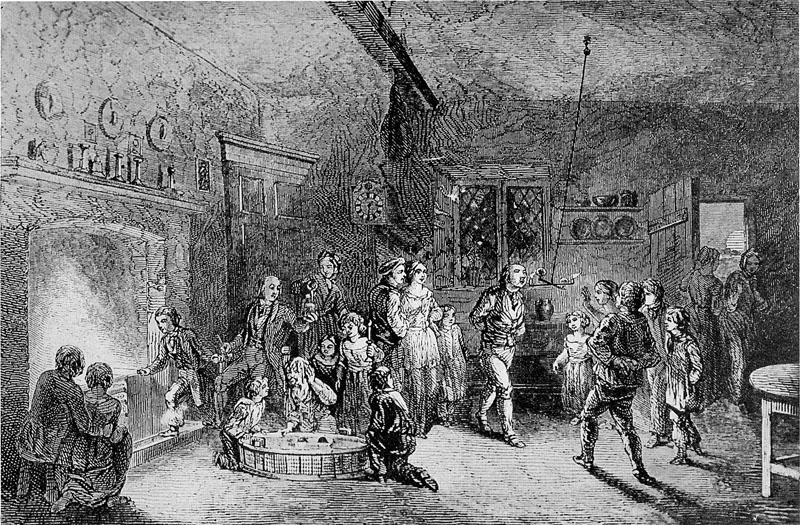
Enter the Hallows. Most of what a New World witch can do on Halloween reflects inherited practices from the British Isles. Because the Separatists (aka Puritans) were fiercely anti-holiday for religious reasons, the phenomenon of autumnal trick-or-treating and masked mischief didn’t really arrive in America until during the mid-19th century. Certain pockets of Appalachian settlers—due to their Scots-Irish heritage—began holding “snap-apple” or “nutcrack” nights. When the wave of Irish immigrants made their way to America following the potato famine in the mid-1800’s, this set of practices expanded to become a widespread phenomenon.
At this time of year, all sorts of mischief is afoot. And all sorts of merrymaking accompanies it. Some of the age-old practices (or at least centuries-old practices) associated with October 31st are:
Nutcrack Night – There are several divinatory rituals performed with nuts kept in the shell and placed in a fireplace which foretell of love, loss, and survival into the next year.
Snap-Apple Night – Games involving apples, such as bobbing for them or “snapping” after an apple dangled from a string using only one’s teeth, are very popular. In some of these games, objects are hidden inside apples in order to bestow blessings on the one who manages to catch the elusive fruit. Providing, of course, that the one catching the apple doesn’t break his or her teeth.
Guising – The practice of going out dressed in various fiendish costumes is one that shows up in many cultures. In Halloween celebrations, the reason usually given for this is that the frightening devils, ghosts, and goblins will either be frightened by mortals dressed like them, or mistake those mortals for their own and leave them be. This clearly taps into a major theme for the Hallows holidays: the roving spirits, sometimes seen as the Wild Hunt (see “Roving Spirits” below)
A-Souling – The origin of trick-or-treating, going a-souling (or just souling in some places) meant traveling from house to house, singing songs or repeating rhymes in hopes of getting some sort of reward. The most common reward was a little cake called a “soul cake.” There is a famous song which encapsulates the practice nicely. This practice also became part of the Christmastide celebration, in the form of caroling (see “Into the Dark” below)
Mischief-making – A nearly universal phenomenon, the idea of a holiday where good people do naughty things is quite cathartic. Witches should understand that there is something subtler going on when the world is turned upside down and people begin acting “devilish.” In America, we seem to appreciate this sort of phenomenon on April Fool’s Day, but less so on Halloween. This may be because in recent years the nature of the pranks has gone from soaping shop windows and throwing streamers of paper (or toilet tissue) over trees and houses to the infamous arson found in Detroit on “Devil’s Night,” or Oct. 30th. However, a witch playing at devilish tricks is less likely to be doing harm to his or her neighbors at this time of year, and more likely to be playing “tricks” on the natural order of things.
Ghost Stories – What would Halloween be without a good scare, right? Ghost stories told at this time of year can be spooky, terrifying, or even rather funny. Stories about devils, goblins, and other hellish creatures are also appropriate, as are tales of witches and witchcraft. Telling stories about famous witches, in fact, can be a great way to combine the ancestral aspect of the holiday (as the witches of the past are spiritual ancestors if not genetic ones) and the more evocative and spooky side of Halloween.
Roving Spirits
The restless dead are fairly universal. Many cultures have tales of vampire-or-zombie-like creatures which return from beyond the grave to wreak havoc on the living. Still more common is the recognition that the dead come back in a less menacing form: as ghosts or spirits to visit the living. The living, however, often fear the dead who belong to a world that terrifies us (if only because we don’t know of many who come back from it…or so we think, more on that later).
In terms of witchcraft, however, the dead are our friends. They are our ancestors, teachers, progenitors, and constant companions. Any witch worth his or her blessed salt has communion with the dead—or at least spirits of some kind.
One particular group of spirits out and about on this night goes by the name of the Wild Hunt. Fundamentally, this is the fairy court (also sometimes called the Unseelie Court or any number of other epithets) riding out into the mortal world. The souls of the dead are being led by this party’s ride through the darkness to the point where they may cross over into the Underworld. The problem is that the Wild Hunt isn’t exactly concerned if it gathers the souls of the dead or the souls of the living, and thus a mortal caught out by the Hunt can be in dire straits. The tale of Tam Lin is an excellent point of reference: the mortal Tam Lin was abducted by the Wild Hunt and must remain with them for seven years. After that, he is to be offered up as a “tithe to Hell” by the Fairy Queen. His lover (and the mother of his child yet unborn) saves him in a sort of reversal of the Wild Hunt, winning him back to the mortal realm
Other roving spirits may need guidance from the living on the nights of Hallows. One of the primary traditions associated with these nights is the lighting of candles in windows to call the souls of dead ancestors home to rest and visit. It is presumed that if they can at least get home for a while and share a little meal (see “The Dumb Supper”) they will be refreshed and able to find their way to the Underworld again.
Or so we hope…
The Dumb Supper
The famous Dumb Supper has been added to the ritual observance of many groups during the Hallows. I attended a Wiccan-style Samhain event which featured a very moving Dumb Supper once, and the appeal was not lost on me. The point of the Dumb Supper, at least superficially, is an act of communion with the deceased and other spirits. This is not exactly different than a Red Meal, save that during the Dumb Supper, silence is required while the meal is served and consumed. I’ve always understood the silence to be a method for tuning into the spiritual world around us, especially since our minds are focused on that world when we consume a communal meal.
The experience can be deeply emotional for some, as the beloved ancestors and friends who have passed on return to us and manifest themselves in order to share in our world once more. Some people are able to hold silent conversations with the dead during this meal, and some find that the meal acts more as a prelude to spirit communication. Either way, the Dumb Supper held at Hallows is particularly significant because beyond being a communal meal with particular ancestral spirits, the shades of all the dead are able to join in the feast. This leads some to set apart a portion of the meal in advance for those less-than-savory ghosts and goblins that might seek to do harm to the witch or her company. This portion is then offered as far away from the main table as possible—off her property if feasible.
There are other aspects of the Dumb Supper which are not as simple as a plate of food and a brimming cup of cider passed around in silence. One ritual for this meal involves setting the table backwards, as well, and leaving an empty seat. If a girl were to do this, during the course of the meal, the shade of her future husband would appear in the empty chair while they dined. One folktale about this practice recalls how a girl performed this rite and saw her future husband, though he seemed to be in tremendous pain. When she later met him, she knew him instantly but said nothing of the ritual. They were married, and soon after she made a casual comment about the Dumb Supper rite she’d performed when a young girl. The husband grew purple with rage and told her “So it was you! I went through hell that night and back again, you foul witch!” and promptly stabbed her in the heart. Above all things, such stories are fables about the consequences of being frivolous with magic.

Into the Dark
While the New World Witch may not find himself tied to the common “wheel of the year” associated with other denominations of magical religion, there is definitely something about Hallows that has to do with darkness and light. The shifting tides of these forces becomes more and more apparent the further into autumn we journey each year, until it seems our whole day is but a breath between nights. For a witch, this is a blessing in many ways: we seem to have more liberty to be ‘oot and aboot’ in the dark of night, the moon with all its power is most easily viewed in a night sky, and it seems as though the mysterious and unknown are everywhere in the darkness.
This dark time of year is full of rituals and mischief. From innocently childish pranks like soaping windows to the destructive fires of Detroit’s Devil’s Night, there seems to be a sense of Merry Misrule which kicks in as the daylight shrinks away from us. The nights of Hallows are potent for this sort of behavior, not least because we also add the additional tool of disguise. Between night and the masks, it’s no wonder a number of people simply lock their doors and don’t come out until morning during this holiday. Which is their loss, of course.
Guising—going door to door in costume begging treats or money—has been around since at least the middle ages, and may have antecedents in ancient practices. In Britain and parts of the American South, the practice of guising during festivals happens not just at Hallows, but Christmas as well. Seeing as how Christmas is a fulfillment of darkness and misrule which begins at Hallows, that makes a good deal of sense to me. Sadly, society does not like us to dress up and go door to door at Christmastime unless it’s in the form of Santa or carolers (though both are clearly connected to this practice, too).
Experiencing the dark of the year in conjunction with the rising of the dead lends a spooky air to this holiday, but inside that spookiness is a winking jester. This is supposed to be fun, an inversion of the normal way of things where we teach our children to share and be cautious. On Hallows, we want them dressed as monsters and ghouls, begging for candy from our neighbors, though. And that is just as it should be. Yes, there is certainly a place for solemnity in the darkness, but there is also a place for mirth.
Hailing the Hallows
So what might a New World witch do on Hallows that is so different from everyone else? Quite simply, not much. Take the kiddies trick-or-treating, indulge your sweet-tooth, attend a masked ball or party, give someone a friendly fright, and do whatever all of your non-witchy neighbors are doing. If you wish, have a Dumb Supper and leave a candle in the window for the dead. Go spend some time in a graveyard, leaving offerings for the dead and asking them to help you. Do divinations with cards, shells, or whatever you like. See if you can get your friends into it—even if you camp it up a bit, that’s okay. It is that Merry Misrule I spoke of earlier coming out. The dead can appreciate a good laugh, and you may be surprised how accurate your readings are if you let down the guard of seriousness which we so often keep up when working with the spirits. Do keep some magical protection about, as some boogers are like people and have no sense of humor; it’s best to leave them be, but a little cross or star worn about the neck or a good bag of salt tied to your clothes wouldn’t hurt either.
If you absolutely must make this holiday something more dramatic than it is, I recommend looking to stories for your answers. Read tales like “Godfather Death” or “Jack and the Devil,” and see what you can make of them. You may come up with something worth trying, or you may just learn a new yarn to spin sometime in the future. Share your meals and stories with the dead as best you can—leave seats and plates empty but set apart for your invisible guests, and invite them to participate in the festivities. Play games of divination with nuts and apples, and mirrors and Ouija boards if you dare. Sneak off to a dark corner with someone and have a little extra fun if you can, and if not, just revel in the madness of the nights of Hallows.
As a final note, Hallows is also a good time of the year for finding lost things, ferreting out thieves, and hex work, should you be so inclined to do such workings. It is also a nice time to think about just what it means to be a witch, because you are surrounded by both the living and the dead in a very tangible way on these nights. And a witch, above all, is someone who is of both worlds: living and dead at the same time. What better time than Halloween to show that off?
Works Consulted (and generally just good reading):
Belk, Russell W. “HALLOWEEN: AN EVOLVING AMERICAN CONSUMPTION RITUAL”, in Advances in Consumer Research Volume 17, pp. 508-517.
Burns, Robert. “Halloween.” Available online at http://www.robertburns.org/works/74.shtml.
Clar, Mimi. “Negro Beliefs.” Western Folklore, Vol. 18, No. 4 (Oct., 1959), pp. 332-334.
Gainer, Patrick W. Witches, Ghosts, & Signs. West Virginia Univ. Press, 2008.
Grimm, Jacob & Wilhelm. The Complete Fairy Tales of the Brothers Grimm. Bantam, 2003.
Hendricks, George D. “Superstitions Collected in Denton, Texas.” Western Folklore, Vol. 15, No. 1 (Jan., 1956), pp. 1-18.
Hutton, Ronald. Stations of the Sun: A History of the Ritual Year in Britain. Oxford Paperbacks, 2001.
Milnes, Gerald C. Signs, Cures, & Witchery. University of Tennessee Press, 2007.
Santino, Jack. All Around the Year: Holidays & Celebrations in American Life. Univ. of Illinois Press, 1995.
—. Halloween & Other Festivals: Life & Death. University of Tennessee Press, 1994.

