Podcast 32 – Voodoo Hoodoo with Denise Alvarado

-SHOWNOTES FOR EPISODE 32-

Summary
This episode looks at the particular practices of Voodoo and Hoodoo around New Orleans. We have an interview with spellbook author Denise Alvarado, several excerpts from folkloric and magical texts, and even some music.

Play:

Download:  New World Witchery – Episode 32

-Sources-
First, my apologies for the sudden cut-off in the interview. That was a technical difficulty on my end, but we still got almost a full 30 minutes of discussion with a stellar guest, so enjoy!

Books
Mules & Men, by Zora Neale Hurston
Voodoo in New Orleans, by Robert Tallant
Black & White Magic of Marie Laveau, by NDP Bivens
Music
All songs were taken from the Florida Folklife collection, and are available here: http://www.floridamemory.com/collections/folklife
The songs were “Crow Dance” and “Oh Mr. Brown,” both sung by Zora Neale Hurston, and “Sissy in the Barn,” sung by the children of Carver Elementary School in 1954.

Guest & Announcements
Denise Alvarado can be found at her website, Mystic Voodoo.

Please also check out her books, The Voodoo Hoodoo Spellbook (soon to be released in an expanded edition by Weiser Books), Voodoo Dolls in Magic & Ritual, and The Voodoo Doll Spellbook. You should also subscribe to her journal, Hoodoo & Conjure Quarterly.

Don’t forget about the Second Annual Pagan Podkin Supermoot in Salem, MA, on the weekend of Sept. 17th, 2011.  Find out more details about the event and opportunities to come meet us in person at the PPSM2 Website. [Laine respectfully asks that she not be in any photographs, due to privacy concerns—Cory will be happy to wear a wig and pretend to be Laine, however].

I’ll also be at the West KY Hoodoo Rootworker Heritage Festival (event site) teaching a course on “Biblical Magic & Sorcery.”

Promos & Music
Title music:  “Homebound,” by Jag, from Cypress Grove Blues.  From Magnatune.
Promo 1 – Conjure Doctor Magical Supplies
Promo 2 – Lakefront Pagan Voice
Promo 3 – Druidcast

Podcast 29 – An American Shaman

-SHOWNOTES FOR EPISODE 29-

Summary
Today we talk with author and American folk magician/shaman Jack Montgomery.  Then we have some listener feedback and a few announcements.

Play:

Download:  New World Witchery – Episode 29

-Sources-
American Shamans, by Jack Montgomery
Strange Experience: The Autobiography of a Hexenmeister, by Lee Gandee
Fifty Years as a Low Country Witch Doctor, by Sheriff J. E. McTeer
High Sheriff of the Low Country, by Sheriff J. E. McTeer

If you would like to donate to the Japanese relief effort, here is the Peter Dybing page we mentioned in the show.
Please also consider donating to the Red Cross Disaster Relief Fund, which is currently helping victims of the Alabama Tornado.

Promos & Music
Title music:  “Homebound,” by Jag, from Cypress Grove Blues.  From Magnatune.
Promo 1 – Irish & Celtic Music Podcast
Promo 2 – Dr. E’s Conjure Doctor Products
Promo 3 – Magick & Mundane
Promo 4 – Forest Grove Botanica

Blog Post 124 – Tobacco

[A note here:  This is NOT a medical blog, and the information here should not be treated as medical information. I present only folkloric examples of practices historically done by certain people at certain times. Additionally, I am NOT condoning the use of cigarettes, snuff, or any other tobacco product, especially for minors. If you choose to put into practice anything you find here, you take responsibility for your own actions.  Leave me out of it.  Thank you!]

This particular magical herb/plant/ingredient is rather controversial. As a reformed smoker, I know the power of tobacco’s hold on a person—it’s not just the nicotine, but a whole range of psychological dependencies that develop when one is a smoker.  What I’m looking at in this post, however, is not really tobacco as a commodity sold in convenience stores using cartoon animals, but instead the plant found in the Nicotiana genus. Tobacco is a member of the nightshade family (Solanaceae), which includes other rather magical plants like belladonna, datura, and mandrake as well as common (yet mythically significant) edibles like the tomato, potato, and chili pepper.  The plant is also a potent natural insecticide—or insect deterent, rather—and an infusion of tobacco leaves in water is often sprayed in organic garden to keep pests away.

Tobacco, like corn, is deeply significant to certain Native American tribes, who incorporate tobacco into ceremonies and offerings.  Cherokee shamans, for example, would use sacred tobacco in ceremonies designed to combat “night-goers,” evil spirits or people who invaded the dreams of others.  Tobacco smoke was also used as a curative for a number of ailments, and these uses filtered into non-Native practices over time (which we’ll see in just a moment).

When tobacco met European colonists, it experienced a boom in popularity that has kept it one of the top cash crops worldwide ever since—for better or for worse.  It has been deeply wound up in the lives of most North Americans for centuries now, including in their folk medical and magical practices.  One oft-repeated use of the leaf was as a treatment for insect stings and bites, as well as other types of wounds:

  • Tobacco used as a poultice to soothe “abdominal pain…cuts, stings, bites, bruises, and even bullet wounds.” It is thought to “draw out poison” (Randolph, p. 98)
  • “TOBACCO. The leaves are put on a wound to stop bleeding or to prevent infection” (Gainer, p.109)
  • Tobacco, especially homegrown, is good for insect stings and bites (Foxfire 9, p. 66)
  • Wet leaves are wrapped on feet to prevent infection of “full sores” (Cavendar, p. 118-9)
  • Tobacco juice/tea used to wash wounds from snake/dog bites (Cavendar, p. 118-9)
  • A personal informant told me that her grandmother used to put wads of chewing tobacco on cuts, bug bites, and stings to help heal them (informant “Darlene”)

The other chief folk medicinal use for tobacco was the application of smoke to sick or troubled persons.  There were almost as many mentions of this method as there were of the poultice method.  Here are a few:

  • Tobacco smoke can be held in the mouth as a cure for a toothache (Cavendar, p. 118-19)
  • Smoke was blown into an ear for an earache, accompanied by the rhyme “Hurt, Hurt, go away/go into a bale of hay” (Cavendar, p. 118-9)
  • Tobacco smoke is blown into the clothes of colicky children to quiet them, or blown through a straw and “bubbled” in milk as a sedative (Randolph, p.98)

This method clearly derives (I think, anyway) from the Native American medical practices which Europeans adopted in the New World.

The use of tobacco has always had its controversies, of course.  Some objected to it on aesthetic grounds, thinking the act of smoking vulgar and primitive.  Others were disgusted by the smoke and smell associated with the burning leaves.  Still others thought it a waste of money or even a diabolical entrapment for hapless Christians.  One poem I found was circulated in the middle-Appalachians during the nineteenth century and covered all these points:

“Tobacco is an Indian weed,

The Devil himself sowed the seed;

Robs your pockets, burns your clothes,

And makes a chimney out of your nose” (Milne, p. 58)

The religious objections to tobacco were primarily on its use as a vice and an intoxicant.  According to Foxfire 7, the Jehovah’s Witnesses had especial objections to it, and for quite intriguing reasons:  “Smoking has always been completely out of vogue among Jehovah’s Witnesses…As the Society researched the derivations of tobacco and smoking, they found it to be associated with spiritism.”  They also related tobacco to “drugs” used by “priests in pagan ceremony and worship” (Foxfire 7, p. 152-3).

When it comes to purely magical uses of tobacco, the information I found varied a good bit.  Zora Neale Hurston mentions it as a cursing ingredient in a powerful separation spell.  She also tells a very interesting story about a man who takes shelter in an abandoned house only to be joined by a mysterious old man who begins spitting tobacco across the fire at him. When the man attempts to fight the old fellow, he finds himself thrown across the room over and over again.  In this context, there seems to be a subtle current relating the “old man” of the story to the Crossroads Man, Papa Legba, or perhaps the Devil (or maybe even all three from a certain perspective).

One article from 1890 indicated that tobacco was included in mojo bags made with the famous lucky rabbit’s foot.

Cat Yronwode recommends tobacco as an ingredient in court case and spirit contact work.  In this latter capacity, I’ve see tobacco used as an offering to various spirits, particularly crossroads entities and spirits of the dead (Central American folk-saint/crossroads spirit Maximon frequently smokes cigarettes or cigars).  Denise Alvarado’s Voodoo-Hoodoo Spellbook indicates that tobacco is frequently offered to Baron Samedi in the New Orleans Voodoo tradition.

I would also suggest that due to the calmative and drawing effects that tobacco exhibits in folk medicine, it makes a useful addition to house-cleansing and blessing incenses.  A very small pinch added to another incense blend in a well-ventilated house should draw evil spirits out of your home and welcome friendly (and particularly, ancestral) spirits into it.  If you or anyone you live with cannot abide tobacco smoke, however, consider burying a little cut tobacco leaf at the four corners of your property to produce a similar effect.

Lastly, if you choose to smoke tobacco in a ritual context, consider whispering prayers as you exhale smoke.  It makes a fantastic visual focus point to see your requests and adoration slowly rising from your mouth and into the air.  Again, I don’t condone smoking (especially not outside of a very occasional ritual setting), but if you do incorporate it into your practices, I hope that this suggestion helps.

That’s it for the devil-weed tobacco!  I hope this proves useful to some of you out there.  Please let me know if you have any other magical or folk remedy uses for tobacco leaf in the comments below.

As always, thanks for reading!

-Cory

Podcast 27 – Spring Cleaning

-SHOWNOTES FOR EPISODE 27-

Summary:
In this episode, we move away from the philosophical topics and back to the practical necessities of life, namely, Spring Cleaning!  We discuss various magical cleaning methods, then Laine looks at coconuts and Cory talks about floor washes.

Play:

Download:  New World Witchery – Episode 27

-Sources-
Encyclopedia of 5000 Spells, by Judika Illes
Spiritual Cleansing, by Draja Mickaharic
Floor Washes” on the Lucky Mojo site
Blog Post 113 from our own blog

Promos & Music:
Title music:  “Homebound,” by Jag, from Cypress Grove Blues.  From Magnatune.
Promo 1 – Druidcast
Promo 2 – Radiolab
Promo 3 – The Infinite & the Beyond

Blog Post 119 – A Little Love Magic

I’m sure with Valentine’s Day just around the corner, I won’t be the only one to cover today’s topic:  love magic.  Yes, I know that Valentine’s is a commercial holiday designed to sell greeting cards (or something like that), but this seems as good a time as any to introduce some of the folklore and magic surrounding that strange, powerful feeling of love which seems to rule over so much of our human existence.  We’ll also look a little at lust, though I’ll likely save a detailed discussion for a sex magic post of some kind.

I should also say that this little article only scratches the surface of the overall material on this enormous branch of magical practice.  Love spells seem to be some of the most commonly sought and most often used enchantments in the world, so any blog post on them will necessarily be rather skint on details.  Also, this particular article is a sort-of companion to our upcoming podcast episode, which will be on this topic as well.  In the episode, we’ll discuss things like the ethics of love spells, so I only really want to touch on the lore and some of the basic spell ideas here.  Of course, if you want to leave comments or send emails regarding questions of ethics, I fully support that!

So what is love magic?  Most people would probably understand a spell cast by a young man on his high school crush to make her go out with him as a type of love spell, but what about a spell cast by a wife on an errant husband to make him stay a little closer to home?  Is a spell to spice up things in the bedroom a love spell, or just a lust spell, or maybe a little of each?  As I pored over the research, I found that there are several distinct categories for love magic:

1)      General-purpose love spells, such as wearing rose quartz, hanging a “loving bell,” spells to help a girl find a beau/husband soon, etc.

2)      Love divinations, like dream interpretations, carrying a four-leaf clover in the bible, catching a bouquet at a wedding, etc.

3)      Lust magic & aphrodisiacs, like the famous Love potion #9, dried turkey bones, powdered bird tongues, vanilla, etc.

4)      Person-specific love spells, which make one particular person fall in love with another, using things like hatbands/socks, mirrors, a particularly ghoulish dead-man’s mojo, etc.

5)      Magic for staying together, common in hoodoo, such as tying a man’s nature, writing bloody initials for reconciliation, menstrual blood in food, etc.

6)      Splitting up work, designed to break a couple apart using things like the black cat/dog hair spell, Hurston’s nine needles spell, etc.

Taking these various categories—which are just my understanding of the material, by the way, and should not be taken as gospel—let’s look at some of the individual spells, beliefs, signs, and ceremonies associated with each one.

A word of warning before we begin: I DO NOT ADVOCATE THE USE OF ANY OF THESE SPELLS. I’m presenting them as matters of folkloric record only.  Many of these techniques and/or formulas can be unsanitary or downright dangerous, so please keep that in mind as you read.

General-Purpose Love Spells

This category is fairly well addressed in modern neo-Pagan magical texts, so I won’t get much into it here.  I recall learning early on from Scott Cunningham’s Earth Power and other books like it that rose quartz could be worn to draw love to you, or just inspire loving feelings in you.  Oraia from Media Astra ac Terra covers the metaphysical properties of rose quartz very well in Episode 20 of that show, so if you want more info, I’d suggest listening to her examination of it.

Cunningham’s book also contains a spell for a “Loving Bell” which involves hanging a small bell somewhere the West Wind can touch it, reciting a little chant, and waiting for the bell to “whisper” your desire for love onto the wind, calling a lover to you (p.46).

Another basic spell from Draja Mickaharic’s A Century of Spells calls for burning a candle anointed with a mixture of basil and almond oil to draw love into one’s life.

As far as North American folklore goes, general-purpose love spells are actually a bit rare.  They most often tend to be focused on getting a spouse or preventing spinsterhood (forgive the sexist language there, but these do seem to be customs targeted at women).  For instance, in Vance Randolph’s Ozark Magic & Folklore he mentiones that Ozark girls will pin pieces of a wasp’s nest inside their clothing to draw courtship from men.  Randolph also mentions a peculiar love charm that he encountered in the mountains and which reputedly brought love into a young girl’s life:

“Many mountain damsels carry love charms consisting of some pinkish, soaplike material, the composition of which I have been unable to discover; the thing is usually enclosed in a carved peach stone or cherry pit and worn on a string round the neck, or attached to an elastic garter. I recall a girl near Lanagan, Missouri, who wore a peach stone love-charm on one garter and a rabbit’s foot fastened to the other.” (p. 166)

It’s not unreasonable to think that the “pinkish, soaplike material” may well be a piece of rose quartz.  Or, it may be something else entirely.  Patrick W. Gainer records the oft-repeated superstion that if someone sweeps under or on top of a girl’s feet, she will never marry, so girls were very careful not to let that happen.  Taking the last bite of any food at the table meant that a girl should kiss the cook or else end up an old maid, too.  Gainer also says that a girl who hold’s a bride’s dress on her lap within ten minutes will marry within a year and that if a girl lends her garter to a bride on her wedding day, she can expect to marry soon, too.

Love Divination

There are so many wide-ranging methods of determining a future lover’s identity that it would likely give me carpal tunnel and send my readers into a glazed-eye coma trying to list them all.  Divining one’s future love life is probably the most common form of divination, and can be found everywhere from the playground to the wedding chapel to the funeral home.  Most folks know about catching bouquets and garters at a wedding to indicate who the next to be married will be.  Some of the more unusual methods of determining one’s romantic future are:

  • Dream of a funeral and attend a wedding
  • Count seven stars for seven nights, and you will dream of the man you will marry.
  • To dream of the man you will marry, take a thumbful of salt the night before Easter
  • Marry soon if you dream of a corpse
  • If two forks are at a place-setting on the table, the one who sits there will be married.
  • Put three holly leaves under your pillow at night and name each leaf.  The one that is turned over in the morning will be the name of your husband.
  • Put a four-leaf clover in the Bible.  The man you meet while you are carrying it will be your husband.
  • On the first day of May before sunrise, if you see a snail within a shell, your future husband will have a house.  If the snail is outside the shell, he will have none.  Sprinkle meal in front of the snail and it will form the initial of the man you are to marry.
  • Walk around a wheat field on the first day of May and you will meet your mate.
  • The white spots on your nails tell how many lovers you will have.
  • On the first day of May, look into a well and you will see the face of your future husband.

There are lots of other methods for determining a future spouse, of course, such as peeling an apple in one long strip and tossing it over your shoulder to determine the initial of one’s eventual husband or wife.  Several Halloween traditions also focus on love divination, such as throwing nuts into the fire to see if they pop or fizzle, thus reflecting the strength of the love between those who threw.  Really, we could be here all day with these, so let’s just say a little reading will reveal a plethora of divinatory options to the curious witch.

Lust & Aphrodisiacs

This is another broad and often-discussed topic, and one which folks can get into heated debates about very easily.  For instance, many people contend that certain foods—chocolate, oysters, strawberries, etc.—act as aphrodisiacs and cite medical reports to back up their claims.  Others cite counter-claims which demonstrate that any aphrodisiac effect from food is purely psychosomatic /placebo effect.  Love potions are incredibly popular, so much so that there’s an enduring pop song by the Searchers entitled “Love Potion No. 9,” which later inspired a popular film of the same name (featuring the lovely Sandra Bullock).  I’m not going to get into the ingredients for that potion here, but if you’re interested in it, the upcoming Spelled Out segment on the podcast will look at one recipe for this famous draught.
In American folklore, many ingredients can be brewed into love potions and used to drive a partner wild.  Randolph records that yarrow is used in love potions given to men, as are dodder/love vine/angel’s hair, lady’s slipper, and mistletoe.  Boys make a love potion from a wild gander’s foot, powdered and put into a girl’s coffee.  The use of bird ingredients in such potions is rampant, inlcluding the use of powdered turtle-dove tongue, chicken hearts, and rooster blood for various love and beauty blends.   Girls in the Ozarks would keep dried turkey bones in their rooms in order to seduce their beaus when the time was right, too.

Randolph also mentions that a woman can surruptetiously touch a man’s back to inspire feelings of lust in him.  Zora Neale Hurston says in her essay “Hoodoo in America” that a potent aphrodisiac charm from Jamaica includes mixing angle worm dust with High John chips and wearing this as a mojo around the waist.  Oils and powders such as “Come to Me Boy/Girl” and “Chuparosa” are also used to intoxicate a lover’s senses and make him/her crazy with lust and love.  There’s also a hoodoo formula called the “Hot Mama Douche” which is juniper berries steeped in vinegar and which is designed to bring a woman all the sex she can stand. Vanilla, dabbed behind the ears, is also reputed to drive men wild.
Person-specific Love Spells

These are the controversial, yet oft-sought after, spells which one person uses on another to command love.  There are a lot of ethical questions involved in these enchantments, and I won’t get into my perspective on them here (though I do talk a bit about it on the show).  As the folklore goes, there are a lot of ways to make someone yours through magic.  Most of them involve putting a little bit of yourself—such as urine, blood, or sweat—into them, often via food.  Wearing the other person’s clothing, especially intimate clothing that has had contact with their skin or which has encircled some part of their body (like a ring, hatband, glove, sock, etc.) will also allow you to command their love.  Some examples:

  • If a girl steals a man’s hatband and wears it as a garter, it will make him fall in love with her (Randolph, OM&F)
  • Socks and hatbands can be used to rule unruly men (Hurston, Mules & Men).
  • Turning down a man’s hatband and pinning two needles in it in a cross-wise fashion makes him love you (Haskins, Voodoo & Hoodoo)

Other spells to gain the love of a person include tying poppets/dolls together, knotting used clothes from each person together, or burying personal items from that person on your property.  In this latter vein, Zora Neale Hurston records an interesting spell using the person’s image captured in a mirror:

“To bind a lover to a place: a) This is for a girl: Let him look into a mirror but don’t you look into it. Take it home. Smash it and bury it under the front steps and wet the spot with water. He cannot leave the place. b) This is for a boy: Take three locks of her hair, throw one over your head, put one in your bosom, and one in the back of your watch. Then do the same thing with a mirror that the girl does and she is tied. You can’t undo this.” (from “Hoodoo in America”)

Similarly, getting a potential lover to walk over or under a charm specifically planted to catch his/her love can be very effective.  Hurston’s Mules & Men contains the following spell:

Use nine lumps each of starch, sugar, & steel dust wet with Jockey Club perfume and put into nine mojo bags tied with red ribbon.  Put these all around his home (or yours), especially at entrances and under rugs, and he will be unable to resist you.

As I mentioned before, the best ways to gain control of a lover tends to be to make him or her ingest something that has a bit of one’s own bodily fluid.  Randolph mentions the use of menstrual blood in drink (though I usually find that more connected to the next section, “Magic for Staying Together”), as well as using whiskey in which fingernail trimmings have been soaked.  In Folk Beliefs of the Southern Negro, Newbell Niles Puckett records a love charm which uses bathwater to similar effect: “a great love charm is made of the water in which the lover has washed, and this, mingled with the drink of the loved one, is held to soften the hardest heart.”

Magic for Staying Together

When a relationship hits a rough patch, people often do all sorts of things they wouldn’t normally do.  While some spells in this category are designed to bolster the already strong bonds between two happily enamored people, more often than not these spells are done out of desperation.  A wife wants to keep her philandering husband at home and away from other women.  A man wants to bring back a lover who has left him.  These aren’t particularly happy spells, but they do make up a good bit of the overall love spell genre, so here are a few of the more common or more interesting ones.

One spell I found repeatedly, and one which I mentioned in the previous section, was the use of menstrual blood in food.  It appeared in the folklore from multiple cultures and always with the same basic idea: a little of a woman’s menses in a man’s food or drink will make him absolutely hers and keep him from ever straying.  Urine occasionally pops up in this method, too, though it is far less common.

Other methods involve attaching something to a man’s clothes to mark him as one’s own.  In Hurston’s “Hoodoo in America” she notes in Section 9 that there is a such a ritual for regaining and binding the affection of an errant man. It is given in the “dialogue with Marie Laveau” style which is also in the N.D.P. Bivens text Black & White Magic of Marie Laveau. It involves using Van Van and Gilead buds placed in the man’s clothes or fashioned into a talisman for him to wear. A picture of Mary is then prayed over, and the man is supposed to stray no more.

Randolph’s Ozark informants revealed a number of methods for keeping or returning a straying lover, including:

  • A girl can write her initials and her sweetheart’s using the blood from the third finger of her left hand in order to reconcile with him after a fight.
  • Salting a fire brings an absent lover home, as does leaving one’s shoes in a “T” formation by the hearth.
  • A girl can clean her fingernails on Saturday, say a “mysterious old sayin’” and make a man visit her on Sunday. Mountain boys even say ‘my gal fixed her nails yesterday’ to indicate they must go courting.

Of course, sometimes it’s not enough to make someone stay a little closer to home.  One hoodoo method for controlling an errant man is to measure his penis with a piece of string (often red) while he is asleep, wet it with his semen, then tie nine knots in it.  This method takes away his “nature” and keeps him from being able to perform with anyone but the woman who has the string.  In some cases, this means that the man is unable to perform entirely unless the woman unknots the string first, which I imagine puts a damper on spontenaity in the bedroom.  However, as the proverb goes, desperate times call for desperate measures (pun very much intended).

Splitting Up

This is an area I’ve got no experience with myself, and one which I shy away from in general.  As such, my research here is a bit thinner than in other categories of love magic, but I do have one or two examples to provide.

Hurston provides a method for making couples fight like cats and dogs using the hair from—you guessed it—cats and dogs:

“To Make a Fuss and Fight. Take a small bit of the hair of a black cat and of a black dog and mix same with nine grains of red pepper seed and names of persons you wish to make fuss or fall out with each other. The names are written nine times crossed. Place this under their house, gallery or bury same at their gate. The articles can be sewed into a bag, and, if possible, place in the pillow or mattress.” (“Hoodoo in America”)

Hurston also mentions a spell using nine broken needles to break up a couple in her book, Mules & Men.

There are a number of products available for break-up work, including figural candles of a man and woman which are burned so that they separate over time.  The Lucky Mojo company sells many of these items, and also has a page outlining other breakup spells, such as feeding two halves of an egg to a black dog and a black cat, or writing a person’s name on the back of a river turtle to send him/her away from a relationship.

Whew! Love is a pretty big topic, and I’ve only given you a few examples here.  There are so many other love spells and magical techniques for gaining love, keeping love, or ending love that trying to list them all would be ridiculous.  I hope, though, that if you’re curious you’ll continue to look into this sort of magic, and let us know what you find.  If you have spells you’ve used in this vein of magic, I’d love to know those, too!  And we’ll have a podcast up soon on this topic, as well, so be listening for that.  Until next time..

Thanks for reading!

-Cory
Blog Post 118 – Four Thieves Vinegar

Greetings everyone!

I recently received an email regarding a topic we discussed on the podcast a while back:

“Cory, on one episode you mention 4 thieves vinegar and was wondering if you had the recipe. I totally want to make some! I heard what items go into it, but don’t know the proportions.”

I was surprised that I actually haven’t done a post on this yet, as it is such a fundamental formula, and so easy to make.  So today I thought I’d put up some information on this particular recipe.

Let’s start with the history.  The legend is that sometime during the plague years of the 16th and 17th centuries, a story went about that four spice merchants had discovered a secret formula which made them immune to the plague and which they’d rub on their bodies before robbing corpses ravaged by the disease.  That formula was eventually revealed to be a strong red wine vinegar with a number of different spices—reputedly one for each thief—most notably a lot of garlic.  Vinegar and garlic have some strong antiseptic properties, so it’s not hard to imagine that in a time before Leeuwenhoek’s discovery of microorganisms in 1675 any application of anti-microbial formula would help prevent a communicable disease.

Of course, the history provided is the stuff of legend, and may or may not have a basis in fact.  The earliest English reference to the Four Thieves and their famous concoction appears in 1825, in the publication Pharmacologia, where it is referred to as Four Thieves Vinegar or Marseilles Vinegar, after the French region where some legends claim the Thieves operated.  A 1939 article published in Pennsylvania History by Mulford Stough notes that the formula was used in Philadelphia during the outbreak of a plague during the 1790’s.  Stough blames the outbreak on the huge influx of immigrants from Santo Domingo (basically the Haitian Revolution concurrent with that time period sent a large number of Dominicans and Haitians fleeing to America, through major centers like New Orleans and Philadelphia).  While there’s no explicit link between the use of the vinegar formula to battle the disease and the immigrants themselves, I’m inclined to allow myself a bit of speculation here and say that there is a connection.  Whether the European formula entered the immigrants’ magical systems here, or whether the arrival of the immigrants (who may already have been using the formula magically) spurred its resurgence, I cannot say.

What I can say is that the potion did enter into the folk magical practices of America, and has continued to remain popular.   It’s also a flexible formula, one that has been adapted and changed many times over the years, depending on the need of the practitioner.  Here I’d like to give you my own personal recipe and method for making it and tell you a bit about how I use it, then look at some variations from other recipes and magical folk.

Cory’s Four Thieves Vinegar (please feel free to copy, use, distribute, etc. with attribution)

Ingredients

  • One pint mason jar, filled to just about 3/4 full with good cider vinegar
  • One head of garlic, peeled of skins (around 8-12 cloves)
  • One large handful of red chili flakes (probably about 2 tbsp, though I don’t measure that way when I make this stuff)
  • One large handful of black mustard seeds (again, around 2 tbsp, and if you can’t find black mustard, brown will be fine, though you might want to toast them to release their oils and blacken them a bit)
  • One handful of salt (not quite as much, maybe 1.5 tbsp)–kosher or sea salt are best
  • Optional ingredients include: a sprig of rue (I usually include), black peppercorns (small handful of these), rosemary, other types of chilies such as habanero or jalapeno, guinea pepper grains, galangal root, ginger root, etc.  You only need a little bit of any of these to boost the overall strength of the mix.

Put your ingredients into your mason jar, making sure it doesn’t overflow.  Cap and seal, then shake vigorously for 30-60 seconds.  Put it a cool, dark place or a refrigerator.  Shake daily for 2 weeks, then keep stored in a dark pantry or a fridge.

If you want to time your vinegar production magically, set it up to begin when the moon is waxing and finish when the moon is full if you intend to use it  for protection.  Go from full to new moon if you want to use it to banish someone/thing.  If you can make it while the moon is “in Aries,” “in Leo,” or “in Sagittarius” that might boost its power, too.

The ways I use FTV tend to be protective and for uncrossing work.  A little can be added to a bath to help knock off any evil eyes or general bad luck.  During spring cleaning, I usually add a little urine (in a separate bucket, please!) and red brick dust to a wash that I use on the front door and porch steps of my home to repel any harm sent my way.  One of my favorite ways to use FTV is to mix it with some olive oil and put it on a salad as a sort of spring tonic to clear out any lingering malevolence that might have accrued in my body.  Adding a tablespoon of it to a glass of water and drinking every morning is another good way to go (I’ll admit that I did this for a while but eventually let it slide and now just use the salad dressing method instead).

If you want to use it for banishing someone, you can break a bottle of it on their property (much like War Water) or stick their name paper in a jar of the vinegar—maybe with an extra handful of red pepper flakes to really heat up the spell.  Or, and this is probably going to blow your mind, give it to them to eat.  But wait! you say.  I’ve been eating it all along and it’s protecting me.  What’s going on here?  This is one of those weird circumstances where intention seems to play a part.  If you serve it to them with the desire to get them to leave you alone, that seems to be enough.  Of course, if you’ve timed the production to make the vinegar essentially banishing anyway—in which case I hope you’re not eating it—then intention may or may not really be what’s causing the results.

Okay, so now for the variations.  Of course, there are lots of folks who follow the older French recipe and use red wine vinegar instead of cider vinegar.  I just use the latter because it’s more typically American and thus something I have a stronger connection to, but feel free to use either version.  Other variations include one from author Ray T. Malbrough’s Charms, Spells, & Formulas in which he says: “To a gallon of strong cider vinegar add a handful of the following: rosemary, wormwood, lavender, rue, sage, and mint.  Add 1 ounce of powdered camphor gum.”  He goes on to recommend shaking and heating the mix for four days before finally straining it and bottling it, and that would definitely speed up the process.  I would say, however, that ingesting this version might not be a good idea with the camphor gum in it (camphor is poisonous if swallowed).  Malbrough recommends the vinegar as a cursing agent, one that can be used to cross someone’s luck or break up their home.

Cat Yronwode speaks of its uses, saying “Four Thieves Vinegar is used for protection, because it contains garlic, and also to cause confusion and discord among enemies, because it is sour” (p. 203).  Jim Haskins mentions it as “bad vinegar” in his book Voodoo & Hoodoo, and talks of it being used to curse and break up homes.

Draja Mickaharic gives a recipe in his book, A Century of Spells:

“To make the original Four Thieves Vinegar, peel a number of cloves of garlic.  Place the garlic in a clean glass bottle.  When the bottle is full of peeled garlic cloves, wine vinegar is poured over the garlic until the bottle is full.  The bottle can then be capped and placed in the refrigerator, root cellar, or spring house for a week or so.  The vinegar should be used a little at a time, with new wine vinegar being added as some is drawn out.  It will last a year or so before a new batch needs to be made” (p. 130-31).

Mickaharic also says that “Purists use a red Bordeaux wine, and wait for it to turn to vinegar before using it…Apple cider vinegar is not the ‘real thing’ but it works just as well in magic and better for some healing work,” which is basically how I feel about the topic.  He recommends it as a spring tonic and calls it a great salad dressing, too!

Northwoods witch Sarah Lawless says that her FTV uses “the old school recipe which is more a tonic than a crossing blend – onion, garlic, thyme, oregano, rosemary, lavender, peppercorns, bay leaves, and red wine with red wine vinegar”  (Thanks Sarah!).

One of the more unusual recipes I’ve found for this mixture is from Dorothy Morrison’s Utterly Wicked, which lists the recipe as including Adam & Eve Root (a type of endangered orchid found in the eastern U.S.), John the Conqueror root, black pepper, and vetivert.  This is a recipe I also would probably never eat, as the High John root comes from the Ipomoea genus which has demonstrated toxicity.  However, this recipe is very unique as it does not contain most of the key ingredients found in other blends: garlic, red pepper, rosemary, etc.  About the only ingredients it has in common with other recipes are black pepper and, well, vinegar.  I’ve not tested the efficacy of this version, so if anyone out there has, I’d love to know what you think of it!

Four Thieves Vinegar continues to be popular among occultists and witches, but it’s got a broader appeal, as well.  One of the best sites I found while researching this article was Secret of the Thieves, a website which tells the history of FTV and offeres a wide range of products based on the recipe such as toothpaste, mouthwash, hand sanitizer, soap, and even dental floss!

So if you’re looking for a good, widely-used folk-magical formula, I recommend making this rather simple one yourself.  It’s easy, has protective and cursing applications, and keeps for a long time.  If you have other variants, I’d love to hear those, and if you find new applications for the vinegar, please let me know those as well!

Thanks for reading!

-Cory

Blog Post 113 – Spiritual House Cleaning

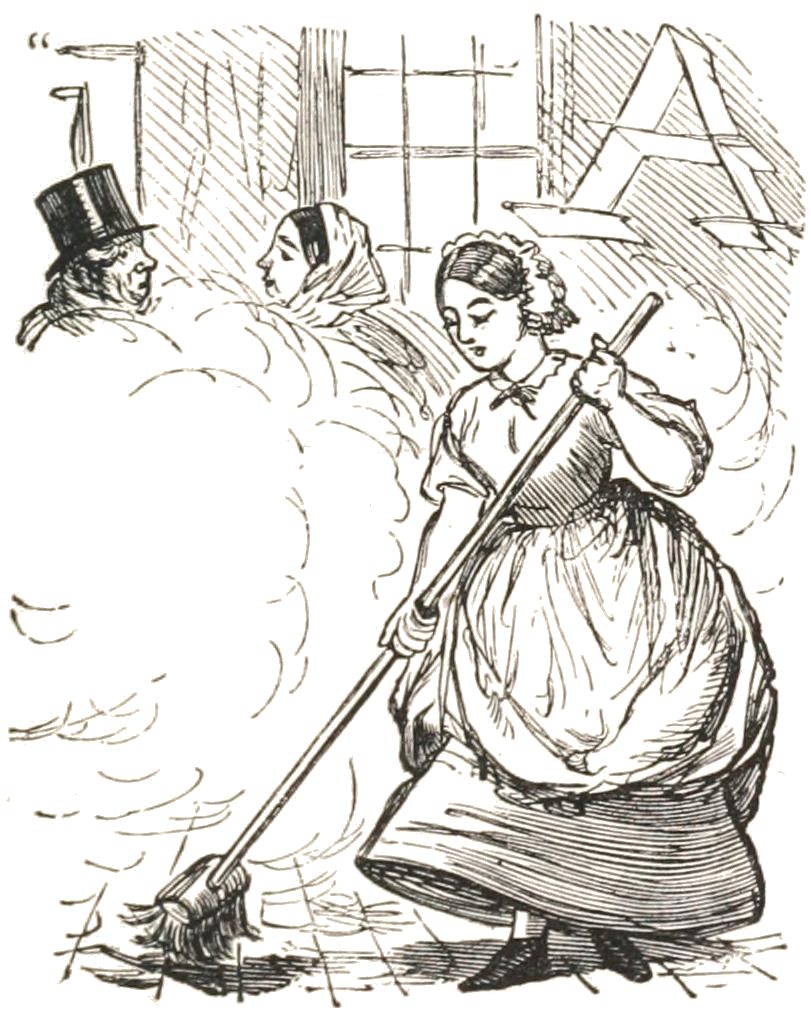
Home Sweet Home, by Douglas William Jerrold (via Wikimedia Commons)

It’s always nice to start the New Year off with a clean, well-appointed home.  In some traditions, this is not mere vanity or hygiene, but a spiritual necessity that must be done on New Year’s Eve to ensure that the home is clear and ready for the coming year.  Today, I thought I’d look at a few of the magical methods for housecleaning, as well as some of the most common cleaning agents with a magical touch.

Sweeping & Vacuuming – It has to be done.  There’s just no way of getting around it.  The floors must be kept clean, at least within reason, and usually a broom or a vacuum is employed to that end.  Workers in the conjure and hoodoo traditions tend to have specific techniques for sweeping, often going from the topmost floor of the house to the bottom and working from the back of each floor towards the front (though I’ve seen variations on that, often depending on specific needs—getting rid of a bad spirit might involve sweeping out the back door, for example).  While floor washes are the go-to method for spiritually cleansing a house and adding specific magical vibes to the area (see Mopping & Floor Washes below), you can add a degree of magic to the sweeping and vacuuming process, too.  Various powders can be sprinkled on floors and carpets and left there for a bit before sweeping.  These will absorb some spellwork and leave other magic behind.  Some good ones to try out (available at Lucky Mojo):

  • Fear Not to Walk Over Evil – A powerful anti-hex and anti-foottrack magic powder.
  • House Blessing – A simple, very peaceful powder.
  • Crown of Success or Fast Money – To encourage prosperity and abundance.
  • Chuparosa/Hummingbird – To create love and attraction between partners in the home.

Likewise, you might also opt for simple, household items to do some of your mojo work during sweeping and vacuuming.  Many spices make great conjure sweeps (and smell wonderful when taken up by a vacuum and slightly warmed by the machine’s motor—an added aromatic energy).  Some that I like to use:

  • Cinnamon – Creates a sense of prosperity and joviality.  Some use it for business success, but I find it creates more of a personal confidence and comfortability than anything purely financial.
  • Allspice – Another success spice, but also good for stimulating conversation.  I like to vacuum with cinnamon and allspice sprinkled on the carpets before guests come over to encourage a warm, friendly atmosphere.
  • Pine Needles – Good for uncrossing and refreshing a home.  Not a kitchen spice, of course, but still easily accessible.  Be careful though, as too many pine needles can gum up machinery (like vacuums) quickly!
  • Rosemary – Good for domestic bliss, as well as helping those who smell it focus and think clearly.
  • Oregano – Keeps meddlesome influences from interfering in your life.  Makes a nice “law-keep-away” substitute, and discourages nosy neighbors.
  • Garlic Skins – Kills off evil, but it will leave a distinctive odor in the air.
  • Rose Petals – Encourages love and passion when crumbled around the home and left for a bit before sweeping/vacuuming.
  • Salt – Great for stopping any hexes put upon you and removing unwanted spiritual energies from your home.  I use baking soda (a type of salt) sprinkled on carpets before vacuuming to both absorb odors and remove pesky curses.  Jim Haskins records a method of preventing unwanted guests from returning which simply involves sweeping salt after them when they leave.
  • Sugar – A little of this will add a sweetness to your home, though make sure you get it all and don’t use too much—a little sweetness may be great, but a lot of ants aren’t.

The basic method here is to sprinkle everything, let it sit for a bit (if you can stand letting it sit for 24 hours, that is lovely, but probably a little excessive—30 minutes is often plenty of time, and even a 5-minute wait will give you a quick dose of magic).

Mopping & Floor Washes – This is probably one of the best known hoodoo methods of cleansing, blessing, and enchanting a home.  Using a prepared magical floor wash to clean anything that can handle getting wet (including the walls) still makes for great spellwork.  Some of the most famous floor washes are (again from Lucky Mojo):

  • Chinese Wash – An old school formula which reputedly came out of Chinatown (though which Chinatown is not particularly clear).  It’s made from several powerful ingredients, many of which are found in Van Van (see below), with broom straws added for extra oomph.  Good for knocking out any hexes and doing purification work.
  • Van Van – We’ve covered this in Blog Post 81, but briefly this is a blend of several Asian grass extracts, chiefly lemongrass and vetiver root.  It, like Chinese Wash, cleanses and purifies.
  • Peace Water – When made in its most interesting form, peace water is beautiful to look at, with layers of blue and white/clear liquid on top of one another in a mesmerizing stasis.  When mixed up and sprinkled into a floor wash, this helps create feelings of calm, quiet, and tranquility in even very turbulent homes.
  • Rose Water – This very basic addition to a floor wash can be found in many ethnic grocery markets.  It’s not much more than a strong rose tea stabilized with alcohol, so you could easily make your own, but it’s also fairly cheap to buy.  When used in a floor wash, it helps promote feelings of love and agreement.

In addition to these specialty formulas, there are lots of common household cleaners you can use with a magical bent:

  • Pine-Sol – This commercial floor cleaner basically evolved out of hoodoo floor washes.  Cat Yronwode even suggests adding a little Van-Van to a bottle of Pine-Sol and using it as a simple substitute for Chinese Wash.  Traditional pine scent is great, of course, or you can go with…
  • Lemon Pine-Sol – Or any lemon-scented cleanser like it.  Lemons have a cut-and-clear effect on a space, and have long been associated with destroying curses and breaking hexes.  Charles Leland’s Aradia records an anti-evil-eye charm which is fundamentally a pomander made of a lemon and pins.  It leaves a lovely clean smell, too, though a fairly artificial one in most cleansers.  Feel free to add some fresh squeezed lemons to your mop bucket for a rootsier version of lemon-cleanser.
  • Ammonia Draja Mickaharic recommends a simple floor wash of ammonia and salt added to mop water, and it really makes a wonderful cleansing and protecting wash water.  It can really neutralize almost anything thrown at you, magically speaking, and it disinfects beautifully.  Mickaharic also recommends a little ammonia down every drain when you finish cleaning (just a teaspoon or so), to finish off your magical housecleaning.
  • Vinegar – Four Thieves Vinegar is popular as a counter-curse wash, and as a protective mix-in for a mop-water.  But really, any vinegar will help get rid of unwanted energies and protect the home from invaders and malicious forces.  If the scent is strong enough, it may protect you from visitors altogether.
  • Urine – This one is very traditional in hoodoo, though much frowned upon in modern use.  It has, however, been long used as a cleaning agent, and a little urine diluted in some mop water can be very powerful for “marking your territory” and protecting the home.  It can also instill a sense of good luck in the place, and ensure fidelity in your mate and passion from your lover.  If they don’t catch you doing it, of course.

There are lots of other cleaning agents out there that you can use, of course.  Almost anything scented probably has at least some tenuous connection to a magical formula, so a little homework can help you transform that bottle of Mop-N-Glo into a powerful apothecary’s potion.

Windows & Doors – You don’t do windows, you say?  Well, you should at least open them up!  Whenever you do a good house-cleansing, throwing up the windows and letting some fresh air circulate is vital to getting everything “right.”  It helps balance out all the forces in the home, allows bad spirits to leave, and refreshes the air in the house.  It’s cold to do this in winter, of course, but turning the heat off for 10 minutes and letting a little fresh air in can make all the difference in getting a home feeling good and happy again.  Likewise, the doors should be opened for a bit to let the air circulate.

When it comes to washing doors and windows, you can really use any of the same washes I talked about above in the Mopping & Floor Washes section.  You can also use a variety of other ingredients to get things right at all your entrances and exits.  For example, many folks take a little olive oil (or holy oil, which is basically blessed and sometimes lightly scented olive oil) and make a little sigil in the corner of every window, to seal that entrance against evil intrusions.  Some folks put blue bottles in the windows, or jars full of sand or marbles, in the hopes that any witches who might try to get in will be forced to count the contents of the container and be unable to do so before daybreak (when their power ends).  You can make a wash water of red brick dust, urine, and salt in warm water and use it to scrub your door to add a powerful layer of protection.  You can also sprinkle salt or brick dust lines down at the threshold and in the sills of every window to keep out unwanted spirits and spells.

Clearing the Air – Once the house has been aired out and all the windows and doors cleaned and opened for a while, some folks like to light some incense, use room sprays, or even just make a little something in the kitchen to add an element of magic to the home.  I’ve covered some of the holiday scents and their uses in Blog Post 108, and I’ve already mentioned pine and citrus scents as powerful agents for spiritual and physical cleansing.  Other odoriferous offerings to your home can include:

Fresh Bread – One of the best symbols of abundanace and prosperity.  Bake a loaf in your oven and let the scent fill the home.  Cookies are also good for this.

Floral Scents – Like jasmine, rose, or lavender.  All of these have specific uses, and add specific magical “vibrations” to an area (rose fragrances inspire love to many, for example), so look into the flowers you like and figure out what note they will set in your newly cleaned domicile.

Sweeteners – I did mention this in Blog Post 108, but I also said it’s a bit strong when burned.  If you are airing your house out, however, a little honey, brown sugar, molasses, or even table sugar might be a good thing to burn or warm on the stove, as it will provide a sublimely “sweet” feeling to the area.  Draja Mickaharic highly recommends this, and I can’t say I’m against it either.

Nailing It Down – This is a practice particular to conjure and hoodoo, though there are likely variants or similar practices in other magical systems.  The basic idea is that by pounding nails into your home’s corners (and the corners of your property), you fix it there and create a stable environment.  You also assert your ownership of the place, and help to guarantee your continued residence there.  The most commonly used nails for this are the “square-cut” kind, usually sold cheaply at hardware stores.  For doing the corners of your property, you would want to use something bigger, like old railroad spikes.  The basic idea is that you simply nail them into every corner of your home, particularly the ones along outside walls.  You can bless them with oil or holy water or anything else you feel is appropriate, or simply nail them down while saying a little prayer that you remain safe, happy, and comfortable in your home as long as the nails remain in place.  Remove them if you ever have to move away for any reason.

That’s a lot of cleaning!  But it’s always good to have a clean home, for both practical and spiritual reasons, so give some of these a go and see how they work for you!  And if you missed your New Year’s cleaning deadline, well, you can always do these things during your Spring cleaning, too.

I hope this has been useful!  Thanks for reading!

Oh, and Happy New Year!

-Cory

Blog Post 106 – Book Review

The Faeries’ Guide to Green Magick from the Garden by Jamie Wood and Lisa Steinke, illustrations by Lisa Steinke

When I was asked to review this book from the publisher*, I said yes without knowing anything about it. The title intrigued me, so I thought I’d give it a chance. I have to be honest though, anytime I hear anything about “faerie” books, I’m always a bit wary. Some books can be a bit more new agey than I like, and, dare I say it- a little fluffy. However, I was pleasantly surprised by how this book treats the subject of faeries.

To start out, the authors talk about Man and his symbiotic relationship with the earth. Talk is quickly shifted to a “go green” type of message, and how important this is in order to have any relationship with the faeries. It comes off a bit heavy handed, especially since it’s all information that any pagan already knows. However, Wood and Steinke then go on to explain how they view faeries- as the life forces of plants. They explain that plants are living beings, and that each faerie has an individual energy and personality that is a manifestation of that plant energy. They go on to say that Steinke’s lovely illustrations are her own personal interpretation of that faerie energy. I was really happy with this explanation, as it’s pretty close to my own view of faeries and they explain it in a easy to understand way.

There are a few more chapters on magickal** gardening, green gardening, and complimentary medicine. I found these to be a bit extraneous though, because they only touch on the subjects in passing. I’m glad though, because the best part of the book is what’s next- the Herbal Index. I loved this part of the book. The set up is that each herb has it’s own entry, with 33 of the most common herbs represented. Each herb has Steinke’s illustration of the faerie energy of the herb, a description of the plant, how to take care of it, and some magickal way to use the herb- whether that be an ingredient in a recipe, an ingredient in a spell, or perhaps a way to make your own beauty product. The only thing I found myself wishing for in this portion of the book was an actual picture of the plant/herb. However, since they’re so common, a quick google search will pull up plenty of pictures. I really enjoyed this portion of the book, and I think it would be great for someone new to working with herbs (like me).

Overall, I was pretty happy with The Faeries Guide to Green Magick from the Garden. It is definitely written for those new to gardening, working with faeries, and even to witchcraft in general. Sometimes the tone is almost apologetic for being about “magick”- as if they are writing to the average person who has never even thought about magick or witchcraft before, which is not who is going to be buying this book. I found this to be a bit patronizing at times.

However, the Herbal Index alone makes the book worth it to me. The descriptions, how to care for the plant, a fun way to use that particular herb, and not to mention the wonderful illustrations, all made me think it will be a good book to have in my repertoire. Again, it is for beginners, so if you’re a seasoned herbalist, this book will probably not have enough information for you. But, if you want an easy introduction into working with faeries and working with magickal herbs, then think about checking out this book.

-Laine

*In the interest of full disclosure, the publisher contacted me and asked if I would give an honest review of the book. I haven’t been paid for this review, and I didn’t pay for the book.

**Also, I’d like to note that I don’t usually make the distinction between magic and magick, but the book makes a point of explaining this, so I figured I would stick with that spelling. The same goes with the fairy/faerie spelling.

Podcast 19 – Curses & Hexes

-SHOWNOTES FOR EPISODE 19-


Summary
This episode is all about the controversial topic of hexing and cursing.  We discuss the ethics, methods, and types of cursing, as well as some personal experience with the subject.  Then Laine talks about Goofer Dust in WitchCraft, while Cory looks at Uncrossing in Spelled Out.

Play:

Download: New World WItchery – Episode 19

-Sources-
We cite Peter Paddon’s Crooked Path series on ethics.
Many spells and recipes discussed are in Judika Illes’ Encyclopedia of 5000 Spells
Lucky Mojo’s page has excellent entries on Hot Footing & the Evil Eye
Cat Yronwode’s Hoodoo Herb & Root Magic contains information on the Live Things in You Curse

Our contest will feature products from our Compass & Key Etsy shop and Judika Illes’ book, The Weiser Field Guide to Witches.


Promos & Music
Title music:  “Homebound,” by Jag, from Cypress Grove Blues.  From Magnatune.
Promo 1 – Appalachian Witch Doctor Tales
Promo 2 – Pennies in the Well
Promo 3 – Lakefront Pagan Voice

Blog Post 98 – Critter Bits (Magical Animals, Part III)

So I had mentioned a couple of weeks ago that I wanted to talk a little about the use of animal parts in magic.  Animals and magic have gone hand-in-hand for a very long time.  The reading of entrails from ritually slaughtered animals has been used as a divination technique since at least the pre-Roman era.  Talismans designed to imbue the carrier with the particular power of an animal were often made from that animal’s fur, bone, or skin.  Owen Davies chronicles the frequent use of virgin parchment—a type of scroll medium made from a highly treated animal skin, usually from a creature like a lamb or goat—in the construction of ancient Near Eastern and Mediterranean grimoires (in his book appropriately entitled Grimoires).  The thought was that this particular material would endow whatever was written on it with an extra layer of power, thereby charging sigils, elevating incantations, and generally adding a little va-voom to the inscribed workings of magicians.

On North American soil, many of the old rituals and magical practices found in places like Europe and Africa took root.  Some of them changed quite a bit as they grew here, and some stayed more or less recognizable.  I thought a brief survey of the common animal curios used in witchcraft—both folklorically and practically—might be a good way of seeing the connection between critters and crafting.  Please take note now, I AM NOT ADVOCATING THE INJURY, SENSELESS SLAUGHTER, TORTURE, OR HARM OF ANY ANIMAL.  This information is for educational purposes.  If you choose to use this information in your own practice, please do so responsibly and without resorting to cruelty.  There are lots of ways to gather magical tools and ingredients from animals which are already dead (see Ms. Graveyard Dirt’s excellent site for some great examples).  Okay, now that that’s out of the way, let’s look at some of these critter bits:

1)      Rabbit’s Foot – We’ve covered this here in the podcast (on Episode #13) and the blog (in the Lucky Rabbit’s Foot entry), so I won’t spend a lot of electrons on it here.  It suffices to say that the rabbit’s foot remains one of the most popular luck charms in the canon of animal curios.  It may have significant underworld ties, and it may simply be related to speed and fertility. Whatever its originally intended meaning, it stands for good luck now, especially in gambling.

2)      Toad’s Bone/Black Cat Bone – These are some of the darkest and most disturbing of animal curios, as the rituals required to obtain them are brutal.  The Toad’s Bone is mostly found in British magical lore, and was written about extensively by Andrew Chumbley, former Magister of the Cultus Sabbati.  Scholar Ronald Hutton also details the significance of this bone to members of the Toadsmen, a secret society along the lines of Freemasonry, in his excellent history of modern witchcraft Triumph of the Moon.   This ritual artifact was obtained (at least in one version—there are multiple ways this ritual can play out, depending on what source  you look to) by burying a toad alive in an anthill and letting the ants  strip it down to the bones.  The bones are then taken to a stream and floated one by one until one bone floats agains the current.  This bone is then the magic bone, and can imbue the witch carrying it with all sorts of interesting powers from spirit summoning to invisibility.  The black cat version of this same rite is even more gruesome.  As it is recounted in Mules & Men by Zora Neale Hurston, the cat is thrown into a pot of boiling water (also alive), and cooked until all the flesh falls from the bones.  The bones are then either floated in a stream (the same as the toad’s bones) or passed under the tongue of the magician.  The magic bone in this tradition turns the user invisible, and can also be used in some powerful love spells.  Most places selling this bone today are actually selling chicken bones painted black, and hopefully few people are actually performing this ritual as it occurs in folklore.  Again, I don’t condone this rite, and present it as a curiosity of history and culture rather than a suggested magical practice.

3)      Racoon Penis Bone – This is a popular charm in hoodoo, used in luck and love magic.  The bone itself, which is usually very thin and has a curved shape, has no disturbing ritual for obtaining it, but can simply be taken from an animal killed for meat or even from a roadkill hit (though I’d suggest being very careful how you handle remains of this nature, as they can often be riddled with diseases).  Cat Yronwode suggests that this particular curio entered American magical practice by way of Native American sources, and points out that the Pawnee often placed these bones along with ears of corn into sacred bundles.  I’ve heard that in the Appalachian and Ozark Mountains, it was common for boys to give girls these bones on red thread necklaces as love tokens (though I’ve not yet found a primary source for this claim).  Raccoons are not the only animal to have this bone—or “baculum”—and in fact many mamal species have it.  Other animals like foxes and dogs also have these bones, and occasionally these will turn up in magical charms, too.

4)      Rattlesnake Rattle – Snakes in general have a lot of lore about them, but the rattlesnake is particularly of note because its rattlemakes it a unique member of its family.  The rattles themselves have been collected for years as lucky charms.  Cat Yronwode suggests uses including:

  • A charm to help musicians play well
  • A simple “Live Things in You” curse
  • A personal power token
  • A gambling charm to bring luck

Rattlesnake rattles are fairly delicate things, especially once they’ve been dessicated for use in crafts and magic.  You can occasionally find one which has been turned into a key ring or charm, but the best way to handle these is to put them in a little vial or a small box of some kind and carry that with you.

5)      Snake Fangs/Bones/Skin – As I said earlier, snakes generally have all sorts of magical connotations.  You can look back at our blog entry on them (Snakes) and find out a good bit there, but here are some highlights:

  • Fangs can be worn as necklaces or carried as tokens of protection (from snakebite in some cases)
  • The bones or skin can be powdered and added to food to cause a “Live Things in You” curse
  • The skin of a snake soaked in vinegar can be used to treat boils in the Ozark magical tradition
  • The shed skins can be powdered and added to all sorts of crossing and jinxing formulae, including goofer dust and a variant on hot foot powder

Many pet stores will happily give you any leftover snake sheds they have if you call and ask politely, and if you develop a good enough relationship, you can sometimes wrangle dead snakes and/or bones out of them, too.  Roadkilled snakes are also good, but be absolutely sure they’re dead before approaching them.

6)      Dog/Cat Hair – These curios are nice because the animals don’t have to be hurt to acquire them.  Usually black hair is used, and preferably from all-black animals.  When the two hair types are mixed together in a mojo bag or vinegar jar, they can cause people to fight “like cats and dogs.”  Black cat hair can also be used to gain good luck, and black dog hair can be used to inspire feelings of loyalty or obedience in others.  If you have a black cat or dog, you probably have plenty of this available to you on furniture, carpet, etc. (I speak from experience here).  If you don’t, you might find a friend who does and see if they will let you have some of it for use in your magical workings.  At worst, you might have to snip off a little from the animal, but thankfully that does no harm (unless it’s the middle of winter and you leave a bald patch—don’t do that).

7)      Chicken Legs/Feet/Feathers – Chickens are popular creatures for magic, mostly because they are expendable (I call them like I see them) and ubiquitous.  Black hens and their feathers are wonderful for curse-breaking, according to Cat YronwodeStarr Casas, a notable rootworker from Texas, often speaks of using chicken legs or feet during cleansing work.  Even just having chickens can be particularly magical, since they will scratch up and destroy any curses laid for you on your property.  A Pow-wow charm from John George Hohman suggests that you do the following to prevent house-fires:

Take a black chicken, in the morning or evening, cut its head off and throw it upon the ground; cut its stomach out, yet leave it altogether; then try to get a piece of a shirt which was worn by a chaste virgin during her terms, and cut out a piece as large as a common dish from that part which is bloodiest. These two things wrap up together, then try to get an egg which was laid on maunday{sic} Thursday. These three things put together in wax; then put them in a pot holding eight quarts, and bury it under the threshold of your house, with the aid of God, and as long as there remains a single stick of your house together, no conflagration will happen. If your house should happen to be on fire already in front and behind, the fire will nevertheless do no injury to you nor to your children. This is done by the power of God, and is quite certain and infallible. If fire should break out unexpectedly, then try to get a whole shirt in which your servant-maid had her terms or a sheet on which a child was born, and throw it into the fire, wrapped up in a bundle, and without saying anything. This will certainly stop it. (#114)

The chicken’s wings can also be used to make a fan which some magical folk use to direct smoke during spiritual fumigations.  So popular is this animal in magic that one of my favorite grimoires is actually called The Black Pullet (a pullet being another name for a hen).

8)      Eggs – These are often used for spiritual cleansing, across several traditions.  In Mexican folk healing (curanderismo), an egg can be used to sweep, massage, and mark a person’s body to remove the Evil Eye (mal ojo) or harmful witchcraft.  The egg can also be “read” after this process to determine things like spiritual attachments, disease, bad luck, etc.  Another Pow-wow cure with a curious resemblance to the Toad’s Bone ritual earlier mentioned directs anyone suffering from failing health to catch rain water in a pot before sunrise without speaking to anyone, boil an egg in it, poke holes in the shell, and leave the egg on an anthill to be devoured.  This will supposedly allow the ailment to be “eaten” by the ants.  Eggshells also have some magical significance.  When powdered, they become cascarilla, which is used in Afro-Caribbean magic.  Cat Yronwode also lists several really interesting spells that can be done with black hens’ eggs.  For example, boiling a black hen’s egg and feeding half to a black cat and half to a black dog while saying two people’s names will cause them to have a falling out.  There is also a rather fascinating magical detective spell that can be done by placing an egg in each of a murder victim’s hands.  After the burial, the eggs will rot and eventually burst, at which time the murderer will return and be caught.

9)      Animal Fat – This is less of a curio than an ingredient, and the different fats from different animals (often referred to as that animal’s “grease”) have distinct properties.  According to Hoodoo Herb & Root Magic, “Rattlesnake fat is a powerful ointment.  Rub it on any painful body part, or stroke the whole body downward to expel conjure poisons” (p. 162).  Ozark healers commonly used “skunk grease” to cure various rhumetoid conditions.  Vance Randolph says “The grease from skunks or civet cats, mixed with peppermint leaves, is highly praised by some hillfolk as a lubricant for rheumatic joints. It is said that the fat of a male wildcat is best of all” (OM&F, p. 108).   In Pow-wow magic, a range of animal fats is used to make a potent anti-rust treatment for firearms:

Take an ounce of bear’s fat, half an ounce of badger’s grease, half an ounce of snake’s fat, one ounce of almond oil, and a quarter of an ounce of pulverized indigo, and melt it altogether in a new vessel over a fire, stir it well, and put it afterward into some vessel. In using it, a lump as large as a common nut must be put upon a piece of woollen cloth and then rubbed on the barrel and lock of the gun, and it will keep the barrel from rusting.  (#110)

Wild animal fat has mostly gone out of use, though it can occasionally still be found, particularly in the mountain regions of America.

10)   Bear/Badger/Other Teeth – These curios are usually gambling, luck, or protection charms.  Hohman mentions the badger’s tooth as a wonderful gambling talisman.  Bear teeth appear in protective necklaces (along with claws in many cases).  One of Vance Randolph’s stories from the Ozarks recounts a man who kept a big boar’s tooth on a leather thong over his fireplace.  Whenever any of his children would get a toothache, he’d make them wear the necklace until the pain went away.  These charms are common in many places, and hardly unique to the New World (the badger is an Old World animal, after all).  Plenty of places, including the wonderful site The Bone Room, sell teeth, bones, and other animal curious for use in crafts, magical or otherwise.

I think that will end our survey for today.  There are still plenty of parts and pieces I’ve missed, including gator paws and heads, various animal skins, porcupine quills, and the myriad insect charms that could still be discussed (and hopefully will be at some future date or dates—ants alone obviously have plenty of magical uses).  If you can think of other charms, I’d love to hear them, and feel free to share your folklore regarding animal remnants and magic in the comments section!

Until next time, thanks for reading!

-Cory