Blog Post 109 – Holidays in the Mountains

Hi there, everyone!

Today, I’m going to be sharing a little bit of holiday lore from the mountains, both the Ozarks and the Appalachians (to those readers wondering when I’ll start including the Rockies, I promise I’ll get there one day!  I’m just woefully ignorant of the traditions from that area).  There are a number of pieces of folklore associated with the winter holidays in the mountains.  Often, storytelling and family visits were the primary entertainment in the financially poor but folklore-and-culturally-rich mountains once the cold weather set in.  Christmas was not always celebrated, especially during the early years of settling, largely because many Protestants settling in the Appalachians viewed the holiday with suspicion and regarded it as a Catholic celebration.  One source records that the penalty for observing Christmas during the Puritan era was a “fine of five shillings” (WG&S, p.28).  Over time, however, as more people of mixed backgrounds settled the area, Christmas became a social holiday.  Patrick Gainer records that holidays in the mountains included:

  • Fireworks and noisemaking
  • Very little decorating prior to the widespread introduction of electricity (most homes didn’t have a Christmas tree)
  • School Christmas parties
  • Costumed visits to friends and neighbors (called “Belsnickling”—more on that in a minute)
  • Toys for children, though almost entirely homemade ones

Belsnickling

The tradition of Belsnickling is particularly interesting.  It seems to be a mumming tradition in the vein of similar British activities, but is really practiced by only the Germanic settlers in the Appalachians.  It relates to the Belsnickle (whose name may come from pelz Nicholas, or “furry Nick”), a devilish traveling companion to good St. Nick during his holiday visits who would punish the wicked children in the same way that the saint rewarded the good ones.  In some variations, it was not St. Nick who traveled with Belsnickle, but Kriss Kringle (likely a derivation from the Germanic kriskindl, or “Christ-child”).   Gerald Milnes describes the practice thusly:

“To people in the Potomac Highlands, belsnickling is the action of going from house to house in masquerade, with residents guessing the belsnicklers’ identities…Sometimes treats were offered to the belsnicklers, and sometimes belsnicklers offered treats to the household” (SC&W, p.186)

Milnes also offers a variety of pranks and tricks related to this practice:

  • Candy would be thrown on the floor, and when children dove for it, they would have their fingers switched by the belsnicklers
  • Bands of belsnicklers would wander through the countryside hooting and yelling all through the night
  • People in costume would tap on the windows of houses and scare the children inside
  • Firecrackers would be lit and thrown into people’s homes

He also relates this practice back to something deeply witchy—the Wild Hunt:

“Belsnickling and similar activities, as group practices, have obscure beginnings, but they may well go back to the old Teutonic concept of the wild hunt.  In Scandinavian and German versions of this myth, a huntsman with dogs, accompanied by spirits, hunts the wild woman.  In some versions, the huntsman, a lost soul, leads a band of wild spirits to overrun farms at Christmas time (the winter solstice)” (SC&W, p. 186).

Christmas Dinner in the Mountains

Of course, no Christmas would be complete without a feast in modern minds, but the table offerings were not quite the same for every family.  Often, up in the mountains in the early-to-midwinter, the meal would consist on the wild meat that was available rather than anything domestically raised.  In Foxfire 12, informant John Huron describes a most particular holiday meal:

“Groundhogs aren’t bad eatin’ either if you cook them right…baked and layered with onions and sweet potatoes.  That was what Charlie’s daughter, Margaret, would fix him for Christmas dinner every year.  They invited me and my wife, Sandy, and my son, Jay, over for Christmas dinner one time, and that’s what we had.  A groundhog is a lot cleaner animal than a chicken.  When you get right down to it, a chicken is a nasty critter” (FF12, p.248)

Signs and Omens on Christmas

There are a number of superstitions which have sprung up around the holiday season, too.  Often, weather and luck are intimately tied to Christmas, though sometimes the date shifts a little between December 25th (“New” Christmas) and January 6th (“Old” Christmas).  Some of the signs and omens from the Appalachians and Ozarks include:

  • It will be a fruitful year if the eaves of the house drip on Christmas (SC&W)
  • Children born on Christmas Day can understand the speech of animals (WG&S and OM&F)
  • Being the first to say “Christmas Gift” to another on Christmas Day yielded good luck (WG&S)
  • On Christmas Eve at midnight, all farm animals will bow down and speak to acknowledge Christ’s birth (SC&W and OM&F)
  • Those with the “second sight” make predictions most accurately on Christmas Eve (IaGaM)
  • “A green Christmas makes a fat graveyard” – warm weather at Christmas will lead to many deaths over the coming year (OM&F)
  • On Old Christmas, the sun actually rises twice instead of just once (OM&F)
  • Bees buzz so loudly on Old Christmas they can be heard for miles away (OM&F)
  • Elderberries always sprout on Old Christmas, no matter what the weather (OM&F)

Even with its rather slow, Puritanical start, Christmas in the mountains has become one of the most magically charged times of the year.  From eating groundhogs to playing rowdy pranks to witnessing the miraculous behavior of animals, this is certainly one of the most interesting times of the year.  And, in my humble opinion, one of the most magical.

Thanks for reading!

-Cory

Blog Post 102 – 15 Books

Hello everyone!

I recently saw a rather interesting post from a friend on a social networking site in which she listed her “Top 15 Most Influential Books” when it comes to witchcraft.  Since I posted a book review last week (and since most book reviews going forward will likely be shared between this site and the Pagan Bookworm site), I thought that continuing that “bookish” trend might be good.  So this week I will be posting about various texts which have a place North American magical traditions.  Some will be of the grimoire type, and others may just be good reads, but hopefully all of them will be tomes you get much pleasure and use from if you crack the spines and turn the pages.

To start with, however, I’m going to re-use that meme and list my own Top 15 Most Influential (Witchcraft) Books.  These are not necessarily books that I think of as “great,” or even in some cases “good” books.  Many have erroneous information or are, at best, a good starting place for further exploration.  All of them, however, have help shape my study of magic, folklore, and witchcraft in some way, and that’s what this list is really all about.  I’m presenting them in a (roughly) chronological order, since that’s how I best remember them.

TOP 15 MOST INFLUENTIAL (WITCHCRAFT) BOOKS
(2010 Edition)

  1. The Encyclopedia of White Magic by Paddy Slade.  This book was the first book of “real” magic I ever procured.  I’ve talked about it on the show, but the short version is that I was about 11 or so, and I pestered my mother into buying it for me.  Since then, I’ve definitely grown away from its ideas, though I periodically return to it for nostalgic reasons.  It also got me thinking about magic as a folklore-based thing, rather than a sci-fi/fantasy phenomenon.
  2. Earth Power/Earth, Air, Fire & Water by Scott Cunningham.  I know there are lots of folks who regard Cunningham with disdain, but I’m not one of them.   His two books of folk magic, focused on practical spellwork using natural elements, absolutely cemented my interest in spellwork as something more than an esoteric psychological tool.  I still find some of his spells useful, though I’m no longer in tune with his particular worldview or ethical stance.  Moreover, I think that there are far worse books with which one could begin one’s magical studies.  I’ve found over the years that many folkloric sources bear out the techniques described by Cunningham, and I still regard his work fondly.  There are certainly weak points in these books, but winnowing the chaff away is fairly easy with a little work.
  3. Cunningham’s Encyclopedia of Magical Herbs by Scott Cunningham.  I’ll not launch into another defense of the author, but instead say that this book (and to a lesser extent, his Complete Book of Incense, Oils, & Brews) augmented my practice of magic again and helped me to start making my own spell ingredients.  It also helped me to cultivate an interest in gardening, for which I am most grateful.  This book also has one other great thing going for it: an amazing bibliography.  While it obviously pulls from sources like Culpepper’s Herbal, it also contained references to things like Vance Randolph’s Ozark Magic & Folklore (which is also on this list).  So I am quite thankful to this book, and this author.
  4. Jude’s Herbal Home Remedies by Jude C. Todd.  This was an impulse buy to augment my growing interest in herbs after I had eagerly devoured the Cunningham tomes.  It’s not a magical book, per se, but focuses mostly on the physical properties of herbs and their applications as health and beauty aids.  It provided a wonderful resource for learning how to interact with various herbs and brew potions, ointments, tinctures, etc. at home.  I still turn to it sometimes for home remedies, and it also has a place because later encounters with books like J.G. Hohman’s Long Lost Friend reminded me that most magical workers had plenty of practical, non-magical herbal info at their fingertips, too.  Jude’s book filled that role for me.
  5. Magical Tales: The Storytelling Tradition by R.J. Stewart.  In my sophomore year of university, I participated in a storytelling class that changed my life.  It took fairy and folktales off of the written page and showed me something deeply vital about them emerges when they are shared with others.  I also happened to be taking classes in things like fairy and folklore interpretation using academic studies like Bruno Bettelheim’s The Uses of Enchantment and Mary Louise von Franz’s The Interpretation of Fairy Tales.  Into this mix came R.J. Stewart’s book, which looked at the phenomenon of storytelling from the point of view of a magical practitioner.  I know a lot of folks were influenced by Stewart’s The Underworld Initiation, and I think that book is absolutely wonderful.  As far as my own personal influence goes, though, this is the one I’d say really connected to me.   It convinced me that stories contain more than just helpful magical tidbits, but sometimes are magical rituals in disguise, if you’re willing to work through them.
  6. Treasury of Irish Myth, Legend, & Folklore by Lady Gregory & William Butler Yeats.  I couldn’t have really appreciated this book prior to encountering book no. 5 on this list (and going through the courses I did at the same time).  I actually had picked up this text years before because of a passing interest in Ireland which I inherited from my mother (we have family ties back to County Mayo).  After I began to understand fairy tales as something more than fanciful stories, however, this book became an absolute mother lode of good magical material.  I’ve since discovered many of the tales have parallels or retellings in Appalachian and Southern folklore, too, which makes me feel even closer to it.
  7. The Complete Fairy Tales of the Brothers Grimm by Jacob & Wilhelm Grimm, Jack Zipes trans.  I actually borrowed this specific collection from a girlfriend, and its completeness stuck with me.  It included a number of tales often omitted, and several tale fragments I’ve not seen in most editions.  Particular variants aside, this collection falls into the same category as nos. 5 & 6 on the list.  Again, I didn’t know what I had until long after I had it, and now I don’t think I could live without it.
  8. The Marriage of Cadmus & Harmony by Roberto Calasso.  At some point, I became a bit of a mythology junkie, particularly Greek myths.  I read and re-read Edith Hamilton, Bulfinch, and the textbooks from my college classes on the topic.  I went to source material by Hesiod, Homer, Euripides, Aeschylus, and anyone else I could find.  I’m definitely not an expert, but as enthusiastic amateurs go, I foment with glee when I encounter new Hellenic tales.  When I got to Calasso’s book, however, I was taking an advanced course on mythology at school, and everything completely changed.  It was this book that taught me one fundamental thing about mythology (and likewise storytelling and therefore magic):  it changes.  More importantly, there is no “true” or “right” version of any story, but simply the stories themselves.  Mythology isn’t linear, but a web of tales—sometimes they contradict each other, sometimes they conflict with what we think about the culture, and sometimes they don’t make much sense to us.  In all cases, though, the tales are true at a level not related to cross-referencing and documentation, but someplace deeply human.  Calasso showed me that by bombarding me with the stories over and over again in his book, every time a little different, but all connected together, until I got it.  I really do need to send him a thank-you note for that.
  9. Aradia, or The Gospel of the Witches, by Charles Godfrey Leland.  Encountering Leland, for me, was like having someone splash very cold water on my face by the bucketful.  I devoured his work Etruscan Roman Remains and his Gypsy Sorcery & Fortune-Telling, of course, with all the tenacity of a budding folklorist.  It was Aradia, however, that really sent me sailing when I read it.  At the time, I was studying with the outer court of a Gardenerian coven, and had to read things like Gardener, Dion Fortune, and other modern occult classics.  When I got to Leland’s book, though, it felt so different, so authentic that I refused to believe its wild claims and actually got angry at it for deceiving me so well.  I’ve since, however, learned that this book is something special—neither entirely true nor entirely false.  More importantly, it is useful, and its mythos grips me in a very strange way.  I can’t come down in favor of Aradia as a piece of unsullied witchlore, historical to its last printed letter.  But I can say that figuratively, it’s as close to a witch’s gospel as I’ve seen yet.  In short, it just “feels” witchy, and makes me feel the same every time I read it.
  10. Call of the Horned Piper by Nigel A. Jackson.  As I branched out and away from Wicca, looking for something I could connect with better, I began to find a lot about something called “Traditional Witchcraft.”  There were dozens of websites, letters (mostly from Robert Cochrane), and books which I suddenly had to read, and in a very brief period I managed to get through most of them.  While there have been a number of very influential and powerful works in the Trad Craft vein that I love, one stands out to me.  Nigel Jackson’s tome is slim, barely the width of a pencil.  It’s a chapbook, really, yet it contains so much information that I can’t imagine life without it (much less because finding a copy is becoming harder and harder to do).  This book is probably more responsible for my religious magical practices than any other, and encapsulates in about 150 pages what many books cannot in 300 or more.
  11. Ozark Magic & Folklore by Vance Randolph.  This is a book that I found first by accident while seeking information on weather lore, then again by chance looking for an herbal reference.  Finally, I was browsing one of Cunningham’s books and saw this title again in the bibliography, and realized I needed to seek it out.  I’ve since read it many times, and it always offers up a plethora of magical information to me.  Randoph’s book is not a how-to, but one could build a complete magical system out of his work.  Yet it also guides one to several other magical books and traditions as well.  This is the book that made me realize North America is full of occult power and lore, if I was only willing to dig for it a bit.
  12. Hoodoo Herb & Root Magic by Catherine Yronwode.  I’ve referenced this book and the accompanying website (Lucky Mojo Co.) so much on this blog and in the show you probably don’t need me to tell you it’s been an influence.  I’ll just reiterate what a valuable piece of work it is and suggest that without it, I’d probably be fairly lost when it comes to making hoodoo charms, mojos, potions, and formulae.
  13. The Silver Bullet by Hubert J. Davis.  Following the ideas gleaned from Vance Randolph, I began looking for other folklore collections from America which might contain a few sprinklings of witchcraft.  A friend suggested I look into The Silver Bullet, and it truly was a revelatory experience.  In the pages of Davis’ book, the complete repertoire of the American witch dances out.  The book’s segments on what witches do, how to become a witch, and what to do to counter curse read like thinly veiled instructions on American witchery taken right out of a cauldron.  Like Randolph, a person could likely develop a complete magical system based on what this book contains.  It is a marvelous book, and one I turn to repeatedly for witchlore.
  14. The Encyclopedia of 5000 Spells by Judika Illes.  This is another one I constantly reference.  Its real influence on me lies in the fact that I share a love of it with Laine.  We both get so much out of it that it acts as a sort of magical bridge between us.  The Secret Garden likewise strengthens that bond—it’s one of her favorite books and another example of magic buried in storytelling which appeals to me—but Judika’s wonderful book (books really—they’re all quite good—but I decided to go with this one as we use it the most) really is our default grimoire at this point.
  15. The Bible.  This one is the last on my list because I’ve only been able to really understand it as a book of magic recently.  I’ve known that certain metaphorical elements of the Bible have always had parallels in world mythology, but it’s only since working with things like Psalms, the Blood Verse (Ezekiel 16:6), and folk Catholic prayers that I’ve come to understand it as a sort of grimoire.  Magic pervades the text, though it often must be disentangled from a lot of theology, history, folklore, etc.  And while I do use the Bible as a sourcebook for magic, I also am not a monotheist, so I have to struggle with certain elements of it.  This is rewarding in its own way, though, and I tend to think of the Bible as a “family” book—since most of my immediate predecessors were Christian (and mostly Catholic), my use of that magic ties me to them, even though I’m not worshiping the same deities they did, exactly.    I also prefer to work with some of the deuterocanonical books, such as the Book of Wisdom found in the Catholic Bible, or the Book of Enoch which is mostly found in the Coptic or Ethiopian Orthodox Bible.  But that’s just a personal preference.

So that’s my list!  Long, I know, and probably way too much commentary, but maybe it will give you some insight into the places I’ve come from and the type of magical person I am.  Or maybe it will give you a reason to catalogue your own influences.  If you do that, I’d love to see them!  Please let me know what books influenced your path, and feel free to post your lists (or a link to your blog if you do a list there) on the comments.

Thanks so much for reading!

-Cory

Blog Post 98 – Critter Bits (Magical Animals, Part III)

So I had mentioned a couple of weeks ago that I wanted to talk a little about the use of animal parts in magic.  Animals and magic have gone hand-in-hand for a very long time.  The reading of entrails from ritually slaughtered animals has been used as a divination technique since at least the pre-Roman era.  Talismans designed to imbue the carrier with the particular power of an animal were often made from that animal’s fur, bone, or skin.  Owen Davies chronicles the frequent use of virgin parchment—a type of scroll medium made from a highly treated animal skin, usually from a creature like a lamb or goat—in the construction of ancient Near Eastern and Mediterranean grimoires (in his book appropriately entitled Grimoires).  The thought was that this particular material would endow whatever was written on it with an extra layer of power, thereby charging sigils, elevating incantations, and generally adding a little va-voom to the inscribed workings of magicians.

On North American soil, many of the old rituals and magical practices found in places like Europe and Africa took root.  Some of them changed quite a bit as they grew here, and some stayed more or less recognizable.  I thought a brief survey of the common animal curios used in witchcraft—both folklorically and practically—might be a good way of seeing the connection between critters and crafting.  Please take note now, I AM NOT ADVOCATING THE INJURY, SENSELESS SLAUGHTER, TORTURE, OR HARM OF ANY ANIMAL.  This information is for educational purposes.  If you choose to use this information in your own practice, please do so responsibly and without resorting to cruelty.  There are lots of ways to gather magical tools and ingredients from animals which are already dead (see Ms. Graveyard Dirt’s excellent site for some great examples).  Okay, now that that’s out of the way, let’s look at some of these critter bits:

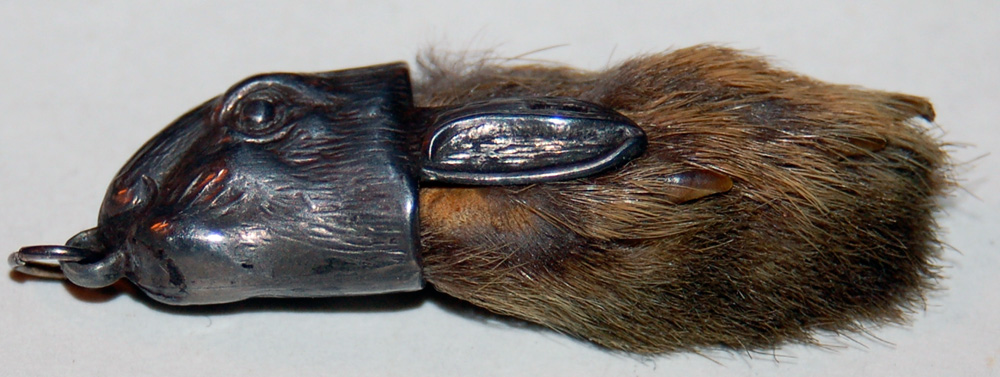
1)      Rabbit’s Foot – We’ve covered this here in the podcast (on Episode #13) and the blog (in the Lucky Rabbit’s Foot entry), so I won’t spend a lot of electrons on it here.  It suffices to say that the rabbit’s foot remains one of the most popular luck charms in the canon of animal curios.  It may have significant underworld ties, and it may simply be related to speed and fertility. Whatever its originally intended meaning, it stands for good luck now, especially in gambling.

2)      Toad’s Bone/Black Cat Bone – These are some of the darkest and most disturbing of animal curios, as the rituals required to obtain them are brutal.  The Toad’s Bone is mostly found in British magical lore, and was written about extensively by Andrew Chumbley, former Magister of the Cultus Sabbati.  Scholar Ronald Hutton also details the significance of this bone to members of the Toadsmen, a secret society along the lines of Freemasonry, in his excellent history of modern witchcraft Triumph of the Moon.   This ritual artifact was obtained (at least in one version—there are multiple ways this ritual can play out, depending on what source  you look to) by burying a toad alive in an anthill and letting the ants  strip it down to the bones.  The bones are then taken to a stream and floated one by one until one bone floats agains the current.  This bone is then the magic bone, and can imbue the witch carrying it with all sorts of interesting powers from spirit summoning to invisibility.  The black cat version of this same rite is even more gruesome.  As it is recounted in Mules & Men by Zora Neale Hurston, the cat is thrown into a pot of boiling water (also alive), and cooked until all the flesh falls from the bones.  The bones are then either floated in a stream (the same as the toad’s bones) or passed under the tongue of the magician.  The magic bone in this tradition turns the user invisible, and can also be used in some powerful love spells.  Most places selling this bone today are actually selling chicken bones painted black, and hopefully few people are actually performing this ritual as it occurs in folklore.  Again, I don’t condone this rite, and present it as a curiosity of history and culture rather than a suggested magical practice.

3)      Racoon Penis Bone – This is a popular charm in hoodoo, used in luck and love magic.  The bone itself, which is usually very thin and has a curved shape, has no disturbing ritual for obtaining it, but can simply be taken from an animal killed for meat or even from a roadkill hit (though I’d suggest being very careful how you handle remains of this nature, as they can often be riddled with diseases).  Cat Yronwode suggests that this particular curio entered American magical practice by way of Native American sources, and points out that the Pawnee often placed these bones along with ears of corn into sacred bundles.  I’ve heard that in the Appalachian and Ozark Mountains, it was common for boys to give girls these bones on red thread necklaces as love tokens (though I’ve not yet found a primary source for this claim).  Raccoons are not the only animal to have this bone—or “baculum”—and in fact many mamal species have it.  Other animals like foxes and dogs also have these bones, and occasionally these will turn up in magical charms, too.

4)      Rattlesnake Rattle – Snakes in general have a lot of lore about them, but the rattlesnake is particularly of note because its rattlemakes it a unique member of its family.  The rattles themselves have been collected for years as lucky charms.  Cat Yronwode suggests uses including:

  • A charm to help musicians play well
  • A simple “Live Things in You” curse
  • A personal power token
  • A gambling charm to bring luck

Rattlesnake rattles are fairly delicate things, especially once they’ve been dessicated for use in crafts and magic.  You can occasionally find one which has been turned into a key ring or charm, but the best way to handle these is to put them in a little vial or a small box of some kind and carry that with you.

5)      Snake Fangs/Bones/Skin – As I said earlier, snakes generally have all sorts of magical connotations.  You can look back at our blog entry on them (Snakes) and find out a good bit there, but here are some highlights:

  • Fangs can be worn as necklaces or carried as tokens of protection (from snakebite in some cases)
  • The bones or skin can be powdered and added to food to cause a “Live Things in You” curse
  • The skin of a snake soaked in vinegar can be used to treat boils in the Ozark magical tradition
  • The shed skins can be powdered and added to all sorts of crossing and jinxing formulae, including goofer dust and a variant on hot foot powder

Many pet stores will happily give you any leftover snake sheds they have if you call and ask politely, and if you develop a good enough relationship, you can sometimes wrangle dead snakes and/or bones out of them, too.  Roadkilled snakes are also good, but be absolutely sure they’re dead before approaching them.

6)      Dog/Cat Hair – These curios are nice because the animals don’t have to be hurt to acquire them.  Usually black hair is used, and preferably from all-black animals.  When the two hair types are mixed together in a mojo bag or vinegar jar, they can cause people to fight “like cats and dogs.”  Black cat hair can also be used to gain good luck, and black dog hair can be used to inspire feelings of loyalty or obedience in others.  If you have a black cat or dog, you probably have plenty of this available to you on furniture, carpet, etc. (I speak from experience here).  If you don’t, you might find a friend who does and see if they will let you have some of it for use in your magical workings.  At worst, you might have to snip off a little from the animal, but thankfully that does no harm (unless it’s the middle of winter and you leave a bald patch—don’t do that).

7)      Chicken Legs/Feet/Feathers – Chickens are popular creatures for magic, mostly because they are expendable (I call them like I see them) and ubiquitous.  Black hens and their feathers are wonderful for curse-breaking, according to Cat YronwodeStarr Casas, a notable rootworker from Texas, often speaks of using chicken legs or feet during cleansing work.  Even just having chickens can be particularly magical, since they will scratch up and destroy any curses laid for you on your property.  A Pow-wow charm from John George Hohman suggests that you do the following to prevent house-fires:

Take a black chicken, in the morning or evening, cut its head off and throw it upon the ground; cut its stomach out, yet leave it altogether; then try to get a piece of a shirt which was worn by a chaste virgin during her terms, and cut out a piece as large as a common dish from that part which is bloodiest. These two things wrap up together, then try to get an egg which was laid on maunday{sic} Thursday. These three things put together in wax; then put them in a pot holding eight quarts, and bury it under the threshold of your house, with the aid of God, and as long as there remains a single stick of your house together, no conflagration will happen. If your house should happen to be on fire already in front and behind, the fire will nevertheless do no injury to you nor to your children. This is done by the power of God, and is quite certain and infallible. If fire should break out unexpectedly, then try to get a whole shirt in which your servant-maid had her terms or a sheet on which a child was born, and throw it into the fire, wrapped up in a bundle, and without saying anything. This will certainly stop it. (#114)

The chicken’s wings can also be used to make a fan which some magical folk use to direct smoke during spiritual fumigations.  So popular is this animal in magic that one of my favorite grimoires is actually called The Black Pullet (a pullet being another name for a hen).

8)      Eggs – These are often used for spiritual cleansing, across several traditions.  In Mexican folk healing (curanderismo), an egg can be used to sweep, massage, and mark a person’s body to remove the Evil Eye (mal ojo) or harmful witchcraft.  The egg can also be “read” after this process to determine things like spiritual attachments, disease, bad luck, etc.  Another Pow-wow cure with a curious resemblance to the Toad’s Bone ritual earlier mentioned directs anyone suffering from failing health to catch rain water in a pot before sunrise without speaking to anyone, boil an egg in it, poke holes in the shell, and leave the egg on an anthill to be devoured.  This will supposedly allow the ailment to be “eaten” by the ants.  Eggshells also have some magical significance.  When powdered, they become cascarilla, which is used in Afro-Caribbean magic.  Cat Yronwode also lists several really interesting spells that can be done with black hens’ eggs.  For example, boiling a black hen’s egg and feeding half to a black cat and half to a black dog while saying two people’s names will cause them to have a falling out.  There is also a rather fascinating magical detective spell that can be done by placing an egg in each of a murder victim’s hands.  After the burial, the eggs will rot and eventually burst, at which time the murderer will return and be caught.

9)      Animal Fat – This is less of a curio than an ingredient, and the different fats from different animals (often referred to as that animal’s “grease”) have distinct properties.  According to Hoodoo Herb & Root Magic, “Rattlesnake fat is a powerful ointment.  Rub it on any painful body part, or stroke the whole body downward to expel conjure poisons” (p. 162).  Ozark healers commonly used “skunk grease” to cure various rhumetoid conditions.  Vance Randolph says “The grease from skunks or civet cats, mixed with peppermint leaves, is highly praised by some hillfolk as a lubricant for rheumatic joints. It is said that the fat of a male wildcat is best of all” (OM&F, p. 108).   In Pow-wow magic, a range of animal fats is used to make a potent anti-rust treatment for firearms:

Take an ounce of bear’s fat, half an ounce of badger’s grease, half an ounce of snake’s fat, one ounce of almond oil, and a quarter of an ounce of pulverized indigo, and melt it altogether in a new vessel over a fire, stir it well, and put it afterward into some vessel. In using it, a lump as large as a common nut must be put upon a piece of woollen cloth and then rubbed on the barrel and lock of the gun, and it will keep the barrel from rusting.  (#110)

Wild animal fat has mostly gone out of use, though it can occasionally still be found, particularly in the mountain regions of America.

10)   Bear/Badger/Other Teeth – These curios are usually gambling, luck, or protection charms.  Hohman mentions the badger’s tooth as a wonderful gambling talisman.  Bear teeth appear in protective necklaces (along with claws in many cases).  One of Vance Randolph’s stories from the Ozarks recounts a man who kept a big boar’s tooth on a leather thong over his fireplace.  Whenever any of his children would get a toothache, he’d make them wear the necklace until the pain went away.  These charms are common in many places, and hardly unique to the New World (the badger is an Old World animal, after all).  Plenty of places, including the wonderful site The Bone Room, sell teeth, bones, and other animal curious for use in crafts, magical or otherwise.

I think that will end our survey for today.  There are still plenty of parts and pieces I’ve missed, including gator paws and heads, various animal skins, porcupine quills, and the myriad insect charms that could still be discussed (and hopefully will be at some future date or dates—ants alone obviously have plenty of magical uses).  If you can think of other charms, I’d love to hear them, and feel free to share your folklore regarding animal remnants and magic in the comments section!

Until next time, thanks for reading!

-Cory
Blog Post 80 – Horseshoes

Following in the vein of recent posts, today I’m looking at another luck charm:  the horseshoe.  One thing Laine and I discussed in Podcast 13 was that the horseshoe seems to be a rather ubiquitous talisman.  It is so ubiquitous, in fact, that many folks may not even realize it has any magical connotation at all.  In an article from Western Folklore entitled “Lucky Horseshoes,” Jeannine E. Talley writes:

The horseshoe as a bestower of luck is so frequently encountered that it has become a cliche, but at the same time an isolated belief without a context. Barnet’s comment that the mule has been “pounding it full of luck” provides not only the ‘logic’ explaining why the horseshoe is full of luck but also reveals that luck is ac-cumulative. His insistence that the old nails must be used to hang the shoe is not found in standard collections for folk belief, but is akin to the notion that if the hardware is hung with prongs down, the luck will “run out.” This instance is a prime example that collecting the item is not enough; the contextual background of any item is of equal importance since it often contains the rationale which makes the belief credible. (p. 129)

I like this particular examination of the horseshoe because it details two points:  1) the horseshoe’s luck comes from its association with the horse itself and 2) as Talley states, the luck is accumulative, so the longer a shoe has been on a horse, the luckier it is.

Of course, there are plenty of other theories about why a horseshoe might be lucky.  Robert M. Lawrence, in his article,  “The Folk-Lore of the Horseshoe” describes the horseshoe as a talismanic emblem with many possible folkloric connections, including:

  • The Jewish Passover – like blood spread on doorposts/lintels and rowan trees in Scotland
  • Serpent emblem – “In front of a church in Crendi, a town in the southern part of the island of Malta, there is to be seen a statue having at its feet a protective symbol in the shape of a half-moon encircled by a snake”
  • Moon emblem – “the brass crescent, an avowed charm against the evil eye, is very commonly attached to the elaborately decorated harnesses of Neapolitan draught horses, and is used in the East to embellish the trappings of elephants.”
  • Phallic Emblem of some kind
  • Prong-shamed talisman – like protective horns of animals (connected to African symbols)
  • Horse as Sacred Animal (as mentioned above)
  • Iron as “Virtuous” metal capable of dispelling harmful forces (Journal of American Folklore, v.9, n.35, 1896, p. 288-292)

I hope to get into some of these symbols and ideas in other posts at another time—particularly iron, which shows up a lot in fairy doctoring practices and other magical systems—so for now I think it suffices to say that horseshoes have a lot of lore to build upon and are quite lucky, though no one seems to know exactly why they are so.

So how does one use horseshoes?  First of all, the shoe needs to be one which actually has been on a horse at some point (remember all that pounding of luck into it in Jeannine Talley’s article?).  Likewise, there are some who say that hanging a horseshoe involves using a spent horseshoe nail, too.  That seems to be a slightly less stringent requirement, but if you happen to have a spare horseshoe nail with your horseshoe, why not use it?

The issue of which way the “horns” of the shoe are pointing seems to be hotly contested by those who concern themselves with such things.  Both opinions seem to have some sound reasoning behind them, which I mentioned in the most recent podcast.  The general idea boils down to whether you think the horns up are “holding in the luck” or whether the horns down are “pouring the luck out on you.”  Either way, I think this is where instinct kicks in.  If you feel like you’ve hung it the “wrong way,” you probably have and  you should switch it.  But if you feel like your luck’s in good condition and your horseshoe’s “right,” then leave it be.

As to how specifically a horseshoe might be used, Harry M. Hyatt has a few examples of horseshoes in hoodoo work:

1) From Vol.2,p.1547

NAIL A HORSESHOE UP
OVER YOUR FRONT DOOR.
NAIL A PENNY DOWN IN THE FRONT
DOOR TOO. SCRUB IT ALL THE TIME.*
THESE WILL BRING YOU GOOD LUCK.

Dey kin use a horseshoe. Yo’ take a horseshoe an’ yo’ kin nail it up
ovah yore front do’ an’ take a penny an’ nail it down in de front do’; an’
yo’ jes’ let dat penny stay dere all de time an’ yo’ scrub ovah dat penny
all de time, an’ jes’ leave it dere an’ dat’ll be good luck fo’ yo’.
[Savannah, GA; Madam Pauline; Informant #1274. C575:1-C586:10 = 2136-2167.]

2) From Vol.2,p.1443

A HORSESHOE OVER THE DOOR
KEEPS SPOOKS OUT AND BRINGS LUCK.
& A MULESHOE OVER THE DOOR OF A BUSINESS
BRINGS BUSINESS SUCCESS

Keep a horseshoe – keep it ovah de do’ to keep de spook outa dere an’
fo’ luck, specially a man who does business. He’d have a new [mule] shoe ovah
de do’ – like he do’s a business roun’ in a shop or a restaurant or somepin
lak dat, because a mule is a hard-workin’ thing, hard-workin’. All right.
An’ jes’ lak ah’d have de mule when he hitch out an’ go to his stall to
eat, people be coming to his place and say….
[Sumter, SC; Informant #1387; Cylinders C885:1-C902:4 = 2366-2383]

(Both of these can be found in Hyatt’s book or in the excellent Yahoo! Group  “HyattSpells”)

I like the first example because it combines the lucky penny with the lucky horseshoe, and places luck at your head and your feet, so every time you enter a door,  you get caught between the two and get a double dose of luck.  I also like the rationale for using a mule shoe to boost business (because the mule is so hard-working).

Finally, Vance Randolph describes the Ozark methods of horseshoe deployment in Ozark Magic & Folklore:

  • Most hillfolk of my acquaintance use a horseshoe instead of the stone (to protect chickens from hawks), and some think that a muleshoe is even better. It is frequently fastened in the firebox of the stove rather than in the oven. In the old days the muleshoe was hung up in the fireplace, or even set into the mortar at the back of the chimney (p. 43)
  • Many hillfolk think that the man who finds a horseshoe with the closed end toward him will do well to “leave it lay.” If the open end is toward the finder, he sometimes spits on it and throws it over his left shoulder, a procedure which is supposed to bring good fortune. Or he may place it in a tree or on a fence,saying: “Hang thar, all my bad luck!” In this case, whoever touches the hanging horseshoe falls heir to the misfortune of the man who placed it there (p. 62)
  • Probably the commonest way to keep witches out of the house is to nail a horseshoe over the door; this is regarded as a sort of general prophylactic against witches, bad luck, contagious disease, and other evil influences (p. 283)

So that’s the lucky horseshoe.  Another long article, so I apologize for that, but hopefully you aren’t too bored.  Skimming is probably a good skill to apply when reading these blogs.  At any rate, if you have any questions or comments about horseshoes, please feel free to post them!

As always, thanks for reading!

-Cory

Podcast 13 – Lucky 13

-SHOWNOTES FOR EPISODE 13-

Summary
On this, our Lucky 13th episode, released on Friday the 13th, we’re looking at luck charms and where they come from.  We’ve also got a money bowl spell in WitchCraft, and Van Van oil in Spelled Out.

Play:

Download:  New World Witchery – Episode 13

-Sources-
We reference lots of sources, including:
-Cat Yronwode’s Lucky W Amulet Archive
-The Uncle Remus stories by Joel Chandler Harris
-Harry M. Hyatt’s Hoodoo – Conjuration – Witchcraft – Rootwork
-The article “Charles Chestnutt & the Doctrine of Conjuration”) by Bettye Jo Crissler Carr
-Judika Illes’s book Encyclopedia of 5000 Spells
Ozark Magic & Folklore by Vance Randolph
-The Chan Chu money frog of Chinese lore
-Richard Dorson’s Buying the Wind

Promos & Music
Title music:  “Homebound,” by Jag, from Cypress Grove Blues.  From Magnatune.
Promo 1- Witchery of One
Promo 2- Media Astra ac Terra
Promo 3- Borealis Meditation
Promo 4 – Iron Powaqa

Blog Post 79 – Lucky Rabbit’s Foot

For today’s post, I’m looking at the folklore and magic surrounding one of the most ubiquitous pieces of conjure paraphernalia, the rabbit’s foot.  There are plenty of theories about this particular luck charm, but not much that can be definitely put down regarding its origin or provenance.  Rabbit foot charms have been around since at least the mid-to-late 19th century in North America, and likely predate the Civil War.  They are used for general luck, gambling aids, love enhancers, and other areas where a bit of extra luck might help.

A quick word of warning, however.  Many of the sources I’ll be citing in this post also date from earlier eras, and thus have a great deal of offensive material in them.  There are words that appear here which would likely incite violence if used lightly today, so please understand that I present them here as a piece of the folklore to which they belong.  Just as a smart modern magician finds a reasonable substitution for liquid quicksilver/mercury (and thus avoids madness and poisoning), a wise student of folklore and folk magic remembers that just because a sentiment appears in print doesn’t make it right or appropriate.

There, now let’s move on to some of the good stuff about rabbits’ feet.

Catherine Yronwode provides information on the rabbit’s foot on her Lucky W Amulet Archive, describing  the foot as catalogue offerings from the early-to-mid twentieth century:

As for the foot itself, a circa-1940 mail order catalogue from the Standard O and B Supply Company, a Chicago-based distributor of African-American hoodoo material, offered undyed rabbit foot charms “made with a metal band and a link to attach on chain.” The Johnson-Smith Novelty Company offered identical charms in its 1941 catalogue. The advertisement shown here goes these one better and promises a free vial of Van Van oil with each rabbit’s foot; the formula is a Louisiana hoodoo favourite that “clears away that evil mess” and increases the strength of any good luck charm to which it is applied. Since none of the older catalogues or ads mention any colour when describing rabbit’s foot charms, it can be assumed that the items were undyed and came only in natural tan or white.

She goes on to talk about her uncertainty regarding why a rabbit’s foot might be so lucky:

Why is the rabbit foot lucky? I am not sure. Rabbits are swift and they reproduce prolifically, but the luck of the rabbit foot is monetary and sexual; as far as i know, it is not related to swiftness or fertility. There is considerable evidence that the lucky rabbit foot is a remnant of an African clan totem, an importation related somehow to Br’er Rabbit, the famous protagonist of an African trickster-god myth-cycle.

Yronwode points out that the rabbit’s foot appears in the famous Uncle Remus stories, written by Joel Chandler Harris in 1881.  In a tale entitled “Brother Rabbit and his Famous Foot,” Uncle Remus describes the tricky Br’er (or Brother) Rabbit’s prosperity-drawing mojo bag (which he refers to as a money purse, or dialectically a “money-pus”):

Brer Wolf look at de money-pus, en see w’at in it. Hit ‘uz one er deze yer kinder money-pus wid tossle on de een’ en shiny rings in de middle. Brer Wolf look in afar fer ter see w’at he kin see. In one een’ dey wuz a piece er calamus-root en some collard-seeds, en in de tier een’ dey wuz a great big rabbit foot (Harris p. 223)

So even a rabbit carries a rabbit’s foot for luck and money.  How’s that for strange?  But why is it so lucky?  In a 1973 thesis on conjuration in the works of African-American author (and somewhat accidental folklorist) Charles Chestnutt, Bettye Jo Crisler Carr uncovers some possible reasons behind this talisman:

One might have expected Chesnutt to refer to ghosts who haunt graves, to witches ‘riding’ their hapless victims by night, to conjurers tying bits of roots in tiny bags to ward off evil. But surely his reference to the efficacy of ‘de lef hin’ foot er a graveya’d rabbit, killt by a cross-eyed nigger on a da’k night in de full er de moon’—surely that is something Chesnutt (or Uncle Julius, who seems equally real) has made out of whole cloth.

An examination of folklore sources, however, justifies Chesnutt’s requirements for the rabbit-foot good-luck charm. An informant from Atlanta states that the talisman must, indeed, be the ‘left hind foot of a graveyard rabbit.  Mary Owen, recording her collected tales prior to 1893, adds to the requirement that it must be ‘de lef hine-foot ob er grabe-yahd rabbit kilt in de dahk o’ de moon.’ A Memphis informant states further that the graveyard rabbit must have been killed by a cross-eyed person. Louise Pendleton, also writing before the publication of Chesnutt’s stories, comments that the use of the rabbit foot for good luck ‘may be traced to the fetishism, or worship of guardian spirits dwelling in inanimate objects, of their African ancestors.’ (Carr,  “Charles Chestnutt & the Doctrine of Conjuration”)

So now we can see the process of making the charm has something to do with its luck associations.  If a cross-eyed person could catch a rabbit in a graveyard in the dark, he would indeed have to be very lucky, and thus his luck might transfer to the animal’s foot (this is a bit of a stretch for a reason, in my opinion, but there certainly seems to be a specific tradition involved in collecting this talisman).  Much of this lore is corroborated by Harry M. Hyatt in his five-volume compendium on African-American folk magic, Hoodoo – Conjuration – Witchcraft – Rootwork.   Two prime examples are included here:

Vol.2,p.1541

A RABBIT’S LEFT HIND LEG, TAKEN WHILE THE ANIMAL IS STILL WARM
AND SEWN INTO A BAG, SHOULD BE CARRIED WITH YOU AT ALL TIMES,
AND KEPT UNDER YOUR PILLOW AT NIGHT FOR LUCK.

If yo’ wanta go git a job agin, yo’ could use a rabit’s foot – yo’ use a rabbit’s left foot. Ketch a rabbit, if yo’ kin kill him; if yo’ can’t ketch it, kill it. Well, befo’ he gits cold, take de left laig of dis rabbit off. (Front or back?) De back laig. Take de back laig off while it’s warm an’ yo’ sew it up in some cloth an’ when yo’ go tuh bed at night, yo’ jes’ carry it an’ push it in yore pillah. If yo’ git up tuh go in de daytime, wear it in yore pocket or either yo’ could have it in yore stockin’. Put it in yore hat or shoe or anything an’ jes’ keep it wit chew all de time. Yo’ll have good luck wit de rabbit’s left hind laig. (When you are going out to get a job?) Yes sir.

[Savannah, GA; Madam Pauline; Informant #1274. C575:1-C586:10 = 2136-2167.]

Vol.2,pp.1486-7

A CHARM TO CARRY

BURY THE RIGHT FRONT FOOT OF A RABBIT IN THE CEMETERY.
AFTER NINE DAYS AND NINE NIGHTS, DISINTER IT.
WEAR IT ON A CHAIN OR FASHION IT INTO SOMETHING SIMILAR TO WEAR
AND CARRY IT WITH YOU.

You take off his right feet, yo’ bury it in de cemetery – let it stay dere fo’ nine days an’ nights. Yo’ go an’ git it out from under dere an’ make yo’ a chain an’ put it on yo’ fo’ a locket or either, yo’ know, yo’ kin jes’ have it made into somethin’ den – yo’ know, somethin’-like. Dat’s de rabbit foot. [She laughs.] Den y’ jis’
tote it wit yo’ or either place it fo’ a watch charm or anythin’ like dat – right feet, jes’ one, de front.

[Waycross, GA; Informant # 1125 (Contact man Edwards’s landlady); Cylinder C235:4-C250: 1 = 1816-1831, and C384:1-C392: 5 = 1965-1973]

One of the common threads to the rabbit’s foot seems to be an intimacy with death or the dead.  The rabbit must be freshly killed (or “warm”) or found in a cemetery.  This may have something to do with its luck.  The dead are able to provide luck to the living in some folkloric accounts, and a magical animal like a rabbit which becomes tied to the dead may well be “running” luck back and forth from them to you.  If you are interested in more spells like the two immediately above, by the way, you can find many of Hyatt’s spells transcribed in the Hyatt Spells Yahoo! Group.  If you manage to find actual text volumes of his work and you have an interest in folk magic, buy them.  They will be worth it.

Finally, Ozark folklorist Vance Randolph records a couple of uses of the rabbit’s foot charm in his Ozark Magic & Folklore:

  • Some healers claim to cure hiccoughs by rubbing a rabbit’s foot on the back of the patient’s neck unexpectedly.
  • I recall a girl near Lanagan, Missouri, who wore a peach stone love-charm on one garter and a rabbit’s foot fastened to the other.

This particular lucky charm can be found throughout North America, often sold in roadside stores, children’s candy-and-prize machines, and even gas stations.   It’s commonly rubbed to actually activate the luck, and “fed” with an oil like Fast Luck or Van Van on a regular basis.  If you happen to have one of these in keychain or charm form, I’d love to hear your experiences with it.  Have rabbit’s feet ever brought you extra luck?  Or, as the joke is often made, is it just “unlucky for the rabbit”?

Thanks for reading (and reading and reading)!

-Cory

Podcast 11 – Magical Tools

-SHOWNOTES FOR EPISODE 11-

Summary
Today we announce the upcoming break due to Cory’s grad school (don’t worry, we’ll be back sooner than you think!).  Then we talk about magical tools in American witchcraft, and we have our WitchCraft and Spelled Out segments.

Play:

Download:  New World Witchery – Episode 11

-Sources-
Mules & Men, by Zora Neale Hurston – mentioned in the show
Lucky Mojo site – particularly rabbits’ feet, gator parts, and raccoon bones
Hoodoo Root & Herb Magic, by Catherine Yronwode – lots of info on magical curios
Mojo:  Conjure Stories, by Nalo Hopkinson – the book I’m reading now which I mentioned when discussing gator heads

Promos & Music
Title music:  “Homebound,” by Jag, from Cypress Grove Blues.  From Magnatune.
Promo 1 – Iron Powaqa
Promo 2-  Witches’ Brewhaha

Blog Post 66 – The Moon

In a lot of modern Pagan religions, such as Wicca and Druidism, there is a certain amount of emphasis placed on the moon.  Phases of our celestial companion become symbolic stand-ins for various god and goddess figures, or particular aspects of those figures (as in the famous Maiden/Mother/Crone cycle).  With the full moon upon us, I thought I might take a little look at just how American witchcraft interacts with that lovely sphere.

There is a great deal of lunar lore found in Native American legends.  In one tale from the Kalispel Tribe of Idaho, the moon is equated with the famous trickster/father figure, Coyote:

“Once there was no Moon for someone had stolen it. The people asked “Who will be the Moon?” The Yellow Fox agreed to give it a try but he was so bright it made the Earth hot at night. Then the people asked Coyote to try and he agreed. The Coyote was a good moon, not to bright – not to dim. But from his vantage point in the sky the Coyote could see what everyone was doing. Whenever he saw someone doing something dishonest he would shout “HEY! That person is stealing meat from the drying racks!” or “HEY! That person is cheating at the moccasin game!” Finally, the people who wished to do things in secret got together and said “Coyote is too noisy. Let’s take him out of the sky.” So someone else became the moon. Coyote can no longer see what everyone else is doing but he still tries to snoop into everyone else’s business” (WWU Planetarium American Indian Starlore page).

The Cherokee thought of the Moon as brother to the Sun (an instance of the moon being seen as male, which appears in several cultures).

The image of the Man in the Moon is frequently found in American folklore.  Many of these traditions hail from European lore, including poems found in Mother Goose:

THE MAN IN THE MOON
The Man in the Moon came tumbling down,
And asked the way to Norwich;
He went by the south, and burnt his mouth
With eating cold pease porridge.
(from The Real Mother Goose)

In other cultures, the moon contains figures less familiar to most Americans.  The Old Farmer’s Almanac includes examples of the moon seen as a woman with child, a toad, a giant, a rabbit, and a boy and a girl carrying a bucket (as in “Jack and Jill”).

There are also particular moons associated with particular months.  A good list of them can be found at the Farmer’s Almanac site, here.  Many are linked with agricultural cycles (such as Green Corn Planting Moon or Harvest Moon), and some are clearly linked to hunting (like the Buck Moon).

There is a plethora of magical lore associated with the moon.  My earlier posts on planting by lunar signs and weather lore both have lunar connections within them.  Likewise, the witch initiations post mentions the practice of shooting at the moon to become a witch.  Edain McCoy, in her book In a Graveyard at Midnight, also has a fun bit of moon magic:

“To remove a curse from your home, you can try shooting your shotgun out an open window at the full moon, while shouting a curse at the Devil.  However, don’t try this if you live in a city or populated area, or you will likely find the police at your door” (McCoy, p. 107)

There are also beliefs about marriage and courtship dates associated with lunar phenomena – waxing-to-full moons are best for “tomcattin’” according to Vance Randolph’s Ozark Magic & Folklore.

Of course, witches can find lots to do under a full moon.  Personally I find it to be an ideal time for:

  • Storytelling gatherings (especially around a campfire)
  • Divination and fortune-telling
  • Working with Otherworld entities like spirits, ghosts, fairies, etc.
  • Possession-based magic and shapeshifting
  • Love and beauty magic
  • Crafting magical tools and supplies

These are only my thoughts on the subject, of course, and there are plenty of great sources on lunar folklore out there.  And, of course, your mileage may vary when it comes to making the most of a full moon.  I’d love to hear what you all do with regards to lunar-linked magic.  Please feel free to share your methods, practices, ideas, and thoughts with us here!

Until next time, thanks for reading!

-Cory

Blog Post 60 – Appalachian Mountain Magic, Part III

Today I’m finishing up the introduction to the magic of Appalachia by looking at “yarb Doctors” and some of the other magical oddities of the mountains.

Yarb Doctors
The final part of the mountain magical triumvirate is the “Yarb Doctor.”  These are often seen as the male counterparts to the Granny women already discussed.  These were folks who knew enough herbal medicine to make cures and remedies for all manner of ailments.  Vance Randolph describes them thusly:

“Besides the regular and irregular physicians, who live mostly in the villages, the backwoods country swarms with ‘yarb doctors’…who have never studied medicine at all. Some of these nature doctors are women, others are preachers who do a little doctorin’ on the side, and many of them are unable to read or write. They rely mainly upon herbs, barks, roots, and the like. For internal medication these substances are steeped in hot water, and “horse doses” of the resulting teas are administered at frequent intervals. In some cases the tea is boiled down to a thick paste called ooze, or mixed with strained honey to make a syrup” (OM&F, p.92)

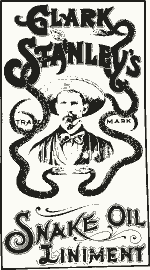
Often, this is what we think of when we talk about “snake oil salesmen.”  The yarb Doctor basically dealt in herbal formulas for treating common ailments.  Some of these formulas became fairly well-known.  When a particular yarb Doctor’s formula reached a particular level of renown (and often even if it didn’t and an unscrupulous “doctor” was simply chasing a dollar) these medicines would become a famous “patent medicine.”   This is not to say that the yarb Doctor (variously known as an “herb doctor,” “rubbing doctor,” or “nature doctor”) was simply a quack making money off of ignorant mountain folk.  In most cases, these were locals with a knack for making formulas and medicines from the indigenous flora of the area, including roots, barks, flowers, and leaves.  Some of the mixtures are still in use today, albeit changed much from their original purpose.  Root beer is a prime example of what happens when you make a patent medicine out of sarsaparilla and sassafras roots and mix it with a little sugar and soda water.  Appalachian yarb Doctors had good reason to make medicines:  they lived in the pharmaceutical breadbasket of the country.  According to Dave Tabler’s Appalachian History blog:

“Big Pharma had not yet perfected the widespread manufacture of synthetic drugs in 1932. Instead, the industry relied on ‘western North Carolina, southwestern Virginia, eastern Kentucky, and eastern Tennessee [to] furnish 75% of the crude botanical drugs which the continent of North America supplies to the drug markets of the world,’ according to an article in Economic Geography that summer”

The remedies proffered by yarb Doctors were not limited only to plants and their components, but often included a few more unusual ingredients.   For example, dealing with a toothache was a common enough problem in the mountains, where access to regular dental care was limited or non-existent:

“There were many treatments for a toothache.  Some of the more common ones were holding tobacco smoke, a sip of red oak bark decoction, or whiskey in the mouth; chewing ragweed leaves; applying cinnamon or clove oil, camphor, or persimmon juice to the tooth and gum; placing a ball of cotton soaked in paregoric, camphor, turpentine, or kerosene on top of the tooth; and holding a bag of warm ashes or salt against the cheek.  If a large cavity was present, it was stuffed with soda, salt, cow manure, spider webs, aspirin, burned alum, dried and pulverized buckeye skin, or crushed puff-balls” (FMSA, p.107)

There are a number of remedies used by these mountain medicine men which are still in common practice.  Clove oil, for example, is still used to numb the pain of a toothache.  Some methods, though, such as packing a cavity with cow dung, seem to have fallen by the wayside (I’ll not say whether I think that a good or bad thing, though I’m less than eager to put cow dung in my own mouth if I’m being entirely honest).

Other Aspects of Mountain Magic
There are, of course, many areas of mountain magic which don’t fall neatly into the three categories I’ve laid out here.  yarb Doctors and Granny women had much in common and there is a great deal of crossover in their particular lines of work.  Likewise, one who could dowse for water could usually also perform some other occult action, such as simple curing.  I have an in-law whose great-grandfather (the seventh son of a seventh son, no less) could dowse and “buy” warts off of people in order to effect a cure, for example.

Other aspects of mountain magic have already been touched on in this blog.  Some of the areas we’ve covered here which have a huge place in the folk magical practices of Appalachian peoples include:

One of the biggest areas I’ve not yet covered in detail is the Appalachian preoccupation with death, dying, corpses, and graveyards.  Edain McCoy’s In a Graveyard at Midnight includes a great deal of this lore in her chapter on “Death, Dying, and ‘Haints,’” which focuses mostly on the rituals surrounding death and burial as well as protection from the dead.  At some point, I’ll be doing a bit more on this topic, but for now I think the most important thing to note is that death and birth were—and are—the two most important events in a human life, and the mountain folk treated them with respect, awe, and not a little fear.

A final area of interest for mountain dwellers where the occult was concerned had to do with divining the future.  Rather than foreseeing events having to do with money or fame or anything like that, almost all Appalachian divinations performed in the home had to do with love.  This is, again, a topic I’ll be delving into with more depth at another time.  But often the “games” played by young girls in the mountains revolved almost entirely around divining the name, appearance, or attributes of a future husband.  And there are also plenty of tales which deal with the terrible consequences of treating these sorts of divinations lightly (such as the story of the “dumb supper” which eventually leads to a young girl’s brutal murder).  Suffice to say, Appalachian folk know that life has its dark side, and they aren’t afraid to talk about it.

That’s it for mountain magic this week.  I hope this has been a useful introduction.  This, like many of the other topics here, only scratches the surface, and I hope to return and look at Granny women, yarb Doctors, dowsers, power doctors, signs and omens, death lore, and just about everything in more depth at a later date.  But for now, I’ll wish you a happy weekend.
Thanks for reading!

-Cory

Blog Post 59 – Appalachian Mountain Magic, Part II

Today, I’m continuing the look at Appalachian mountain magic by focusing on a few of the specific “jobs” performed by mountain magicians.

Grannys, Dowsers, and Yarb Doctors

In general, the current incarnation of Appalachian magic is broken into a few categories.  Mountain witches may do only one “magical” thing all their lives, or they may perform a broad array of tasks for their communities, some magical and some not.  Often, the word “witch” never enters the picture or has a negative connotation (with one very key exception, explained below).  But the basic functions of a mountain magician can be broken down into a set of roles, as follows.

Granny Women
This is probably the best known and most ambiguously defined magical “job” in the mountains.  Granny women filled several roles in the community:

  • They acted as healers in communities where trained doctors were scarce, nonexistent, or deeply distrusted.
  • They assisted doctors when professional medicine was required, and often during childbirth.
  • They acted as midwives and postpartum caretakers for new babies and mothers.
  • They might be called upon to perform blessings for livestock or land before planting, owing to their roles as birth-helpers (thus helping the earth and one’s livestock birth the food one would eat for the coming year).
  • In some cases, they might also perform basic divinations, like determining the sex of a baby by dangling a wedding ring over the woman’s palm or belly.

Often the work done by these women was broader in scope than mere medicine.  It took into account a patient’s whole state, including spiritual or psychological.  Sometimes the work done by Grannies baffled the doctors performing the births, though they obviously were a great comfort to the mothers:

“Granny-women might perform a number of rituals which doctors found silly and irrational. Some were designed to give the mother psychological, if not physical, relief from her pain. She might give the woman her husband’s hat to hold during the ordeal, thus bringing him symbolically into the delivery room. If the labor were particularly severe, she would place an axe or knife under the bed to “cut” the pain in two. Sometimes, weather permitting, she would throw open every door and window in the house, in a symbolic representation of opening the birth canal” (from “In Defense of Granny Women,” by Janet Allured)

The term “Granny women” isn’t exactly accurate, either.  Many women were not particularly old when they learned about midwifery from their own female relatives, and even some men were known to assist during childbirth.  While much of the training to become a Granny was on-the-job, there were surprisingly sophisticated teaching materials as well:

“To train them [potential midwives], we had a very large wooden box.  At the bottom and on the top, there was a simulated abdomen and perineum—just like the mother—so we could actually teach them the mechanism of labor, and so we could teach them what was going on inside” (Foxfire 2, p.277)

Payment for a Granny woman’s services varied, often depending on the economic state of those she helped (which was usually fairly poor).  A passage from Folk Medicine in Southern Appalachia, by Anthony Cavender, illustrates the point:

“A typical fee charged by a physician in Kentucky for delivering a baby in the latter part of the nineteenth century was about $10, a substantial sum for an average farming family.  Physicians were often paid in commodities, such as corn, timber, pigs, cows, and corn mash whiskey, or labor in kind.  Some granny women charged a modest fee of a dollar or two or its equivalent in materials, but many did not” (FMSA, p.129)

These women served a vital role in their communities, and while some of them were labeled as “witches,” they seldom endured physical persecution as they were far too valuable.

Dowsers
The exception to the rule of bad “witches” were the dowsers, often called “water witches.”  These were people—most often men, though women were certainly known to perform water witching as well—who could locate underground streams through the use of various magical techniques.  The most common method was to use a forked branch cut from a witch hazel tree (some sources list other trees, like willow) and to walk slowly along a piece of property until the rod reacted by bobbing up and down or giving some other sign.  Despite being called “water witches,” there were seldom any negative connotations to the profession, as it was an absolutely necessary service in a time when digging wells was costly and difficult business.  Vance Randolph describes them thusly:

“Nearly all of the old settlers…believe that certain persons can locate underground streams by ‘cunjurin’ round’ with forked sticks. These characters are called water witches or witch wigglers, and the forked switches they carry are known as witch sticks. Despite this sinister terminology, the waterfinder has no dealings with the Devil, is not regarded as dangerous by his neighbors, and has  nothing to do with witchcraft proper…Nearly all of the really old wells…were located by witch wigglers. Even today there are many substantial farmers who would never think of drilling a well without getting one of these fellows to witch the land” (OM&F, p.82)

In addition to locating underground water currents, dowsers could also locate other materials, like oil or precious metals.  Some practiced what is called “map dowsing,” where a map would be laid out in front of the dowser and he or she would use a pendulum to figure out where to start the search for whatever material was being sought.  This practice is very well accepted in the mountains and throughout the rural parts of North America.  In Signs, Cures, & Witchery, Gerald C. Milnes  examines the widespread nature of dowsing, as well as some of its history:

“Water witching (rhabdomancy) is very common in West Virginia.  According to a study done about fifty years ago, at that time there were twenty-five thousand practicing water witches in this country.  The actual practice of divining with a forked stick, as we know it, began in the late fifteenth or early sixteenth century in Germany.  Martin Luther believed the practice violated the first commandment.  Through the ages it has been roundly denounced as the devil’s work and praised as a remarkable aid to a basic necessity of rural life—finding water.  It is often categorized with such rural customs as planting by the signs” (SC&W, p.133)

There have been many efforts to scientifically prove or disprove dowsing, all with varying degrees of success and failure.  It seems that there is something to it, but that it may have a great deal more to do with the person doing the dowsing than the actual practice itself, at least as far as science is concerned.  However, from my personal point of view, the practice of water witching is akin to pendulum divination of any kind and something worth adding to a witch’s repertoire.  In one of Peter Paddon’s Crooked Path episodes, for example, he talks about ley lines and the currents of magical energy flowing through the world.  Dowsing is a great way to help detect those currents and to tap into and work with them to improve one’s witchcraft (again, in my opinion).

Whew!  This is already getting to be a long post, so I’m going to stop here for today and save the last little bit of this topic for tomorrow.  Please feel free to add any comments or questions, and if you have any family stories about Grannies or dowsers, I’d love to hear them!

As always, thanks for reading!

-Cory