Blog Post 51 – Book Review

Happy Friday, all.  Today, to make up for a rather long post yesterday, I’m just doing a quick blurb on a book I’ve not referenced much here, but which will likely be cropping up as we get into discussions of things like curanderismo and brujeria.  The book I’m looking at is called Spiritual Cleansing by Draja Mickaharic.

Mickaharic was an immigrant from Central Europe who arrived in the U.S. just as World War II was dawning.  The occult seems to have interested him from a relatively young age, and he’s produced copious volumes on various magical themes.  What strikes me as unique is that despite his Old World roots, most of his magical writings focus on what I would call New World systems, such as Caribbean, Southern, and Mexican folk magic.

Spiritual Cleansing is, according to its subtitle, “a handbook of psychic self-protection.”  Much like Dion Fortune’s Psychic Self-Defense, this book is mostly aimed at beginning practitioners or those with little experience in occult topics.  It’s chief goal is to help a person who might be facing all sorts of spiritual afflictions to remove those problems and prevent future recurrences.  Mickaharic is very insistent in this text that his work is not to be taken as medical advice (which is a sound if common legal disclaimer in works like this), but also that it is only for basic spiritual cleansing and protection.  He advises those with serious afflictions to seek out the help of a professional spiritual practitioner, and therein lies some of his charm.  He takes his subject very seriously, and his tone comes across a bit like an admonition from a grandparent.  This is probably because he was nearly 70 when the book was first published in 1982.  A more recent edition came out in 2003 with additional material, including a chapter on “Quieting the Mind.”

Mickaharic’s work is incredibly practical.  He discusses a lot of different spiritual cleansing techniques without high-flown language.  Some of the topics he addresses are:

-Dealing with Malochio (the Evil Eye)
-Cleansing oneself with spiritual baths
-Using eggs to remove negative energy
-Burning incenses to fumigate oneself for protection
-The proper use of Holy Water

One thing that some readers may be turned off by is the matter-of-fact way he says to do things.  For example, of burning incense he says “If we burn incense with no real purpose, we may find the forces  [higher powers] decide we are calling a wrong number—and they will not act in harmony with our desires…To be able to use an incense properly we must first understand these rules” ( p. 78).  He then goes into the rules as he sees them.  In another passage, he advises against using rain water for spiritual cleansing because “Rain water is difficult to use as it has variable vibrations…[and] should not be used for any spiritual work except by those who have been specifically told to use it by a spiritual practitioner” (p. 67).  I know such “this is this and that is that” statements are a big turn-off for many magical folk (and I have a feeling Laine would strongly disagree with Mickaharic on his perspective concerning rain water).  But I’d like to offer up, as some small defense of this work, that it is written for an inexperienced magical practitioner.  Someone with a better understanding of magic very well may be able to bend his “rules,” but Mickaharic is more concerned with the well-being of the reader he’s never met and wants to make sure they don’t get into anything they can’t handle.

Many of the spells and workings in this book are wonderful.  Some bear striking similarities to hoodoo work (his home sweetening spells involve burning brown sugar, which is very common in hoodoo), and many are very close to curanderismo practices (the egg cleansings in particular strike this note with me).  Some things in this book seem a little pedantic to me, of course, but then again I’ve been reading magical books for a long time.  In the end, I still think the good of this book outweighs anything bad I can say of it, and so I’m recommending it to you.  If you have an interest in spiritual cleansing and protection, or in Mexican folk magic, hoodoo, and other natural magical systems, this is a book well worth tracking down.

Have a great weekend!  Thanks for reading!

-Cory

Blog Post 49 – Snakes

I hope you’ve got your good boots on today, because we’re getting into the tall grass and looking for snakes!  Snakes have had a place in magical lore for a very long time.  In Ancient Greece, Artemis and Apollo were sometimes associated with snakes.  Apollo was famous for slaying the great serpent Python (see Ovid’s Metamorphoses, Book I), and his priestesses were ever afterwards known as the Pythia.  Artemis, offended by King Admetus’s oversight of an offering due her, filled his bed with serpents.  In Vodoun tradition, the Creator figure is a great serpent, Damballah.  Stories of creation and snakes seem to go hand in hand across many cultures.

In the New World, snakes have a mixed significance.  On the one hand, the biblical story of Eden in Genesis lays a lot of the blame for humanity’s disobedience on the serpent in the garden.  At the same time, humanity would be without knowledge without the snake, so there’s more than one way to look at the story.  However, if you ask many Christians today who the snake was, they will answer “the Devil” or “Satan,” so for all intents and purposes, mainstream culture takes a fairly negative view of these slithering creatures.  That does not mean, however, that all snakes are viewed as little devils, and many folks actually like them.  Farmers like snakes because they keep rodent populations down in barns and fields, for example.

In magic, snakes are one of the most potent animals you can use.  There are several different magical traditions surrounding snakes or their various parts and pieces.  Catherine Yronwode notes that “the blood, eggs, heads, flesh, sheds, and skins of all species of snakes are used in jinxing and crossing” and the manufacture of various hoodoo mixtures, like Goofer Dust or Live Things In You poisons (HHRM p. 186).  She also mentions that the sheds can be used to calm one’s mind.  Other hoodoo-related uses of snake sheds and bones include situations where cunning might be needed, or for luck and power.  In this last case, rattlesnake bones and rattles are often used.  Musicians who wish to play well and win contests often keep a rattle with their instruments, according to Yronwode.

In the case of the Live Things In You curse, powdered snake parts—usually eggs or sheds—are mixed into a victim’s food.  The target then feels as though the creature is wriggling around in his body, causing him pain and distress, as well as the feeling that he might be going crazy.  You can read more about this kind of baleful working in Superstitions & Folklore of the South, by Charles W. Chestnutt, at the University of Virginia website.

Vance Randolph recorded several bits of magical lore concerning snakes in his Ozark Magic & Folklore:

  • To cause a rain, a snake could be hung belly-up on a fence (p. 30)
  • Burning shoes in the fireplace will drive away snakes (p. 68)
  • Snake-skin soaked in vinegar is applied to boils to reduce them (p. 101)
  • Snake-bites treated by doctors will always ache on the anniversary of the bite (p. 159)

Randolph also mentions the snake-handling “Holy Roller” churches sometimes found in rural areas of the South.  These churches base their practice on an admonition in Mark 16: 17-18:   “And these signs shall follow them that believe; In my name shall they cast out devils; they shall speak with new tongues; They shall take up serpents; and if they drink any deadly thing, it shall not hurt them; they shall lay hands on the sick, and they shall recover” (KJV).

A final tale from the Ozarks concerns a family that had a secret method of dealing with snakes:

“Miss Jewell Perriman, of Jenkins, Missouri, tells me that her Uncle Bill had a secret method of curing snake bite, and people came from miles around for treatment. Uncle Bill belonged to a family of which it was said ‘them folks don’t kill snakes.’ This is very unusual in the Ozarks, where most people do kill every snake they see. When a large copperhead was found in the Perriman house, Uncle Bill caught it with the tongs, carried it out into the orchard, and released it unharmed. His cure for snake bite was known in the family for at least a hundred years…The secret is lost now, for Uncle Bill is long dead, and his son died suddenly without issue. All that Miss Perriman knows of the snake-bite cure is that the snake must not be injured, and that Uncle Bill had a strip of ancient buckskin in which he tied certain knots as part of the treatment. She showed me the buckskin. It was about half an inch wide, perhaps twelve inches long, carefully rounded at the ends. Three knots had been tied in it, one in the middle and one at either end” (Randolph, Ozark Magic & Folklore, p. 159).

Wouldn’t you love to know what that secret was?  I sure would!

I suspect that snakes will always have a place in magical lore.  They have the ability to slide between upper and lower worlds easily.  Some can kill with a bite, but also provide useful services to us in many ways.  They seem to show up everywhere in the world (except Ireland…but that’s a completely different subject) and they always connect to something primal in us: fear, knowledge and gnosis, or even sexuality.  I’ll be keeping my good boots on when dealing with them, but I definitely have a particular love for these critters.

Thanks for reading!

-Cory

Blog Post 46 – Magic and Mother Goose

I received a comment from reader Chet the other day which inspired this particular blog post.  So, many thanks, Chet!  He mentioned that he’s been listening to his daughter’s music, which includes many nursery rhymes, and hearing not-so-subtle references to fairly adult topics (such as the sexual undercurrents in a song like “There’s a Hole in My Bucket”).  This idea may be old hat to some, but I thought it might be worth taking a few nursery rhymes and dropping them into the cauldron to see what bubbled up.  Please note that my witchy exegesis here may be entirely wrong, but it may also provide some new perspectives on old songs and rhymes.  I welcome all comments on these interpretations (well, all civil comments, that is).

You can find a great list of Mother Goose rhymes here, along with some brief explanations of each one.

Now, onto the rhymes!

Jack-be-Nimble
Jack be nimble
Jack be quick
Jack jump over
The candlestick.

This little rhyme was first published in the 18th century, according to one source.  It may have referred to a clever and quick pirate called “Black Jack,” but  it also likely has something to do with the practice of jumping over fires, as is sometimes done at May Day (or Beltane) celebrations.  In these instances, the leaper jumps over a bonfire in order to gain blessings—like fertility and an easy birth for women—or protection, or to purify one ritually.  Afterwards, the ashes would be scattered over the fields to ensure a fertile crop.  In its diminished form with a candle-stick, a person could leap the candle forwards and backwards three times (or nine times in some cases) while asking for such blessings, and if the candle remained lit, the wish would be granted.  This might make for an interesting spell, though I cannot recommend it for safety reasons—if you choose to do it, you do so at your own risk and would be well advised not to wear loose-fitting or flowing clothes.

Peter Pumpkin Eater
Peter Peter pumpkin eater,
Had a wife and couldn’t keep her!
He put her in a pumpkin shell,
And there he kept her very well!

This rhyme fits in very well at New World Witchery, because it originates in North America.  While many nursery rhymes came from the UK, the mention of the pumpkin in this one tells of its roots (pumpkins are a New World fruit unknown in Europe prior to the colonial era).  But what is it all about?  Well, if a man has a wife he can’t “keep,” it means that she is being generally unfaithful to him, and turning him into a cuckold.  My take on this particular rhyme is that our good fellow Peter knows of his wife’s infidelity and decides to put a stop to it.  He does this by putting something of hers—likely something very intimate like used underclothes—into a pumpkin shell, which as it rots, prevents her from being able to dally with other men.  This sort of spell is common enough in hoodoo, and is generally referred to as binding someone’s “nature” so they cannot sexually perform with another partner.   This is my take only, of course, and your mileage may vary.

For Want of a Nail
For want of a nail the shoe was lost.
For want of a shoe the horse was lost.
For want of a horse the rider was lost.
For want of a rider the battle was lost.
For want of a battle the kingdom was lost.
And all for the want of a horseshoe nail.

This rhyme is used, according to some, as a way of chastising children who do not see the consequences of their actions.  I certainly agree that in that light, this rhyme is a wonderful didactic tool.  However, I also like to think there’s something a little more magical that can be gleaned from this little bit of lore.  For example, there is a great deal of sympathetic magic which focuses on using something small, like a poppet, to affect something bigger, like a person.  Examined thusly, this chant might be a great way to amplify magical activity.  For example, if you were trying to banish something—like a disease—you could take something from the ill party (hair, fingernails, or clothing worn while sick) and bind it into a charm which might be buried, burned, or otherwise permanently disposed of while chanting this rhyme.  In this way, you’d be telling the disease that it no longer has the power to ravage the entire body, because you’ve taken away a part of the “body” from it.  The disease would then give up, having lost its “kingdom.”  The healing example may be a bit of a stretch, though, as the primary way I can see this little spell being used is to banish unwanted persons from your life.

Pat-a-Cake
Pat a cake, Pat a cake, baker’s man
Bake me a cake as fast as you can;
Pat it and prick it and mark it with a ‘B’,
And put it in the oven for Baby and me.

I see two ways that this lovely little rhyme might be given a magical connotation:  1) By baking food and marking it with someone’s initial, you’re essentially creating a poppet of that person, which can be used in many kinds of spells, or 2) This could be a lovely way to help someone with fertility or family blessings, as having a “bun in the oven” is a common euphemism for pregnancy.  In this latter case, when the mother-to-be devours the cake marked with an initial (perhaps the future baby’s, or her own if she hasn’t picked a name yet), she would be putting the “baby” in her belly.  A newly pregnant mother might also do a spell based on this to ensure a healthy baby, and a new mother might then play this game with her child as a way of continuing the blessing for her child (as well as endlessly amusing the little one, which is really what I think this rhyme is all about in the end).

Crooked Man
There was a crooked man and he walked a crooked mile,
He found a crooked sixpence upon a crooked stile.
He bought a crooked cat, which caught a crooked mouse.
And they all lived together in a little crooked house

Finally, we come to one of my personal favorites.  I know that some interpretations put a meaning on this rhyme referring to the unification of Scotland and English under a single ruler, but I tend to think of the rhyme in more esoteric terms.  The repetition of the word “crooked” seems to be almost a mantra, or a chant for moving into another state of mind.  And I think that the “crooked mile” could well be the “crooked path” of witchcraft.  The “crooked stile” is likely the gateway between worlds, too.  So my best use of this charm is to act as a “road opener” between the mundane world and the world of spirits.  There are also plenty of stories about paying a “tithe to hell” before crossing over (see Tam Lin or Thomas the Rhymer), and it’s usually something nominal (or at least, something that seems nominal at the time), so a sixpence would fit the bill. I also wonder if the crooked house is the proverbial witch’s cottage, or something a little more significant. Perhaps the “house” is the line down which a tradition is passed? And because that line sometimes veers out of strict blood ties and into adoptive relationships, it could be seen as a “crooked house.”  Of course, these are all just my speculations, but I like them.

I could go on and on with these rhymes, looking at them through the lens of witchcraft, and probably find something of value in most any nursery rhyme I read.  However, it’s probably best to say here that just because I interpret something with a witchy twist doesn’t mean that historically it has any such meaning.  In many cases, these rhymes are just entertainments for the very young, and a bit of whimsy for the slightly less young.  I like to think that magic and childhood go together, though, so I will happily continue scouring these rhymes for a bit of hidden wonder.  If you do the same, I’d love to hear what you come up with!

Thanks for reading!

-Cory

Blog Post 42 – Five-finger Grass

Catherine Yronwode calls this “the most popular green, leafy herb in hoodoo” (HHRM, p. 95).  It’s known by several names, including Cinquefoil and Tormentil (which is actually a particular species in the broader genus of Potentilla, which also includes Five-finger Grass).  This herb, which is not actually a grass, is one of the best to keep around.  It’s fairly easy to grow from seed, or from root cuttings as it is a rhizome.

The value of this herb has been known for a long time.  Sir Francis Bacon noted that it seemed to attract a particular type of wildlife, saying “The toad will be much under Sage, frogs will be in Cinquefoil” (The Works of Sir Francis Bacon, p. 548).  John George Hohman mentions it in his The Long Lost Friend, saying “If you call upon another to ask for a favor, take care to carry a little of the five-finger grass with you,

and you shall certainly obtain that you desired” (Hohman, #14).

This particular herb is a very positive one.  It’s used for protection because of its hand-like shape (imagine a hand held up to halt evil in its tracks), but also in love spells, money and luck workings, and even travel magic.  Here are some of the basic ways to use it:

  • Take a pinch of cinquefoil and put it behind a mirror (in the space between the mirror and its backing).  Then hang the mirror where it faces your front, or main, door.  A landlord or debt collector will be unable to force you from your home, and anyone coming to see you will be predisposed to show you kindness.
  • Carried with Comfrey Root and Lodestone in a black bag and dressed with Commanding Oil, it prevents you from getting lost in your travels (this spell is from Catherine Yronwode, HHRM, p. 95)
  • According to Judika Illes’ Encyclopedia of 5000 Spells, burning Cinquefoil as incense before bed will let you dream of your lover
  • Mixed with Deer’s Tongue and Calamus root and powdered, it can be used to dress love letters in order to encourage loving thoughts from your intended.
  • Putting a pinch of the grass in your wallet or purse will keep you lucky with your money, helping you to spend it wisely, find good bargains, and have luck when you risk it at games of chance.
  • Add it to a mojo bag with a Lucky Hand Root and an Alligator Foot or Rabbit Foot charm, then feed the bag with Hoyt’s Cologne or another lucky scent for help when you’re playing cards.
  • Made into a strong tea and used as a floor wash (or combined with another floor treatment like Chinese Wash) Five-finger Grass will remove curses put upon your household.  You can also add other protective herbs like Rue or Rosemary to help with this.

Botanical.com mentions that the herb has also had reputed healing qualities ascribed to it for quite some time.  In days of yore, it was used to heal aches and sores (esp. those which were ulcerous, such as sores in the mouth), and also to help ease coughs.  Today, they say that “the dried herb is more generally now employed, for its astringent and febrifuge properties.”

You can grow or buy this herb, and it’s definitely a good one to have around your front door (remember the protective qualities; it might even keep the Jehovah’s Witnesses away!), if there’s a sunny spot for it—it prefers full sun and does well in rock gardens.  It’s got very pretty little yellow flowers, similar to a strawberry plant’s.  However you get it, I definitely recommend having it on hand if you are going to be doing hoodoo for luck or money.  Or any number of other spells, for that matter.  I hope you’ve enjoyed this herb, and this week’s posts!

Thanks for reading!

-Cory

Blog Post 41 – Zombie Dust

Good morning everyone!  Today I’m going to be talking about one of the most interesting magical ingredients available on the market today:  Zombie Dust.

This particular magical supply is the stuff of legends, and has long been used in Voodoo and hoodoo ceremonies involving resurrection of the dead.  The powder is sprinkled over a recently deceased corpse, which then rises in the thrall of the one who did the sprinkling, becoming a sort of slave to the magician.  The use of Zombie Powder was chronicled in the 1986 documentary film, Zombie Nightmare.  In the movie, we are allowed to witness an actual resurrection ceremony performed by a Voodoo priestess.  The powder is never shown in great detail, but it is clearly used to perform the rite.

The ingredients are usually a closely guarded secret, however I can share at least a few of the most “active” components with you here today.  Some traditional ingredients include:

  • Bone of the father unwillingly given
  • Flesh of the servant willingly sacrificed
  • Blood of the enemy forcibly taken

These ingredients, however, may merely be for show, as the key ingredient seems to be moon dust.  Moon dust is lunar detritus which falls to the earth after the dozens of meteors which strike the moon’s surface daily send up plumes of the stuff which then make their way to earth.  Moon dust can only be collected during a full moon, however, when you can see the little particles making their way down along the silvery beams.  The easiest way to collect moon dust (though there really is no “easy” way) is to stand in the light of the full moon with a glass jar held up to catch the falling particles.  It takes a good bit of moon dust to make Zombie Powder, so it’s possible you’ll be standing in the dark for quite a while.  Just remember that moon dust is very light, so don’t shift the jar at all or it may cause the particles you’ve already captured to float out of the container.

There are many who speculate (and I am among them) that it is the moon dust which actually leads to resurrection of the dead.  This is why so many cultures want their dead buried before the light of the full moon can touch the corpse.  Further evidence of this idea comes from Cambodia, where certain swamps receive more nights of full moonlight than anywhere else on earth.  The swamps are also home to a particular type of mosquito, which breeds in the moon dust-filled waters.  In 2005, these mosquitoes began biting people and causing outbreaks of zombism in the area.  A BBC article on the subject explains the phenomenon in more detail.

I have only rarely used Zombie Dust myself, and I always put my zombie servants back in their graves when I’m done with them—it’s the responsible thing to do, really.  If you’re interested in seeing an actual zombie raising performed on video, you can see the dead being raised here.   A somewhat more bizarre version of the rite is available here as well.

That’s it for today!  Thanks for reading everyone!

-Cory

P.S.  Oh!  And Happy April Fools’ Day!

Blog Post 39 – Angelica Root

Since we talked about the very masculine High John yesterday, today I thought we’d look at its feminine “counterpart,” Angelica.  The main plant bearing this name is Angelica archangelica, appropriately enough, and it has strong associations with angels and holiness.  It is often associated with the Archangel Michael, and has much of his same protective power.

Culpepper, in his medieval herbal manual, writes of this herb:  “To write a description of that which is so well known to be growing in almost every garden, I suppose is altogether needless; yet for its virtue it is of admirable use” (Culpepper 8).  This plant has been grown commonly for hundreds of years, for its medicinal, culinary, and magical properties.  It’s one of the common flavorings found in liqueurs such as Chartreuse and it has a highly aromatic quality that runs from root to leaf.

Botanical.com describes it thusly:

“The roots of the Common Angelica are long and spindle-shaped, thick and fleshy – large specimens weighing sometimes as much as three pounds – and are beset with many long, descending rootlets. The stems are stout fluted, 4 to 6 feet high and hollow. The foliage is bold and pleasing, the leaves are on long stout, hollow footstalks, often 3 feet in length, reddish purple at the much dilated, clasping bases; the blades, of a bright green colour, are much cut into, being composed of numerous small leaflets, divided into three principal groups, each of which is again subdivided into three lesser groups. The edges of the leaflets are finely toothed or serrated. The flowers, small and numerous, yellowish or greenish in colour, are grouped into large, globular umbels. They blossom in July and are succeeded by pale yellow, oblong fruits, 1/6 to a 1/4 inch in length when ripe, with membraneous edges, flattened on one side and convex on the other, which bears three prominent ribs. Both the odour and taste of the fruits are pleasantly aromatic.”

The root of the plant has potent estrogen-like compounds, which is likely one reason it has a strong connection to women.  It’s also supposed to be good for helping to break fevers and expel disease, particularly diseases of the lungs.

Magically, this plant is female, through and through.  That’s not to say men can’t use it, of course.  I bound up an Angelica root in white linen and placed it beneath our bed when my wife was pregnant to protect her and the developing baby (all turned out quite well, by the way).  But Angelica is renowned for its power to protect women and undo harmful magic.  Some of the various spells one can do with Angelica include:

  • Carrying the root to protect from harm (in general)
  • Women can carry the root, along with a picture of St. Michael the Archangel, to protect from unwanted advances (or worse) from men
  • Dress Angelica root with Blessing oil (or just olive oil over which prayers have been said, such as Psalm 23) in order to protect a newborn baby (place the anointed root in a white cloth under the baby’s bed).
  • Ground Angelica root can be mixed with salt and another protective herb, like rue, rosemary, or sulfur (not an herb, I know, but I think you follow me) and kept in a small white mojo bag to guard against hexes.  Alternatively, the mixture can be sprinkled across doorways or mixed into an Uncrossing floor wash to remove jinxes placed on one’s household.
  • A strong tisane (or tea) of the root can be made and used to sprinkle a new home or a home where negative spiritual activity has occurred in order to make the home calm and peaceful.

Additionally, Cathreine Yronwode mentions that “Angelica stem candied in sugar is an old fashioned treat said to keep children healthy” and that “When buying Angelica, be aware that its occasional alternate name Masterwort more truly belongs to Imperatoria ostruthium…Also, Hercules Club, a plant in the Aralia family, is called Angelica Tree by some, but is not related to Angelica” (Yronwode 30).

Thanks for reading!

-Cory

Blog Post 38 – High John

Howdy all!

I hope you had a great weekend!  This week, I’m going to be focusing on herbs, roots, and curios used in various American magical practices.  I’m starting with one of the most common and most important roots in hoodoo:  High John the Conqueror.

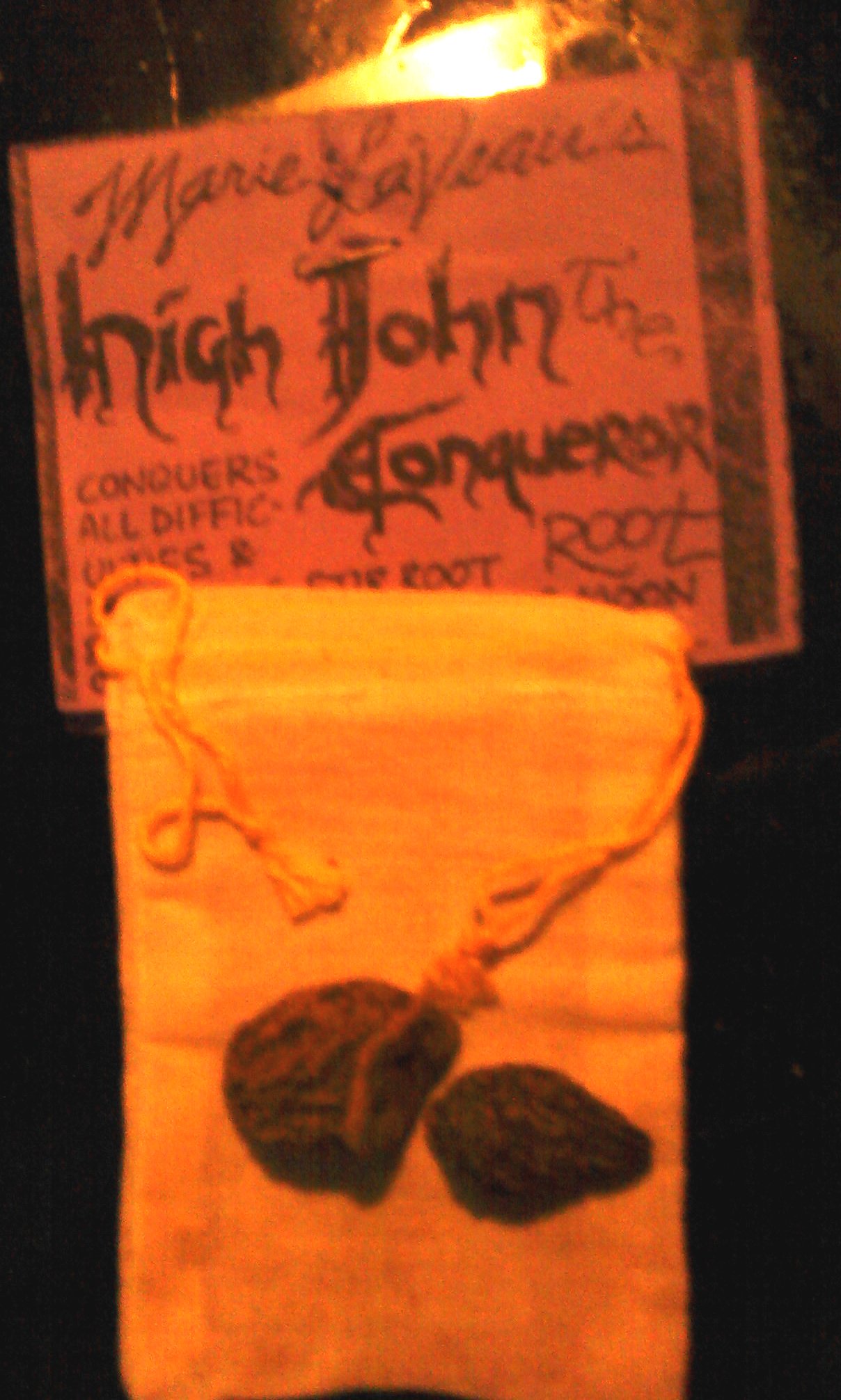
This shriveled root is part of the Ipomoea genus, and is a relative of the Morning Glory.  Its resemblance to a shrunken testicle has made it a powerful symbol of potency and virility.   I consider it to be one of the quintessential hoodoo herbs (which is the reason I included it in my “hoodoo kit” post).  Catherine Yronwode says of the root in her Hoodoo Herb and Root Magic book, “ A person possessing a John the Conqueror Root will never be long without money or a lover and will be extremely lucky in games of chance and business” (HHRM p. 111).

Some of the most common ways to use this root are to put it into a jar of neutral oil (such as safflower or olive) and let it sit for a few weeks, occasionally shaking the jar.  The resulting oil (which will have little to no smell and to which you should add some vitamin E or tincture of benzoin to prevent rancidity) can be used to anoint anything that needs more power.  Rubbed on your hands and feet, it adds personal power to everything you do.  Rubbed on money kept in your wallet, it helps you be more successful in luck and business endeavors.  Rubbed (very lightly) on the penis, it restores male virility and enhances sexual prowess.

Another key way to use this root is to keep a whole root in your pocket, either by itself or wrapped in a red cloth bag as a mojo hand.  Fed regularly (once a week at least) with whiskey or the High John Oil I just described, it keeps you empowered and potent at all times.  According to the lore, money comes easier, luck favors you, love finds you, and sex is better than ever.

You can also add John the Conqueror (by the way, you say it “John the Con-ker”) chips or oil to other mojo hands to increase their potency as well.  I like to add them to success and business workings, because they tend to work faster and require less finagling on my part after my initial efforts.

The High John root has appeared in pop culture several times, too.  Whenever hoodoo comes up in songs, a mention of this root is seldom far behind.  For example, in the Allman Brothers Band remake of Willie Dixon’s “Hoochie Coochie Man,” radio audiences of the 70’s heard the lyrics:

“Got a John the Conquerer root and got some mojo too,
We got a black cat bone, we’re gonna slip it to you.”

Considering the libertine behavior the singer boasts of elsewhere in the song, having a little magic keeping his virility charged certainly seems like a good idea (I’ll address the black cat bone reference in another post).  Muddy Waters (who worked with Willie Dixon quite a lot) also recorded a blues song featuring the hoodoo charm, entitled (appropriately) “My John the Conqueror Root.”

There are lots of places to find this root on the web, and if you have a local botanica of some kind, they will also likely carry this curio.  I highly recommend anyone looking into American magic familiarize him/herself with High John.  Who couldn’t use a magical boost from such a potent little root?

Thanks for reading!

-Cory

Podcast 6 – Hoodoo and an Interview with Conjure-man Papa Toad Bone

-SHOWNOTES FOR EPISODE 6-

Summary
In this episode, we discuss hoodoo and rootwork, particularly our experiences with it.  Then we have an interview with esteemed conjurer Papa Toad Bone.

Play:

Download:  New World Witchery – Episode 6

-Sources-

Websites
Lucky Mojo Co. – A site with lots of hoodoo information
Toad’s Bone Apotheca – Our guest’s marvelously funky and fantastic online curio shop
Mississippi Cunning + Conjure – A forum space for those interested in Southern magic and Traditional sorcery
Scarespite – A repository of Traditional Witchcraft and Sorcerous folklore

Promos & Music

Title music:  “Homebound,” by Jag, from Cypress Grove Blues.  From Magnatune.
Promo 1-Inciting a Riot Podcast
Promo 2- Druidcast
Promo 3- Podcast Appalachia

Blog Post 33 – A Hoodoo Starter Kit (Intro, Part V)

For my final post this week, I’m putting up my idea of what a beginning rootworker might want to have on hand.  Think of it as a sort of “first aid kit” for getting your hands dirty in hoodoo.  This is only my opinion, by the way, so your mileage may vary according to different conjure practices.  If you have any questions, please feel free to email me or to add a comment to this blog page and I’ll do my best to answer them.  Now, onto the kit!

Candles – I keep lots of these on hand, in several different sizes.  They’re good for doing most types of simple jobs where all that’s required is a quick dressing and a little time to burn them.  You can use color correspondences, if you like, but I find plain white (or beeswax candles with a  golden tint to them) work just fine for me.

Candlesticks/Holders (at least two) – I say at least two because you never know when you’ll need to burn for two things at the same time (say a separation working and then a protection one to help a woman in a bad relationship get out safely and stay safe).  There are some candle burnings, too, where progressively moving the candles closer together or further apart is part of the job being done.

High John root(s) and/or oil – This is the quintessential hoodoo root.  It’s small, brown, and not very impressive to look at, but man it packs a punch.  Anything that needs extra potency can benefit from High John.  There are plenty of folks who simply carry one in their pocket, feeding it regularly with whiskey or oil, to help them always be performing at their best, whatever they do.

Small assortment of condition oils – If I’m being really 100% honest, you don’t need these the way you might need other things on this list.  And you can certainly make your own versions of them rather than buying them from a store.  I like to have some of the basics on hand (especially Van Van and Fiery Wall) because it’s easy to dress a candle with them and do a quick burning, or to dress a mojo bag with them quickly.

Uncrossing – This one’s great for removing hexes and jinxes.
Attraction – Can draw love, money, luck, and other positive things into your life.
Van Van – This oil is a general use oil, good at removing obstacles, increasing luck, finding love, and many other things.
Compelling/Commanding – If you intend to do this kind of work, these are good to have. Compelling makes your target do what they say they will do, and Commanding makes them do what you want.
Blessing – This one is important for cleansing and blessing homes, marriages, children, etc.
Fiery Wall of Protection – A vital oil if you want really good protection for a person or place.

Whiskey (or other alcohol) – When you feed your mojos or other work, the typical offering is whiskey.  It’s also a good offering for working with ancestors and spirits (though some Native American spirits do NOT like it, apparently).  Some who do not use alcohol in their magic will use oils or holy water instead.

Salt – Good for setting protective barriers, for use in spiritual baths (especially to remove harmful influences), and adding to certain jobs where you are trying to neutralize someone else’s work.

Pepper (black and red) – Both are used to make things “hot” for a target, and also in the Hot Foot jobs a rootworker may be called upon to do.  They can be used in other work, as well, particularly if you’re trying to make things “fiery” for any reason (protection, sex, etc.).

Four Theives Vinegar – This is a centuries-old formula and there’s no need to buy it.  Just take good quality cider vinegar (or wine vinegar if you prefer) and add black and red pepper, garlic, and mustard seeds, then let it sit in a dark place, shaking it daily.  After about two weeks, voila!, Four Thieves Vinegar.  There are variations on the recipe (I use rue in mine), so find one that works for you.  It’s good for protection and hexing jobs, and it tastes delicious on a salad!

Honey/Molasses/Sugar/etc. – This is for any kind of sweetening work you do.  You can also add it to certain spiritual baths to help make things sweeter for you in general.  Choose a sweetener that is regionally appropriate—molasses is good in the South, while in Vermont maple syrup would be good.

Red cloth squares – For making mojo hands.  This doesn’t have to be anything fancy.  Flannel and linen are fairly traditional, but whatever is available in your local fabric store’s remnant bin will probably be just fine.  Or cut up an old red t-shirt.  In a pinch, white cloth can be used for most jobs, too.

Bottles/jars – Keep these on hand for doing Honey Jars or Vinegar Jars, as well as making protective bottle spells (like Witch Bottles) or even just as a back-up candle holder.  I save old baby food jars for this kind of work.  If you have a Sharpie, you can even draw or write on the glass, if you feel so inclined.

Envelopes/plastic baggies/etc. – For collecting ingredients or gathering spent spell materials for proper deployment (at a crossroads, in running water, etc.).  I will also confess I usually keep little paper envelopes on hand so that if I’m visiting someone that will be a target for a job and I use their bathroom…well, let’s just say most people leave things like hairbrushes pretty much out in the open…

Bible or other holy book – I’m not saying you have to thump it, sell it, buy it, preach it, or even believe in all of it, but the precedent for using Scripture in hoodoo is long-standing.  I’m not Christian but I use the Psalms in my work fairly often.  If you have a vehement dislike of Christian religion, and the Bible in particular, find another holy book that does work for you, such as the Koran, the Bhagavad Gita, or the poems of Rumi.  My only admonition here is that if the book isn’t spiritual in nature, I would avoid using it in rootwork.  There seems to be something very profoundly sacred about the relationship between a holy book and a magic spell, something that the spirits on the other side respond to.  That’s just my opinion, of course, so if you don’t believe me, I can live with that.

So that’s it for this week’s Introduction to Hoodoo!  I hope you’ve been enjoying this series.  We’ll be doing plenty more with rootwork in the future, including having a guest on our next podcast  who is a professional rootworker!   That episode should be out next week, and hopefully we’ll have a couple of other neat treats for you then, too.
Thanks for reading!

-Cory

Blog Post 32 – Hoodoo You Do (Intro, Part IV)

This blog post will primarily deal with types of hoodoo spells, or “tricks.”  It’s not a complete list of all types of hoodoo magic by any stretch of the imagination, but for someone just getting into it, this should give you an idea of what a conjure man/woman does, and give you some places to start if you want to do hoodoo for you.

Mojo Bags – Probably the best known of the hoodoo magical charms, mojos go by many names:  hands, tobys, jomos, etc.  These small talismans are little bags designed to be worn out of sight and usually close to the skin.  A particular type of mojo worn only by women is the “nation sack” of Memphis, TN.  The way these charms are made may vary a bit from place to place or worker to worker, but the general idea is that a small flannel sack, usually red but sometimes other colors, is filled with magical ingredients—usually an odd number of them.  It’s then closed up, and often anointed or “fed” with some offering on a regular basis (whiskey, rum, or other alcohol is a common food for a mojo hand; some of the condition oils found in hoodoo are also appropriate).  I recently heard these bags described as little spirit houses, and to my mind, that’s a perfect description.  The herbs, oils, curios, and other elements of hoodoo are matched together to make a little home for a spirit who can aid the worker in getting what he or she wants.  I often include a written charm in mine (being inclined towards the written word as I am), and usually I make my mojos as part of a larger working, such as a Candle Burning.

Candle Burnings – Also commonly called “setting lights,” candle burnings in hoodoo are similar to candle burnings in any other magical system.  The only real difference is the method (or methods) of dressing the candles.  In hoodoo, when a worker is dressing a candle to draw something (like money, love, health, etc.), he or she will cover the candle in herbs and oils from the bottom-up.  To rid oneself of something (like a jinx), candles are dressed top-down.  Personal concerns, such as a target’s hair or fingernails, are usually incorporated in the dressing, or may be placed beneath an inverted saucer upon which the candle is burned.  Name-papers with written charms may also be used in this manner.  Henri Gamache’s Master Book of Candle Burning is an excellent resource for this type of magic.

Readings – Most rootworkers begin with a reading of some kind.  Whether its tarot cards, palm reading, or just a sort of psychic once-over with second sight, the conjure person will need to get a good idea of what the client needs—not just what he or she wants.  Often, readings are done as part of a larger interview process to really hone in on what kind of work the rootworker will need to do.  I like to use playing cards to read before doing most magical workings, even ones for myself.

Honey Jars – We covered them a bit in our Special Episode recently, but I love these things, so I’ll mention them again here.  Basically, a honey jar is exactly what it sounds like:  a jar full of honey.  Into this sweet-and-sticky pot you place the names (and personal concerns in some cases) of those you wish to “sweeten up.”  These jars are also known as “sweetening jars,” and can actually contain almost any kind of pure sweetener, such as brown or white sugar, molasses, or syrup.  This is a good way to start doing hoodoo, because it is a very positive type of magic (you’re only making your relationships with those you sweeten better, after all) and it also teaches you to get your hands a little dirty (because you must push the names into the jar with your fingers, and then lick them clean…a nice reward for your efforts!).  You can make jars for each person you want to sweeten if you’re working more elaborate spells on them, or keep one jar with lots of names in it for general sweetening.  You can also make vinegar or “souring” jars, which is a form of Hexing.  I’d generally wait to do a souring jar until after you’ve tried a few sweetening ones, though.

Foot-track Magic – This type of magic stems from African Traditional practices, in which the footprint of a person could be used magically against them (or to help them, but usually harmful magic is associated with foot tracks).  The basic idea behind this kind of spell is that the feet come in contact with a magical potion, powder, or other ingredient and draw the psychic contagion up into the body.  One of the most famous examples of foot-track magic is the use of goofer dust on someone.  The hexing dust is sprinkled somewhere where the target will walk over it, and the poisonous influence of the powder will cause the target’s body to swell and fill with pain, and possibly even die.  Of course, it’s possible to do helpful spells with foot-track work, like laying a prosperity blend in someone’s path to ensure they have good luck, but this is a less common use of this magic.

Washing/Bathing – While I love the fact that hoodoo gets down and dirty, I also really like the emphasis it puts on cleanliness.  There are lots of formulae designed exclusively for things like washing one’s floors to banish harmful things and/or draw beneficial ones.  For example, you can wash your business doorstep or the sidewalk in front of your shop with a money drawing blend (such as bayberry, cinnamon, and rose-of-jericho water) from the outside-in to draw customers to you.  Bathing is also important in hoodoo, particularly ritual bathing performed over a series of 3, 5, 7, or 9 days.  Much like in Candle Burning, if you take a hoodoo bath, you’ll want to stand in the tub and wash up to draw something (like money) and down to get rid of something (like a bad habit).  Prayers, psalms, and other magical phrases may be recited while bathing, and usually at least some of the bath water is saved and later disposed of ritually (by pouring at a crossroads, for example).   I highly recommend Draja Mickaharic’s Spiritual Cleansing if you want to learn more on this subject.

Cleansings/Uncrossing Work – Related to Washing/Bathing is the concept of a Cleansing or an Uncrossing.  These workings are usually done to remove the effects of harmful witchcraft or hexing, and can be done by a rootworker or by a client under a worker’s direction.  Some common methods of uncrossing involve the aforementioned ritual bathing while using downward motion and uncrossing herbs (like rue, hyssop, and salt), marking the client with the “five-spot” or quincunx pattern using an uncrossing oil, or even running a raw egg around the client’s body to absorb negative spiritual energies (this is similar to cleansings found in other systems, like curanderismo).  A rootworker may also smoke or fumigate a client, using a sheet to tent the seated client from the shoulders down and burning incense beneath the chair to fill the tent with sacred smoke.  There are related areas of hoodoo spellwork which are more protective than cleansing which involve putting down salt, chalk, or brick dust lines around a person’s home to prevent harm from reaching them, but these are usually done after a cleansing has been performed on both the client and his/her house.

Jinxing/Hexing – So I know it seems backwards to discuss this after Cleansing/Uncrossing, but I generally feel like it’s better to know how to stop a harmful spell before you get started, so that’s why I mentioned the other first.  However, Jinxing/Hexing is a big part of hoodoo.  From the harmful forms of Foot-track Magic mentioned earlier to more fearsome curses (such as the disgusting but terrifying “Live Things in You” curse, in which a target is tricked into swallowing powdered snake skin, spider eggs, or other unsavory items so that they begin to feel like things are literally crawling around inside them).  Learning to hex someone with hoodoo isn’t hard, though it often requires a strong stomach.  One simple and quite grave curse is to make a doll-baby (stuffed poppet) with the person’s name paper or personal concerns inside of it, then put that into a small coffin and bury it in a graveyard.  The victim should feel their own life-force fading as long as the buried doll remains in the cemetery (a word of warning, though—in most places digging so much as a single spoonful of dirt is considered vandalism and is quite illegal, therefore I do not advocate it).  A simpler and much tamer curse is the vinegar jar I mentioned in our Witch Bottle Special.  By simply placing someone’s name into a jar of vinegar, along with things like red pepper flakes, black pepper, and garlic, you can sour their life pretty effectively.  Shaking the jar every time you think about it can help “stir up” more trouble for them.  Cursing someone for fun, by the way, is always a bad idea.  You never know when it might backfire and wind up dragging you right into trouble, so make sure you’re working “justified,” perhaps by doing a Reading first.

Love Spells – The simplest of these is a type of Honey Jar in which two people’s names are kept and a candle burned over the top of it.  This sweetens them to each other and helps set magic in motion to keep them sweet on one another.  Love spells in hoodoo, though, are not always so nice.  There are plenty of spells aimed at separating lovers (candles are even sold which look like married couples and which, when burned, come apart and lead to divorce or estrangement).  There are also more intense love spells aimed less at finding that one true love than at exercising power over the target (see Controlling Spells for more on that).  Many love spells, though, are more like the sweetening spells, and simply help a person find or catch that perfect mate.  There are some extremely simple love spells in hoodoo which involve little more than tying two dirty socks—one from each mate—together and hiding them away so that love will remain forever “bound” between them.  Of course, for those coming from a background where this sort of manipulation is a magical no-no, even a fairly benign hoodoo love spell can seem a little sinister.  But then, no one says you have to do every spell in the hoodoo spellbook, right?

Controlling/”Bend Over” Spells – I saved these spells for last because I find them incredibly interesting.  They are so antithetical to the kind of magic I did for years, because they completely ignore the idea of non-manipulation.  These spells are all about manipulation, in fact.  Controlling spells (and their sister workings, “Compelling” and “Bend Over” spells) usually involve forcing another person to do what you want them to do.  Sometimes, as in the case of Compelling or Pay Me Now! spells, the force is simply making the target fulfill a promise they’ve already made.  But often these tricks are laid in order to keep an errant spouse from philandering about, or to make a boss give you that raise you’ve been after.  Using roots like licorice and calamus, as well as personal effects from the target (name papers are much less effective in this kind of work, in my experience), a rootworker can do a heckuva number on someone.  One of the most famous methods of using this kind of magic involves a woman putting a bit of her menstrual blood in her husband or lover’s food, thereby making him remain faithful to her.  She can also “tie his nature” by measuring his penis with a string, then soaking it in his semen and tying knots in it.  That way, he will find himself useless unless she releases him, which presumably will only happen when he’s with her.  It’s intense stuff!  But it also makes sense.  For many folks, these workings are last-resort measures.  In some cases—such as using Courtcase formulae or spitting galangal root juice on a courthouse floor—they are the only methods available to poor folks being ground down by the gears of the legal system.  Who wouldn’t want magical reassurance that the judge was on their side?  While I don’t recommend starting with these kinds of spells, I will say I’ve gotten to really like them over time.  They’ve proven useful, and a good rootworker knows how to set limits when using Controlling magic.

Like I said, this isn’t an exhaustive list of all hoodoo techniques and spells, but it should at least give you an idea what kinds of magic are available in the rootworking system.  As always, I recommend checking out the Lucky Mojo site for more info on many of these methods, and if you have any comments or questions, you can email us or leave a comment and I’ll be happy to respond!

Thanks for reading!

-Cory