Podcast 16– An Interview with Judika Illes and Listener Feedback

-SHOWNOTES FOR EPISODE 16-

Summary
Today we answer some listener questions and present some feedback.  Then we have an interview with magical author Judika Illes.

Play:

Download:  New World Witchery – Episode 16

-Sources-

Books by Judika Illes:
The Encyclopedia of Spirits
The Encyclopedia of 5000 Spells
Magic When You Need It
Pure Magic
The Weiser Field Guide to Witches

Author Website:  http://www.judikailles.com/

Promos & Music
Title music:  “Homebound,” by Jag, from Cypress Grove Blues.  From Magnatune.
Promo 1 – Iron Powaqa
Promo 2 – Witches Brewhaha

Blog Post 80 – Horseshoes

Following in the vein of recent posts, today I’m looking at another luck charm:  the horseshoe.  One thing Laine and I discussed in Podcast 13 was that the horseshoe seems to be a rather ubiquitous talisman.  It is so ubiquitous, in fact, that many folks may not even realize it has any magical connotation at all.  In an article from Western Folklore entitled “Lucky Horseshoes,” Jeannine E. Talley writes:

The horseshoe as a bestower of luck is so frequently encountered that it has become a cliche, but at the same time an isolated belief without a context. Barnet’s comment that the mule has been “pounding it full of luck” provides not only the ‘logic’ explaining why the horseshoe is full of luck but also reveals that luck is ac-cumulative. His insistence that the old nails must be used to hang the shoe is not found in standard collections for folk belief, but is akin to the notion that if the hardware is hung with prongs down, the luck will “run out.” This instance is a prime example that collecting the item is not enough; the contextual background of any item is of equal importance since it often contains the rationale which makes the belief credible. (p. 129)

I like this particular examination of the horseshoe because it details two points:  1) the horseshoe’s luck comes from its association with the horse itself and 2) as Talley states, the luck is accumulative, so the longer a shoe has been on a horse, the luckier it is.

Of course, there are plenty of other theories about why a horseshoe might be lucky.  Robert M. Lawrence, in his article,  “The Folk-Lore of the Horseshoe” describes the horseshoe as a talismanic emblem with many possible folkloric connections, including:

  • The Jewish Passover – like blood spread on doorposts/lintels and rowan trees in Scotland
  • Serpent emblem – “In front of a church in Crendi, a town in the southern part of the island of Malta, there is to be seen a statue having at its feet a protective symbol in the shape of a half-moon encircled by a snake”
  • Moon emblem – “the brass crescent, an avowed charm against the evil eye, is very commonly attached to the elaborately decorated harnesses of Neapolitan draught horses, and is used in the East to embellish the trappings of elephants.”
  • Phallic Emblem of some kind
  • Prong-shamed talisman – like protective horns of animals (connected to African symbols)
  • Horse as Sacred Animal (as mentioned above)
  • Iron as “Virtuous” metal capable of dispelling harmful forces (Journal of American Folklore, v.9, n.35, 1896, p. 288-292)

I hope to get into some of these symbols and ideas in other posts at another time—particularly iron, which shows up a lot in fairy doctoring practices and other magical systems—so for now I think it suffices to say that horseshoes have a lot of lore to build upon and are quite lucky, though no one seems to know exactly why they are so.

So how does one use horseshoes?  First of all, the shoe needs to be one which actually has been on a horse at some point (remember all that pounding of luck into it in Jeannine Talley’s article?).  Likewise, there are some who say that hanging a horseshoe involves using a spent horseshoe nail, too.  That seems to be a slightly less stringent requirement, but if you happen to have a spare horseshoe nail with your horseshoe, why not use it?

The issue of which way the “horns” of the shoe are pointing seems to be hotly contested by those who concern themselves with such things.  Both opinions seem to have some sound reasoning behind them, which I mentioned in the most recent podcast.  The general idea boils down to whether you think the horns up are “holding in the luck” or whether the horns down are “pouring the luck out on you.”  Either way, I think this is where instinct kicks in.  If you feel like you’ve hung it the “wrong way,” you probably have and  you should switch it.  But if you feel like your luck’s in good condition and your horseshoe’s “right,” then leave it be.

As to how specifically a horseshoe might be used, Harry M. Hyatt has a few examples of horseshoes in hoodoo work:

1) From Vol.2,p.1547

NAIL A HORSESHOE UP
OVER YOUR FRONT DOOR.
NAIL A PENNY DOWN IN THE FRONT
DOOR TOO. SCRUB IT ALL THE TIME.*
THESE WILL BRING YOU GOOD LUCK.

Dey kin use a horseshoe. Yo’ take a horseshoe an’ yo’ kin nail it up
ovah yore front do’ an’ take a penny an’ nail it down in de front do’; an’
yo’ jes’ let dat penny stay dere all de time an’ yo’ scrub ovah dat penny
all de time, an’ jes’ leave it dere an’ dat’ll be good luck fo’ yo’.
[Savannah, GA; Madam Pauline; Informant #1274. C575:1-C586:10 = 2136-2167.]

2) From Vol.2,p.1443

A HORSESHOE OVER THE DOOR
KEEPS SPOOKS OUT AND BRINGS LUCK.
& A MULESHOE OVER THE DOOR OF A BUSINESS
BRINGS BUSINESS SUCCESS

Keep a horseshoe – keep it ovah de do’ to keep de spook outa dere an’
fo’ luck, specially a man who does business. He’d have a new [mule] shoe ovah
de do’ – like he do’s a business roun’ in a shop or a restaurant or somepin
lak dat, because a mule is a hard-workin’ thing, hard-workin’. All right.
An’ jes’ lak ah’d have de mule when he hitch out an’ go to his stall to
eat, people be coming to his place and say….
[Sumter, SC; Informant #1387; Cylinders C885:1-C902:4 = 2366-2383]

(Both of these can be found in Hyatt’s book or in the excellent Yahoo! Group  “HyattSpells”)

I like the first example because it combines the lucky penny with the lucky horseshoe, and places luck at your head and your feet, so every time you enter a door,  you get caught between the two and get a double dose of luck.  I also like the rationale for using a mule shoe to boost business (because the mule is so hard-working).

Finally, Vance Randolph describes the Ozark methods of horseshoe deployment in Ozark Magic & Folklore:

  • Most hillfolk of my acquaintance use a horseshoe instead of the stone (to protect chickens from hawks), and some think that a muleshoe is even better. It is frequently fastened in the firebox of the stove rather than in the oven. In the old days the muleshoe was hung up in the fireplace, or even set into the mortar at the back of the chimney (p. 43)
  • Many hillfolk think that the man who finds a horseshoe with the closed end toward him will do well to “leave it lay.” If the open end is toward the finder, he sometimes spits on it and throws it over his left shoulder, a procedure which is supposed to bring good fortune. Or he may place it in a tree or on a fence,saying: “Hang thar, all my bad luck!” In this case, whoever touches the hanging horseshoe falls heir to the misfortune of the man who placed it there (p. 62)
  • Probably the commonest way to keep witches out of the house is to nail a horseshoe over the door; this is regarded as a sort of general prophylactic against witches, bad luck, contagious disease, and other evil influences (p. 283)

So that’s the lucky horseshoe.  Another long article, so I apologize for that, but hopefully you aren’t too bored.  Skimming is probably a good skill to apply when reading these blogs.  At any rate, if you have any questions or comments about horseshoes, please feel free to post them!

As always, thanks for reading!

-Cory

Podcast 13 – Lucky 13

-SHOWNOTES FOR EPISODE 13-

Summary
On this, our Lucky 13th episode, released on Friday the 13th, we’re looking at luck charms and where they come from.  We’ve also got a money bowl spell in WitchCraft, and Van Van oil in Spelled Out.

Play:

Download:  New World Witchery – Episode 13

-Sources-
We reference lots of sources, including:
-Cat Yronwode’s Lucky W Amulet Archive
-The Uncle Remus stories by Joel Chandler Harris
-Harry M. Hyatt’s Hoodoo – Conjuration – Witchcraft – Rootwork
-The article “Charles Chestnutt & the Doctrine of Conjuration”) by Bettye Jo Crissler Carr
-Judika Illes’s book Encyclopedia of 5000 Spells
Ozark Magic & Folklore by Vance Randolph
-The Chan Chu money frog of Chinese lore
-Richard Dorson’s Buying the Wind

Promos & Music
Title music:  “Homebound,” by Jag, from Cypress Grove Blues.  From Magnatune.
Promo 1- Witchery of One
Promo 2- Media Astra ac Terra
Promo 3- Borealis Meditation
Promo 4 – Iron Powaqa

Blog Post 79 – Lucky Rabbit’s Foot

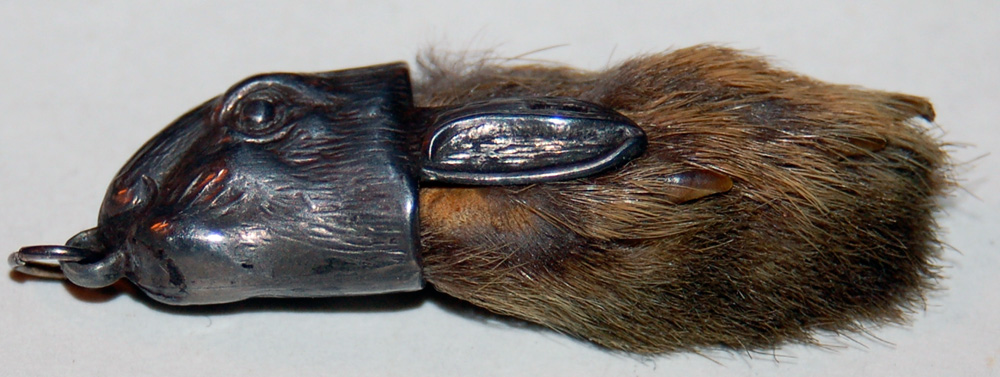
For today’s post, I’m looking at the folklore and magic surrounding one of the most ubiquitous pieces of conjure paraphernalia, the rabbit’s foot.  There are plenty of theories about this particular luck charm, but not much that can be definitely put down regarding its origin or provenance.  Rabbit foot charms have been around since at least the mid-to-late 19th century in North America, and likely predate the Civil War.  They are used for general luck, gambling aids, love enhancers, and other areas where a bit of extra luck might help.

A quick word of warning, however.  Many of the sources I’ll be citing in this post also date from earlier eras, and thus have a great deal of offensive material in them.  There are words that appear here which would likely incite violence if used lightly today, so please understand that I present them here as a piece of the folklore to which they belong.  Just as a smart modern magician finds a reasonable substitution for liquid quicksilver/mercury (and thus avoids madness and poisoning), a wise student of folklore and folk magic remembers that just because a sentiment appears in print doesn’t make it right or appropriate.

There, now let’s move on to some of the good stuff about rabbits’ feet.

Catherine Yronwode provides information on the rabbit’s foot on her Lucky W Amulet Archive, describing  the foot as catalogue offerings from the early-to-mid twentieth century:

As for the foot itself, a circa-1940 mail order catalogue from the Standard O and B Supply Company, a Chicago-based distributor of African-American hoodoo material, offered undyed rabbit foot charms “made with a metal band and a link to attach on chain.” The Johnson-Smith Novelty Company offered identical charms in its 1941 catalogue. The advertisement shown here goes these one better and promises a free vial of Van Van oil with each rabbit’s foot; the formula is a Louisiana hoodoo favourite that “clears away that evil mess” and increases the strength of any good luck charm to which it is applied. Since none of the older catalogues or ads mention any colour when describing rabbit’s foot charms, it can be assumed that the items were undyed and came only in natural tan or white.

She goes on to talk about her uncertainty regarding why a rabbit’s foot might be so lucky:

Why is the rabbit foot lucky? I am not sure. Rabbits are swift and they reproduce prolifically, but the luck of the rabbit foot is monetary and sexual; as far as i know, it is not related to swiftness or fertility. There is considerable evidence that the lucky rabbit foot is a remnant of an African clan totem, an importation related somehow to Br’er Rabbit, the famous protagonist of an African trickster-god myth-cycle.

Yronwode points out that the rabbit’s foot appears in the famous Uncle Remus stories, written by Joel Chandler Harris in 1881.  In a tale entitled “Brother Rabbit and his Famous Foot,” Uncle Remus describes the tricky Br’er (or Brother) Rabbit’s prosperity-drawing mojo bag (which he refers to as a money purse, or dialectically a “money-pus”):

Brer Wolf look at de money-pus, en see w’at in it. Hit ‘uz one er deze yer kinder money-pus wid tossle on de een’ en shiny rings in de middle. Brer Wolf look in afar fer ter see w’at he kin see. In one een’ dey wuz a piece er calamus-root en some collard-seeds, en in de tier een’ dey wuz a great big rabbit foot (Harris p. 223)

So even a rabbit carries a rabbit’s foot for luck and money.  How’s that for strange?  But why is it so lucky?  In a 1973 thesis on conjuration in the works of African-American author (and somewhat accidental folklorist) Charles Chestnutt, Bettye Jo Crisler Carr uncovers some possible reasons behind this talisman:

One might have expected Chesnutt to refer to ghosts who haunt graves, to witches ‘riding’ their hapless victims by night, to conjurers tying bits of roots in tiny bags to ward off evil. But surely his reference to the efficacy of ‘de lef hin’ foot er a graveya’d rabbit, killt by a cross-eyed nigger on a da’k night in de full er de moon’—surely that is something Chesnutt (or Uncle Julius, who seems equally real) has made out of whole cloth.

An examination of folklore sources, however, justifies Chesnutt’s requirements for the rabbit-foot good-luck charm. An informant from Atlanta states that the talisman must, indeed, be the ‘left hind foot of a graveyard rabbit.  Mary Owen, recording her collected tales prior to 1893, adds to the requirement that it must be ‘de lef hine-foot ob er grabe-yahd rabbit kilt in de dahk o’ de moon.’ A Memphis informant states further that the graveyard rabbit must have been killed by a cross-eyed person. Louise Pendleton, also writing before the publication of Chesnutt’s stories, comments that the use of the rabbit foot for good luck ‘may be traced to the fetishism, or worship of guardian spirits dwelling in inanimate objects, of their African ancestors.’ (Carr,  “Charles Chestnutt & the Doctrine of Conjuration”)

So now we can see the process of making the charm has something to do with its luck associations.  If a cross-eyed person could catch a rabbit in a graveyard in the dark, he would indeed have to be very lucky, and thus his luck might transfer to the animal’s foot (this is a bit of a stretch for a reason, in my opinion, but there certainly seems to be a specific tradition involved in collecting this talisman).  Much of this lore is corroborated by Harry M. Hyatt in his five-volume compendium on African-American folk magic, Hoodoo – Conjuration – Witchcraft – Rootwork.   Two prime examples are included here:

Vol.2,p.1541

A RABBIT’S LEFT HIND LEG, TAKEN WHILE THE ANIMAL IS STILL WARM
AND SEWN INTO A BAG, SHOULD BE CARRIED WITH YOU AT ALL TIMES,
AND KEPT UNDER YOUR PILLOW AT NIGHT FOR LUCK.

If yo’ wanta go git a job agin, yo’ could use a rabit’s foot – yo’ use a rabbit’s left foot. Ketch a rabbit, if yo’ kin kill him; if yo’ can’t ketch it, kill it. Well, befo’ he gits cold, take de left laig of dis rabbit off. (Front or back?) De back laig. Take de back laig off while it’s warm an’ yo’ sew it up in some cloth an’ when yo’ go tuh bed at night, yo’ jes’ carry it an’ push it in yore pillah. If yo’ git up tuh go in de daytime, wear it in yore pocket or either yo’ could have it in yore stockin’. Put it in yore hat or shoe or anything an’ jes’ keep it wit chew all de time. Yo’ll have good luck wit de rabbit’s left hind laig. (When you are going out to get a job?) Yes sir.

[Savannah, GA; Madam Pauline; Informant #1274. C575:1-C586:10 = 2136-2167.]

Vol.2,pp.1486-7

A CHARM TO CARRY

BURY THE RIGHT FRONT FOOT OF A RABBIT IN THE CEMETERY.
AFTER NINE DAYS AND NINE NIGHTS, DISINTER IT.
WEAR IT ON A CHAIN OR FASHION IT INTO SOMETHING SIMILAR TO WEAR
AND CARRY IT WITH YOU.

You take off his right feet, yo’ bury it in de cemetery – let it stay dere fo’ nine days an’ nights. Yo’ go an’ git it out from under dere an’ make yo’ a chain an’ put it on yo’ fo’ a locket or either, yo’ know, yo’ kin jes’ have it made into somethin’ den – yo’ know, somethin’-like. Dat’s de rabbit foot. [She laughs.] Den y’ jis’
tote it wit yo’ or either place it fo’ a watch charm or anythin’ like dat – right feet, jes’ one, de front.

[Waycross, GA; Informant # 1125 (Contact man Edwards’s landlady); Cylinder C235:4-C250: 1 = 1816-1831, and C384:1-C392: 5 = 1965-1973]

One of the common threads to the rabbit’s foot seems to be an intimacy with death or the dead.  The rabbit must be freshly killed (or “warm”) or found in a cemetery.  This may have something to do with its luck.  The dead are able to provide luck to the living in some folkloric accounts, and a magical animal like a rabbit which becomes tied to the dead may well be “running” luck back and forth from them to you.  If you are interested in more spells like the two immediately above, by the way, you can find many of Hyatt’s spells transcribed in the Hyatt Spells Yahoo! Group.  If you manage to find actual text volumes of his work and you have an interest in folk magic, buy them.  They will be worth it.

Finally, Ozark folklorist Vance Randolph records a couple of uses of the rabbit’s foot charm in his Ozark Magic & Folklore:

  • Some healers claim to cure hiccoughs by rubbing a rabbit’s foot on the back of the patient’s neck unexpectedly.
  • I recall a girl near Lanagan, Missouri, who wore a peach stone love-charm on one garter and a rabbit’s foot fastened to the other.

This particular lucky charm can be found throughout North America, often sold in roadside stores, children’s candy-and-prize machines, and even gas stations.   It’s commonly rubbed to actually activate the luck, and “fed” with an oil like Fast Luck or Van Van on a regular basis.  If you happen to have one of these in keychain or charm form, I’d love to hear your experiences with it.  Have rabbit’s feet ever brought you extra luck?  Or, as the joke is often made, is it just “unlucky for the rabbit”?

Thanks for reading (and reading and reading)!

-Cory

Blog Post 73 – Book Review

I know, I know, two book reviews in a row may seem excessive, but I spent a lot of time reading over the past few weeks, so bear with me.  Plus, you may find some new books to investigate!

Today’s book is Blue Roots by Roger Pinckney.  It’s about rootwork, hoodoo, and conjure, but not the broad, general kind so often discussed in other books and on blogs and webpages (including this one).  Instead, Pinckney focuses on the healing and magical traditions of one particular group:  the Gullahs.  Primarily associated with the Savannah, Georgia area, the Gullah people inhabit a large swathe of the lower Atlantic seaboard, especially the islands just off the coast of George and South Carolina.   They are often referenced as an “untouched” enclave of African-American culture, and portrayed as a sort of quaint and folksy pocket of rural Americana.

Pinckney does little to disabuse the reader of those notions, creating a fairly warm, nostalgic book about folk healing practices (and a little bit of magic, too) found on the Southern Atlantic coast.  The author also spends a good bit of time examining the spiritual practices of the Gullah, with an emphasis on spirits, the dead, ancestors, and African Diaspora remnants.  From a section on the “haint blue” paint commonly found around doors, windows, and porches in the Southeast:

“Prior to the [American] Revolution when coastal plantations produced indigo dye for English cloth, planters gave their slaves the dregs from the boiling pots, which the slaves used to decorate window frames and porch posts, in the believe the blue color kept the plentiful spirits at bay.  When indigo cultivation declined in the 1780s, Gullah slaves continued the custom with blue paint.  It is a practice that survives to this day, perhaps no longer for a spiritual repellent, but as a tradition, nevertheless” (p. 72).

The book generally does a good job of highlighting some of the beliefs and practices associated with the Gullah, and also pays wider homage to the Southern incarnations of hoodoo and African religion.  Pinckney sometimes seems uncomfortable with rootwork as a magical practice, and prefers to refer to those who use herbs, roots, and animal parts as “root doctors” rather than “conjurers.”  His attitude in general is that of a journalist who does not believe most of what he’s told, but who really wants to.  He explains a lot of rootwork’s more magical components as methods of psychological intimidation.  In his chapter “The Power of the Root,” he describes an hypothetical visit to a root doctor in detail, then concludes with this sentiment:

“And will the root actually help him?  Probably so.  If rootwork were not effective, the practice would have died out centuries ago.  Most likely, one of the man’s [the client] confidants will mention the conjuration to another, and the news will go whispering through the community until the rejected woman [the target] hears that she has been rooted.  And since she knows in her heart that all her subversion was wrong in the first place, she will immediately desist her sundry annoyances” (p. 62).

This perspective is not one I particularly endorse, as I truly think rootwork has power in and of itself, and that the spiritual and magical components are far greater than the psychological ones, but it is certainly not an invalid point of view.

Some of the best chapters in this book are about Sherriff J. E. McTeer and his battles with the infamous Dr. Buzzard.  I mentioned both of these famous conjure men in my post on Who’s Who in Hoodoo, Part II, and they both feature prominently in Jack Montgomery’s work, American Shamans.  Pinckney spends a lot of time on their lore and their recorded history, which sometimes differ quite a bit.  Actually, the lore he presents in most of his chapters is quite good, and he uses a journalist’s nose for facts to substantiate or repudiate certain points, while never discounting the broader nature of a story’s “truth.”

This is a book that I recommend to those interested in Southern rootwork, particularly its history and social relevance.  It’s not one you can learn a lot of new tricks from, but you can certainly pick up a few things as you read.  If nothing else, Pinckney has a deep love and reverence for the Gullah, the South, and rootworkers at large, so the book feels like a conversation with a good friend.  If you think hoodoo, particularly the kind found in the Carolina/Georgia islands, is your thing, check out Blue Roots.

Blog Post 72 – Book Review

Hi everyone,

I’d like to recommend a book today which falls firmly into the “fiction” category, but which has an amazing amount of conjure-related material in it.  It’s called Mojo: Conjure Stories, and is edited by Nalo Hopkinson.  I say “edited by” because this is a collection of short stories, and every one revolves around some deep South magical topic.  Some are okay, some are quite good, and many are superb.  The book features authors like science-fiction maven Barbara Hambly, African-American author devorah major, and dark fantasy genius Neil Gaiman.

Here are just a sampling of the stories in this excellent tome:

“Daddy Mention and the Monday Skull” by Andy Duncan – An aged convict contacts an alligator swamp spirit in order to get a beautiful singing voice (and consequently a chance at freedom), but winds up biting off a good deal more than he can chew.

“Heartspace” by Steven Barnes – A man goes to visit his estranged and dying father, only to walk into the middle of a conflict between his fiery half-sister and his father’s new wife—a Gullah woman with some powerful tricks up her sleeve.

“The Skinned” by Jarla Tangh – An old man who knows the secret behind the terrifying monsters lurking in his neighborhood decides he will confront the beasts, only to endanger his very soul in doing so.

“Death’s Dreadlocks,” by Tobias S. Buckell – The children of an African village caught in the crossfire of several warlords turn to Old Ma, who teaches them to see the ropy strands of Death’s hair all around them and avoid fatality.  The children decide to follow the hair back to its source and put an end to Death once and for all.

“The Horsemen and the Morning Star” by Barbara Hambly – The Old Gods from across the sea ride their “horses” (slave devotees) in order to battle a plantation owner and his sorcerous friend, who are conjuring up their own forces—Satan himself—using the slave children as sacrifices to do so.

“Cooking Creole” by A. M. Dellamonica – A man who’s tried his hand at gambling, guitar playing, and other “gifted” talents decides to go to the crossroads one last time.  He thinks he’s finally found his calling:  he wants to learn to be a Cajun cook.  But he doesn’t know just what this cooking school will cost him.

“Shining through 24/7” by devorah major – This strange tale revolves around a woman who tries to steal from a hoodoo woman.  A hoodoo woman who happens to live near a chemical storage facility.  A radioactive chemical storage facility.   A strange but delightful story.

And these are only about half of the wonderful tales collected in this book.  I picked it up out of my local library and loved it.  If you have any interest in Southern folk magic, African-American religious practices, fairy tales and fantasy, or just plain old good storytelling, I highly recommend getting this book.

Thanks for reading!

Cory

Blog Post 71 – How I Spent My Summer Vacation

Hello everyone!

We’re almost at the end of this hiatus, and I haven’t posted anything really since right before I went off to grad school for the summer.  But that doesn’t mean I haven’t been up to some witchy business in the meantime.  Today I thought I’d share a few of the things I’ve been doing over the past six weeks (well, other than performing detailed exegeses of 18th-century English poetry and seeing about 27 different versions of Shakespearean performances).

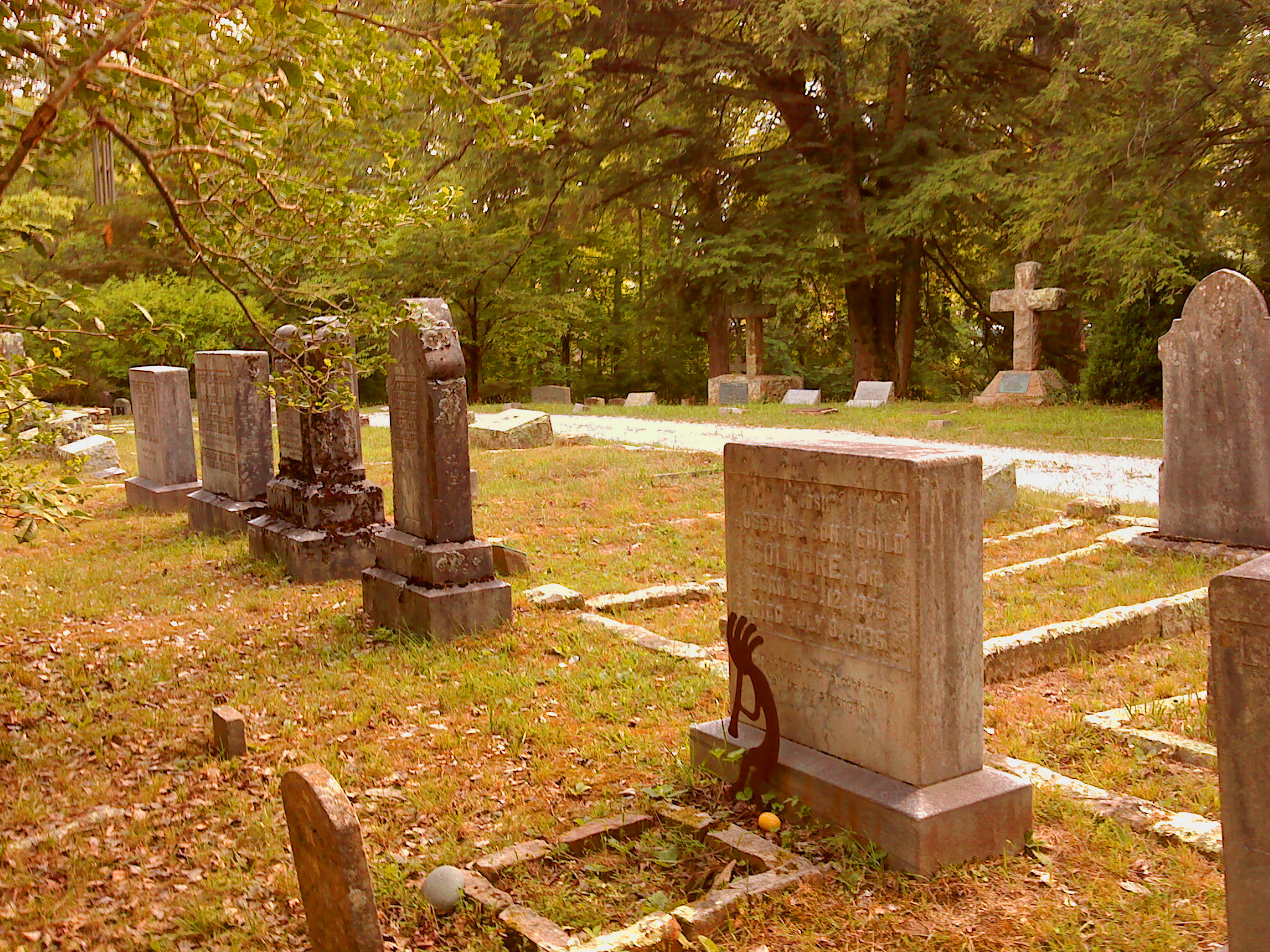
The first thing I should tell you is that I was living on campus, and this campus just happens to be a beautiful rural campus right at the edge of Appalachia.  My access to folklore primary sources was much abetted, and my opportunities to get out in the woods increased a good bit.  Secondly, my dorm was immediately across from a beautiful old cemetery.  As you can probably guess, I spent a good bit of my time there.  Here are some photos of the amazing graves and other funerary décor found in the old boneyard.The graves here date back to around the mid-nineteenth century, so they aren’t incredibly old, but many of them are gorgeous.  And they are certainly older than lots of other cemeteries in the area.

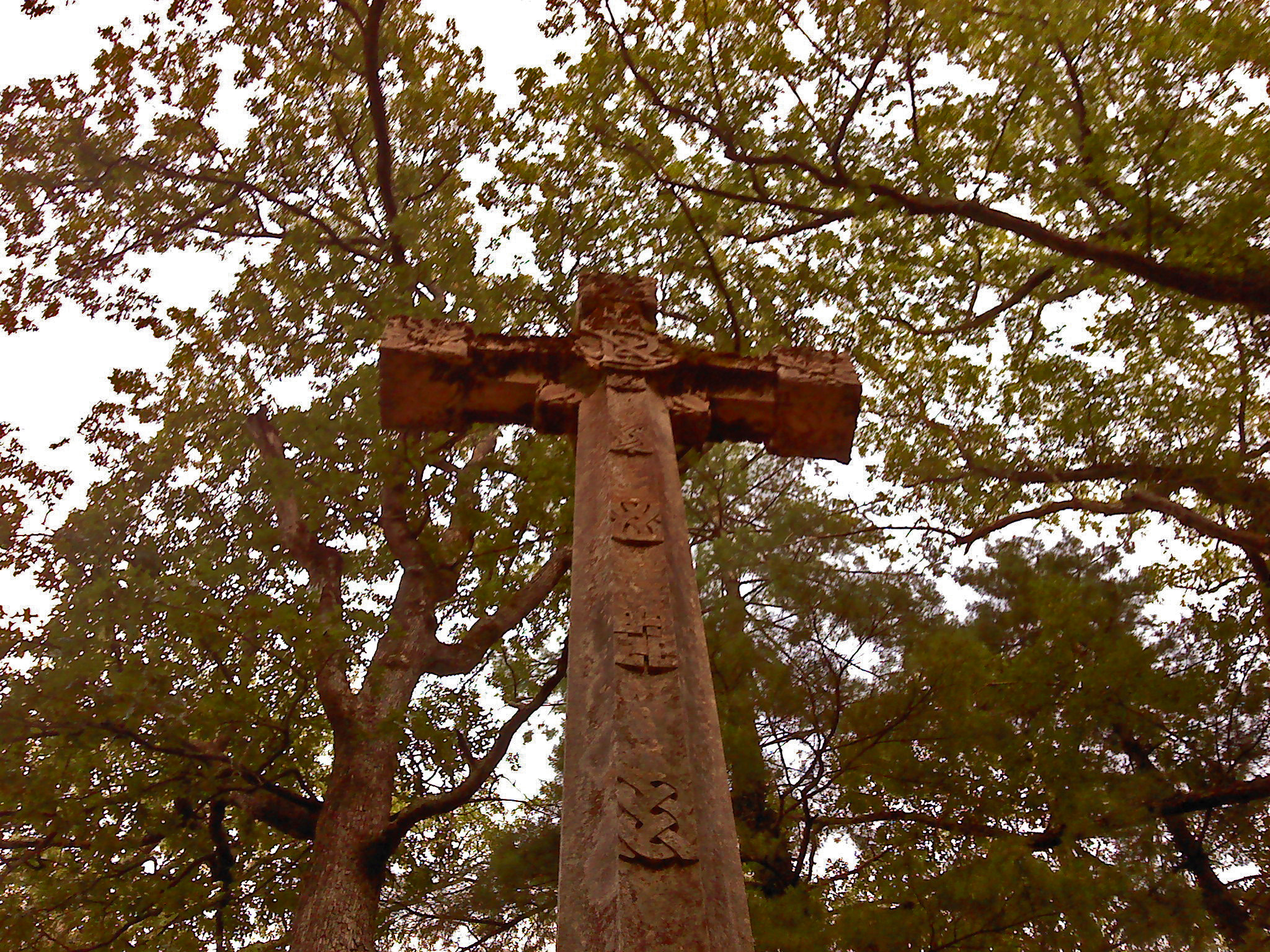
This also happens to be a religious school, so there are plenty of beautiful crosses here, too.  Since it’s as close to Appalachia as it is, the cemetery has a strong Celtic influence in the stonework.

The time I spent here mostly involved taking late night (or often midnight) walking tours of the area.  Among all those graves and under a very starry sky, it was pretty amazing.  If you’re wondering whether or not I encountered “anyone,” though, I have to say the answer is no.  I did bring offerings of food and whiskey several times, leaving them near the small side gate rather than any specific grave (since I wasn’t trying to contact anyone in particular, that made sense to me).  Wildlife abounds near this cemetery, so I often heard things wandering out in the dark just beyond the light’s cast.  I even occasionally met other folks taking late night constitutionals among the headstones.

Since I wanted to do well in my schoolwork, I also made up a potent little mojo bag, which I carried in my pocket.  I anointed it daily with either Crown of Success oil or some local whiskey, depending on what seemed appropriate for the day.  As far as I can tell, it worked magnificently (though I’m still waiting to get final grades back…mojo don’t fail me now!).  I may outline just how I made this specific mojo bag later this week in case there are other students looking for a little “oomf” in their studies.

Of course, a huge portion of my time was dedicated to reading completely non-magical texts (Paradise Lost, vast quantities of Shakespeare, a number of Restoration-era authors like Swift, Pope, and Dryden, etc.), but I also had time to work my way through a few magically inclined books as well.  I’ll be posting some reviews of those as time permits this coming week, so stay tuned for those.

The beautiful natural surroundings of the school also afforded ample opportunities to get outdoors.  Though the heat was stifling some days, trees always provided comforting shade and occasional mountain breezes helped cool me off, too.  So many of the plants that grow in that area have magical connections:  elder, sumac, sweet gum, passionflower, poke berries, and blackberries all grow wild.  I did some harvesting, particularly a good bunch of sassafras, so I’ll try to get some info up on that at some point, too.

Last, but certainly not least, I also had long drives to and from school on the weekends, so I filled up my iPod with lots of witchy podcasts and caught up on some of my favorites.  I also got to hear some new ones (at least new to me) that were excellent.  If you haven’t checked out Pagan Hooligans yet, it’s a great show and the hosts are a lot of fun.  They’re recording their adventures in paganism from day one, and it’s really a refreshing perspective!  I’ve also started really listening to and enjoying Iron Powaqa Radio, which has a decidedly sassy side and always makes me smile.

So that was my summer in a nutshell, I suppose.  I’m going to be trying to get back in the swing of regular posts as soon as possible, and hopefully there will be another podcast up fairly soon, too.  Until then, thank you all for your patience and support!  Feel free to post, email, discuss, and generally share your own New World Witchery here, and we’ll look forward to hearing from you!  Thanks for reading!

All the best, and be well,

-Cory

Blog Post 68 – Be Our Guest?

So running with an idea (and a title lovingly borrowed) from Juniper over at Walking the Hedge and Standing Stone and Garden Gate, I’m putting out a call for submissions to our wonderful readers.  I know we probably have at least a couple of writers out there as well, and we’d love to have you do a guest post for New World Witchery.

We’re going to have about 6-8 weeks of low posting from me, and we’d like to be able to post at least 3 articles per week if possible.  So that means we need 18-24 well-written, proofread, researched, reasoned, resonant, and remarkable entries.  Something tells me we’ve got a few folks who might just be up to the task, so if you’re interested, here’s the submissions guide:

1)      Each article should be no less than 300 words, and no more than 2000.  500-800 words is usually ideal length, but there is some flexibility.
2)      MS Word (.doc) attachments are ideal, with inline email text being a secondary preference.
3)      Please include all links with your submission.  I may have to tweak them slightly to get them on the site, but I definitely can’t chase down links for you.  Footnotes or endnotes should be similarly included.
4)      Any artwork must be in the public domain (try Wikimedia Commons to start) or your own original picture/art with authorization to use it on the site.
5)      All work must be your own.  Citations are fine, along with short passages of material presented in a scholarly fashion, but please, no plagiarism.
6)      Please proofread your work.  Excessive typos and grammar snafus will not be corrected or posted.
7)      You retain all publication rights to your material other than the first-time online publication rights.  In other words, you’re free to submit this on a site like Witchvox or to a print publication, as long as you say that it was first published on this site.  (I’ll also assume the right to reprint passages or references to your work in future publications, but I will not publish your article in its entirety without your permission).

Of course, I’m always happy to get nice, scholarly articles on the topics of hoodoo, pow-wow, curanderismo, witchcraft, etc.  But what I’d really like is to get articles on the following topics, specifically:

  • Personal or family magical lore (such as magical practices, divinations, weather signs, etc.).  Please include your family background (such as region or ethnic heritage), too, so we know where these things come from.
  • Regional magical lore, including things like witch stories, magical places, spells, famous witches, etc.  Of course, please let us know which region you’re writing about (you don’t have to be too specific—“Appalachia” or “New England” would be sufficient).
  • Spell-work hits and misses.  Tell us about spells you’ve done, ingredients you’ve used, charms you’ve said and what your results were.
  • Botanical or animal curios and your personal experiences with them.  Are there ones you favor?  Ones you shy away from?
  • Favorite spells and practices.  Do you particularly like working with the dead?  Do you have a favorite way to communicate with the Ancestors?  Are you a sharp-shooter when it comes to love mojos?  Tell us what you do and how you got so dang good at it!
  • Magical book reviews are also welcome, especially ones dealing with North American folk magic and witchcraft (not Wicca—there are lots of reviews on Wiccan books, so we don’t really want those here).  History, folklore, and regionally specific spellbooks (like conjure or brujeria books) are all excellent candidates for review.

Other topics are welcome; just email and ask about them first.  Not every article may get published on the site, so if we don’t select yours or if we suggest some revisions first, please don’t take it personally.

“Geez!” you say.  “That’s an awful lot of work for not getting paid!”  Ah, but there’s the twist in the plot!  While we’re still a relatively poor blog and podcast, we’re gearing up for another contest.  Anyone who writes a guest article that we post on New World Witchery will be entered for that contest.   We’ve still got to work out just what we’re going to give out, but right now we’re looking at having three winners drawn at random.  If you submit multiple posts and we publish them, you get an entry for every article we put up!  Each winner will get a different, unique prize, so this could shape up to be a very interesting contest.

So, yes, technically you’re still not getting paid exactly, but you may wind up with something cool in the end.  And you’ll be adding to the wealth of knowledge found here, so you are benefitting a whole wide world of witchy folk.  Isn’t that a nice feeling?

So, if you’re interested in being a part of New World Witchery, email us your articles and maybe win a prize in the process!  In case you can’t get the email from that link, it’s compassandkey@gmail.com.

Many thanks, and we look forward to hearing from you!

-Cory

Podcast 11 – Magical Tools

-SHOWNOTES FOR EPISODE 11-

Summary
Today we announce the upcoming break due to Cory’s grad school (don’t worry, we’ll be back sooner than you think!).  Then we talk about magical tools in American witchcraft, and we have our WitchCraft and Spelled Out segments.

Play:

Download:  New World Witchery – Episode 11

-Sources-
Mules & Men, by Zora Neale Hurston – mentioned in the show
Lucky Mojo site – particularly rabbits’ feet, gator parts, and raccoon bones
Hoodoo Root & Herb Magic, by Catherine Yronwode – lots of info on magical curios
Mojo:  Conjure Stories, by Nalo Hopkinson – the book I’m reading now which I mentioned when discussing gator heads

Promos & Music
Title music:  “Homebound,” by Jag, from Cypress Grove Blues.  From Magnatune.
Promo 1 – Iron Powaqa
Promo 2-  Witches’ Brewhaha

Blog Post 66 – The Moon

In a lot of modern Pagan religions, such as Wicca and Druidism, there is a certain amount of emphasis placed on the moon.  Phases of our celestial companion become symbolic stand-ins for various god and goddess figures, or particular aspects of those figures (as in the famous Maiden/Mother/Crone cycle).  With the full moon upon us, I thought I might take a little look at just how American witchcraft interacts with that lovely sphere.

There is a great deal of lunar lore found in Native American legends.  In one tale from the Kalispel Tribe of Idaho, the moon is equated with the famous trickster/father figure, Coyote:

“Once there was no Moon for someone had stolen it. The people asked “Who will be the Moon?” The Yellow Fox agreed to give it a try but he was so bright it made the Earth hot at night. Then the people asked Coyote to try and he agreed. The Coyote was a good moon, not to bright – not to dim. But from his vantage point in the sky the Coyote could see what everyone was doing. Whenever he saw someone doing something dishonest he would shout “HEY! That person is stealing meat from the drying racks!” or “HEY! That person is cheating at the moccasin game!” Finally, the people who wished to do things in secret got together and said “Coyote is too noisy. Let’s take him out of the sky.” So someone else became the moon. Coyote can no longer see what everyone else is doing but he still tries to snoop into everyone else’s business” (WWU Planetarium American Indian Starlore page).

The Cherokee thought of the Moon as brother to the Sun (an instance of the moon being seen as male, which appears in several cultures).

The image of the Man in the Moon is frequently found in American folklore.  Many of these traditions hail from European lore, including poems found in Mother Goose:

THE MAN IN THE MOON
The Man in the Moon came tumbling down,
And asked the way to Norwich;
He went by the south, and burnt his mouth
With eating cold pease porridge.
(from The Real Mother Goose)

In other cultures, the moon contains figures less familiar to most Americans.  The Old Farmer’s Almanac includes examples of the moon seen as a woman with child, a toad, a giant, a rabbit, and a boy and a girl carrying a bucket (as in “Jack and Jill”).

There are also particular moons associated with particular months.  A good list of them can be found at the Farmer’s Almanac site, here.  Many are linked with agricultural cycles (such as Green Corn Planting Moon or Harvest Moon), and some are clearly linked to hunting (like the Buck Moon).

There is a plethora of magical lore associated with the moon.  My earlier posts on planting by lunar signs and weather lore both have lunar connections within them.  Likewise, the witch initiations post mentions the practice of shooting at the moon to become a witch.  Edain McCoy, in her book In a Graveyard at Midnight, also has a fun bit of moon magic:

“To remove a curse from your home, you can try shooting your shotgun out an open window at the full moon, while shouting a curse at the Devil.  However, don’t try this if you live in a city or populated area, or you will likely find the police at your door” (McCoy, p. 107)

There are also beliefs about marriage and courtship dates associated with lunar phenomena – waxing-to-full moons are best for “tomcattin’” according to Vance Randolph’s Ozark Magic & Folklore.

Of course, witches can find lots to do under a full moon.  Personally I find it to be an ideal time for:

  • Storytelling gatherings (especially around a campfire)
  • Divination and fortune-telling
  • Working with Otherworld entities like spirits, ghosts, fairies, etc.
  • Possession-based magic and shapeshifting
  • Love and beauty magic
  • Crafting magical tools and supplies

These are only my thoughts on the subject, of course, and there are plenty of great sources on lunar folklore out there.  And, of course, your mileage may vary when it comes to making the most of a full moon.  I’d love to hear what you all do with regards to lunar-linked magic.  Please feel free to share your methods, practices, ideas, and thoughts with us here!

Until next time, thanks for reading!

-Cory