Blog Post 155 – Radiolab and Robert Johnson at the Crossroads

Hi all!

I know this isn’t the botanical lore I was promising for the month of April, but don’t worry, there’s more of that coming. I just had to share something that my very dear and wonderful friend Kathleen alerted me to. One of my favorite non-magical podcasts in the world, Radiolab, just did a really interesting mini-show on a topic which intersects with our work here!

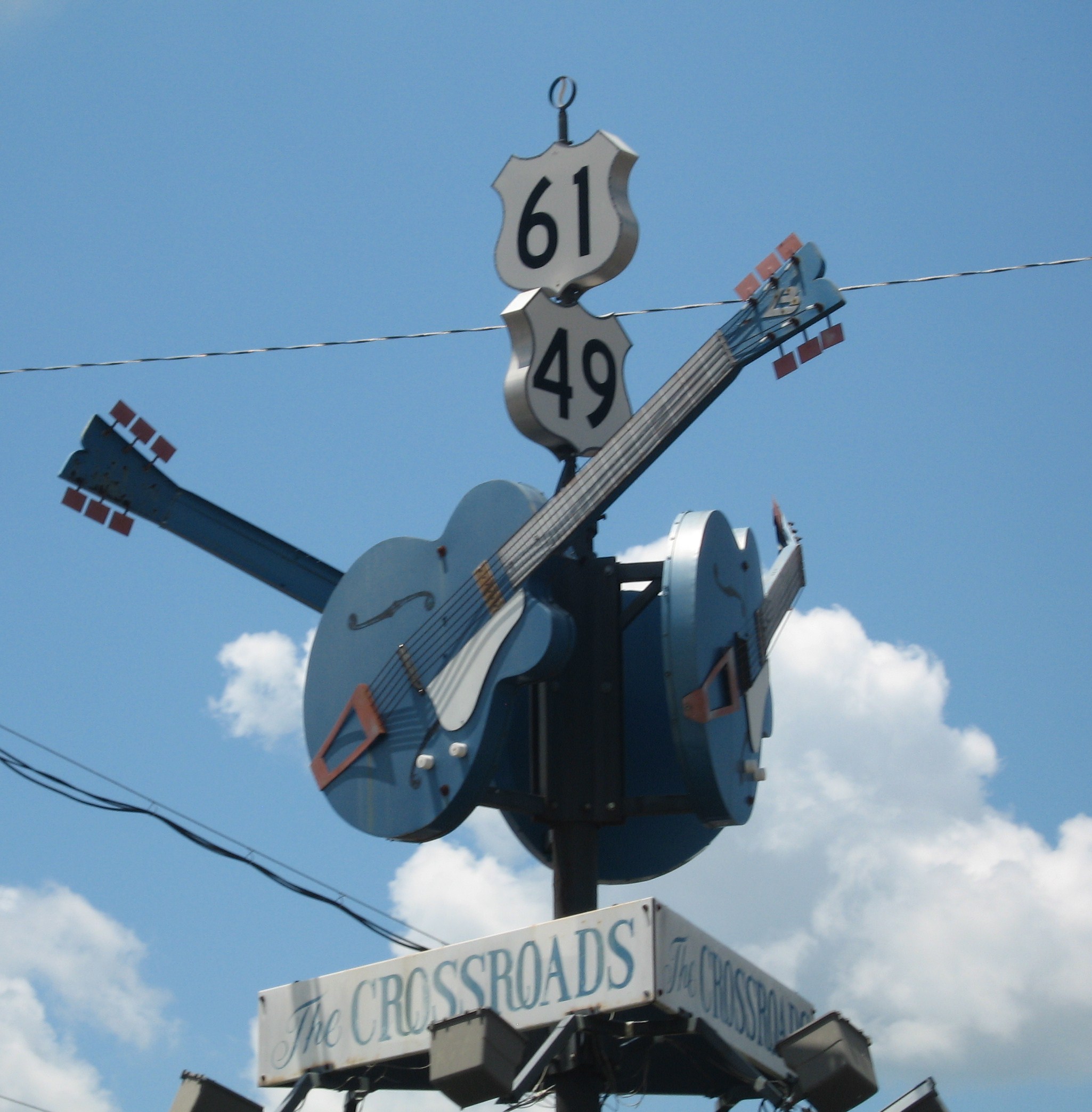
Please hop over and check out the 30 minute Radiolab short on the Crossroads, specifically the tangled crossroads legend surrounding blues players Robert Johnson (to whom the myth of selling his soul to become a great blues player is frequently ascribed) and Tommy Johnson (who may actually have done the crossroads ritual). There are fantastic interviews with music historians, blues experts, and even Tommy Johnson’s brother, all of which help shed light on the strange and gorgeous African American folk tale about gaining new power at the crossroads.

I should point out that they come at this from a scientific and historical perspective, and really are pursuing the true story about the musicians rather than doing much to get at the folkloric roots of the crossroads phenomenon. They specifically wind up ignoring the existence of the story in other African American literary and folklore sources, such as these:

  • The multiple incidents of crossoroads conjure recorded by Harry M. Hyatt between 1935-1939 (found at the bottom of the Lucky Mojo page linked above), which would have pre-dated the “creation” of this story as described in the Radiolab short
  • The numerous incidences of crossroads as places of healing, particularly trading things like a wart or a sty to a mysterious stranger, in Southern and African American folklore (which can be found in Hyatt’s work, the work of Vance Randolph, and Newbell Niles Puckett).
  • Puckett’s description of the crossroads ritual as an origin for folk hero Jack, which was published in 1926 and states:

Various legends are in vogue among the Negroes to account for the origin of this creature.  One illustrating the common theme, was told me by a root-doctor last summer.  Jack sold himself to the devil at the crossroads one night at twelve o’clock. For seven years all power was given to him to do as he pleased, but at the end of that period his soul belonged to the devil. [This eventually goes on to tell the story of Jack-o-Lantern, but the crossroads portion of it is given here as illustration of my particular point]

  • Zora Neale Hurston’s 1931 article on African American folk magic, which has the following item in it:

How to Have a Slick Hand with People.

On the dark moon of any Friday night, dress yourself in black. Sit flat in the fork of a cross road at exactly twelve o’clock and sell yourself out to the devil. After which you shall have power to do anything you wish to do (“Hoodoo in America,” 392)

  • The appearance of crossroads in European folk magic (such as that found in Charles Leland’s Gypsy Sorcery & Fortune-telling, published in 1891, long before the legends being described in the blues tales)

There are so many other appearances of crossroads in folklore that it would be daunting to tackle them here (though I will probably try to do a bigger article on them some day). My real point is just to say that while I love the Radiolab story, they definitely overlooked a large amount of crossroads material so that they could focus more on the story of two real blues musicians, which is understandable.

I really do hope you’ll give this particular show a listen. It’s great, especially in its ability to untangle the two legends from one another, and you get to hear some really hauntingly good blues, too.  Let me know what you think of it!

All the best, thanks for reading, and see you down at the crossroads…

-Cory

Podcast 41 – Spring Lore Spectacular!

-SHOWNOTES FOR EPISODE 41

Summary
This episode is all about the various springtime lore we received for our recent contest. It’s lots of bunnies, eggs, and the occasional swat on the behind in this show! Plus we have our contest winners announced.

Play:
DownloadNew World Witchery – Episode 41

-Sources-

Almost all the lore was listener submitted, but we do have a few links to share:

1. We received some great lore from Peter M, who runs a stellar blog on New England folklore. Check it out!
2. You should also check out folklore submitter Jen’s blog, Rue & Hyssop, which is delightful!
3. If you want to know more about gardening and astrology, we did several posts on the topic: Blog Posts 18, 19, & 20.
4. We mentioned two books: Old Wives’ Lore for Gardeners by Maureen & Brigit Boland, and Grimoire for the Apprentice Wizard by Oberon Zell-Ravenheart
5. In case you can’t get enough of Cory, he was also on the March episode of Inciting a Brewhaha
6. You should definitely also listen to the 2012 episode of Between the Earth and Stars by Oraia Helene. It’s amazing!

Congratulations to our Spring Lore Contest winners!

1. Jen at Rue & Hyssop won the Card Reading from Cory
2. Kelly won the copy of Etched Offerings: Voices from the Cauldron of Story
3. StarRider won the Compass & Key Apothecary prize pack

Many thanks to all who entered! We think this was a great show and couldn’t have done it without you!

You can now request Card Readings from Cory via email, if you are so inclined.

Don’t forget to follow us at Twitter!

Promos & Music
Title music:  “Homebound,” by Jag, from Cypress Grove Blues.  From Magnatune.

Promo 1 – Between the Earth & Stars
Promo 2 – Lakefront Pagan Voice
Promo 3 – Pagan in Portland

Blog Post 154 – Buckeyes

I imagine that I’ll get a sharp increase in visitors from Ohio with this article. Today’s featured botanical is the buckeye, which is both the name of the tree and the fruit (or nut) of that tree. It grows in a wide variety of locations, including all over Europe and North America, and is also frequently referred to as a “horse chestnut” (which is actually a very specific species within the bigger buckeye family). Since you can find a great deal of botanical information on the tree elsewhere (like at the USDA Plants database), I’ll narrow my focus here to the folklore and magical uses of the nut.

T.F. Thiselton-Dyer, author of the botanical mythography classic The Folk-lore of Plants, makes the following observations about the horse-chestnut:

“A Worcestershire name for a horse-chestnut is the ‘oblionker tree.’ According to a correspondent of Notes and Queries (5th Ser. x. 177), in the autumn, when the chestnuts are falling from their trunks, boys thread them on string and play a ‘cob-nut’ game with them. When the striker is taking aim, and preparing for a shot at his adversary’s nut, he says:—

‘Oblionker!

My first conker (conquer).’

The word oblionker apparently being a meaningless invention to rhyme with the word conquer, which has by degrees become applied to the fruit itself.” (CH XVIII)

Already I love this plant, don’t you? Essentially they seem to be used as marbles in children’s games (give them one point for that), and they also have a nice phonetic connection to the powerful hoodoo charm, John the Conqueror root, which is frequently called John de Conker (and that’s another point to the buckeye!). They actually look llike smoother versions of High John roots in some ways, so it doesn’t surprise me to find that they sometimes get substituted in for their powerful underground counterpart:

“Buckeye nuts are believed by some hoodoo “doctors” to increase a man’s sexual power. Shaped like miniature testicles, they are sometimes carried in the pants pockets as charms to bring men “good fortune in sexual matters.” In the southern and eastern regions of the United States, buckeyes are carried in mojo bags to cure or prevent such ailments as arthritis, rheumatism, and migraine headaches” (Gerina Dunwich, Herbal Magic, 86).

Cat Yronwode similarly cites buckeyes as charms for increasing male potency. Both Yronwode and Dunwitch, however, make it clear that a buckeye’s primary powers are to aid as a gambling charm and to help stave off aches and pains—particularly rheumatism and headaches. This view is heavily supported by a number of folklore sources:

From Newbell Niles Puckett, Folk Beliefs of the Southern Negro

  • Where the left hind foot of a graveyard rabbit, a buckeye, a horse chestnut, and a luck bone from a pig ham are put together for good luck [A charm for good luck] (316)
  • A buckeye carried in the pocket will surely bring one good luck (314)
  • A buckeye carried in the left pocket is generally supposed to work a cure for rheumatism as well as for piles, a belief apparently English (360)
  • Red pepper rubbed up and down the back ‘warms up de system,’ as does also a new domestic sack half full of salt into which nine grains of red pepper and four buckeyes have been put. Wear this around your waist and you will never again be bothered with chills (366)
  • In Mississippi and Alabama it is believed that if one carries buckeyes in the pocket he will have no chills through the year (366)

From Harry M. Hyatt, Folklore of Adams Co., Illinois

  • 1328. “My brother always carries a buckeye in his pocket to get money.” (28)
  • 1329. “I always carry three buckeyes in my pocket to always have money. My grandfather did this through the Civil War, my mother did this, and I am carrying three buckeyes too.” (28)
  • 4534. The person who carries a buckeye in the pocket never becomes sick. (99)
  • 4688. The person who carries a buckeye in the pocket never suffers from backache. (103)
  • 5233. A buckeye carried in your pocket or the band of your hat prevents headache. (118)
  • 5588. As a treatment for piles, a buckeye is worn: in the pocket (usually the left), or one in each pocket, or one pinned to the underclothes, or one round the neck, or one rolled in the top of each stocking. (126)
  • 5684. One buckeye is worn in one of several places as a rheumatism remedy: about the neck, on the breast, in a pocket (especially a hip pocket), round the waist, and under the bend of the knee.  Sometimes, they say buckeyes are ineffective for rheumatism, unless you begin by using an unripe one. Moreover, it is occasionally said, to lose this nut in the process of curing yourself brings bad luck. And finally, because a buckeye is also called a horse chestnut, the real chestnut is worn as a substitute, but this seems to be rare. (129)
  • 5685. Buckeyes used for curing rheumatism should always be carried in pairs. This also makes you lucky at the same time. (129)
  • 5686. “If you carry three buckeyes in a sack so they will be on your skin, good for rheumatism; if the buckeyes dry all up when wearing, then they are doing you good; but if they don’t dry all up, they are doing you no good.” (129)
  • 11073. It is lucky to keep a buckeye in your purse, on your person, or in your house. (262)
  • 13443. Keep a buckeye in your pocket while playing baseball and you will have good luck. (310)
  • 13984. You obtain good luck for a card game, if a buckeye is worn in your right pocket. (319)

From Daniel & Lucy Thomas, Kentucky Superstitions:

  • 1224 – One subject to a headache may prevent it by carrying a buckeye in his pocket (105)
  • 1288 – Carry a horse chestnut [another name for a buckeye] in the pocket, to avert piles (110)
  • 1299 – To avert rheumatism, carry a horse-chestnut in the pocket (111)
  • 2887 – You will have good luck if you carry a horse-chestnut (219)

Kentucky Superstitions also has this rather fantastic bit of lore about the good ole horse-chestnut:

  • 2889 – If one eats a buckeye, his head will turn around (219)

Vance Randolph devotes a sizeable amount of space to the folklore of buckeyes among the hillfolk of the Ozarks, also pointing out their strong associations with healing and protection from painful diseases. He relates an excellent story about just how deeply ingrained the belief in buckeye powers was in the mountains:

There is an old saying that no man was ever found dead with a buckeye in his pocket, but this is not to be taken seriously. Most people who carry buckeyes regard them as a protection against rheumatism, or hemorrhoids. One of the most successful physicians in southwest Missouri always carries a buckeye ; when it was mislaid once he was very much disturbed and let an officeful of patients wait until his pocket piece was recovered. It is very bad luck to lose a buckeye. I asked this doctor about it once. “No, I’m not superstitious,” he said grinning, “I just don’t want to get the rheumatism!” (Ozark Magic & Folklore, 153)

There is some excellent lore about the buckeye and just why it became the namesake for Ohio from the Ohio Department of Natural Resources website. They mention the lucky association, likening it to a four-leaf clover or rabbit’s foot, and links the state nickname to William Henry Harrison or alternatively to Col. Ebenezer Sproat (a simply fantastic name), both Ohioans of historic and heroic stature.

Probably my favorite bit of folklore concerning the lovely horse-chestnut comes from an online forum I found while researching this topic. You can read the full thread here, but I simply cannot fail to mention this fantastic tidbit:

There is a belief by some that only half the buckeye is poisonous, and that only squirrels know which half that might be in a particular nut. Squirrels do sometimes eat a part of the nut.

There you have it: squirrels are smarter than we are. But I’ve known that for a while (at least in my case it’s true).

At any rate, the buckeye can be carried as a lucky charm or worked into other magical preparations, and it has a huge body of lore associated with it. So much, in fact, that I’ve barely (prepare for pun) cracked the shell here. If you know of great buckeye lore and magic, I’d love to hear about it! Or if you just want to pelt me with horse-chestnuts for making bad puns, I’ll be here all day.

Thanks for reading!

-Cory

Quick Update! – Spring Lore Contest Reminder

Hi folks!

This is just a reminder that if you want to get into the drawing for our Spring Lore Contest, there’s never been a better time than now!  You’ve only got five days left—until March 21, 2012! We’re looking for Springtime Lore this time around: seed planting rituals & customs, fertility charms, spring cleaning spells, etc. Anything and everything related to Easter eggs, baby animals, April showers, and (shudder) bunnies. We’re trying to put together an episode featuring folklore, ritual, and practice from all over the country and the world relating to rebirth, green grass, renewal, etc. and we need your help to do it! So if you’ve been hanging on to a killer magical gardening tip, a clever and enchanted use for chocolate rabbits, or a story about dancing naked around a maypole, fire up your email and send it in!

So what’s in it for you if you send us lore? Prizes!

The Prizes

  • A copy of Etched Offerings: Voices from the Cauldron of Story from Misanthrope press (an anthology of pagan fiction featuring stories from several podcasters like Oraia Helene, Saturn Darkhope, & me!)
  • An email card reading from Cory, with a 1-2 page card report featuring a 2-card split and 7-card layout, plus interpretations and a fairy-tale recommendation to connect your reading to a story you can turn to for more inspiration.
  • A goody box from Compass & Key Apothecary featuring several of our oils, curios, and mojo bags. While actual contents of the box are subject to change, they will likely have at least 2 oils, 2 mojo bags, 1-2 curios (like rabbits’ feet, gator paws, or Mercury dimes), and 3-4 herbal samples.

How to Enter

Send your entries to compassandkey@gmail.com to enter, and be sure to put “Spring Lore” in your subject line.

We hope to hear from you soon! Remember, the deadline is midnight on March 21st, 2012, so get those entries in before then!

All the best, and thanks for everything you do!

-Cory

Podcast Special – Tricksters

-SHOWNOTES FOR PODCAST SPECIAL – TRICKSTERS

Summary
This is a storytelling episode featuring several tales, songs, and rhymes about various New World trickster figures.

Play:
Download: New World Witchery Special – Tricksters

-Sources-
The tales today come from a variety of sources:
Mules & Men, by Zora Neale Hurston
A Treasury of Afro-American Folklore, by Harold Courlander
Favorite Folktales from Around the World, by Jane Yolen
AmericanFolklore.net – A site by author S.E. Schlosser
The Tar Baby and Other Rhymes of Uncle Remus, by Joel Chandler Harris
Myths, Legends, & Folktales of America, by David Leeming & Jake Page

Scholarly sources cited include:
The Witch Must Die, by Sheldon Cashdan
The Uses of Enchantment, by Bruno Bettelheim

We also have two blog posts that might be of interest:
Blog Post 150 – The Trickster’s Web
Blog Post 151 – New World Tricksters

We’ve got a Spring Lore Contest going on until March 21, 2012! We’re looking for Springtime Lore this time around: seed planting rituals & customs, fertility charms, spring cleaning spells, etc. Anything and everything related to Easter eggs, baby animals, April showers, and (shudder) bunnies. Send your entries to compassandkey@gmail.com to enter, and be sure to put “Spring Lore” in your subject line.  Three participants will win one of three prizes: a copy of Etched Offerings: Voices from the Cauldron of Story from Misanthrope press (an anthology of pagan fiction featuring stories from several podcasters like Oraia Helene, Saturn Darkhope, & me!), an email card reading from Cory, and a goody box from Compass & Key Apothecary featuring several of our oils, curios, and mojo bags. More details coming soon!

You can now request Card Readings from Cory via email, if you are so inclined.

Don’t forget to follow us at Twitter!

Promos & Music
Title music:  “Stagolee” by Hogman Maxey (from Archive.org).
Featured Songs:
Tough Titty Cupcakes,” by Tricky Pixie
Coyote Chant,” by Michael Drake
Raven Song,” by Michael Drake

Blog Post 150 – The Trickster’s Web

I’ve been thinking a lot lately about the importance of tricksters in folklore and fairy tales. I know it’s fairly well-trod ground to start looking at the mythical value of tricksters like Coyote and Loki and Hermes and all the other devious deities and demigods who so love to upend the orderly world in favor of a little creative chaos. I’m not going to dive into specific tricksters here (though I do intend to do some exploring of North American tricksters in the not too distant future), but I wanted to look instead at the folkloric need for these figures. After all, they’re not exactly protagonists, and they’re not exactly antagonists, but they are something else entirely. Their very identification and definition is tricky. So what is the trickster’s role in the tales we tell? According to Jane Yolen, author/editor of Favorite Folktales from Around the World:

“The figure of the trickster can be found in every folklore tradition. The trickster as hero or as god plays an important role: Anansi in Africa is sometimes heroic, sometimes foolish, with definite supernatural powers. LIkewise his famous Native American counterparts, Coyote and Rabbit, act as both fooler and fooled….The German Tyll Ulenspiegel, a popular peasant jester, actually lived in the fourteenth century, but within another two centuries had become a legend around whose names volumes of anecdotes and jests had accumulated…Whether the trickster is an animal such as Brer Rabbit or Raven or the wily fox, or supremely human like the German master thief, he plays his tricks out to the end. And sometimes it is a bloody and awful ending” (From section “Tricksters, Rogues, & Cheats,” 127).

So then the trickster can be both a guide for overcoming adversity and self-empowerment, and he can be a sacrificial victim to fate—sometimes illustrating the tragically comic cycle of life and death we all must go through. In this latter capacity, the trickster attempts to operate outside the web of Fate (or natural order, if you prefer), and becomes deeply entangled in the threads he or she tried to avoid. I think here of Anansi, the spider, who in one tale learns of a magic spell which causes anyone who says the word “five” to drop dead on the spot and thus begins tricking various creatures to say that word so that he may eat them. Of course, the trick gets turned around on him, and he accidentally says “five” when a clever bird refuses to play by his rules, thus ending his own life. It is a storytelling picture of a spider weaving one web inside of another, only to be caught by the bigger web he didn’t see.

Why then do we need to have clever characters that can be so easily duped or destroyed? Do they play a similar role to folkloric devils, existing simultaneously as a threat and a challenge (and thus also functioning as teachers in some ways)?  I would assert here that when a trickster is overcome by his own tricks, it is because his deceit has crossed a line. Knowing how and when to play a trick is deeply important. Teachers understand that the process of discovery is very important to really gaining understanding as opposed to simply forcing short-term rote memorization (a topic we discussed in our recent podcast on riddles). I’ll get to the role of deceit a bit more in depth in a moment, but first let me briefly detour back to the ide of a trickster as an empowering figure.

Without diving too deeply into the sticky issues of what is “moral” in fairy and folk tales, I think it’s relevant to point out that concepts of “good” and “bad” or “right” and “wrong” form central pillars around which many stories are built. At the same time, there remains an intense ambiguity about just about every “moral” decision in a fairy tale—the witch in “Hansel and Gretel” does seem to deserve to die, as she wants to kill and eat children, but is it a particularly happy ending for the children to return to a father who willingly (if reluctantly) abandoned them to that horrible ordeal? Bruno Bettelheim, in his controversial and classic fairy tale exegesis The Uses of Enchantment has this to say:

“Amoral fairy tales show no polarization or juxtaposition of good and bad persons; that is because these amoral stories serve an entirely different purpose. Such tales or type figures as ‘Puss in Boots,’ who arranges for the hero’s success through trickery, and Jack, who steals the giant’s treasure, build character not by promoting choices between good and bad, but by giving the child the hope that even the meekest can succeed in life” (10).

So then, the child, who knows intuitively that he or she is not as strong and capable in many ways as the adults around him or her, needs to understand that strength and physical skill are not the only methods for overcoming adversity. Brains count for something, too. For those of us who have outgrown the age of childhood (though you’ll be hard-pressed to convince me I’ve outgrown it in any way but the number of years shown on my driver’s license), that lesson can still be immensely invaluable. When we are faced with an ogrish boss or a monstrous task or a devilish choice, we need to believe that we have a tool in our arsenal that can beat the odds—and that’s where the trickster becomes more than a comical prop or sacrificial victim. As Bettelheim says, “Children know that, short of doing adults’ bidding, they have only one way to be safe from adult wrath: through outwitting them” (28). We, too, as adults and as magical folk, deal with a number of dangerous situations all the time, and we must adopt the trickster’s cleverness if we hope to overcome the challenges we face in one piece. To illustrate this point, Bettelheim relates the tale of the “Fisherman and the Jinny” (one we’ve mentioned a lot), in which a fisherman is threatened by a genie that he releases and must trick him back into the bottle or be killed by him. The genie is clearly bigger and more powerful, and only by means of deviousness can the fisherman preserve his life.  If you want to lend a magical quality to your life, think about how often you bottle the genie of a ferocious argument with a lover or friend by a few carefully placed words or a well-timed gesture.

Still, one moral lesson that we so often teach our children (and one which we repeat to ourselves ad nauseum) is: don’t lie. Lies are bad. Always tell the truth. Except, of course, when you shouldn’t. And here we come to my last point of examination in the role of the trickster. In The Witch Must Die, scholar Sheldon Cashdan looks at lies and deceit by examining three fairy tales: “The Goose Girl,” in which lying is punished brutally when it is found out; “Rumpelstiltskin,” in which lies are accommodated and made true by the intervention of magic and/or fate; and “Puss in Boots,” in which trickery is rewarded because it is cleverly executed. What Cashdan uncovers by contrasting these stories is that trickery when performed for the sake of trickery is ambivalent, and when done in the service of another person (or a righteous cause) is praiseworthy, but deceit performed for the sake of harm to another must bring judgement or punishment down on the deceiver/trickster. As he puts it:

“[I]t is the intent behind the lie that counts rather than the lie itself. In other words, there may be instances in which telling lies is justified…These contrasting approaches to deception reflect the ambivalence people harbor about telling the truth. On the one hand, we know that lying is wrong. At the same time, it is hard, as Diogenes discovered, to find an honest man…In some fairy tales, lying is not merely treated with ambivalence but is actually rewarded” (140).

For an a magical practitioner, then, the power of the trickster is power that can be used reactively (to combat an attack or overcome an obstacle) or chaotic (to inspire the topsy-turvy energy that seems to surge up periodically in Nature), but if it is used offensively it must be justified. Willfully entrapping someone by magical means—and here I’d venture away from magic and say this principle extends to social behavior, too—has to have some solid reasoning behind it, or else the universe has a way of bringing its own justice down on the tricksy person who did the ensnaring.

What the trickster seems to say to me, then, is this: If you are a spider, spin for the beauty of your web; spin that you may catch the food you need; spin to keep your enemies away. But beware weaving the web of greed and harm, because there’s likely a bigger web you do not see, and a bigger spider who is very hungry dangling not far overhead.

Whew, enough philosophy, right? What are your thoughts on tricksters, especially as teachers? Do you agree about the idea of justification? Have you ever experienced a trickster in your own life or practice? Let us know in the comments below!

Thanks for reading!

-Cory

Podcast 40 – Rhymes, Games, and Riddles

-SHOWNOTES FOR EPISODE 40

Summary
Today we look at a toychest full of children’s nursery rhymes, playground games, and riddles. We talk about how these sing-song verses can sometimes hide bits and pieces of valuable witch lore, as well as how they can be incorporated into one’s practice.

Play:

Download: New World Witchery – Episode 40

-Sources-

  • The book I used for many of the rhymes herein contained is my son’s copy of Mother Goose by Tomie dePaola (the illustrations are excellent and very folk-arty). Some of the rhymes you hear are “The Crooked Sixpence,” “Old Mother Goose,” “Rabbit and Crow,” “Jack and Jill,” and “Two Blackbirds”
  • I mention The White Goddess by Robert Graves as a source of witchy riddle lore.
  • I also pull several riddles from Buying the Wind by Richard Dorson.
  • We have several posts on our blog focused on these topics. Check out “Blog Post 53 – Riddle Me This,” “Blog Post 54 – The Devil’s Nine Questions,” and “Blog Post 55 – Games” for more info.
  • I also highly recommend checking out Peter Paddon’s Crooked Path site, as he frequently discusses riddles and rhymes as a part of witchcraft practice.
  • The excellent article that kicked off this whole topic was “Rhyming Witchcraft,” by Elizabeth Yetter, submitted by listener Anastasia. Thanks!

We’ve got a Spring Lore Contest going on until March 21, 2012! We’re looking for Springtime Lore this time around: seed planting rituals & customs, fertility charms, spring cleaning spells, etc. Anything and everything related to Easter eggs, baby animals, April showers, and (shudder) bunnies. Send your entries to compassandkey@gmail.com to enter, and be sure to put “Spring Lore” in your subject line.  Three participants will win one of three prizes: a copy of Etched Offerings: Voices from the Cauldron of Story from Misanthrope press (an anthology of pagan fiction featuring stories from several podcasters like Oraia Helene, Saturn Darkhope, & me!), an email card reading from Cory, and a goody box from Compass & Key Apothecary featuring several of our oils, curios, and mojo bags. More details coming soon!

You can now request Card Readings from Cory via email, if you are so inclined.

Don’t forget to follow us at Twitter!

Promos & Music
Title music:  “Homebound,” by Jag, from Cypress Grove Blues.  From Magnatune.

Incidental songs and rhymes are from the Alan Lomax folk recording collection at the Library of Congress.

Promo 1 – Forest Grove Botanica
Promo 2 – The iPod Witch
Promo 3 – Druidcast

Quick Update – Spring Lore Contest!

Howdy everyone!

We’ve got a Spring Lore Contest going on until March 21, 2012! We’re looking for Springtime Lore this time around: seed planting rituals & customs, fertility charms, spring cleaning spells, etc. Anything and everything related to Easter eggs, baby animals, April showers, and (shudder) bunnies. We’re trying to put together an episode featuring folklore, ritual, and practice from all over the country and the world relating to rebirth, green grass, renewal, etc. and we need your help to do it! But because we like you an awful lot, we also want to give you the chance to win shiny and wonderful things from us when you send us your lore!

The Prizes

  • A copy of Etched Offerings: Voices from the Cauldron of Story from Misanthrope press (an anthology of pagan fiction featuring stories from several podcasters like Oraia Helene, Saturn Darkhope, & me!)
  • An email card reading from Cory, with a 1-2 page card report featuring a 2-card split and 7-card layout, plus interpretations and a fairy-tale recommendation to connect your reading to a story you can turn to for more inspiration.
  • A goody box from Compass & Key Apothecary featuring several of our oils, curios, and mojo bags. While actual contents of the box are subject to change, they will likely have at least 2 oils, 2 mojo bags, 1-2 curios (like rabbits’ feet, gator paws, or Mercury dimes), and 3-4 herbal samples.

How to Enter

Send your entries to compassandkey@gmail.com to enter, and be sure to put “Spring Lore” in your subject line.

We hope to hear from you soon! Remember, the deadline is midnight on March 21st, 2012, so get those entries in before then!

All the best, and thanks for everything you do!

-Cory

Blog Post 149 – Witch Wars

The term “witch wars” comes up frequently in discussions about neo-Pagan community infighting, as shorthand for the feuding and vitriolic verbal sparring that happens periodically between rival groups. Such wars, however, have not always been barbs exchanged over message boards or smear campaigns between unfriendly covens. The nature of magical practice has almost guaranteed that so long as one witch could cast a spell, another could undo it.

So how do witches fight witches? With magic, of course, but so many of these tales involve what seems to be a battle of wills between two equally gifted magical workers. Strangely, while a witch might attack a person or family, when the witch-doctor enters the picture and counter-attacks the witch, the witch-doctor is seldom targeted back during the battle. Most of the witch-doctor’s services are more geared towards revealing the identity of a witch and providing victims a way to remediate their own problems. This is true in both New World and Old, as scholar Owen Davies demonstrates in his seminal text on English cunning folk, Popular Magic:

“The cure of witchcraft could be effected in three main ways: by going straight to the source and tackling the witch either physically or through the law courts; by breakin the spell at a distance via magical rituals; or by using a mix of herbs and charms to expel the witchcraft from the patient’s body. Cunning-folk were instrumental in facilitating all these methods,and they sometimes employed a combination of all three…the client saw what they wanted to see; in other words, the person they already suspected. The process was one of confirmation rather than detection…” (Popular Magic, Davies, 106-7)

The biggest step in fighting a witch was determining who he or she was. Then, a magical remedy would be applied to disrupt the spell which was affecting the victim. This might involve scalding milk from a bewitched churn, shooting an image of the witch with a silver bullet, etc. Then, in a critical step, the witch would attempt to come to the property of the victim and either enter the home or take something from the house. There seems to be a uniform understanding that such an act must be prevented, or else the witch’s power would remain or perhaps grow stronger over the victim. Davies gives one such example from England:

“In 1682 the parents of a bewitched girl named Mary Farmer were advised by ‘Dr Bourn’ to burn her clothes. He assured them ‘that then the witch which had done her the hurt, would come in.’ The parents testified in court that, having done this, a neighbor, Joan Butts entered their house, ‘and tumbled down, wallowing on the ground, making a fearful and dismal noise.’” (Davies, 109)

In this case, further magical action must be taken, including smoking a cow’s heart in the chimney, to break the witch’s spell.

The magical battles took place between malevolent witches and the community-sanctioned (or at least tolerated) ‘white witches’ or ‘witch-doctors’ indicate that those who could fight a curse were usually fairly well known to their community. A story from Hubert J. Davis’ The Silver Bullet tells of one such struggle, which occurred when a family sought to alleviate its suffering and bewitchment by calling in a man gifted at ‘overlooking’ or breaking curses. To break the curse placed on the family’s child, Tim and Ada consult with this ‘Quaker doctor’ (most likely a Pow-wow/braucher), who provides them with a stoppered bottle into which the family’s nail parings, hair, etc. are gathered, then left under the burning embers of the fire. Adding in some prayers, including a candle burning which ends with the traditional “In the name of the Father and the Son and the Holy Ghost” (further indication of Pennsylvania Dutch magical practice), the “tall, stinguished looking man with thick white hair and a well-trimmed moustache [and] kindly blue eyes” forbids them from letting anyone into their house for three days. Sure enough, an old woman by the name of Old Betty Orts attempts to come in, revealing her as the witch. At that point, the father strikes her head, drawing blood (which immediately saps the power of a witch), and the curse is broken (“The Quaker Doctor and His Magic Bottle,” Davis, 56-8).  The pattern of curse, diagnosis, prescription, attempted incursion, and final defeat of the witch is maintained.

In another account of Appalachian witch warring, an interesting and somewhat unusual battle occurs between two men (in most of these tales at least one of the magicians is female). Patrick W. Gainer recounts the battle between Uncle Johnnie and Uncle Jimmie Webb which took place over the use of a butterchurn. Uncle Johnnie, when denied use of the churn—and here it should be pointed out that the woman he wished to borrow from had two churns available, thus demonstrating the lack of social hospitality mentioned in my earlier post on the Witch’s Ire—enchants it so that he may steal her butter. Uncle Jimmie then helps the churn’s owner, Eliza Morris, to break the spell by whipping it with switches while churning with his left hand. This, in turn, causes Uncle Johnnie to suffer welts and undoes the enchantment (“Uncle Johnnie Bewitches the Cows,” Witches Ghosts & Signs, Gainer, 142-4).

This is not, of course, a wholly good vs. evil phenomenon. Scholar Emma Wilby notes that magical folk in England often employed their magic as the situation dictated, being neither entirely helpful nor entirely harmful:

“Although some cunning folk had a reputation for being wholly good, a large proportion of them were considered ambivalent, that is, they could employ their magical powers to both help and harm…The trial records of East Lothian cunning woman Beigis Tod, who was accused of witchcraft in 1608, echo this popular perception when they claim that Beigis was known to be skilled in both ‘on-laying and af-taiking of seiknes’. [Wilbiy’s italics, short for “laying on and taking off of sickness”].” (Cunning Folk & Familiar Spirits, Wilby, 54)

These mixed talents were often set against each other, with one magical practitioner putting a spell on a person, place, or group of people, and another showing up to take it off. Sometimes this un-bewitching was done for free, but frequently a fee would be charged, which led some to suspect that the ‘bad’ witches and the ‘good’ witches were in league with each other and splitting the profits. One such example is the tale of “Mont and Duck” from Hubert J. Davis, in which an old couple moves into an area which suddenly begins experiencing oubreaks of illness. The community blames the newcomers, of course, but the response is interesting:

“[O]ne of their neighbors accused Mont and Duck of having cast a spell on their sick cow. Old Mont awed his accuser by readily admitting that his wife, Duck, had the power of evil, and that he could break the spells. Shortly after this, he began to offer to cure ailing animals by removing the spells on them in return for a bushel of potatoes or some other vegetables, or even a piece of meat” (“Mont and Duck,” The Silver Bullet, Davis, 214).

One family that refuses to pay for relief from magical attack experiences a death in this story, and the entire community takes their powers quite seriously. Mont is valued, but feared, for his powers as a witch-doctor, and the racket they have established continues for quite a while without any repercussion from the locals.

Yet there are certainly accounts of magical battles in which the side of ‘good’ seems to be operating from a mostly altruistic stance. Arguably one of the most famous magical battles in American lore is the account of sorcerous combat between Sherrif James E. McTeer and Dr. Buzzard (presented here in quoted abbreviated form from Low Country Voodoo, by Terrance Zepke, and also found in American Shamans by Jack Montgomery):

“One person who remained unimpressed with the root doctor [Dr. Buzzard, aka Stephaney Robinson] was Sheriff J.E. McTeer. He was elected in 1926 and saw many stgrange things that were attributed to Dr. Buzzard, such as people getting sick and dying or witnesses having seizure in the middle of testifying in court…The sheriff…began a lifelong study of conjuring so he could better understand it. In time he, he became known as a ‘white root doctor.’ …McTeer felt strongly that he was the one who could stop Dr. Buzzard once and for all…[he] issued a warning that if the witch doctor didn’t stop, he would eventually bring him to justice.

The infamous root doctor was not used to being threatened. To the contrary—most folks feared or respected him too much to even think about it. The sheriff’s warning mae him so mad that the witch doctor set out to ruin him. The spiritual warfare came to a halt after Dr. Buzzard’s son was killed in a car crash. The conjurer believed the wreck was was the High Sheriff’s doing and went to see his adversary. The root doctor told th sheriff that he respected his mantle and would leave him alone if McTeer would do the same. McTeer agreed, on the condition that Dr. Buzzard quit practicing sorcery. The conjurer thought about it for several seconds before nodding his head in agreement” (Low Country Voodoo, Zepke, 82-4)

In this fighting-fire-with-fire version of the witch war, ‘good’ triumphs in the form of McTeer, though Dr. Buzzard would eventually return to his old ways with diminished success.

So, in conclusion, the witch war has not always been the genteel affair that it is today. When sharp tongues trade barbs, it can be unpleasant, but thankfully no one is stealing anyone else’s butter, drawing blood from anyone else’s forehead, or causing the death of someone else’s child to prove a point. Or at least, I hope they’re not. I think I’ll go and recharge my house protection spells now…

Thanks for reading!

-Cory

Blog Post 148 – The Witch’s Ire

Or, Why Witches Cast Curses & Steal Milk

Until relatively recently, most stories about witches in folklore and literature did not portray them as intensely helpful, benevolent creatures in touch with the natural world and working on behalf of cosmic balance. Fairy queens, enchantresses, and other witch-types did perform beneficient acts, of course (think of the benevolent fairies of “Sleeping Beauty” or the kindly-but-righteous “Mother Holle”), but one had to be careful not to run afoul of their temper or risk angering others of their kind. And acts of benificience performed for one person could easily result in tragic consequences for another (think here of Medea’s sacrifice of her own brother to save her beloved Jason).  When most people think of witches, though, they are imagining the wicked kind, the one working curses on unsuspecting victims or blighting crops or summoning up armies of flying monkeys to steal flashy footwear.

Today I thought it would be worth looking at just why witches in stories—particularly New World tales—might be doing such heinous deeds. What did people do to get on the witch’s bad side, and what could be done to remedy that problem? Let’s start by looking at a story from S.E. Schlosser’s American Folklore site, about a New Jersey witch named Moll DeGrow. You can read the full story at her site, but the basic idea is that DeGraw (who may or may not have folkloric connections to Maryland witch Moll Dyer) was an evil witch, who “took delight in the misery of others, and made things miserable for the folks living near her. If a neighbor slighted her, she would sour their milk. If anyone called her a witch, she made their dogs turn vicious.” She reportedly causes all manner of calamity, including the use of spectral hellhounds to torment a family which speaks ill of her and magically slaying a number of infants from families against whom she bore a grudge. “When she was accused by a hysterical mother of causing the death of her baby girl, Moll DeGrow just laughed and didn’t deny it.” When the townsfolk collect themselves to go and kill her, they find she is already dead, her corpse grinning cruelly at those who find it, and her ghost lingering on to haunt the area.

DeGrow’s story may seem essentially like a cut-and-dry case of wicked witchery, but perhaps the townsfolk aren’t the only victims here. Kieth Thomas, in his excellent essay “The Relevance of Social Anthropology to the Historical Study of English Witchcraft” (found in Elaine Breslaw’s Witches of the Atlantic World) makes a strong case that in most accusations of witchcraft, the alleged witch almost always acted in a roundabout form of self-defense, taking justice into her own hands when necessary and using one of the few tools at her disposal—magic—to effect real change on her own behalf. “Contemporaries were horrified by the witch’s activities,” Thomas says, “But they seldom denied that she had genuine reason for wishing ill upon her victim” (66). Thomas then goes on to point out that in many cases, the ‘witch’ in question was known to her accusers, and her persecutors frequently had turned away a request for aid in a time when the interdependence of a community was a nearly sacred bond. “The requests made by the witch varied, but they were usually for food or drink—butter, cheese, yeast, milk, or beer…They are not to be confused with simple begging. Rather, they illustrate the breakdown of the tradition of mutual help upon which many English villages communities were based” (67). So in the context provided by Thomas, a witch was a victim—even a begrudgingly acknowledged one—within the social rules of her community.  With that in mind, let’s look at the story of Moll DeGrow again.

In the DeGrow tale, the witch may have taken delight in the misery of her neighbors, but every instance of her wreaking havoc follows upon some perceived injury—a slight which led to sour milk, an accusatory epithet which led to animal bewitchment. And her grudge against local families must have been severe if she unleased death on their households. What exactly had they done to her? Of course, DeGrow may also be innocent of the last and most heinous of these acts, as she never admits guilt but merely “laughed and didn’t deny it.” Considering how often I’ve laughed in uncomfortable situations, I cannot help but wonder if maybe a little bit of shock and a lot of disbelief might not have been at play in that strange episode (that is, of course, all speculation on folklore, so please enjoy it with a hefty grain of salt).

With a worldview in which a wicked witch is merely fighting back against those who have done her wrong (or done those she loves wrong, as a mama witch is probably one of the scariest people a young beau can face), let’s look at a few cases of seething sorcery from other New World sources. The book Black & White Magic of Marie Laveau, by N.D.P. Bivens, uses a format in which a supplicant comes before the Voodoo Queen Marie (here a sort of witchy godmother) to redress some injustice and gain his or her heart’s desire. Here are a couple such cases:

THE LADY WHO WISHED TO CROSS HER ENEMIES

Oh good mother I come to you with my heart bowed down and my shoulders drooping and my spirits broken. For an enemy has sorely tried me. Has caused my loved ones to leave me, has taken from my worldly goods and my gold. Has spoken meanly of me and caused my friends to lose their faith in me. On my knees I pray to you a good mother that you will cause confusion to reign in my enemies house and that you will cause hatred to be on my enemies head and that you will take their power from them and cause them to be unsuccessful (8).

TO CONTROL TROUBLESOME NEIGHBORS

Oh dear Mother I come unto you to tell you of my unsettled mind and my grave troubles. There is some one who lives near me, but who has no neighborly love for me nor anyone else, but is only full of selfishness and of a mean mind and makes continual trouble for everyone who lives close near and around me, so that there is a continuous strife and wailing wherever that person may be. When I pass near their place of living they at once utter mean words loud enough so that they will reach my ears, in order that I may stop and say to them mean words in return so that this will lead to a court scrape and that the men of the laws may interfere with me, also when any of my loved ones pass the place wherein they live. Then again slander reaches their ears so that there shall be no peace in the neighborhood. When anyone comes to visit the place where I live they lie in wait for them until they come out and words of blasphemy and reproach reach their ears. Can you not in your great wisdom tell me which evil spirit makes them successful in their work of the devil so that I may hope to protect my home and my loved ones and in the end attain peace of mind (26).

In both situations, the victim is obviously the supplicant (though we only get the supplicant’s point of view, of course, a detail worth noting). In both cases, the supplicant appeals to the powers of witchcraft and conjure to fix the problem, and the prescribed solutions to fit these circumstances are not the gentle type (the latter story results in something like an intense hot-footing charm). Again the idea of neighborly duties are inverted, with the supportive role transformed into a grotesque exercise in social ostracism. In such a situation, a little manipulative spellwork hardly seems unjustified.  Reacting to an enemy is not the same thing as offensive magic, and in both cases the supplicant likely could perform countermagic with a clean conscience.

There are numerous other tales of witches who receive the short end of the stick in life and take it out on their callous neighbors, such as:

  • The tale of Granny Lotz in The Silver Bullet, an elderly woman whose neighbor “got after” her about forgetting to close her gate, which allowed his cattle to get loose. Because he ignores her age and persecutes her (a point the story makes as a mark against him), she bewitches his cows to give bloody milk (Davis 35).
  • A pair of stories entitled “How Witches got Milk and Butter” and “The Milk Witch of Wood County,” from Witches, Ghosts, & Signs. In both tales the witches are portrayed as poor members of the community who keep their families fed and healthy by magically stealing milk from neighbors. In neither case do neighbors take any relatilatory action, however, recognizing that the theft is occasional and non-debilitating, and that they witches seem to need it more than the dairymen do (Gainer 167-8).
  • Two stories in Ozark Magic & Folklore tell about witch-theft, too. In one case, two women “who lived all alone in a nearby farm” managed to siphon off milk from neighbors’ cattle using an enchanted dishcloth. In another story, a woman refuses to sell some ducks (at a low price, admittedly) to a reputed witch, who tells her the ducks will be dead by the following Monday. Sure enough, the ducks die, and the witch is blamed for the deaths (though it could be argued, of course, that the witch merely knew about the impending deaths and wanted to get some ducks on the cheap, ensuring a positive outcome for both parties, but that is certainly not implied by the story) (Randolph 270-1).

None of this is to say that a witch’s ire was fairly earned. In fact, most illustrations of such cases seem to side emotionally with the victims, even when recognizing the marginalized and abused position of the witch. The witch is thought to overreact, bringing death and destruction in turn for slights and offenses. She, too, neglects her neighborly duties by neglecting social norms in many ways within these tales. Yet it is worth remembering that keeping on a witch’s good side is possible in every version of these tales, and frequently it seems that only those who deliberately set out to poke a sleeping dragon truly get bitten. The central message of all these tales seems to be, “Don’t make the witches angry; you wouldn’t like them when they’re angry.”

Of course, if you happen to know your own counter-curses and spells, it’s a whole ‘nother ball game. When magical workers earn the ire of one another…well, that’s a post for another day, I think.
Thanks for reading!

-Cory