Blog Post 188 – Visitors, Guests, & Strangers

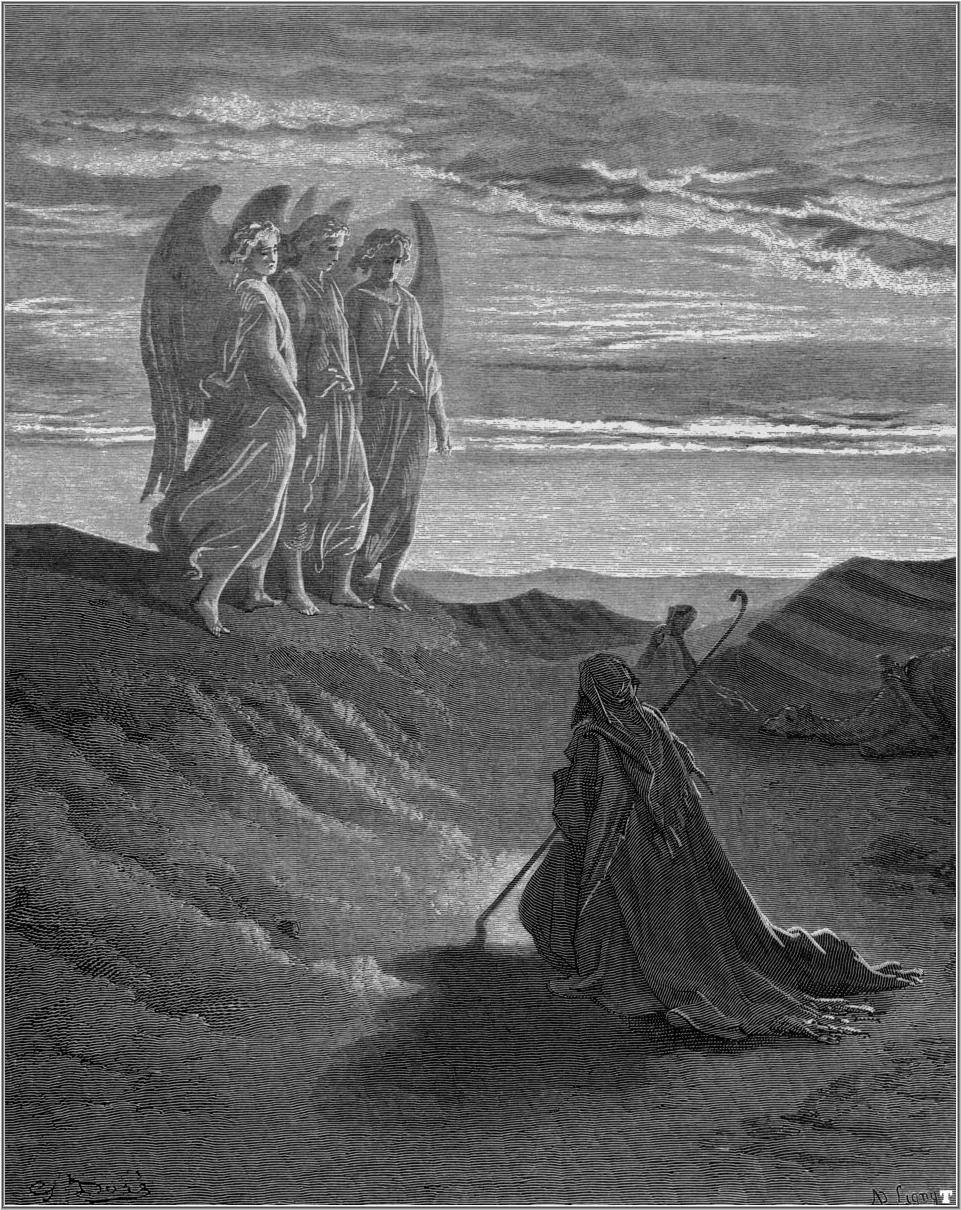
Abraham and the Three Angels, by Gustave Dore (via Wikimedia Commons)

And Moses was content to dwell with the man: and he gave Moses Zipporah his daughter. And she bare him a son, and he called his name Gershom: for he said, I have been a stranger in a strange land. (Exodus 2:22)

And he lift up his eyes and looked, and, lo, three men stood by him: and when he saw them, he ran to meet them from the tent door, and bowed himself toward the ground, And said, My Lord, if now I have found favour in thy sight, pass not away, I pray thee, from thy servant: Let a little water, I pray you, be fetched, and wash your feet, and rest yourselves under the tree: And I will fetch a morsel of bread, and comfort ye your hearts; after that ye shall pass on: for therefore are ye come to your servant. And they said, So do, as thou hast said. And Abraham hastened into the tent unto Sarah, and said, Make ready quickly three measures of fine meal, knead it, and make cakes upon the hearth. And Abraham ran unto the herd, and fetcht a calf tender and good, and gave it unto a young man; and he hasted to dress it. And he took butter, and milk, and the calf which he had dressed, and set it before them; and he stood by them under the tree, and they did eat (Genesis 18:2-8).

Southerners are famous for their hospitality, so much so that the words are coupled together idiomatically in the phrase ‘Southern hospitality.’ Leaving aside potentially ironic implications of that expression (let us not forget that the ‘genteel’ South also maintained a bevvy of Jim Crow laws aimed at making life inordinately inhospitable for Southern Blacks), the concept of being a good host and treating those who arrive at one’s doorstep with dignity, warmth, and grace does have strong roots in American soil. Those roots are not exclusive to that soil, of course; the Ancient Greeks placed a tremendous value on the guest/host relationship, evidenced by numerous ancient writings and even the term the Greeks used for the practice of being a good guest/host, ghosti. Likewise, Hebraic culture values the right treatment of the stranger or alien in one’s land, as in the scriptural passages which launched this article, as well as dozens of other examples throughout the Bible. On American ground, however, this relationship found a variety of expressions among numerous peoples. While the performance of hospitality is inevitably different depending on its cultural context, the surprising homogeneity of value placed on hospitable action speaks to a core of humanity.

The practice of hosting and honoring the unknown guest also appears in a number of folk narratives with a distinctively supernatural bent—hosting angels unwares, so to speak, although in some tales the beings hosted are decidedly non-angelic. In this article we shall see some examples of these supernatural interactions, the rewards and risks involved, and some potential interpretations of the practical application of unearthly hospitality. We will also look at some of the rituals and traditions surrounding hospitality towards mortal beings, which is where we shall begin our examination.

In the Appalachian Mountains, traditions of hospitatlity are very strong, of course, but often mountain people might not see much of others except at major events. Being a good host extends to some of the most private moments in life, including the first night of marriage. The concept of a spontaneous wedding reception, called an ‘infare’ can be summed up thusly: ‘The word infare comes from Old English: in plus faran, to go in. It was a reception held in the home of the newly-married couple. Word was ‘spread around;’ no invitations wer issued, but people in the community knew that they were invited. Refreshments were served and games were played very much as at the play-party [essentially a bridal shower]. Neighbors often brought gifts of food and other things to be used in the home of the newly-wed couple’ (Gainer 32-33). The infare is a concept similar to the charivari or shivaree, which involved friends and neighbors of the newlyweds waking them the morning after with banging pots and pans, bells, whistles, hoots, and a number of innuendos about the wedding night. The function of these hospitality rites centers on a few concepts: celebration of a new union, blessing the happy couple, and community integration.

Sometimes extends to the idea of hospitality as an aspect of place versus people: ‘When you return to the house for something that has been forgotten, sit down in a chair before leaving again to avoid bad luck’ (Gainer 127). In a story from Hoosier folklore, it is neither a person nor place with an expectation of hospitality, but an object—a stove, in this case:

An old lady in St. Francisville sold her cookstove to a man who promised to pay her funeral expenses instead of giving her the price of the stove in ready cash. He didn’t do as he promised. Every time his wife tried to get a meal and cook on the stove, the stove lids would fly off. So he went to the priest and told him about it. “Have you made any promises lately?” asked the priest. Then the man had to confess that he had promised to pay the old woman’s funeral expenses in return for the stove but that he hadn’t done it yet. Then the priest told him to go right away and pay off his debt as quickly as he could. So the man did this and after that he and his wife had no more trouble about being able to cook on the stove, and the stovelids never flew off again (Smith 50).

This last example is essentially a haunting tale, although the aspect of returning a promised favor lets me slip it in edgewise to this look at hospitality. Weddings and ghosts aside, many examples of good housekeeping between the mundane and supernatural realms do follow the ‘angelic’ mode more closely.

In folklore from Mormon sources in the western United States, several stories center on visits from saints and angels. One of the best known versions of such tales is that of the “Three Nephites.”

According to the Book of Mormon, Christ, upon his coming to the American continent, had twelve apostles. When it came time for him to leave, he asked them if there was any wish that he might give them. Nine of them asked to go with him. The other three remained silent. They were told that they would never suffer death. Since then they have roamed the earth in a sort of immortal state. They appear at frequent intervals to give aid to those in distress or to give advice. Mormon literature is full of accounts concerning the mysterious appearance of one of these men and the wonderful things that they have done…Oral versions can be heard in almost every Mormon community (Dorson 500-502).

Dorson then recounts two different versions of the Three Nephites tale. In one, a sick brother is brought back from the brink of death on an isolated plot of land by a wandering stranger, who disappears almost the moment he leaves the house. Other Mormon tales include “The White Bread on the White Cloth,” in which an angelic visitor cures a sick baby from a hospitable household and “The Hungry Missionaries,” which tells the story of a pair of missionary Mormons near starvation who are gifted bread by a kindly stranger, only to find that their parents had given bread to a needy stranger that same night hundreds of miles away. Another version of the visitor tale that pops up frequently in Mormon lore involves the appearance of a “wee small voice” which provided emergency guidance in spiritually challenging situations. Some folklorists have equated the wandering Nephite tales with the tales of the “wandering Jew” found in some European legends (see Gustav Meyrink’s The Green Face for a fictionalized version). While the “wandering Jew” tales frequently bear at least a small amount of anti-Semitic language or tone, Jewish custom also has its own version of the guest, with the empty plate set for Elijah during holy meals. My wife and I adopted a similar custom after seeing Christmas Eve practices in Prague.

Returning to the South, there are a few other places where strangers traveling in strange lands find succor among the locals. In Southern Protestant church circles, there are frequently tales of the wandering preacher being hosted by congregational family members, particularly for meals after Sunday service, often dining with a family while sharing extended prayers, blessings, and occasional sermons. Eventually, he becomes something of a comic character, giving rise to the popular proverb: “When the preacher come by for Sunday dinner it make[s] the chickens cry” (Courlander 500). In some versions, the preacher’s role can be turned into an abuse of power, even something evil or diabolical. Literary examples include Flannery O’Connor’s “Good Country People” and Randall Kennan’s Let the Dead Bury Their Dead. In addition to men (and occasionally women) of the cloth, African American communities put emphasis on the value of storytellers who would move between communities sharing lore and news. In this way, they were similar to a wandering bard figure, but more often the storytellers would be found in a centralized location (porch of a local mercantile—also becomes a literary figure, and a central piece of the narrative in Hurston’s Mules & Men).

The traditions surrounding hospitality, whether Southern or more broadly interpreted, form a core piece of American cosmology. Since one never knows just who one is hosting, graciousness is always a wise decision.

Thanks for reading!

-Cory


Podcast 62 – Pregnancy and Birth Lore

Shownotes for Podcast 62 – Pregnancy and Birth Lore

Summary:
In this episode we’re trying out the wedding ring test, asking about spicy foods, and trying not to scare any birthmarks onto Laine’s baby as we talk about the lore and folk customs surrounding pregnancy and childbirth.

Play:

Download: New World Witchery – Episode 62

-Sources-

We mostly mention various lore we remember without citing sources, but I do mention a few books:

Pagan Podkin Super Moot 5 is going to be in Chicago! Watch Fire Lyte’s page for more detail to come.

Cory is going to be moving to Pennsylvania in the Fall, which may impact the show and blog a bit (but probably for the better in the long run)

If you have feedback you’d like to share, email us or leave a comment. We’d love to hear from you!

Don’t forget to follow us at Twitter! And check out our Facebook page!

Promos & Music

Title music:  “Homebound,” by Jag, from Cypress Grove Blues.  From Magnatune.

Promos:

  1. Lamplighter Blues
  2. Welcome to Night Vale

Blog Post 187 – Magical Hats

Cowboy hats for sale in Austin, TX (photo by Nika Vee, via Wikimedia Commons)

There’s a line from the classic (well, sort of) movie Smokey & the Bandit in which Burt Reynolds’s character explains to his lady of the film that he only takes his hat off for one thing, to which his female companion (Sally Field), of course, replies: ‘Take off your hat.’

Costume is frequently a reflection of ceremonial, ritual, or even magical operation, an outer manifestation of inner desire or power. A nun’s habit or a burqa can both represent a commitment to religious life, and inspire reactions from those around them. The ceremonial robes of a Thelemic magician frequently conform to specific standards to enhance invocations and rituals. The Encyclopedia of American Folklore notes:

Folklorists who discuss adornment have concentrated on costume’s socializing force and its relationship to the maintenance of individual and group identities. According to Don Yoder (1972), folk costume expresses identity in a symbolic way; functioning as an outward “badge” of community identity and expressing an individual’s manifold relationships to and within that community (Brunvand 341).

One of the items frequently associated with magicians is the magic hat—whether it’s the shiny tophat of a stage magician concealing a rabbit in its depths or the pointy, star-spangled adornment of a fantasy wizard. In American lore the hat has a special place as a magical item, frequently providing either symbolic guidance, otherworldly taboo, or a method of deployment in spell-casting.

When people think of American hats, possibly the most iconic is the cowboy’s ten-gallon hat (which, of course, does not hold ten gallons, but the galon hatband worn by Southwestern vaqueros). I remember teaching overseas and asking about impressions of America, and the most common response was that we tend to wear cowboy hats and smile a lot.

The cowboy hat—as well as a number of other elements of ‘rugged’ American folk costume—was borrowed from other cultures:

Many specifically American types of costume emerged from the interaction of diverse costume traditions in dialogue with indigenous materials and environments. Recognizable forms in Western regional costume, for example, are creolized forms resulting from the interaction of different traditions of dress. The costume of mountain men who charted new Western territory—fringed buckskin coats, breeches and shirts, fur “coonskin” hats, and thick, colorful blanket jackets—was an adaptation of Native American costume forms suitable for native environments and constructed with indigenous materials. The occupational costume of the American cowboy was also the result of the interaction of various cultural forms in dialogue with the demands of occupation and environment. Many of the recognizable elements of the classic American cowboy costume, such as spurs, hat, boots, and chaps, were the result of cultural exchanges between working Anglo and Mexican cowboys, known as vaqueros. Vaqueros were known by their wide-brimmed hats, short jackets, colorful neckerchiefs, red sashes, elaborate spurs, and protective leather leggings (Brunvand 343)

Given the emblematic nature of the Stetson and its kin and the frequently superstitious nature of life in the Old West, it is hardly surprising that lore has arisen surrounding this headgear. Probably the most common belief surrounding the cowboy hat has to do with what to do when you’re not wearing it. There seems to be an absolute taboo on placing a hat on the bed, which appears in everything from Southwestern rodeo lore to Oregon folk belief.

In both the American South and West, a particular custom of hat-burning following the birth of the first baby (or sometimes only the firstborn son) of a miner prevails. From Vance Randolph’s Ozark Magic & Folklore comes the following account:

In some clans, when a baby boy is born, a sister of the babe’s father comes to the house, looks at the child, and then burns the first hat she finds. No matter whose it is, nor how valuable, she just picks up a hat and throws it into the fireplace. Many people laugh at this and pretend to take it lightly, but it is never omitted in certain families. I know of one case where there was some doubt about the child’s paternity, and the husband’s family were by no means friendly to the young mother, but despite all this one of the sisters came and burned the hat; she did it silently and grudgingly and most ungraciously, but she did it. This practice is never discussed with outsiders, but it is sufficiently known that a series of funny stories has grownup about hats being burned by mistake, strangers’ hats missing, doctors leaving their hats at home, and so on (Randolph 205)

This practice was also found in California by folklorist Wayland Hand, where “[o]n occasion of a miner’s first trip to the mine after the arrival of the firstborn, his comrades simply seize his hat and burn it despite any resistance or protests offered” (Hand 52). This act functions both as an initiatory rite and as a method of preventing bad luck for the child. Hand also notes that the baby was usually made to touch the hat if possible prior to its cremation. A soldier’s hat could also be worn by a woman in labor to give her strength during the birth, furthering the link between children and hats.

A number of traditions from African American folklore have been attached to hats. In most cases, headgear serves as a method for the transference of contagious magic, sometimes almost in a medical sense: “if one borrows a hat from a diseased person, and the wearer sweats round the forehead where the hat rests, he will take the disease” (Steiner 267). Harry Hyatt recorded a string of beliefs among African Americans surrounding hat lore:

9750. If a girl puts a man’s hat on her head, she desires him to kiss her; if a man puts his hat on a girl’s head, he desires to kiss her.
9751. A girl should never put a man’s hat on her head; it will cause quarrels with him.
9752. The girl who tries on a man’s hat will not get him for a husband.
9753. If a woman throws her hat and gloves on a man’s bed, she wants to sleep with him; if a man throws his hat on a woman’s bed, he wants to sleep with her.
9754. A girl can strengthen a sweetheart’s love by laying his hat on her bed when he comes to see her.
9755. The significance of a beau refusing to hand his hat to his girl when he calls on her is love growing cold. 9756. A girl stepping on a man’s hat will soon marry the owner.
9757. “The girls did this when I was young: in the spring stamp with your thumb in the palm of your hand the first twenty-seven straw hats you see and you will meet your beau.”
9758. If a girl takes the bow out of the hat of each man liked, she will marry the owner of the seventh hat.
9759. Let a girl take as many bows as possible from the hats of men liked and wear them on her garter; the bow staying on longest will reveal who among these men loves her best (Hyatt 231)

Clearly some of these are contradictory, as in the piece about one gender wearing the other’s hat breeding either contempt or desire. There does seem to be a very strong connection between hats and sexuality, however, perhaps because the hat sits so close to the brain and retains the warmth of the head, it may be seen to cause ‘feverish’ behavior, such as love, lust, or even fighting. The divinatory rites surrounding hats are also interesting, although I suspect these performances have less to do with any direct effect upon the mind and more to do with other counting rituals related to love forecasting. Several tricks in the practice of old-style hoodoo involve acquiring the band from a man’s chapeau and using it to deploy any number of tricks, mostly designed to influence him in love (or occasionally business).

A bit of lore from the Southern mountains tells about how a person can reverse bad luck caused by unfortunate omens (in particular a fearsome rabbit crossing one’s path): [If a] Rabbit runs cross yur path, turn yur hat ‘roun’. (Wear your hat with the back part in front.)” (Duncan 236). This is not much different from the idea of turning around if a black cat crosses one’s path or even turning a key or coin over in one’s pocket after seeing an unlucky sign. In an era when hats are frequently worn backward (if worn at all), this sort of act is probably much less out of place today than it would have been half a century or so ago.

Hats, then, can be deeply magical objects to those that wear them. It’s hardly surprising that Lyle Lovett sings of his size-7 Stetson, “Well if it’s her you want, I don’t care about that/ You can have my girl, but don’t touch my hat.”

So what about you? Do you have any hat-related lore? What kinds of hats hold particular magic for you? The pointy costume ‘witch’ hat? A trucker’s cap owned by a favorite grandfather? I’d love to hear what makes your hat special and whether you ever ascribe anything magical to it.

Thanks for reading!

-Cory

Podcast 60 – Aesthetics & Mechanics

Summary:
Tonight we’re responding to a pair of conversations from other shows on witchy aesthetics and the mechanics of magic. First, we’ll look at some ideas about fashion and self-image brought up by Scarlet’s Lakefront Pagan Voice show, then touch on the functional structures of folk magic with reference to a recent Inciting a Brewhaha episode.

Play:
Download: New World Witchery – Episode 60

 -Sources-

  1. The two podcasts we use as our springboards for this show are Scarlet’s Lakefront Pagan Voice Episode 73 – A Witch in the Wardrobe and Inciting a Brewhaha Episode 31 – Superheroes and Modern Magic.
  2. Cory mentions the recent Star Magic course he took with the lovely Bri Saussy as part of his “What’s in Your Cauldron?” He also mentions the New Orleans Wish Dog he’s using as part of a sweetening work.
  3. We are highly encouraging listeners to go check out Heather Dale’s Celtic Avalon campaign and help her to bring her music to the world!
  4. We also announced the winner of our Three Questions contest.

If you have feedback you’d like to share, email us or leave a comment. We’d love to hear from you!

Don’t forget to follow us at Twitter! And check out our Facebook page!

 Promos & Music

Title music:  “Homebound,” by Jag, from Cypress Grove Blues.  From Magnatune.

Promos:

  1. Inciting a Brewhaha
  2. Lakefront Pagan Voice
  3. Kindle Witch Podcast

Incidental music was “Lady Gaga/Myrtle Snow Mix,” found here, and “Hawthorn Tree,” by Heather Dale.

Blog Post 185 – New World Witchery Cartulary No. 5

Happy New Year to you!

Today I thought I might share a few of the things from my holiday stocking, as well as other treats and delights I’ve been enjoying lately. I got a very lovely and eclectic selection of books & music, some of which might be of interest to folks here, so if you find something among the pile that you like, I’d love to know!

The first thing I want to mention is a beautiful copy of Crossway’s Four Holy Gospels. It’s the English Standard Version (ESV) of the books of Matthew, Mark, Luke, & John illuminated using contemporary art by Makoto Fujimura. It’s a big, gorgeous clothbound edition and conveys a great deal of the mystical nature of these texts. I know it’s a bit odd to recommend a Bible of sorts on a site with so much magic and all, but if you’ve been around us for a while you know that we’re equal opportunity when it comes to mysticism and magic. So if you’re looking for a good heirloom version of the gospels with a little artistic magic, this is a good one to have.

In addition to the gospels, I got a copy of an excellent book called Kanaval: Vodou, Politics, & Revolution on the Streets of Haiti. It’s a photojournalistic look at the Haitian carnival costumes, parades, and traditions, and it will be of extreme interest to anyone captivated by the rituals of Vodou(n) or other African Traditional Religions. A number of lesser-known loa show up in the text, and there are oral histories from participants in the celebrations that are simply unmatched in recent history. In addition to the book and its magnificent photos, there are two accompanying CDs (one of which I received along with the gospels from my in-laws—I have an amazing family). One is called Spirits of Life, which has a number of ritual songs, and the other is Rara in Haiti and plays some of the more celebratory carnival jazz-style music.  I also bought myself a simply wonderful new magical psalter from Troy Books:  The Charmer’s Psalter, by Cornish witch Gemma Gary. It has fast become one of my favorite magical books and travels with me everywhere now.

Shifting from the authentic to the entertaining, I’ve been very much enjoying this year’s run of American Horror Story, subtitled Coven and set in a world of New Orleans Voodoo and witchcraft. I actually introduced Laine to the show, and she’s taken off running with it, consuming the first two seasons as well (subtitled Murder House and Asylum). I’m sure we’ll wind up discussing it more elsewhere, and it’s generating some controversy around the Pagan blogosphere, but if you’ve not checked it out and enjoy good, immersive horror, it’s fun to watch, in my opinion.

In that same vein, I’ve also been enjoying the kitschy-but-witchy antics of Witches of East End on Lifetime. I can’t say it’s a must-see, but the episodes I’ve seen have been enjoyable and if you’re a fan of things like Charmed, this might be fun, too. Might.

A lot has been going on in the podcasting universe lately, too. I’ve been tuning in to a couple of new shows, including The Kindle Witch with Faelyn, Pagan Life Radio with Brent/Raven, and one called Disney Story Origins. The first two offer some nice new elements to the Pagan podcasting world. Faelyn uses her show to explore books in a sort of book-club format, while also sharing a lot of neat moments from her own practice. Brent/Raven uses his show to create a really neat community space for talking to Pagans working on specific goals, or just get into good discussions about the role of Paganism in contemporary society. The Disney origins podcast is a gem, where the host compares and contrasts the stories that inspired Disney movies to the films and explores how that translation happens. The most recent episode gets into the excellent recent film Frozen and its inspiration, “The Snow Queen,” by Hans Christian Andersen (a section of which was included in our Yule show this year).

I’m also sad to say we’re losing at least one of our podkin for a while. Gillian at Iron Powaqa recently announced she’s taking an open-ended break from recording to focus on other projects. I completely understand her reasons, but she will definitely be missed. I fear this will be a trend, as several podcasters have disappeared this year.  On a happier podkin note, Fire Lyte has published his first book of poetry, The Playground, which is available in several formats now. If you’re a fan of his poetry, this is definitely a book to get (plus it supports Pagan podcasting, which is always a noble cause).  Finally, if you’ve not been listening to Peter Paddon’s revitalized podcast, do so! It’s the reason New World Witchery even exists, and he’s an absolutely charming fellow (all puns intended).

That’s all the news that’s fit to print for me this week! What was under your tree this year?

Don’t forget to enter our contests! We’ve got a NOLA Swag Bag contest finishing this Friday, and a Three Questions contest which will finish up next week. Give ‘em a go, and maybe win something fun!

Thanks for reading!

-Cory

Quick Update – A New Year, A(nother) New Giveaway!

Divination Prize Pack

There’s a bit of folk superstition about New Year’s Day that says whatever you want to be doing for the next twelve months, make sure you’re doing it on January 1st. You’re also not supposed to start anything you can’t finish, which brings me to this quick-n-dirty little blog post. I intend (dare I say hope?) that I will be doing a tremendous amount of writing over the coming year, including finishing several writing projects I’ve been working on for a while, so I wanted to make sure I wrote something for New World Witchery before midnight tonight. But I also have been using the day to accomplish a dozen other New Year’s magical traditions (cleaning, black-eyed peas, collard greens, etc.) so I thought a short and simple giveaway post might just kill the proverbial twin birds.

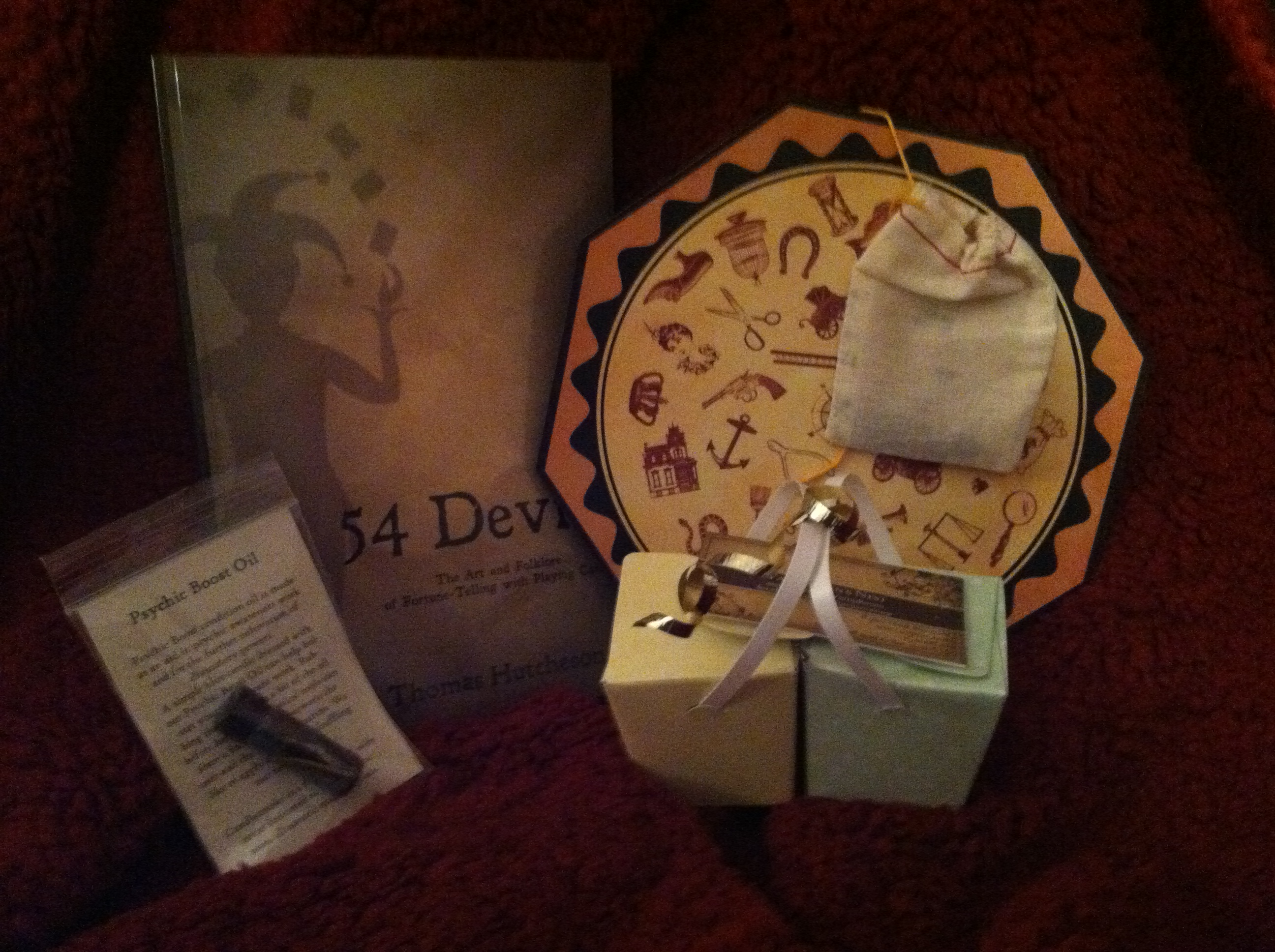
For this giveaway, we’ll be handing out a doozy of a divination prize pack. It includes:

  • A copy of my cartomancy book, Fifty-four Devils
  • A mini-altar kit and pair of mini-dowsing rods from Franchesca at The Texan Heretics
  • A bottle of Psychic Boost Oil from the lovely Magnusons of Candlesmoke Chapel
  • A stunning javamancy board from Chas Bogan of Carnivalia
  • A five-card email card reading from me, complete with card report

Pretty stellar, huh?

So what do you have to do to get an entry into this contest? It’s incredibly simple! Just answer one or more of the following questions:

  1. What are your magical/witchy/Pagan New Year’s resolutions? What magical projects do you hope to get off the ground? Are there areas you want to learn more about? Are you going to get more involved in the community? Just give us a brief snapshot of what you hope to accomplish from a magical standpoint in the coming year.
  2. What is your favorite magical/witchy/Pagan holiday and why? What do you do for it? Has it always been your favorite? What will you be doing to make it special this year?
  3. What (if any) practices, spells, etc. has New World Witchery been able to add to your cauldron? Are there specific regions of folk magic you’ve begun to explore more (like Conjure or Powwow)? Do you find the info here useful on a practical level or is it more of a general information site for you?

That’s it! All you have to do is write to us at compassandkey@gmail.com and answer a question or two or three. You get one entry per question answered, so you have a chance to get up to three entries just by writing to us (you can combine all answers into a single email, as long as you make it clear you’re answering multiple questions somehow). Make sure to use the subject line “Three Questions Contest” so I know what you’re writing us about.

The deadline for this contest will be Friday, January 31st, so get your answers to us by then!

Also, please check out and/or enter our other current contest for one of three NOLA swag bags, which will be ending January 17th!

Thanks everyone for a great 2013, and here’s looking forward to a very enchanted new year!

-Cory

Podcast 58 – Yuletide Cheer! 2013

-SHOWNOTES FOR EPISODE 58

Summary

Our annual fruitcake of wintery music, poetry, & other holiday goodies!

 Play:

Download: New World Witchery – Episode 58

-Sources-

Stories & Poetry:

  1. Noel,” by Katherine Porter
  2. “Christmas,” (two versions) and “Winter,” from The Real Mother Goose
  3. Christmas Trees,” by Robert Frost
  4. A selection from “The Snow Queen,” by Hans Christian Andersen
  5. Santa’s Traveling Companions,” adapted from information at the Saint Nicholas Center

Don’t forget to follow us at Twitter! And at Facebook!

Also, please enter our current contest!

Promos & Music

All songs used with permission/license, from Magnatune, SoundCloud, Creative Commons, and MusicAlley, except as noted.

Playlist:

  1. “Nou is Yole Comen,” Shira Kammen
  2. “Swete was the Song,” by Artsy Honker
  3. “Good King Wenceslas,” US Army Chorus
  4. “Candelight Carol,” Kathmandu Chorale
  5. “Lo How a Rose E’er Blooming,” Annie Hiller
  6. “Carol of the Birds,” by Broceliande*
  7. “The Holly, Witches Dance,” Harper’s Hamper
  8. “Broome, Bonny Broome,” Harper’s Hamper
  9. “Patapan,” Fugli
  10. “Cherry Tree Carol,” Rose & Thistle Band (independent artist)
  11. “This Endris Night,” US Army Chorus
  12. “Cold Blows the Wind,” Music for a Winter’s Eve
  13. “Deck the Halls,” Harper’s Hamper
  14. “Green Grows the Holly,” Shira Kammen
  15. “O Christmas Tree,” Tubachick
  16. “O Tannenbaum,” Kellianna (f. Jenna Greene)*
  17.  “Winter’s Ritual,” SJ Tucker (from Ember Days soundtrack)*
  18. “Wassail Song,” Music for a Winter’s Eve
  19. “Come Landlord fill the Flowing Bowl,” The Limeybirds (independent artist)
  20. “Boar’s Head Carol,” The Pagan Carolers
  21. “O Come Emmanuel,” Mary Ellen Kirk
  22. “Ave Maria,” Kellianna*
  23. “Da Day Dawn,” Samantha Gillogly*

*Used with artist permission

Underscoring music is “Nu Zit Wellekome,” Ralph Rousseau Meulenbroeks, and “Courdian,” Music for a Winter’s Eve, both from Magnatune.

Blog Post 184 – Comets

The Comet of 1680, by Lieve Verschuier (via Wikimedia Commons)

“Like a comet burn’d
That fires the length Ophiuchus huge
In the Arctic sky, and from his horrid hair
Shakes pestilence and war” (Milton, Paradise Lost)

With the ISON comet drawing eyes to the night sky, I started thinking a lot about the superstitions and magical beliefs surrounding the appearance of comets in the sky. Comets have long inspired people in strange, occasionally beautiful, and sometimes disturbing ways. Mark Twain’s life was framed by the appearance of Haley’s Comet, a point the author himself noted. The Heaven’s Gate cult engaged in a group suicide surrounding the arrival of the Hale-Bopp comet.

Increase Mather, famed early American religious writer, dedicated an entire work to explaining the spiritual importance of comets in his Kometographia of 1683. He was responding to the presence of the Great Comet of 1680, which had captured the attention of most of the Western world, and felt that many people would be afraid at this sign and misunderstand it as a phenomenon which directly influenced the course of events on earth, rather than a sign from God of some important event to come (see more here). Generally speaking, comets have historically been associated with strife and woe to come. My Opie/Tatem Dictionary of Superstitions gives a laundry list of examples of ill-omen presaged by what the Venerable Bede called “long-haired stars”:

  • A comet as portending a change in governance (Tacitus, Annals)
  • Famine or pestilence or war or “fearful storms” (Byrhtferth, Manual)
  • A comet [the Great Comet of 1680] appeared two days before the Duke of Monmouth died, and all over Europe before the death of Charles II (J. Case, Angelical Guide)
  • An appearance before the plague struck London (Defoe, Journal of a Plague Year)
  • A wry observation that those who laugh at comets as tokens of disaster will studiously insist on “times and situations proper for intellectual performances” (Johnson, The Idler)

In the New World, comets seem to have retained much of their wicked reputation. In some cases the danger foretold by the comet is vague and ill-defined: “When a comet appears there will be trouble” (Roberts, “Louisiana Superstitions”). In other places, the significance of the hairy star was more direct and its consequences very  clearly understood: “A comet is a sign of war” (Thomas, Kentucky Superstitions).  Why should these astronomical phenomena, which had been showing up in night skies for ages, have such a bad rap? Considering even Classical authors like Tacitus cite the comet as woeful, the impulse must run deep. The unique cosmological view of Calvinism, though, which influenced much of Atlantic American colonization, both denigrated occult practices like witchcraft and supported an enchanted view of a univers under Divine direction:

“The Calvinism of the colonial awakenings also paralleled important occult ideas. The fatalism inherent in Calvinism’s concept of predestination found an occult equivalent in the idea fundamental to astrology that motions of star and planets revealed a future that individuals could not control. Calvinist evangelists and occult practitioners also explained catastrophes in similar ways. Believers in occult ideas thought the coming of comets and eclipses had inescapable and usually disastrous consequences; not even kings and queens escaped their verdicts. No one escaped judgment by the Calvinist God either. Sometimes He damned seemingly model Christians simply to demonstrate His sovereign” (Butler, “Magic, Astrology, & the Early American Religious Heritage”).

The shared cosmology of the colonists saw the universe as inhabited by spiritual consciousness, and an intelligence that wished to convey its meaning to human beings for one reason or another. Signs, omens, and portents were one such method. Comets, with their placement among the stars, their strange and ill-understood movement, and temporary nature made perfect fodder for prognosticators of all stripes—religious, occult, and both (they did exist, even during the Colonial period).

Lest we make the mistake of thinking that the observation of comets was the purview of only a few dusty old white occultists or a lot of fiery former Englishmen with strong religious convictions, I’d also like to point out that the cosmology which imbued comets with significance stretched across a broad swath of New World denizens, including Native Americans, Spanish and French colonists, and of course, the imported Black slaves.

“English Protestants often read unusual events as evidence of the divine presence in everyday life, acknowledging the activity of a creator deity who operated through omens and portents within the natural order, or signs and wonders in the heavens, philosophy known as Providentialism. “Comets, hailstorms, monster births and apparitions” and other disruptions of the ordinary were demonstrations that foretold God’s will or signaled His displeasure withhumankind. Africans’ understandings of the universe were also inspired by visible manifestations of spiritual forces within nature. They too viewed thunder, lightning, and other elements as heralds of sacred hierophanies,the awesome presence of numerous divine beings.” (Chireau, Black Magic).

The Providentialism Chireau notes fits the cosmology of the English and other European settlers, but it is clearly not unique to them. A world with Divine presence not only innate to its component parts, but in which those component parts act as mediums for communicating with humans, is also very much an African perspective. And while it is tempting to think that such beliefs can be relegated to history’s dustbin, we should also remember that in our time comets stir up a lot of strange excitement. Religious scholar Camile Paglia notes, for example:

“The Children of God, founded in 1968 as Teens for Christ by “Moses” David Berg in Huntington Beach, California, were negligible in number but came to public attention when they loudly prophesied that the us would be destroyed by Comet Kohoutek in January 1974. The group continues under the name “The Family” and is regularly excoriated by conserva tive Christian watchdog groups for its practice of free love (called “Flirty Fishing”) as well as its heretical beliefs that Jesus was sexually active and that God is a woman. (Paglia, “Cults and Cosmic Consciousness”)

Paglia also references the Hale-Bopp comet mentioned earlier, and Marshall Applewhite’s Heaven’s Gate cult. I have, so far, not heard of any particularly distressing phenomena surrounding ISON’s appearance, but if nuclear war breaks out, I may have to blame that particular “long-haired star.”

If you have comet lore you’d like to share, please do so in the comments!

As always, thanks for reading!

-Cory

Quick Update – NOLA Swag Contest!

Hi all!

If you’ve listened to the latest episode, you know we’re having another big contest right now. We had such generous sponsors this year we were able to put together a few extra swag bags for fan giveaways, so you have the opportunity to win one of these stuffed full of magical goodies!

kathleen_swag_bag_2013What’s in the bag, you ask? Well, specific contents will vary a bit (due to the personalized nature of the sponsor items in some cases), but I can tell you about our fantastic sponsors and what they sent along to give you a good idea what would be in there:

  • Javamancy KitCarnavalia/The Mystic Dream  – Chas Bogan and Storm Faerywolf created a fun and clever play on geomantic divination with a Victorian flair.
  • Three Venezuelan Powers Holy Card SetsCamino de Yara– The lovely Carolina Gonzalez shares a beautiful bit of South American folk magic with us.
  • Stay with ME Bath The Curio & Candle Shop  – Ms. Melanie made these simply beautiful (and wonderfully scented) magical herbal baths.
  • Lucky Green Rice SachetsDraconis Arcanum  – Rebecca sends you luck and good fortune, and invites you to share the promo code attached to her samples with your listeners (and use it yourself if you like!)
  • Handcrafted Conjure Condition OilsCandlesmoke Chapel– The Magnusons (Sara & Joseph) are sharing some of their incredible and all-natural hoodoo oils.
  • 2014 Witches’ CompanionLlewellyn Publications – This almanac/annual magical compendium has oodles of lunar dates, spells, and articles.
  • Horsetamer CD – Julia Ecklar & Prometheus Music  – This lovely CD crosses Pagan, folk, and pop genres. Music can be used in podcasts, and especially recommended are tracks “With the Trees” & “The Troll King’s Dream.”
  • Traditions Download Card – Kellianna – A beautiful new record with an old soul! Feel free to listen and use the songs from this excellent album in your shows. Features many fabulous duets, including Wendy Rule, and a number of great old songs with Kellianna’s gorgeous vocal updates.
  • EnchantmentPendraig Publishing– Peter Paddon (in attendance with us this year) sent his latest excellent book, all about the use of physical movement and beguiling in witchcraft. I bet he’d even sign it for you if you ask him.
  • Banshees, Werewolves, Vampires, & Other Creatures of the NightRed Wheel/Weiser Books– Weiser supplied this Varla Ventura title all about the beasties of darkness which is sure to keep you up late at night!
  • The Candle & the CrossroadsRed Wheel/Weiser Books– Weiser also supplied this energetic look at Southern folk magic written by Orion Foxwood (who is one of the teachers at the Folk Magic Festival this year).
  • Fifty-four Devils Cartomancy Kit New World Witchery – Cory & Laine give you his book on cartomancy, a fun deck of playing cards to try it out, and Laine’s hand-made card pouches to keep your fortune-telling deck safe!
  • Witches & Pagans Magazine  – BBI Media  – Anne Newkirk Niven & her team at BBI are providing us with the premier magazine in Paganism today.
  • Herbal Healing Salve – Rue & Hyssop/Three Brooms & a Cat  – Jen sadly couldn’t make it this year due to last-minute problems, but sent along these gorgeous hand-made herbal salves in her place.
  • Magical Miscellany Oil & IncenseMagical Miscellany– The lovely Velma Nightshade (also in attendance this year) has provided us with a sampling of her magical wares from her newly launched business venture, Magical Miscellany.
  • Coconut Oil & Obsidian – Kathleen Borealis/Borealis Meditations – Raw coconut oil and hand-selected obsidian chips from our brilliant globe-trotter, Kathleen!
  • Mini-Altar Kits/Dowsing Rods – Franchesca/VampRaven’s Nest– These super-cute little boxes contain a complete miniature altar set with candles, matches, incense, etc., plus a second box with little custom-made dowsing rods!
  • Scarlet’s Deck – Scarlet’s Treasures/Lakefront Pagan Voice– Scarlet surprised us with copies of her own very special and highly limited-edition tarot deck! These aren’t available for purchase anywhere, so only a few people, including us lucky podkin, have a copy!
  • And let’s also do our best to say thanks to Anna, owner of Erzulie’s Voodoo in New Orleans, who hosted us for our event (even if we were our own meet-and-greet, it was still nice of her to let us have the space for a couple hours).

A pretty fabulous haul, eh? There’s definitely at least $100 worth of stuff inside, but really the money side of it doesn’t begin to cover the quality, thought, and love in these items.

So now that you’re eagerly clawing at your scroll button, eyes big as saucers as you see all these amazing things that *you* can win, how do you go about getting your name in the hat?

Official Rules

  1. Purchase something, anything really, from one of the sponsors (preferably from one other than us, and preferably your purchase would have come after November 1st, but we’re not going to be incredibly rigid on those points). You could buy a wanga doll from Erzulie’s, or a copy of one of Peter Paddon’s books from Amazon, or pick up a copy of Witches & Pagans at your local bookstore…pretty much anything you want to buy. It can be for you, it can be a holiday gift, it doesn’t matter. Really we just want you to support our sponsors! [Edit: Dutiful listener Jasmine noted that requiring a purchase could land us in hot legal water. While the spirit of the contest is to encourage business with our sponsors, we will, of course, allow entries from folks who cannot purchase a product. No purchase necessary, simply email us and state you’d like to enter the contest and we’ll put your name in the hat.)
  2. Once you’ve purchased your item, take a photo of you with your purchase (or a copy of the receipt, or a screengrab of your digital receipt, etc.). Send that picture and a brief message asking to enter the contest and saying what you bought to compassandkey@gmail.com (or tweet it to us @NWWitchery).
  3. EVERY item you purchase gets you a new entry (as long as you send us a picture & message), so enter as much as you like!
  4. Contest ends at midnight, Central Time, on Friday, January 17th, 2014! Get us your picture(s) before then!
  5. We will draw three names at random from all the entries, and each of those three names will win a swag bag!
  6. Due to some of the items in this bag and potential international restrictions (as well as international shipping costs), this contest will only be open to listeners in North America. Sorry! 😦
  7. Winners will be announced in the late January show (our 4th pod-iversary!).

Not too complicated, I hope! If you happen to let the sponsors know you found them through New World Witchery, we’d love that, too!

So that’s the basics of this contest. We’ll keep some reminders going throughout the next month and a half, but entering early and often can’t hurt! We’ll also have a few other small contests running between now and then for books and extra swag items, and most of that will happen via Twitter and Facebook, so make sure you’re watching us at those places, too.

Good luck everyone! And thanks for reading!

-Cory

Podcast 57 – New Orleans

Summary:

In this extended episode, we revisit our recent trip to the magical city of New Orleans. We’ll discuss the most recent Pagan Podkin Super Moot, places to see in the Crescent City, and hear some music, travelogues, and even a tea leaf reading or two!

Play:
Download: New World Witchery – Episode 57

 -Sources-

Places Mentioned:

  1. Big thanks and mention to Erzulie’s, which hosted the event!
  2. Yo Mama’s Bar & Grill
  3. Cafe Du Monde (delicious beignets & chicory coffee)
  4. The Gumbo Shop
  5. Chartres House
  6. Bottom of the Cup Tea Room (where we got our leaves read!)
  7. New Orleans Historic Voodoo Museum

Tours & Events:

  1. French Quarter Phantoms (great walking tour with ghost stories & absinthe tasting)
  2. Tours BaYou (awesome downloadable driving tour of the Garden District)
  3. Folk Magic Festival

Pop Culture:

  1. American Horror Story: Coven – Made Laine watch her first episode in NOLA!
  2. Jitterbug Perfume, by Tom Robbins – Cory bought his wife some perfume from Bourbon French Parfum because of its connection to this book.

CONTEST!
We announced a new contest in this episode! Details are coming in a separate post, but the basic rules are: 1) Buy something, anything, from one of the sponsors in the list below; 2) Take a picture with that item (or a a picture/screengrab of the receipt); 3) Send your picture to compassandkey@gmail.com and let us know to enter you in the contest. You could win one of three fully-stuffed PPSM Swag Bags, full of items from these great sponsors!

PPSM Sponsors! (We love them!!!)
(We’ll be posting more on these items in other places, but here’s a short list of the swag items and sponsors)

If you have feedback you’d like to share, email us or leave a comment. We’d love to hear from you!

Don’t forget to follow us at Twitter! And check out our Facebook page!

 Promos & Music
Title music:  “Homebound,” by Jag, from Cypress Grove Blues.  From Magnatune.

Song List:

  1. When the Saints Go Marching In,” by Wingy Malone (from Archive.org)
  2. Joshua Fit the Battle of Jericho,” by the Delta Choral Union (from Archive.org)
  3. Iko Iko,” by the Grateful Dead (from Archive.org)
  4. New Orleans Stomp,” by Louis Armstrong (from Archive.org)

New Orleans Recollections from:

  1. The Texan Heretics
  2. Scarlet at Lakefront Pagan Voice
  3. Kathleen at Borealis Meditation