Blog Post 108 – Holiday Magic in the Kitchen

Today I thought I’d look at some of the holiday lore surrounding baking and cooking.  What would the holidays be without the smells of cinnamon and nutmeg and clove and allspice slowly seeping out of the hot oven?  And who imagines a holiday home without the presence of gingerbread or ginger cake of some kind?  Chocolate and peppermint add extra luxury to an already indulgent season.  In short, much of the magic of Christmastime and Yuletide seems to come from the kitchen (I’m sure many kitchen witches reading that chuckle in amusement that such sentiments even need to be typed out).

So let’s start by looking at some of the ingredients in those festive holiday treats:

Cinnamon – This handy kitchen spice has lots of magical uses.  Cat Yronwode recommends it as a business drawing and gambling botanical.  It can be used to make a wash-water which one would then use to scrub down the walkways in front of a business.  This has the effect of drawing in new clients.  In Jim Haskin’s Voodoo & Hoodoo, cinnamon is mixed with sugar and sprinkled in the shoes to increase gambling fortunes.  Draja Mickaharic describes cinnamon as “calming” with a “protective vibration” and also cites its money-making properties in his Century of Spells (which refers not to a unit of time, but rather a unit of enumeration—a century representing the roughly 100 spells found in the book).  Mickaharic also notes that “it has a claming and quieting effect on young children,” though I imagine in cookie form this may not be the case.

Cloves – Mickaharic says these are “psychically protective,” and keep “negative thoughtforms out of the place where it is burned.”  Presumably including cloves in any baked or cooked dish would involve at least heating them, thus releasing some of this power into the kitchen and home.  Yronwode says that “cloves appear in spells for money-drawing, prosperity, room-renting, and friendship” (HHRM, p. 73).  These are also used to make pomanders, clove-studded oranges rolled in orris root powder and hung as protective talismans in the home (well, protective talismans and lovely nosegays to help imbue the house with that sweet, spicy holiday scent).

Nutmeg – This botanical has a mild narcotic effect and has been a staple of magic for some time.  An old hoodoo charm found in Harry Hyatt’s work and later disseminated by other authors involves sealing a small amount of liquid mercury inside a drilled nutmeg, then carrying the charm around as a gambling mojo (this is NOT RECOMMENDED as mercury is highly poisonous—DO NOT DO IT!!!).  Mickaharic describes nutmeg as an herb which inspires conviviality and jovial behavior, and promotes an air of happy friendship in the home.

Allspice – “Good for social gatherings; increases the flow of conversation and the rapport between people” says Mickaharic (CoS, p.50).  These hard, dried berries can also be soaked for a few hours, then strung as a type of herbal rosary using a needle and thread.  Carrying this can help relieve stress and provide peace of mind.  Yronwode recommends this for business and gambling (there’s a pattern here), and also describes a floor wash one can make with ground allspice.   Mixed with cinnamon and burned as incense, Mickaharic says it “places a smooth and witty feeling” in the home.

Ginger – This fiery herb is used to “heat up” or enhance the potency of various other magical ingredients, and also provides a little kick in spells for love or money (HHRM, p.103).  The root can be used as a poppet due to its shape and sometimes-resemblance to a human body, and would be especially effective in a love or lust working.  It can also be carried for protection.

Sugar – Sweetening!  This can be used to add a “sweet” or happy vibration to the home where it is burned (though it can smell very sharp when burned, too…baking it may not have the same oomph as burning it, but will smell better in the long run).  Of course one can keep all of one’s visiting relatives’ name papers in the sugar jar in order to better provide a happy, congenial home during the holidays, but offering them lots of sugary sweets might help ply a good attitude out of them, too.

As you can see, most of these herbs have to do with prosperity and getting along with one another (and a little protection thrown in for good measure).  This makes sense during a season where money might be tight, tension runs high, and houses are full of dangerous things like fire and hot ovens.  So when doing the holiday baking, it might be worth throwing an extra pinch or two of these spices in to up the magical ante of your confections.

I mentioned gingerbread earlier, and it made me think of a couple of stories from early American folklore about bakers whose experiences with cookies certainly have a magical bent:

The Baker’s Dozen” – A piece of reputed folklore recorded by Charles M. Skinner in 1896, this story revolves around a stingy baker and his encounters with an old crone who bewitches his bakery.  Only through the magnanimous efforts of St. Nicolaus (and by swearing better behavior on a gingerbread cookie shaped like him) does he manage to break the spell.

The Gingerbread Man” – This famous story tells of a gingerbread man come to life who flees his baker and eludes capture by the people and animals of the village.  He meets his match in the swift (and often crafty, in various retellings) fox, who finally devours him.

Finally, I’ll leave you with my family recipe for gingerbread:

1 c. sugar
1 c. shortening
1 c. molasses
½ c. hot water
1 Tbs. cinnamon (or to taste)
1 Tbs. ginger (or to taste)
½ tsp. salt
1 tsp. baking soda
1 egg
7 c. flour, plus a little extra for rolling dough

Preheat oven to 350 degrees. Sift flour and mix in dry ingredients.  Add egg, molasses, and shortening and mix.  Slowly add hot water, mixing as you go.  When dough is sticky, begin to work it into a ball.  Dust a flat surface with flour and begin rolling out the dough, working it until you get it about ¼ inch thick.  Cut out shapes with cookie cutters or a knife.   Bake cookies on a lightly greased cookie sheet for about 15 minutes (or until they are crisp at the edges and fully cooked.  Cool on a wire rack, decorate, and eat!

My mother and I used to bake several batches (rather, a whole day’s worth) of gingerbread, then spend time making the finished products into houses, sleighs, people, and animals.  We gave them as gifts, decorated with royal icing and candy, and were often very popular around the holidays.  I hope you enjoy!  It’ll be like taking a little bite out of your New World Witchery host during the holiday season.

Wait, that probably sounds kind of creepy.  Enjoy anyway!

Thanks for reading!

-Cory

Blog Post 103 – The Chapbook Tradition

My ambitions got ahead of my time last week, so I am behind in posting about magical books in American traditions.  I thought today, though, I’d start at the cheap and plentiful end of the spectrum in the hopes that I might make up for any lack of posting.

Chapbooks—small, cheaply made books usually containing no more than a hundred pages or so—have been a part of the New World landscape since Colonial times.  Many of the most important texts leading up to the Revolutionary War were published in chapbook format, such as Thomas Paine’s Common Sense.  These booklets, which were also frequently referred to as “tracts” or “pamphlets,” were cheap to make and cheap to buy, and could often be found in the stock of travelling peddlars (also known as “chapmen,” where the term chapbook comes from).

In addition to political messages, these little books frequently served as repositories for folklore and folk music, fairy tales, religious information, poetry, fiction, almanacs, and most importantly to us, magic.  I’ll be addressing the topic of almanacs separately, as they have had a tremendous influence on the occult in America, so in this post I’ll focus primarily on the booklets of magic which circulated in North America from the 1600’s until modern times.

Early occult chapbooks generally originated in places like London or Scotland, and bore titles such as Dreams and Moles with Their Interpretation and Signification (London, 1750), The Fortune Teller & Experienced Farrier (Exeter, 1794) or the Spaewife, or Universal Fortune-teller (Scotland, 1860’s).  They contained advice on interpreting signs, reading palms and other body parts, and performing basic divination such as taseomancy (tea-leaf reading).  Some examples of the esoteric knowledge they contained:

  • When a woman dreams she is a man, and is not married, she will have a husband; or if she’s without children, she’ll have a son, but if married ‘twill be ill to have a son; and to a maid-servant, much incumbrance [sic]; ‘tis very fortunate to a harlot, because she will forsake her evil ways. (Dreams & moles)
  • Either he or she that has a mole on the upper part of the ear, and on the right side of his belly, shews the party guilty of such crimes as may endanger their life. (Dreams & moles)
  • [On Palmistry:]  The liver line, if it be straight and crossed by other lines, shews the person to be of sound judgement. (Fortune Teller)
  • To dream you are pleasantly sailing on calm water, denotes a peaceable and quiet life. (Fortune Teller)
  • A Mole on the hip, shows that the person will have many children. (Spaewife)
  • A face naturally pale denotes the person very amorous. (Spaewife)
  • He that hath a great and broad mouth is shameless, a great babbler and liar, proud to an excess, and ever abounding in quarrelsome words. (Spaewife)
  • He that hath a decent beard, handsome and thick of hair, is good-natured and reasonable. (Spaewife)

Some of these books gave medical advice as well, and instructions for livestock management.  In The Fortune Teller & Experience Farrier, author Ezra Pater tells anyone with a horse suffering from a cough to “take five or six eggs, and lay them in a sharp white-wine vinegar, till the shells be somewhat soft, then fling them down his [the horse’s] throat and it will cure forthwith.”   Such remedies would go on to be de rigueur for magical practitioners in rural locations, and especially in the New World.  The reasons for the popularity of such simple guides probably stems from their low cost, but also may have something to do with the rough medicine of frontier life.  In many cases, settlers lived days away from good medical or veterinary care, and so a small practical guide would be indispensible to a rural family.  As for magic’s entanglement with practical medicine, I can only reiterate that until very recently (the mid-to-late twentieth century really) there was no separation between the two, especially not in rural communities.  Not everyone used every remedy, and not everyone used magic, but they were not at odds with each other, either.  I find the best analogy here is a cookbook:  just because you have one hundred recipes doesn’t mean you cook all of them.  In most cases, you specialize and repeat the recipes you like or are best at, and those become your signature dishes.

Over time, other chapbooks emerged and became more and more popular.  In rural and farm communities, such as the Pennsylvania Dutch areas of the middle Appalachians and the Ohio Valley, little books like Hohman’s Long Lost Friend became household texts.  Individual families would also compile their own books, not unlike family recipe books, which might be kept on the same shelf as the family Bible.  In many cases, these chapbooks would be the only texts in the home other than the Bible and perhaps a cherished tome or two of literature like Shakespeare.  In more urban areas, cheap editions of Grimoires found their way into chapbooks, with publishers like Chicago’s William Delaurence producing a number of pirated works in reduced pamphlet form, including The Egyptian Secrets of Albertus Magnus, The Sixth & Seventh Books of Moses, and Hindu Magic and Indian Occultism. In Owen Davies’ excellent history of magical books entitled Grimoires, he explores the influence of the occult in Chicago:

Chicago may have an image as a grim, grey industrial city, but in the early twentieth century it was also a hotbed of mystical, magical, and prophetic activity.  Rural Pennsylvania may have been the cetre of pow wow and New Orleans the home of hoodoo, but Chciago was the undoubted centre of organized occultism and grimoire publication…[it] proved fertile ground for mystical and magical groups. (p.210-11)

Other cities, like Chicago, also began producing quantities of occult chapbooks.  Detroit—which had and continues to have a strong tie to hoodoo—was home to countelss candle shops with shelves full of pamphlets on luck, love, and money magic.  In Harlem, stores like the Hindu Mysterious Store were selling racks of booklets on occult topics into the mid-to-late twentieth century.  Some of the many titles included:

Books like these, especially the dream books (which purported to interpret dream symbols into lucky numbers to be used in lotteries), were tremendously popular.  While the number of shops carrying such literature has diminished recently, the occult pamphlet remains popular and can still be found in many urban magical retailers.

Today, chapbooks still exist and continue to be published, though in two distinct veins.  Some occultists (myself included) like to produce very limited runs of such booklets as artisan items.  The publishing company responsible for the marvelous Witches’ Almanac also issues lovely chapbooks such as Spells & Incantations, Magical Creatures, and Magic Charms from A to Z.  I’m still working on the illustrations and additional material for our New World Witchery cartomancy chapbook, which will eventually be sold through our Etsy shop.  Many classic chapbooks are also still available, such as Henri Gamache’s Master Book of Candle Burning.

The other form in which one can find modern chapbooks will likely lead to scowls from some readers.  If you’re ever standing in line at the grocery store, however, look over at the racks of gum and magazines, and usually near the top there will be small, palm-sized books of cheap newsprint paper and glossy stock covers.  Some of them are all about alleged dieting secrets and pop psychology, but occasionally you can find little tomes of herbal lore, astrological information, and even love spells.  While it may seem unsavory to think of magical literature as an impulse buy in the checkout lane, I would recommend perusing them.  They’re often incredibly cheap and sometimes have good information in them, as well as guideposts to other resources that might be even more worthwhile.  Of course, you may also find all you can do is line your familiar’s cage with them, too, so browse before buying.

I hope this has been useful to you!  If you have any favorite chapbooks or magical booklets, I’d love to know about them!  Please leave a comment or send an email and share them with us.

Thanks for reading!

-Cory

Podcast 20 – Magical Animals

Podcast 20 – Magical Animals
-SHOWNOTES FOR EPISODE 20-

Summary
Today we’re looking at animals and their role in magical practice.  We’ll talk about different species, shapeshifting, and familiars.  In WitchCraft, Laine talks about making Black Cat Oil.  Cory looks at one way to attune with a familiar in SpelledOut.  Don’t forget about the Winter Lore Contest!
Play:

Download:  New World Witchery – Episode 20

-Sources-
Some of the works we cite are:
Patrick Gainer’s WItches Ghosts & Signs
Vance Randolph’s Ozark Magic & Folklore
Ronald Hutton’s Triumph of the Moon
The Foxfire book series
Magical Creatures, from Elizabeth Pepper & Barbara Stacy of The Witch’s Almanac
We mention the Bible, particularly Leviticus 16 (the scapegoat). 16:8 in many translations refers to Azazel (wiki article.  Also, we mention Mark 16: 17-18 (the passage on snake-handling).
We also mention Auntie Greenleaf, whose tale can be found at Americanfolklore.net
You might also be interested in our New World Witchery blog entry on Snakes.
And, of course, we mention Judika Iles’ 5000 Spells again.

Promos & Music
Title music:  “Homebound,” by Jag, from Cypress Grove Blues.  From Magnatune.
Promo 1 – Inciting a Riot
Promo 2 – Borealis Meditations
Promo 3 – RadioLab

Blog Post 102 – 15 Books

Hello everyone!

I recently saw a rather interesting post from a friend on a social networking site in which she listed her “Top 15 Most Influential Books” when it comes to witchcraft.  Since I posted a book review last week (and since most book reviews going forward will likely be shared between this site and the Pagan Bookworm site), I thought that continuing that “bookish” trend might be good.  So this week I will be posting about various texts which have a place North American magical traditions.  Some will be of the grimoire type, and others may just be good reads, but hopefully all of them will be tomes you get much pleasure and use from if you crack the spines and turn the pages.

To start with, however, I’m going to re-use that meme and list my own Top 15 Most Influential (Witchcraft) Books.  These are not necessarily books that I think of as “great,” or even in some cases “good” books.  Many have erroneous information or are, at best, a good starting place for further exploration.  All of them, however, have help shape my study of magic, folklore, and witchcraft in some way, and that’s what this list is really all about.  I’m presenting them in a (roughly) chronological order, since that’s how I best remember them.

TOP 15 MOST INFLUENTIAL (WITCHCRAFT) BOOKS
(2010 Edition)

  1. The Encyclopedia of White Magic by Paddy Slade.  This book was the first book of “real” magic I ever procured.  I’ve talked about it on the show, but the short version is that I was about 11 or so, and I pestered my mother into buying it for me.  Since then, I’ve definitely grown away from its ideas, though I periodically return to it for nostalgic reasons.  It also got me thinking about magic as a folklore-based thing, rather than a sci-fi/fantasy phenomenon.
  2. Earth Power/Earth, Air, Fire & Water by Scott Cunningham.  I know there are lots of folks who regard Cunningham with disdain, but I’m not one of them.   His two books of folk magic, focused on practical spellwork using natural elements, absolutely cemented my interest in spellwork as something more than an esoteric psychological tool.  I still find some of his spells useful, though I’m no longer in tune with his particular worldview or ethical stance.  Moreover, I think that there are far worse books with which one could begin one’s magical studies.  I’ve found over the years that many folkloric sources bear out the techniques described by Cunningham, and I still regard his work fondly.  There are certainly weak points in these books, but winnowing the chaff away is fairly easy with a little work.
  3. Cunningham’s Encyclopedia of Magical Herbs by Scott Cunningham.  I’ll not launch into another defense of the author, but instead say that this book (and to a lesser extent, his Complete Book of Incense, Oils, & Brews) augmented my practice of magic again and helped me to start making my own spell ingredients.  It also helped me to cultivate an interest in gardening, for which I am most grateful.  This book also has one other great thing going for it: an amazing bibliography.  While it obviously pulls from sources like Culpepper’s Herbal, it also contained references to things like Vance Randolph’s Ozark Magic & Folklore (which is also on this list).  So I am quite thankful to this book, and this author.
  4. Jude’s Herbal Home Remedies by Jude C. Todd.  This was an impulse buy to augment my growing interest in herbs after I had eagerly devoured the Cunningham tomes.  It’s not a magical book, per se, but focuses mostly on the physical properties of herbs and their applications as health and beauty aids.  It provided a wonderful resource for learning how to interact with various herbs and brew potions, ointments, tinctures, etc. at home.  I still turn to it sometimes for home remedies, and it also has a place because later encounters with books like J.G. Hohman’s Long Lost Friend reminded me that most magical workers had plenty of practical, non-magical herbal info at their fingertips, too.  Jude’s book filled that role for me.
  5. Magical Tales: The Storytelling Tradition by R.J. Stewart.  In my sophomore year of university, I participated in a storytelling class that changed my life.  It took fairy and folktales off of the written page and showed me something deeply vital about them emerges when they are shared with others.  I also happened to be taking classes in things like fairy and folklore interpretation using academic studies like Bruno Bettelheim’s The Uses of Enchantment and Mary Louise von Franz’s The Interpretation of Fairy Tales.  Into this mix came R.J. Stewart’s book, which looked at the phenomenon of storytelling from the point of view of a magical practitioner.  I know a lot of folks were influenced by Stewart’s The Underworld Initiation, and I think that book is absolutely wonderful.  As far as my own personal influence goes, though, this is the one I’d say really connected to me.   It convinced me that stories contain more than just helpful magical tidbits, but sometimes are magical rituals in disguise, if you’re willing to work through them.
  6. Treasury of Irish Myth, Legend, & Folklore by Lady Gregory & William Butler Yeats.  I couldn’t have really appreciated this book prior to encountering book no. 5 on this list (and going through the courses I did at the same time).  I actually had picked up this text years before because of a passing interest in Ireland which I inherited from my mother (we have family ties back to County Mayo).  After I began to understand fairy tales as something more than fanciful stories, however, this book became an absolute mother lode of good magical material.  I’ve since discovered many of the tales have parallels or retellings in Appalachian and Southern folklore, too, which makes me feel even closer to it.
  7. The Complete Fairy Tales of the Brothers Grimm by Jacob & Wilhelm Grimm, Jack Zipes trans.  I actually borrowed this specific collection from a girlfriend, and its completeness stuck with me.  It included a number of tales often omitted, and several tale fragments I’ve not seen in most editions.  Particular variants aside, this collection falls into the same category as nos. 5 & 6 on the list.  Again, I didn’t know what I had until long after I had it, and now I don’t think I could live without it.
  8. The Marriage of Cadmus & Harmony by Roberto Calasso.  At some point, I became a bit of a mythology junkie, particularly Greek myths.  I read and re-read Edith Hamilton, Bulfinch, and the textbooks from my college classes on the topic.  I went to source material by Hesiod, Homer, Euripides, Aeschylus, and anyone else I could find.  I’m definitely not an expert, but as enthusiastic amateurs go, I foment with glee when I encounter new Hellenic tales.  When I got to Calasso’s book, however, I was taking an advanced course on mythology at school, and everything completely changed.  It was this book that taught me one fundamental thing about mythology (and likewise storytelling and therefore magic):  it changes.  More importantly, there is no “true” or “right” version of any story, but simply the stories themselves.  Mythology isn’t linear, but a web of tales—sometimes they contradict each other, sometimes they conflict with what we think about the culture, and sometimes they don’t make much sense to us.  In all cases, though, the tales are true at a level not related to cross-referencing and documentation, but someplace deeply human.  Calasso showed me that by bombarding me with the stories over and over again in his book, every time a little different, but all connected together, until I got it.  I really do need to send him a thank-you note for that.
  9. Aradia, or The Gospel of the Witches, by Charles Godfrey Leland.  Encountering Leland, for me, was like having someone splash very cold water on my face by the bucketful.  I devoured his work Etruscan Roman Remains and his Gypsy Sorcery & Fortune-Telling, of course, with all the tenacity of a budding folklorist.  It was Aradia, however, that really sent me sailing when I read it.  At the time, I was studying with the outer court of a Gardenerian coven, and had to read things like Gardener, Dion Fortune, and other modern occult classics.  When I got to Leland’s book, though, it felt so different, so authentic that I refused to believe its wild claims and actually got angry at it for deceiving me so well.  I’ve since, however, learned that this book is something special—neither entirely true nor entirely false.  More importantly, it is useful, and its mythos grips me in a very strange way.  I can’t come down in favor of Aradia as a piece of unsullied witchlore, historical to its last printed letter.  But I can say that figuratively, it’s as close to a witch’s gospel as I’ve seen yet.  In short, it just “feels” witchy, and makes me feel the same every time I read it.
  10. Call of the Horned Piper by Nigel A. Jackson.  As I branched out and away from Wicca, looking for something I could connect with better, I began to find a lot about something called “Traditional Witchcraft.”  There were dozens of websites, letters (mostly from Robert Cochrane), and books which I suddenly had to read, and in a very brief period I managed to get through most of them.  While there have been a number of very influential and powerful works in the Trad Craft vein that I love, one stands out to me.  Nigel Jackson’s tome is slim, barely the width of a pencil.  It’s a chapbook, really, yet it contains so much information that I can’t imagine life without it (much less because finding a copy is becoming harder and harder to do).  This book is probably more responsible for my religious magical practices than any other, and encapsulates in about 150 pages what many books cannot in 300 or more.
  11. Ozark Magic & Folklore by Vance Randolph.  This is a book that I found first by accident while seeking information on weather lore, then again by chance looking for an herbal reference.  Finally, I was browsing one of Cunningham’s books and saw this title again in the bibliography, and realized I needed to seek it out.  I’ve since read it many times, and it always offers up a plethora of magical information to me.  Randoph’s book is not a how-to, but one could build a complete magical system out of his work.  Yet it also guides one to several other magical books and traditions as well.  This is the book that made me realize North America is full of occult power and lore, if I was only willing to dig for it a bit.
  12. Hoodoo Herb & Root Magic by Catherine Yronwode.  I’ve referenced this book and the accompanying website (Lucky Mojo Co.) so much on this blog and in the show you probably don’t need me to tell you it’s been an influence.  I’ll just reiterate what a valuable piece of work it is and suggest that without it, I’d probably be fairly lost when it comes to making hoodoo charms, mojos, potions, and formulae.
  13. The Silver Bullet by Hubert J. Davis.  Following the ideas gleaned from Vance Randolph, I began looking for other folklore collections from America which might contain a few sprinklings of witchcraft.  A friend suggested I look into The Silver Bullet, and it truly was a revelatory experience.  In the pages of Davis’ book, the complete repertoire of the American witch dances out.  The book’s segments on what witches do, how to become a witch, and what to do to counter curse read like thinly veiled instructions on American witchery taken right out of a cauldron.  Like Randolph, a person could likely develop a complete magical system based on what this book contains.  It is a marvelous book, and one I turn to repeatedly for witchlore.
  14. The Encyclopedia of 5000 Spells by Judika Illes.  This is another one I constantly reference.  Its real influence on me lies in the fact that I share a love of it with Laine.  We both get so much out of it that it acts as a sort of magical bridge between us.  The Secret Garden likewise strengthens that bond—it’s one of her favorite books and another example of magic buried in storytelling which appeals to me—but Judika’s wonderful book (books really—they’re all quite good—but I decided to go with this one as we use it the most) really is our default grimoire at this point.
  15. The Bible.  This one is the last on my list because I’ve only been able to really understand it as a book of magic recently.  I’ve known that certain metaphorical elements of the Bible have always had parallels in world mythology, but it’s only since working with things like Psalms, the Blood Verse (Ezekiel 16:6), and folk Catholic prayers that I’ve come to understand it as a sort of grimoire.  Magic pervades the text, though it often must be disentangled from a lot of theology, history, folklore, etc.  And while I do use the Bible as a sourcebook for magic, I also am not a monotheist, so I have to struggle with certain elements of it.  This is rewarding in its own way, though, and I tend to think of the Bible as a “family” book—since most of my immediate predecessors were Christian (and mostly Catholic), my use of that magic ties me to them, even though I’m not worshiping the same deities they did, exactly.    I also prefer to work with some of the deuterocanonical books, such as the Book of Wisdom found in the Catholic Bible, or the Book of Enoch which is mostly found in the Coptic or Ethiopian Orthodox Bible.  But that’s just a personal preference.

So that’s my list!  Long, I know, and probably way too much commentary, but maybe it will give you some insight into the places I’ve come from and the type of magical person I am.  Or maybe it will give you a reason to catalogue your own influences.  If you do that, I’d love to see them!  Please let me know what books influenced your path, and feel free to post your lists (or a link to your blog if you do a list there) on the comments.

Thanks so much for reading!

-Cory

Blog Post 100 – Winter Lore Contest!

So I said last week I wanted the 100th blog post to be special, and I thought a contest might just be the way to add that little bit of extra charm.  If you listened to the podcast we posted yesterday, you probably already know about this contest, at least to some extent.    We’re hoping to put together some Yuletide specials, and part of that will involve getting lore from all over the continent (or the world, even) and incorporating that into our shows during December.  We’d love your lore, especially, and we’re even willing to give away some prizes to encourage you to send in your best winter holiday traditions.  Here’s the gist of it:

What We’re Looking For:  Your winter folklore, including (but not limited to) holiday traditions, recipes, songs, and stories; superstitions about specific days, events, omens, or signs are welcome; ghost stories set during the winter, bits of historical information, and ethnic customs are greatly appreciated, too!  We already know that many folks put up decorated trees and exchange presents, so no fair telling us that.  Pretty much everything else is fair game, though.  Try to include as much information as you can, and give us your general location (such as “Pacific Northwest” or “Southern France”).   Also, please tell us if we can use your name when we read your contribution.

What We’re Giving Away:  We’ve got two (2) signed copies of Judika Illes’ latest book, The Weiser Field Guide to Witches that we’re giving away as runner-up prizes.  If you don’t know about this book, here’s the blurb from the publisher:

“Witches peek from greeting cards and advertisements, and they dig twisted roots from the ground. Witches dance beneath the stars and lurk around cauldrons. Witches heal, witches scare, witches creep, and witches teach! A compendium of witches through the ages, from earliest prehistory to some of the most significant modern practitioners, The Weiser Field Guide to Witches explores who and what is a witch. From such famed historical legends as Aleister Crowley, Marie Laveau and Elizabeth Bathory to the popular literary and cinematic figures Harry Potter and The Wicked Witch of the West, Illes offers a complete range of the history of witches. Included also are the sacred–Isis, Hekate, Aradia–and the profane–the Salem Witch trials and The Burning Times. The Weiser Field Guide to Witches is appropriate for readers of all ages and serves as an excellent and entertaining introduction for those fascinated by the topic.”

Those of you who are familiar with our blog and podcast probably know how highly we regard Ms. Illes, and this book is a wonderful addition to anyone’s magical library.

Our grand prize is a Compass & Key Hoodoo Kit, which will contain a number of sensational conjurational goodies, including:

  • A bottle of each of our current condition oils (Attraction, Crown of Success, Uncrossing, Saints & Spirits, and Wall of Flame)
  • A custom-made mojo bag, designed for Success & Prosperity
  • Herb and Curio samples, such as a High John root, Chewing John, Gravel Root, & Spirit Money
  • Condition Soaps designed for ritual bathing
  • Flannel squares for making your own mojo bags
  • A Lucky Rabbit’s Foot
  • And more!

This kit would be a great way to get started with hoodoo, or build upon your current practice.

How to Enter: We want this to be easy, so please just leave a comment on either this blog post or the Podcast 19 Shownotes, or better yet send us an email with your submission at compassandkey@gmail.com!  You can get an extra submission by blogging, tweeting, or sharing our contest and contact information with your social network and sending us either a screenshot or a direct link to where you’ve posted about us.  The cutoff for submissions is Midnight (12:00 AM Central Standard Time) on December 6th (St. Nicholas Day).

If you have questions, feel free to email us those as well!  We really want to get as much lore as we can, so please encourage others to send in their contributions (or if they aren’t interested in witchcraft, just find out their lore and send it in as part of your own entry).
Thank you so much everyone for making this blog such a wonderful place, and we’ll be looking forward to all your submissions very soon!

Thanks for reading!

-Cory

Podcast Special – The Boo Hag

-SHOWNOTES FOR PODCAST SPECIAL-


Summary
This tale relates the events of a marriage that takes a turn for the worse when the husband finds out his new bride is a skin-shedding witch.

Play:

Download:  New World Witchery – Special – The Boo Hag

-Sources-
“The Boo Hag,” retold by S.E. Schlosser, in her collection Spooky North Carolina. Also available on her website.


Promos & Music
“Grifos Muertos” by Jeffery Luck Lucas, from his album What We Whisper, on Magnatune.com

Blog Post 98 – Critter Bits (Magical Animals, Part III)

So I had mentioned a couple of weeks ago that I wanted to talk a little about the use of animal parts in magic.  Animals and magic have gone hand-in-hand for a very long time.  The reading of entrails from ritually slaughtered animals has been used as a divination technique since at least the pre-Roman era.  Talismans designed to imbue the carrier with the particular power of an animal were often made from that animal’s fur, bone, or skin.  Owen Davies chronicles the frequent use of virgin parchment—a type of scroll medium made from a highly treated animal skin, usually from a creature like a lamb or goat—in the construction of ancient Near Eastern and Mediterranean grimoires (in his book appropriately entitled Grimoires).  The thought was that this particular material would endow whatever was written on it with an extra layer of power, thereby charging sigils, elevating incantations, and generally adding a little va-voom to the inscribed workings of magicians.

On North American soil, many of the old rituals and magical practices found in places like Europe and Africa took root.  Some of them changed quite a bit as they grew here, and some stayed more or less recognizable.  I thought a brief survey of the common animal curios used in witchcraft—both folklorically and practically—might be a good way of seeing the connection between critters and crafting.  Please take note now, I AM NOT ADVOCATING THE INJURY, SENSELESS SLAUGHTER, TORTURE, OR HARM OF ANY ANIMAL.  This information is for educational purposes.  If you choose to use this information in your own practice, please do so responsibly and without resorting to cruelty.  There are lots of ways to gather magical tools and ingredients from animals which are already dead (see Ms. Graveyard Dirt’s excellent site for some great examples).  Okay, now that that’s out of the way, let’s look at some of these critter bits:

1)      Rabbit’s Foot – We’ve covered this here in the podcast (on Episode #13) and the blog (in the Lucky Rabbit’s Foot entry), so I won’t spend a lot of electrons on it here.  It suffices to say that the rabbit’s foot remains one of the most popular luck charms in the canon of animal curios.  It may have significant underworld ties, and it may simply be related to speed and fertility. Whatever its originally intended meaning, it stands for good luck now, especially in gambling.

2)      Toad’s Bone/Black Cat Bone – These are some of the darkest and most disturbing of animal curios, as the rituals required to obtain them are brutal.  The Toad’s Bone is mostly found in British magical lore, and was written about extensively by Andrew Chumbley, former Magister of the Cultus Sabbati.  Scholar Ronald Hutton also details the significance of this bone to members of the Toadsmen, a secret society along the lines of Freemasonry, in his excellent history of modern witchcraft Triumph of the Moon.   This ritual artifact was obtained (at least in one version—there are multiple ways this ritual can play out, depending on what source  you look to) by burying a toad alive in an anthill and letting the ants  strip it down to the bones.  The bones are then taken to a stream and floated one by one until one bone floats agains the current.  This bone is then the magic bone, and can imbue the witch carrying it with all sorts of interesting powers from spirit summoning to invisibility.  The black cat version of this same rite is even more gruesome.  As it is recounted in Mules & Men by Zora Neale Hurston, the cat is thrown into a pot of boiling water (also alive), and cooked until all the flesh falls from the bones.  The bones are then either floated in a stream (the same as the toad’s bones) or passed under the tongue of the magician.  The magic bone in this tradition turns the user invisible, and can also be used in some powerful love spells.  Most places selling this bone today are actually selling chicken bones painted black, and hopefully few people are actually performing this ritual as it occurs in folklore.  Again, I don’t condone this rite, and present it as a curiosity of history and culture rather than a suggested magical practice.

3)      Racoon Penis Bone – This is a popular charm in hoodoo, used in luck and love magic.  The bone itself, which is usually very thin and has a curved shape, has no disturbing ritual for obtaining it, but can simply be taken from an animal killed for meat or even from a roadkill hit (though I’d suggest being very careful how you handle remains of this nature, as they can often be riddled with diseases).  Cat Yronwode suggests that this particular curio entered American magical practice by way of Native American sources, and points out that the Pawnee often placed these bones along with ears of corn into sacred bundles.  I’ve heard that in the Appalachian and Ozark Mountains, it was common for boys to give girls these bones on red thread necklaces as love tokens (though I’ve not yet found a primary source for this claim).  Raccoons are not the only animal to have this bone—or “baculum”—and in fact many mamal species have it.  Other animals like foxes and dogs also have these bones, and occasionally these will turn up in magical charms, too.

4)      Rattlesnake Rattle – Snakes in general have a lot of lore about them, but the rattlesnake is particularly of note because its rattlemakes it a unique member of its family.  The rattles themselves have been collected for years as lucky charms.  Cat Yronwode suggests uses including:

  • A charm to help musicians play well
  • A simple “Live Things in You” curse
  • A personal power token
  • A gambling charm to bring luck

Rattlesnake rattles are fairly delicate things, especially once they’ve been dessicated for use in crafts and magic.  You can occasionally find one which has been turned into a key ring or charm, but the best way to handle these is to put them in a little vial or a small box of some kind and carry that with you.

5)      Snake Fangs/Bones/Skin – As I said earlier, snakes generally have all sorts of magical connotations.  You can look back at our blog entry on them (Snakes) and find out a good bit there, but here are some highlights:

  • Fangs can be worn as necklaces or carried as tokens of protection (from snakebite in some cases)
  • The bones or skin can be powdered and added to food to cause a “Live Things in You” curse
  • The skin of a snake soaked in vinegar can be used to treat boils in the Ozark magical tradition
  • The shed skins can be powdered and added to all sorts of crossing and jinxing formulae, including goofer dust and a variant on hot foot powder

Many pet stores will happily give you any leftover snake sheds they have if you call and ask politely, and if you develop a good enough relationship, you can sometimes wrangle dead snakes and/or bones out of them, too.  Roadkilled snakes are also good, but be absolutely sure they’re dead before approaching them.

6)      Dog/Cat Hair – These curios are nice because the animals don’t have to be hurt to acquire them.  Usually black hair is used, and preferably from all-black animals.  When the two hair types are mixed together in a mojo bag or vinegar jar, they can cause people to fight “like cats and dogs.”  Black cat hair can also be used to gain good luck, and black dog hair can be used to inspire feelings of loyalty or obedience in others.  If you have a black cat or dog, you probably have plenty of this available to you on furniture, carpet, etc. (I speak from experience here).  If you don’t, you might find a friend who does and see if they will let you have some of it for use in your magical workings.  At worst, you might have to snip off a little from the animal, but thankfully that does no harm (unless it’s the middle of winter and you leave a bald patch—don’t do that).

7)      Chicken Legs/Feet/Feathers – Chickens are popular creatures for magic, mostly because they are expendable (I call them like I see them) and ubiquitous.  Black hens and their feathers are wonderful for curse-breaking, according to Cat YronwodeStarr Casas, a notable rootworker from Texas, often speaks of using chicken legs or feet during cleansing work.  Even just having chickens can be particularly magical, since they will scratch up and destroy any curses laid for you on your property.  A Pow-wow charm from John George Hohman suggests that you do the following to prevent house-fires:

Take a black chicken, in the morning or evening, cut its head off and throw it upon the ground; cut its stomach out, yet leave it altogether; then try to get a piece of a shirt which was worn by a chaste virgin during her terms, and cut out a piece as large as a common dish from that part which is bloodiest. These two things wrap up together, then try to get an egg which was laid on maunday{sic} Thursday. These three things put together in wax; then put them in a pot holding eight quarts, and bury it under the threshold of your house, with the aid of God, and as long as there remains a single stick of your house together, no conflagration will happen. If your house should happen to be on fire already in front and behind, the fire will nevertheless do no injury to you nor to your children. This is done by the power of God, and is quite certain and infallible. If fire should break out unexpectedly, then try to get a whole shirt in which your servant-maid had her terms or a sheet on which a child was born, and throw it into the fire, wrapped up in a bundle, and without saying anything. This will certainly stop it. (#114)

The chicken’s wings can also be used to make a fan which some magical folk use to direct smoke during spiritual fumigations.  So popular is this animal in magic that one of my favorite grimoires is actually called The Black Pullet (a pullet being another name for a hen).

8)      Eggs – These are often used for spiritual cleansing, across several traditions.  In Mexican folk healing (curanderismo), an egg can be used to sweep, massage, and mark a person’s body to remove the Evil Eye (mal ojo) or harmful witchcraft.  The egg can also be “read” after this process to determine things like spiritual attachments, disease, bad luck, etc.  Another Pow-wow cure with a curious resemblance to the Toad’s Bone ritual earlier mentioned directs anyone suffering from failing health to catch rain water in a pot before sunrise without speaking to anyone, boil an egg in it, poke holes in the shell, and leave the egg on an anthill to be devoured.  This will supposedly allow the ailment to be “eaten” by the ants.  Eggshells also have some magical significance.  When powdered, they become cascarilla, which is used in Afro-Caribbean magic.  Cat Yronwode also lists several really interesting spells that can be done with black hens’ eggs.  For example, boiling a black hen’s egg and feeding half to a black cat and half to a black dog while saying two people’s names will cause them to have a falling out.  There is also a rather fascinating magical detective spell that can be done by placing an egg in each of a murder victim’s hands.  After the burial, the eggs will rot and eventually burst, at which time the murderer will return and be caught.

9)      Animal Fat – This is less of a curio than an ingredient, and the different fats from different animals (often referred to as that animal’s “grease”) have distinct properties.  According to Hoodoo Herb & Root Magic, “Rattlesnake fat is a powerful ointment.  Rub it on any painful body part, or stroke the whole body downward to expel conjure poisons” (p. 162).  Ozark healers commonly used “skunk grease” to cure various rhumetoid conditions.  Vance Randolph says “The grease from skunks or civet cats, mixed with peppermint leaves, is highly praised by some hillfolk as a lubricant for rheumatic joints. It is said that the fat of a male wildcat is best of all” (OM&F, p. 108).   In Pow-wow magic, a range of animal fats is used to make a potent anti-rust treatment for firearms:

Take an ounce of bear’s fat, half an ounce of badger’s grease, half an ounce of snake’s fat, one ounce of almond oil, and a quarter of an ounce of pulverized indigo, and melt it altogether in a new vessel over a fire, stir it well, and put it afterward into some vessel. In using it, a lump as large as a common nut must be put upon a piece of woollen cloth and then rubbed on the barrel and lock of the gun, and it will keep the barrel from rusting.  (#110)

Wild animal fat has mostly gone out of use, though it can occasionally still be found, particularly in the mountain regions of America.

10)   Bear/Badger/Other Teeth – These curios are usually gambling, luck, or protection charms.  Hohman mentions the badger’s tooth as a wonderful gambling talisman.  Bear teeth appear in protective necklaces (along with claws in many cases).  One of Vance Randolph’s stories from the Ozarks recounts a man who kept a big boar’s tooth on a leather thong over his fireplace.  Whenever any of his children would get a toothache, he’d make them wear the necklace until the pain went away.  These charms are common in many places, and hardly unique to the New World (the badger is an Old World animal, after all).  Plenty of places, including the wonderful site The Bone Room, sell teeth, bones, and other animal curious for use in crafts, magical or otherwise.

I think that will end our survey for today.  There are still plenty of parts and pieces I’ve missed, including gator paws and heads, various animal skins, porcupine quills, and the myriad insect charms that could still be discussed (and hopefully will be at some future date or dates—ants alone obviously have plenty of magical uses).  If you can think of other charms, I’d love to hear them, and feel free to share your folklore regarding animal remnants and magic in the comments section!

Until next time, thanks for reading!

-Cory
Podcast 16– An Interview with Judika Illes and Listener Feedback

-SHOWNOTES FOR EPISODE 16-

Summary
Today we answer some listener questions and present some feedback.  Then we have an interview with magical author Judika Illes.

Play:

Download:  New World Witchery – Episode 16

-Sources-

Books by Judika Illes:
The Encyclopedia of Spirits
The Encyclopedia of 5000 Spells
Magic When You Need It
Pure Magic
The Weiser Field Guide to Witches

Author Website:  http://www.judikailles.com/

Promos & Music
Title music:  “Homebound,” by Jag, from Cypress Grove Blues.  From Magnatune.
Promo 1 – Iron Powaqa
Promo 2 – Witches Brewhaha

Blog Post 94 – Compass & Key Relaunch!

It’s here! Sooner than expected, though far too long in the making.  We’re working on lots and lots of products at the moment, but our initial offering includes:

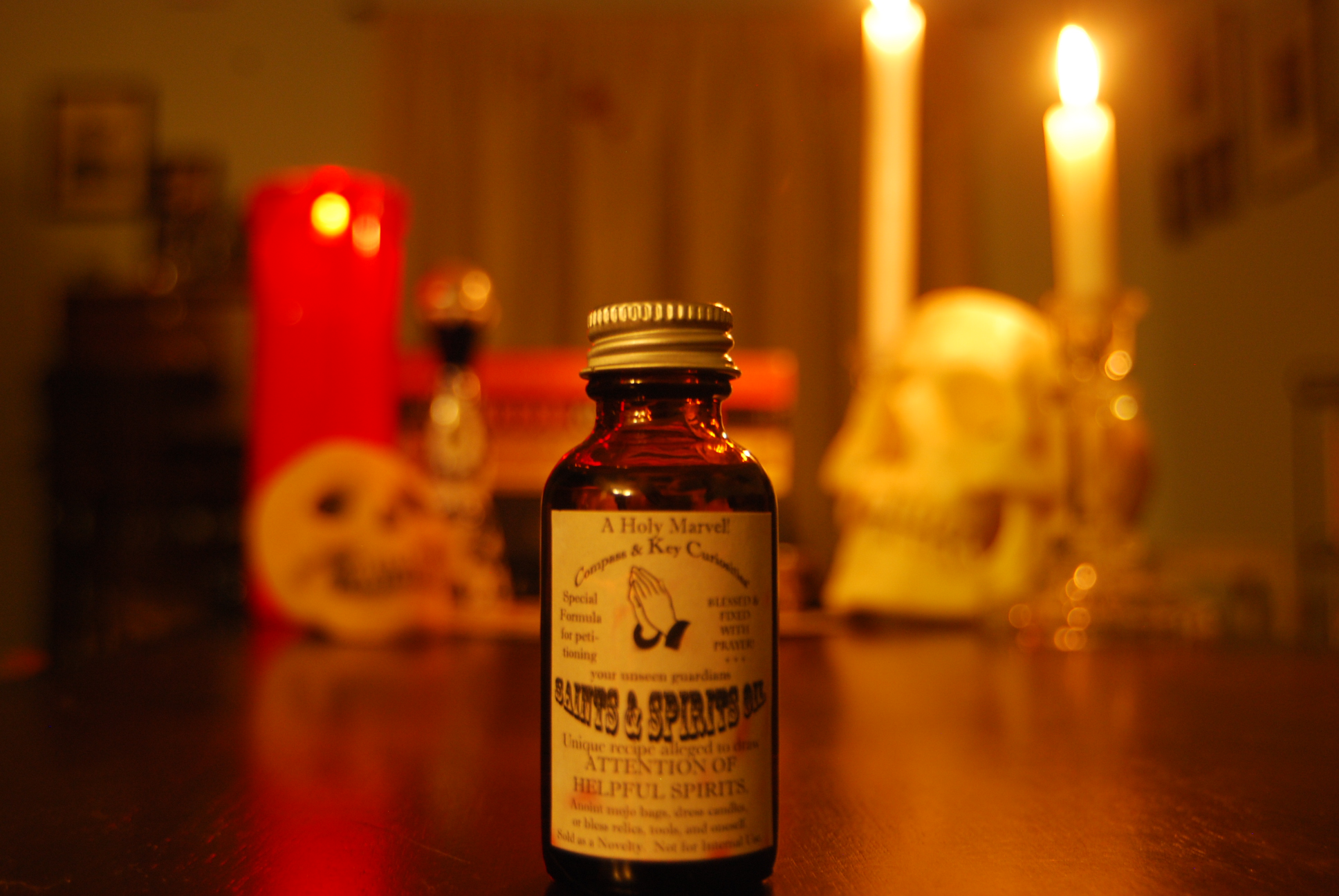
Saints & Spirits Oil – This oil is attuned to the spirit realm, and can be used to anoint offering candles or to work spells relying on the aid of spiritual forces.  It’s got a “churchy” smell offset by lavender for a peaceful, pleasant effect.

Wall of Flame Oil – If you need to keep bad influences out of your life, this oil is right up your alley.  It’s like laying down a ring of fire around you and the people and things you love.  Sharp, clean, and hot smelling, it sends back any hurtful energies directed at you to their sources.

Uncrossing Oil – When you’ve got troubles that just don’t seem to quit, and it feels like your luck has just plain run out, this is the oil to use.  A little of this worn on the body (particularly the hands and feet—though do be careful if you have sensitive skin) or burned while praying can do wonders to knock any curses off of you.

Within the next few days we also hope to be able to offer these:

Crown of Success Oil – One of our favorites!  This sweet, spicy blend is designed for general purpose success spells.  It can also be applied to any more focused mojo, like a simple gambling hand or money drawing bag, in order to bring increased potency.

Crown of Success Mojo Bags – Just like the oil, these general purpose mojos are designed to generate some serious success in your life.  They should be fed at least weekly and carried in a pocket, purse, or somewhere out of sight.  They’re red cotton cloth and smell rather nicely, too!

And we’re also working on these items as well, though they will probably be another week or two away:

Attraction Oil – Need to bring something good your way?  Luck, money, or love?  Well this might be the oil you’re looking for.  It works like a magnet for drawing things to you.  Annoint a little of your money before you spend it and it will come back to you with more in tow eventually.  Dab a little on before going out for the evening and you may find yourself bringing home a new lover.  It’s warm and citrusy with floral notes, and a real pleasure to smell!

Uncrossing Soap – Like the oil, this soap helps peel away the spiritual grime that may be hanging around you.  If you can’t manage to take a full spiritual bath, this soap makes a nice alternative.  Smells great and is made with skin-friendly goat’s milk.

Crown of Success Soap – This richly scented olive-oil based soap can help to bring prosperity and good fortune to those who use it.  Use as a hand soap and wash before leaving the house every day, or as a body soap for occasional boosts to your luck and fortunes.

Saints & Spirits Soap – If you need to get spiritually clean, or just want a nice spiritual cast to your day, this is a great soap for you!  It has a holy scent and peaceful pieces of lavender mixed into it.  It’s a lovely way to get clean, right down to your soul!

Once we get things going, I’m going to start making package sales, where you can buy a mojo and an oil of the same type for a discounted price if you get them together.  I also plan to eventually release that print edition of the cartomancy guide through the Etsy site, but I want it to be a little better quality if I’m asking people to pay for it, of course.

I should say that for legal reasons, all of our products are sold as novelties and are NOT to be ingested!  I offer them as folkloric specimens and results will vary from person to person.

If you have products you’d like to see us offer, by the way, please send us a message!  We’re always interested in seeing what people want.  We tend to lean towards prosperity and blessing-type products at the moment, but we’re not opposed to branching out.

We hope you’ll stop by the store!  Until then, thanks for reading!

-Cory

Blog Post 93 – Sneak Peek

Hi everyone!

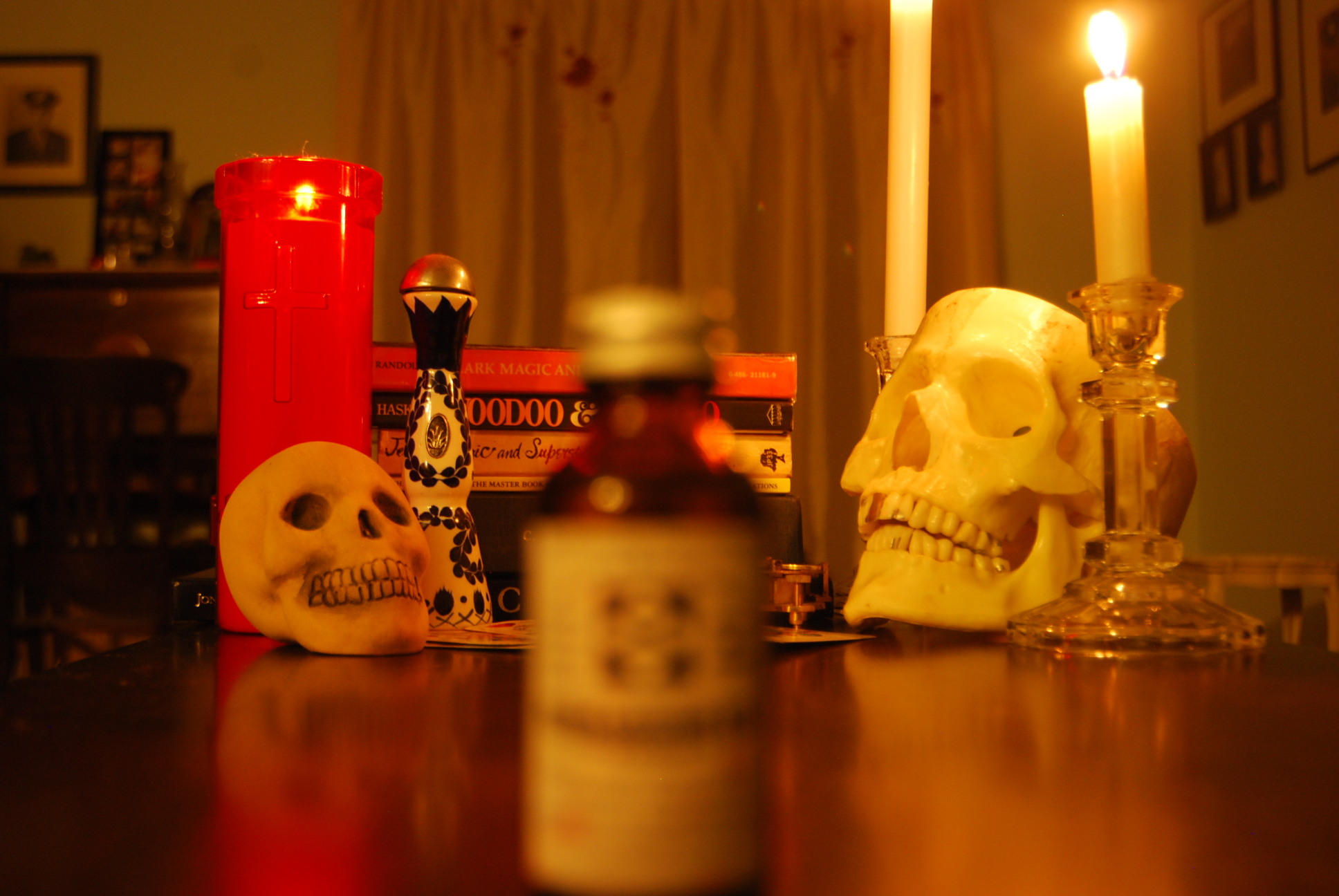
Today I’ve got a few photos of things to tease and entice you.  We’ve got something happening in the very near future and I wanted to let you blog readers be the first to know about it.  You can probably guess from the pictures what the announcement will be.

Be watching for an update soon!  Until then, thanks for reading!

-Cory