We dig into our witchy mail bag for this episode. We discuss the land of Oz, fumigating your purse or wallet, and announcing contest winners, among many other topics.
Please check out our Patreon page! You can help support the show for as little as a dollar a month, and get some awesome rewards at the same time. Even if you can’t give, spread the word and let others know, and maybe we can make New World Witchery even better than it is now.
Producers for this show: Corvus, Khristopher, J.C., Josette, Renee Odders, Ye Olde Magic Shoppe, Raven Dark Moon, Sarah, Catherine, AthenaBeth, Jen Rue of Rue & Hyssop, Little Wren, Jessica, Victoria, Johnathan at the ModernSouthernPolytheist, Montine, Achija of Spellbound Bookbinding, Mandy, Regina, and Hazel (if we missed you this episode, we’ll make sure you’re in the next one!). Big thanks to everyone supporting us!
The Clio site and app, suggested by Fire Lyte (and recommended by Cory)
We mention the idea of “Jack Tales” and the Wizard of Oz stories as examples of fairy lore/mythology for North America
Congrats to our contest winners, by the way! (We won’t spoil the surprise for those listening in)
We’ll be doing a live episode sometime in late October, with a them of spooky stories (especially things like local legends or personal spooky experiences). We’ll try to post about that soon, but if you want to send in your stories, please do!
If you have feedback you’d like to share, email us or leave a comment. We’d love to hear from you!
Don’t forget to follow us at Twitter! And check out our Facebook page! For those who are interested, we also now have a page on Pinterest you might like, called “The Olde Broom.” Have something you want to say? Leave us a voice mail on our official NWW hotline: (442) 999-4824 (that’s 442-99-WITCH, if it helps).
Promos & Music
Title and closing music is “Homebound,” by Bluesboy Jag, and is used under license from Magnatune.
Incidental music is “The Bird and the Rainbow,” by Monplaisir, from Magnatune.
“Tituba and Giles Corey,” by John W. Ehninger. Public Domain. (via Wikimedia Commons)
Welcome! If you’re just starting here, you should know that this post is part of my ongoing series trying to use folklore, history, and contemporary accounts of folk magic to paint a picture of what “New World Witchery” might look like. If you haven’t already done so, you may want to read the first post, “What is New World Witchery?, Part I (Irrational Pragmatism).” Then, at least logically, you might want to read the second post, which looks at how Witchcraft is an Amoral (not an Immoral) Act. But who needs logic? Start here if you please, or go back, or divine the content of future posts through by throwing bones, pulling cards, or shaking a Magic 8 Ball. I am just happy you’re here. Please note: my attempt to lay out some sort of shape that defines New World Witchcraft practices here is likely to satisfy no one (not even me). I undertake this effort largely because I think it gives me a point of reference when I’m developing other articles and trying to see how distinctly “New World” certain practices are. So let’s see where that leads us today (or perhaps, let’s not see…there’s a good bit of shapeshifting and invisibility ahead).
Witches Have a Lot of Friends (You Just Can’t See All of Them)
Anyone familiar with British cunning-folk practices has probably run across the concept of the “fairy familiar” through the works of scholars and authors like Owen Davies, Emma Wilby, and Ronald Hutton. English magical folk frequently entered into short- and long-term relationships with otherworldly beings. Sometimes these relationships were straightforward and reciprocal, and sometimes they seemed to be nearly unwanted but inevitable for the person selected by a fairy for contact and assistance. These are not elvish shoemakers doing a day’s work for a kindly cobbler, but often beings who seem to be able to impact the human world without fully understanding it, and beings who sometimes exact steep prices for their services. Wilby notes the phenomenon in her book, citing several well-known cunning folk and their fairy familiars:
“Susan Swapper (Wales, 1607), for example, claimed that she had been told by a companion that if she knelt to the queen of the fairies the latter would give her ‘a living’ while Joan Tyrry (Somerset, 1555) claimed that the fairies ‘taught her such knowledge that she getteth her living by it’…Jonet Rendall (Orkney, 1629) was told by her fairy familiar ‘Walliman’ that ‘He sould learne yow to win almiss be healling of folk’, while Anne Jeffries (Cornwall, 1645), by virtue of the healing powers she gained as a result of her liaison with the fairies, had ‘monies, at all times, sufficient to supply her wants.”
These fairy relationships enabled many magical folk to get by, and even do some good, although one could also turn the power to do harm as well.
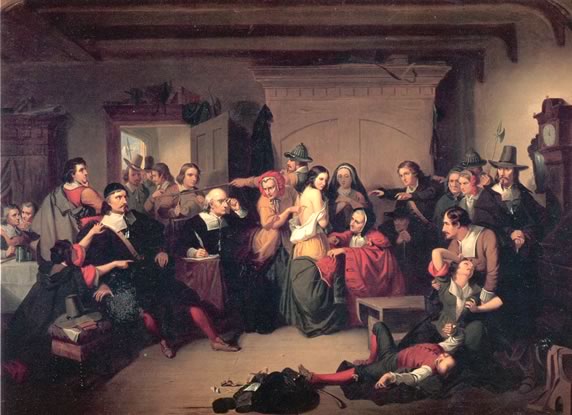
“Examination of a Witch,” by Thompkins H. Matteson (1853-Peabody Collection, Public Domain, via Wikimedia Commoons)
In the New World, relationships with spiritual folk from other realms has almost always been suspect, even diabolical. Trial recordsfrom Salem show accused practitioners of magic confessing to secret meetings in the woods with devils (although there are also potential readings that might suggest meetings with local Indian tribespeople, who were often viewed as satanic savages by English settlers). During the examination of Tituba, for example, the accused slave confessed to meeting with a Devil-figure in the home of her master, Samuel Parris. She claimed to have signed the Devil’s book and to have been forced into doing ill to the children of the household. In another round of examination, she described the familiar spirits of another accused witch, Sarah Good, as a “yellow bird” that drank blood from Good’s hand and which had “wings and two legs and a head like a woman.” The foundation of the Court of Oyer and Terminer, which made the Salem trials so particularly heinous, was the permission granted by the court to allow “specral evidence,” or the suffering of the victims at the hands of unseen spirits, as concrete proof of witchcraft. Of course, many of these details derive from European witchcraft beliefs inherited from earlier trials and confessions, and we should not lay too much stock by them, but they do illustrate an interesting transition within the New World context. In many cases, the concept of “fairy” spirits who aided witches and magical practitioners shifted towards animalfamiliars (often uncanny animals) and spectral beings that could take the witch’s shape or work on the witch’s behalf (even if it was not in the witch’s best interest, as the specters often “attacked” Salem witchcraft victims in open court as the accused witches tried to defend themselves as innocent).
Witches in North America seemed to spend a lot of time either communicating with their spiritual allies (often in transfigured shapes) or gallivanting around in spirit form themselves. A common motif of “spirit flight” would allow witches to grease themselves up with a flying ointment to travel to distant towns and steal from the local larders and dry goods stores (or, even more often, the wine or whiskey stores of the well-to-do—perhaps another incarnation of the class equity balancing act I’ve already mentioned). Keeping witches out of such places involved spreading salt grains or mustard seeds on the porch or roof, hanging a sieve over the door handle, or otherwise forcing the witch to count some minute object like seeds or holes in order to frustrate her entry. Witches were thought to cavort with devils and wicked spirits in their invisible and insubstantial forms, or to go out working all kinds of mischief. A story from the Mississippi Delta region speaks of a “boo hag” that would travel out at night and leave her skin behind. Only when a young man put salt and hot pepper into her skin before she returned could she be defeated. The mindset of diabolical worship and revelry lingered in the popular imagination about witches well past the Colonial period. In the mid-nineteenth century, Nathaniel Hawthorne published his story, “Young Goodman Brown,” which was riddled with such witch lore. In more recent times, magical practitioners such as self-proclaimed “hexenmeister” Lee Gandee reported the constant presence of spirits, who he called his “boys.” Such spirits heightened or enabled magical practices for those who knew them and worked with them, even without the pretext of diabolical pacts.
Of course, not all spirits were unseen by those around the witch. Just as often, the witch’s companions would be animals like Sarah Good’s alleged yellow bird. A Virginia tale about a witch named Rindy Sue Gose tells of her diabolical pact to become a sorceress, for which she received a little black beetle in a medicine bottle, which she fed with blood from her shoulder. The sucking familiar was a trope widely found in European witch tales, and many believed that the animal would do the witch’s bidding by carrying out her orders or doing dark deeds on her behalf. The Southern tale of “Raw Head and Bloody Bones” describes a witch whose prized razorback hog is slaughtered by local ne’er-do-wells only to be resurrected by her magic to seek vengeance on those who took her friend away from her (again, a form of justice and rebalancing). A subtler way of viewing the animal relationship, however, might suggest that the witch did not so much employ the creature as a servant, but as a second self. Many witches in stories engaged in forms of shapeshifting, turning into black cats, large hares, insects, or other beasts in order to travel swiftly and unseen throughout their portion of the world. In shapeshifted form, witches were particularly vulnerable, and any harm that came to them—being cut with a silver knife or shot by a silver bullet—would leave a mark upon their human body that allowed them to be identified later or kill them outright.
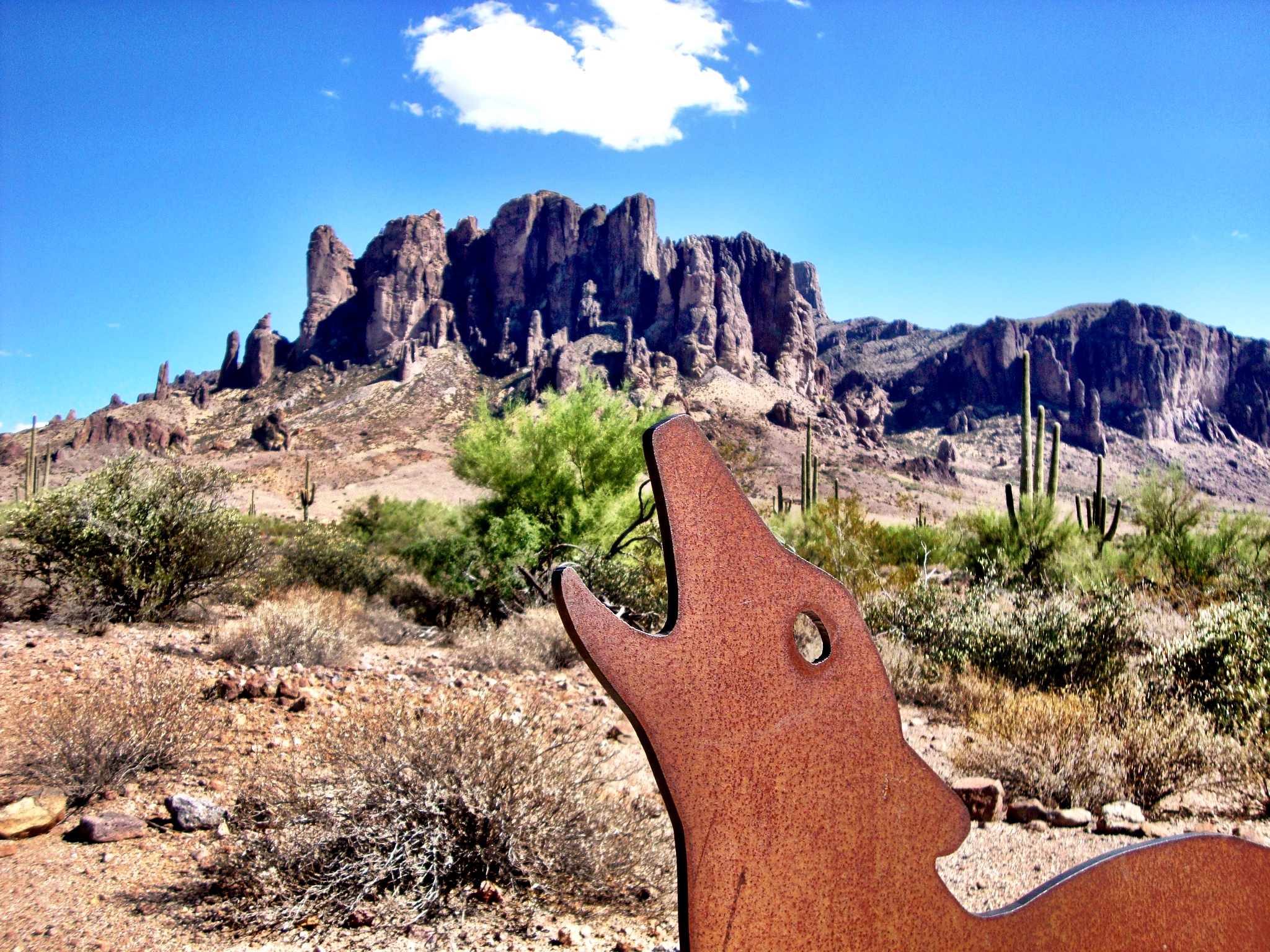
“Superstition Mountain Sentinel (Coyote Sundial),” By Mikesanchez1109 (Own work) [CC BY-SA 3.0, via Wikimedia Commons]
They could transform others as well, using them has horses (as Betty Booker did to the old Skipper). One legend from Acoma describes two evil “warlocks” who used a magic hoop to turn themselves into coyotes in order to kidnap a beautiful girl from a nearby tribe. Interestingly, the medicine man of the tribe tracks them through the help of animals, telling the braves following him “Listen to the bird singing in yon bush. It is warning us of the great danger we ace. It says to hurry for Isleta [the girl] will be abused if she is not rescued soon.” Animal friends with spiritual connections appear to help both “good” and “bad” magicians, and the Acoma tale reads much like European fairy tales that feature animal helpers warning of danger.
Speaking of fairies, did they all disappear in the New World? Not quite. The unseen powers of fairies do linger on in parts of North America, although many of the tales involving them seem to emphasize the need to counteract their work. The concept of being “elf-shot” or attacked by fairy magic seems to have transferred into areas where large Irish and English populations thrived, including parts of the Ozarks and Appalachians. Vance Randolph speaks of “power doctors,” which are remarkably similar to the “fairy doctors” found in Irish folklore, for instance. There are also plenty of tales of “little people” in the New World, often from Native American sources, although the close interactions noted between cunning folk and fairies are largely absent. In more recent years, however, fascination with fairies and similar beings has captivated American imaginations. There are fairy-oriented gatherings, such as FaerieCon and Mythic Worlds, that seek to connect fairy beings with spiritual identity (and have a rollicking good time doing so). Threads of Traditional Witchcraft in North America have made much of connecting with a “fetch beast,” which is similar to but distinct from the familiar spirits seen in earlier periods of American witchcraft. The broad picture of North American witchcraft certainly has room for the fairy brides and husbands and teachers of British lore, of course, but on the whole North American witchcraft seems to lean more towards the animal kingdom, tales of diabolical meetings, and invisible specters than the Good People Under the Hill. Perhaps much of that has to do with the aversion to aristocracy and courtly systems in North America—the fairies of Europe often seem to organize themselves in ways that parallel the human nobles around them. North Americans are largely removed from such formal aristocracies (although they certainly still exist in the forms of social classes, as evidenced by cotillions and debutante balls). We turn, instead, to wilder things—beasts and haints and devils—to connect to magic.
“Tituba and Giles Corey,” by John W. Ehninger. Public Domain. (via Wikimedia Commons)
This post is part of my ongoing series trying to use folklore, history, and contemporary accounts of folk magic to paint a picture of what “New World Witchery” might look like. If you haven’t already done so, you may want to read the previous post, “What is New World Witchery?, Part I (Irrational Pragmatism).” Or don’t. I’m not the boss of you. I have already said there what I will reiterate here: that my attempt to lay out some sort of shape that defines New World Witchcraft practices is likely to satisfy no one (not even me). I undertake this effort largely because I think it gives me a point of reference when I’m developing other articles and trying to see how distinctly “New World” certain practices are. There will always be exceptions, of course. Rules and witchcraft have a murky, complicated relationship, a thought which brings me to the subject of today’s section:
Witchcraft is an Amoral (not Immoral) Act
Despite a common popular conception in parts of early America, most witches are not interested in worshiping a literal Christian Devil or sending random blights over their neighbors’ crops. That doesn’t mean witches do no harm—they seem to do a lot of it, at least in accounts historical and folkloric. For instance, many witches will tie up a rag to an axe handle or fence post in order to steal milk from their neighbors’ cows, thereby stealing directly from the people around them. Seldom are those targeted by witches run into ruin or completely deprived because of the witch’s interference, although it may cause them some anxiety and trouble. The magical theft seems to be an extension of the pragmatism mentioned previously, though, offering the witches involved a way to sustain themselves. There are stories of people being tormented to the point of death, of course, but as in the famous Bell Witch case, much of the lore surrounding such attacks implies that the target has wronged the witch in some way, and that the witch is simply bypassing conventional justice for her own brand (see Keith Thomas’ essay on English witchcraft for a good outline of that argument, which applies equally in a number of Colonial-era witchcraft cases).
Witchcraft is not an act of evil unless it is being labeled that way by those not practicing it, but its applications are often morally ambiguous, verging on unethical. Take for example, the case of Mont and Duck Moore in the Blue Ridge Mountains. Duck would hex livestock within the community, and then Mont would remove the curse…for a fee, of course. This was an act of commerce far more than it was an act of evil. Or at least, it was evil in proportion to its pragmatic approach to earning a living. The case of Betty Booker mentioned previously provides an example with a bit less racketeering. At the far end of the spectrum we have the case of “The Witch of Pungo,” Grace Sherwood, who provided a variety of cures for her community in Virginia, only to end up being “swum” for her troubles (fortunately, she survived the experience). Sherwood reportedly stirred up the ire of some of her neighbors through her witchy ways, but seldom held back in her condemnation of those same neighbors when they leveled accusations against her. Folk magic and witchcraft, as we have seen already, are about meeting needs, and those needs are frequently morally dubious, much more so than the people who perform conjurations to help meet those needs. Cheo Torresnoted that he was once asked what people liked to ask curanderas to do for them by a reporter. He replied: “Well, I said, young men usually want something to help them get sex…[M]idle-aged women usually want something to make their husbands love them again, sine that spark has left their lives. Middle-aged men want something to help them deal with the old aches and pains of their arthritis or their old football injuries. Older women wanted something to help them win at bingo or the lottery. And older men usually wanted something to attract younger women.” Clearly, meeting the needs of those who come to them is what creates moral ambiguity, far more than a witch’s partnership with a particular imp or spirit (although we’ll be getting to that topic soon enough).
Statue of Grace Sherwood on Witchduck Rd., Virginia Beach, VA. By Lago Mar [CC BY-SA 4.0], via Wikimedia CommonsA New World Witch is accountable to herself, and answers to her own sense of morality. Some stories demonstrate a witch paying a price exacted later by a Devil, but for the most part any suffering they find is at the hands of those who work countermagic against them—for example in tales where a hexed butterchurn is used to reverse harm upon the witch who cast the curse in the first place. One informant shared a just such a reversal with me regarding the Evil Eye:
“If your infant is thought to have been given the Evil Eye, it will display tantrums, inexplicable fits, crying, fever, coupled with nausea out of nowhere. If this is determined to be the case, the one suspected of giving the Evil Eye to the child must be confronted in front of said child, and be asked to submit (pass along with their mouth or spit in a glass of water) their saliva to the infant for it to ingest… Giving of themselves a part of them, to queue [quell] its curse.”
The person who gave the Evil Eye was expected to be a person that could be confronted, negotiated with, a part of a community that operated by informal, unofficial, but very potent magical “rules” that could flex and adjust to particular circumstances.
Justice is negotiated in individual encounters rather than through uniform rules. Witches like Sherwood may have had tempestuous personalities but still acted as forces for good in their communities. Milk-stealing witches met their needs through magic, often because they had fallen through any social networks of support that were supposed to exist in their communities, and frequently paid an eventual price for their deeds at the hands of those they’d wronged. Some witches played a system, as in the case of Mont and Duck, and were tolerated by the community at least for a time. No one, it seems, in history or folklore, expects the witch to act in a morally “mainstream” manner, but to operate under her own code of right and wrong (and any shades of gray between).
Next time: Witches Have a Lot of Friends (You Just Can’t See Many of Them).
Thanks for reading!
We tackle the thorny, magical, and morbid world of death from a personal and a magical perspective. We discuss our own experiences with death, some folkloric ideas about death and witchcraft, and a little bit about our thoughts on the afterlife.
Please check out our Patreon page! You can help support the show for as little as a dollar a month, and get some awesome rewards at the same time. Even if you can’t give, spread the word and let others know, and maybe we can make New World Witchery even better than it is now.
Producers for this show: Corvus, Diana Garino, Renee Odders, Ye Olde Magic Shoppe, Raven Dark Moon, The Witches View Podcast, Sarah, Molly, Corvus, Catherine, AthenaBeth, Jen Rue of Rue & Hyssop, Shannon, Little Wren, Michael M. and Jessica (if we missed you this episode, we’ll make sure you’re in the next one!). Big thanks to everyone supporting us!
We briefly mention our “Ancestors” episode, which is kind of our “looking back” idea, but most of the material for this show comes from personal experiences and beliefs. We do, however, mention a few books (or have some sources to recommend):
And do you have an idea for what a New World Witchery drinking game would be like? Email us your ideas! We’d love to hear that!
Don’t forget to join us on Sunday, October 30th for our next MIxlr broadcast. The subject is “Ghost Stories.” We’ll hope to see you there!
Chech out our latest podcast effort, Chasing Foxfire, which just launched in early October. If you like folklore, this show will be connecting the dots between folk tales, science, nature, pop culture, literature, and more.
If you have feedback you’d like to share, email us or leave a comment. We’d love to hear from you!
Don’t forget to follow us at Twitter! And check out our Facebook page! For those who are interested, we also now have a page on Pinterest you might like, called “The Olde Broom.” Have something you want to say? Leave us a voice mail on our official NWW hotline: (442) 999-4824 (that’s 442-99-WITCH, if it helps).
Promos & Music
Title and closing music is “Homebound,” by Bluesboy Jag, and is used under license from Magnatune.
We spend some time outside in this episode, where we talk Appalachian magic and plants with Becky Beyer of Blood & Spicebush. In the second part of the show, Cory tries something new and does a “practical pathworking” in the woods.
Please check out our Patreon page! You can help support the show for as little as a dollar a month, and get some awesome rewards at the same time. Even if you can’t give, spread the word and let others know, and maybe we can make New World Witchery even better than it is now.
Producers for this show: Corvus, Diana Garino, Renee Odders, Ye Olde Magic Shoppe, Raven Dark Moon, Ivory, The Witches View Podcast, Sarah, Molly, Corvus, Catherine, AthenaBeth, & Jen Rue of Rue & Hyssop (if we missed you this episode, we’ll make sure you’re in the next one!). Big thanks to everyone supporting us!
FINAL MONTH! It’s been a while, and we want to do a second round of our Audio Spellbook, so all you have to do is send us the sound of *you* describing your favorite spell which uses everyday ingredients (things you could find in a spice cabinet, grocery store, or backyard, for example). You can either record your spell and email it to us at compassandkey@gmail.com or call us and leave us a voice mail on our official NWW hotline: (442) 999-4824 (that’s 442-99-WITCH, if it helps). You can also get an extra entry by sharing either our Patreon page or our Contest Announcement via your favorite social media (make sure to tag us or get a screen capture you can email to us). What will you be entered to get? Well, you’ll get a NWW Annual Mailer (who can’t use an extra one of those, right?), a couple of bottles of our personally handmade condition oils, a folk charm or two, and a book or two to make it all even better!
You should most definitely check out Becky’s EXCELLENT site, Blood & Spicebush. You may also really enjoy some of the other sites and people she recommends, such as:
Title and closing music is “Pig Ankle Rag,” by The Joy Drops, and is used under a Creative Commons License (available at Soundcloud.com).
The incidental musical selections is “Cabin in the Woods,” by the Be Good Tanyas feat. Jolie Holland (from the Free Music Archive/Soundcloud, used under a Creative Commons License). Additional incidental music is “Lucidique,” by L’Horrible Passion, via Soundccloud.com and used under a CCL. Sound effects derived from original material at SoundBIble.
Our annual holiday music show is light on the talk (due to Cory’s recent illness) and heavy on the, well, wassailing. So pour a warm cup of something delicious and enjoy!
Please check out our Patreon page! You can help support the show for as little as a dollar a month, and get some awesome rewards at the same time. Even if you can’t give, spread the word and let others know, and maybe we can make New World Witchery even better than it is now.
Producers for this show: Diana Garino, Renee Odders, Ye Olde Magic Shoppe, Raven Dark Moon, Ivory, The Witches View Podcast, Sarah, Molly, Catherine, AthenaBeth, & Jen Rue of Rue & Hyssop (if we missed you this episode, we’ll make sure you’re in the next one!). Big thanks to everyone supporting us!
The following songs are used through Creative Commons Licenses and distributed as podsafe media, used under a purchased license, or presented with the permission of the artist. Please see the distribution sites for additional information on the artists, their works, and how to purchase more of their music.
“Ding Dong Maerrily on High/St. Anne’s Reel,” Keltricity (Soundcloud)
“The Holly Bears a Berry,” Shira Kammen (Magnatune)
“Byla Cesta,” Kitka (Magnatune)
“Shchedrik,” Kitka (Magnatune)
“Wassail Song,” Music for a Winter’s Eve (Magnatune)
This episode is a season-appropriate discussion of toys in magic, particularly dolls. We’ll talk about how dolls and poppets get used magically, as well as why they tend to show up in folk and popular horror so often.
Please check out our Patreon page! You can help support the show for as little as a dollar a month, and get some awesome rewards at the same time. Even if you can’t give, spread the word and let others know, and maybe we can make New World Witchery even better than it is now.
Producers for this show: Diana Garino, Renee Odders, Ye Olde Magic Shoppe, Raven Dark Moon, Ivory, The Witches View Podcast, Sarah, Molly, Catherine, AthenaBeth, & Jen Rue of Rue & Hyssop (if we missed you this episode, we’ll make sure you’re in the next one!). Big thanks to everyone supporting us!
We also mention Robert the Doll in Key West, Florida, who has been featured on recent episodes of the podcasts LORE and Stuff You Missed in History Class.
If you have feedback you’d like to share, email us or leave a comment. We’d love to hear from you!
Podcast recommendation: Gordon over at Rune Soup has finally started putting out a podcast, which is definitely worth listening to. Subjects are often deeply philosophical and get at the roots of magical practices with an eye towards history as well. Good stuff!
Tonight we have a special guest with us to discuss shapeshifting once more. Plus we’ll hear an Appalachian folktale and a few shapeshifting spells, too!
Please check out our Patreon page! You can help support the show for as little as a dollar a month, and get some awesome rewards at the same time. Even if you can’t give, spread the word and let others know, and maybe we can make New World Witchery even better than it is now.
Producers for this show: Diana Garino, Renee Odders, Ye Olde Magic Shoppe, Raven Dark Moon, Ivory, The Witches View Podcast, Sarah, Molly, AthenaBeth, & Jen Rue of Rue & Hyssop (if we missed you this episode, we’ll make sure you’re in the next one!). Big thanks to everyone supporting us!
Our friend Achija Branvin Sionnach of Spellbound Bookbinding is our special guest this evening, and he’s also offering a special service to all of our listeners: If you have a paperback book you want leatherbound, he will do it for you for the costs of materials and shipping! Just mention you heard him on our show.
Cory also mentions the short film Foxes, which involves shapeshifting. Our guest tells the story of “Cat & Mouse,” an Appalachian Jack tale. And we also mention the story of Nebuchadnezzar from the biblical book of Daniel.
If you have feedback you’d like to share, email us or leave a comment. We’d love to hear from you!
Title music: “Homebound,” by Jag, from Cypress Grove Blues. From Magnatune.
Music: “Werewolves 2.0,” by Moi, le voisin, from Soundcloud (used under the Creative Commons license). Incidental music is “Ambient 1,” by Olssons, also from Soundcloud.
Podcast recommendation: Check out the latest episode of Infinite Beliefs, which features our friend (and sometime shapeshifting witch) Sarah Anne Lawless!
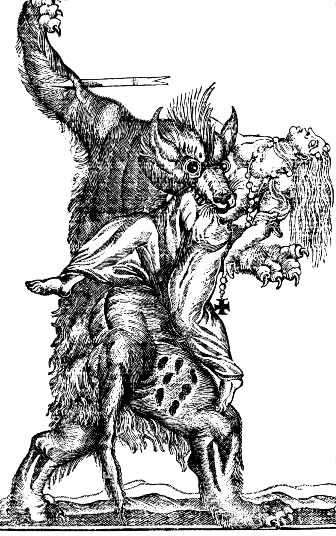
One of the talents attributed to witches in a number of cultures is self-transformation. If you’ve plunged more than ankle-deep into witchcraft research, you’ve likely run across famed Scottish witch Isobel Gowdie’s charm, which she reputedly used to transform into a hare, which begins “An I shall go into a hare, with sorrow and sighing in mickle care…” Gowdie was not alone in her belief that through the force of her magic and her will (and perhaps some psychoactive botanical substances or a judicious application of rendered animal fat), she could change her form to that of an animal. Perhaps the most famous example of this power is the werewolf, which sometimes changes of its own volition, but more often is a victim of the shiny moonlight’s powers.
In the New World, plenty of witches also had the power of transformation. This article will look at a few key tales of shapeshifting from New World lore, and ask questions about what the stories could mean for a magically inclined person with an interest in exchanging human form for an animal’s.
Perhaps the best-known and most widespread incarnation of the shapeshifting legend east of the Mississippi is the story of the loup-garou (sometimes also rou-garou, rugaru, or a similar variation). The beast can be found just about anywhere which saw frequent contact with French Colonial influences, such as in Canadian border zones or Louisiana. Often the loup-garou is essentially a werewolf, a human being who can—through magical means often diabolical in nature—become a wolf-like beast. Some versions of the story, recorded by University of Louisiana professor Barry Ancelet, describe the beast as more of a thief than a predator for humans, stealing fishermen’s clams while they sleep. The exact nature of the creature is also indeterminate, since depending on one’s location, it can “range from the rougarou as a headless horseman to a wolf that prowls the forest at night” (Lugibihl). The actual transformation may be permanent (or even ghostly, as some accounts tell of the beast as the remnant of a cruel old man), or may only last for 101 days, after which time the loup-garou transfers its curse to another person through a bite or drinking his or her blood. A person under the curse seems to know whether he or she is suffering from the transformation, and becomes rather wan and unhealthy, but usually remains silent about the condition with others. A major variation on the loup-garou is the bearwalker, about which Richard Dorson recorded several stories in Michigan’s Upper Peninsula during the mid-20th century. As you can probably guess, the assumption of a bear form (or at least an animal form which resembles a bear more than a wolf) is more common in the lore of the borderlands on the north of the Great Lakes.
In the mid-section of the United States, particularly from the mid-Atlantic down to the upland South and across into the Midwest, the power of transformation is far less canine in nature. While the loup-garou certainly fell into the purview of New World magical lore (albeit lore largely imported from Europe), the tales of transformation one finds in places like Appalachia skew distinctly witchy in flavor. Several stories, including one which we’ve recorded here before called “The Black Cat Murders,” talk about witches transforming into cats in order to visit harm on prospective victims. Patrick Gainer recorded his version of the tale in West Virginia from Mrs. Robert Pettry, whose account included a man with a pet bear that struck off the witch-cat’s paw only to have it transform into a human hand once it was severed. This is a very common feature of witch transformation tales, and often once a witch has been injured in her animal state, she bears the marks of her injury in human form as well (which proves helpful to neighbors in identifying her). One of the remarkable points about these transformations remains that in many cases the witch has a physical human body in one place and a spectral body (with some corporeal aspects, as in the case with the bear above) that can travel around at her behest while remaining deeply linked with her. That trait appears throughout North America (again, with some Old World antecedents, including Africa as well as Europe). A tale from Virginia recorded in The Silver Bullet, by Hubert J. Davis, tells of women who turns into a cat only to have her hand whacked off with a knife. The next day, when the man who did the whacking tries to shake hands with the suspected witch, she refuses because her hand is now missing. Davis also reports a tale of a witch who becomes a cat only to be caught by a lonely mountain man, and transformed back into a woman, she marries him and bears him two children. When he begins drunkenly telling someone how they met, she turns herself and the kids into cats and kittens and they disappear forever through a hole in the wall.
Of course, not all witches turn into cats, and not al were-cats are witches, exactly, either. In Utica, New York, Davis found a tale of a witch who turned herself into a black colt that would appear in neighbors’ fields and graze among their horses. When a man sneakily catches the colt and has it shod at the blacksmith’s (I’d note the importance of iron to this story, by the way), the colt then gets put into a pasture, then disappears. However, a neighbor-woman is seen with bandages on all her hands and feet the next day. New York is also the home of famed witch Aunty Greenleaf, who reportedly would turn herself into a white deer rather than a cat or a horse. She managed to elude hunters constantly until one hunter got the idea to use melted silver for bullets and struck her in her transformed state. She, of course, took ill and died (Schlosser 2005). Another famed shapeshifting creature, however, is not a witch at all, but a Native woman who has been cursed into cat form known as the Wampus Cat (Schlosser 2004). Lest you think that all those who are animagi (to steal a term from Harry Potter) are female, an African American tale speaks of a male witch whose form is that of a boarhog, and who uses his powers of magic and transformation to gain a pretty wife with lots of land. Interestingly, a little boy in the story—often called the “Old Witch Boy”—knows the boarhog witch’s secret and reveals it to the girl’s father, resulting in the death of the hog-witch (Leeming & Page).
Some of the most pervasive and powerful witch-stories of transformation come from the American Southwest. Navajo skinwalker tales abound with narratives about evil witches who could use the pelts of animals to take on different shapes, usually to terrorize outsiders or those they did not like on the reservations. Some accounts claim that the witch who could take on the skin of another creature was the most powerful type of witch, and had mastered what was known as “The Witchery Way.” Such a creature was to be greatly feared, and trade in certain skins and furs was severely limited within Navajo culture. Skinwalkers could be recognized by some of their supernatural abilities, but more especially by their eyes: in animal form, their eyes looked human, and vice versa when in their human form. Nasario Garcia recorded many tales in New Mexico, Colorado, Texas, and California from people in the late 20th and early 21st centuries who reported knowing about or having seen witches that had taken on animal forms, just as skinwalkers do. One story related by a a man who recalled the events of the tale from when he was eight years old told of how his father had been driving an oxcart on a dark night with his son (the narrator) and a few farmhands along with him. Suddenly, two sheep appeared alongside the cart, one white and one black, and simply followed them, always matching pace with the cart. Eventually, they simply disappeared. Many others recorded by Garcia spoke of witches taking on owl forms to travel out by night, or occasionally coyote or dog forms, in which case they seemed to want to bite errant travelers (although never in such a way as to cause permanent injury or death, although most who see these creatures report being terrified).
So just what do witches do once they are transformed? In many of the stories, they seem to be up to no good. The tales of witch-cats often speak of numerous murders or unexplained deaths attributed to the shapeshifting sorcerers in the area. In some tales, witches take on cat forms to sneak into the houses of children and steal their breath (which is obviously related to the superstition about cats stealing babies’ breath). In some cases, the witches seem to be up to mischief, as in the case of Aunty Greenleaf, who likes to lead hunters on wild chases and get them lost, or cause their guns to fail. The loup-garous steals food, or worse, passes its curse on to others, sometimes even drinking the blood of another person to accomplish its nefarious task. The near-universal terror of skinwalkers in the Southwest is attributed to their powers to cause sickness and death as witches, although they seldom seem to kill or even severely maim while in animal form (although there are often reports of animal mutilation later connected to them). Richard Dorson records one tale from the Southwest in which shapeshifting witches seem to threaten each other more than the average person. He speaks of a pair of witches who make a bet about which one is faster in horse form. The loser has to stay a horse, which is accomplished by means of a magical halter. The winning witch sells the loser to a man, whose son accidentally removes the halter, and the witch transforms into a fish and swims away in a nearby river, then continues to transform until he’s a coyote. The coyote is tracked and killed by dogs in the end, and notably the witches have done no harm to anyone but themselves.
Why do shapeshifting witches get a bad rap, then? I would like to suggest that the real uneasiness among those who tell the stories is a fear that witches can be anywhere, and anyone, and just about anything. You never know when you might offend a hidden witch, who could be the cat twitching its tail by the fire or a horse in a pasture across the road. A healthy show of respect (even one tinged with fear) makes for a good insurance policy against the witch’s other fearful talents. Of course, being able to take on animal forms also means that the witch knows just how well you treat the lower orders of species, which might also inspire one to act a little better around the flocks and fields, or to pass an extra dog biscuit to the pooch curled up at your feet. Who knows, that might just be all that stands between you and a rather nasty hex, right?
This time, we look at the lore of shapeshifting witches, including loup-garous, Wampus cats, and skinwalkers. We also briefly discuss the idea of hag-riding.
Please check out our Patreon page! You can help support the show for as little as a dollar a month, and get some awesome rewards at the same time. Even if you can’t give, spread the word and let others know, and maybe we can make New World Witchery even better than it is now.
Producers for this show: Renee Odders & Athena (if we missed you this episode, we’ll make sure you’re in the next one!). Big thanks to everyone supporting us!
We discuss Navajo Skinwalkers a good bit, and you can read about them more in an upcoming article on our site
A pair of podcasts have discussed werewolf legends in great detail recently: LORE and Sawbones have both done a fine job with covering the historical (and skeptical) side of the subject
If you’ve got a paperback copy of a book which you’d like to get bound in leather, our friend Achija Branvin Sionnach of Spellbound Bookbinding is offering our listeners a very deep discount. If you tell him we sent you, he’ll do the leather-binding for you at cost of materials plus shipping.
If you have feedback you’d like to share, email us or leave a comment. We’d love to hear from you!
Title music: “Homebound,” by Jag, from Cypress Grove Blues. From Magnatune.
Music: “Were-Owl,” by S.J. Tucker, from her album Mischief. Incidental music by Brian Johnston, doing a cover of Warren Zevon’s “Werewolves of London,” found at Soundcloud and used under a Creative Commons License.
Podcast recommendation: Laine recommends the podcast Darkness Radio, and Cory suggests the medical/comedy/folklore show Sawbones.






 New World Witchery - The Search for American Traditional Witchcraft