Podcast 24 – Love Magic

-SHOWNOTES FOR EPISODE 24-

Summary

Tonight’s show is all about the love…magic!  We discuss different types of love spells, the ethics of casting them, the power of scent to inspire love, and the famous Love Potion #9.

Play:

Download:  New World Witchery – Episode 24

-Sources-
Earth Power – Scott Cunningham
Ozark Magic & Folklore – Vance Randolph
Mules & Men and “Hoodoo in America” – Zora Neale Hurston
Voodoo & Hoodoo – Jim Haskins
Witches, Ghosts, & Signs – Patrick W. Gainer
Buying the Wind – Richard Dorson
The Voodoo Hoodoo Spellbook – Denise Alvarado

Promos & Music
Title music:  “Homebound,” by Jag, from Cypress Grove Blues.  From Magnatune.
Promo 1 – Forest Grove Botanica
Promo 2 – Wigglian Way
Promo 3 – The Infinite & the Beyond

Blog Post 119 – A Little Love Magic

I’m sure with Valentine’s Day just around the corner, I won’t be the only one to cover today’s topic:  love magic.  Yes, I know that Valentine’s is a commercial holiday designed to sell greeting cards (or something like that), but this seems as good a time as any to introduce some of the folklore and magic surrounding that strange, powerful feeling of love which seems to rule over so much of our human existence.  We’ll also look a little at lust, though I’ll likely save a detailed discussion for a sex magic post of some kind.

I should also say that this little article only scratches the surface of the overall material on this enormous branch of magical practice.  Love spells seem to be some of the most commonly sought and most often used enchantments in the world, so any blog post on them will necessarily be rather skint on details.  Also, this particular article is a sort-of companion to our upcoming podcast episode, which will be on this topic as well.  In the episode, we’ll discuss things like the ethics of love spells, so I only really want to touch on the lore and some of the basic spell ideas here.  Of course, if you want to leave comments or send emails regarding questions of ethics, I fully support that!

So what is love magic?  Most people would probably understand a spell cast by a young man on his high school crush to make her go out with him as a type of love spell, but what about a spell cast by a wife on an errant husband to make him stay a little closer to home?  Is a spell to spice up things in the bedroom a love spell, or just a lust spell, or maybe a little of each?  As I pored over the research, I found that there are several distinct categories for love magic:

1)      General-purpose love spells, such as wearing rose quartz, hanging a “loving bell,” spells to help a girl find a beau/husband soon, etc.

2)      Love divinations, like dream interpretations, carrying a four-leaf clover in the bible, catching a bouquet at a wedding, etc.

3)      Lust magic & aphrodisiacs, like the famous Love potion #9, dried turkey bones, powdered bird tongues, vanilla, etc.

4)      Person-specific love spells, which make one particular person fall in love with another, using things like hatbands/socks, mirrors, a particularly ghoulish dead-man’s mojo, etc.

5)      Magic for staying together, common in hoodoo, such as tying a man’s nature, writing bloody initials for reconciliation, menstrual blood in food, etc.

6)      Splitting up work, designed to break a couple apart using things like the black cat/dog hair spell, Hurston’s nine needles spell, etc.

Taking these various categories—which are just my understanding of the material, by the way, and should not be taken as gospel—let’s look at some of the individual spells, beliefs, signs, and ceremonies associated with each one.

A word of warning before we begin: I DO NOT ADVOCATE THE USE OF ANY OF THESE SPELLS. I’m presenting them as matters of folkloric record only.  Many of these techniques and/or formulas can be unsanitary or downright dangerous, so please keep that in mind as you read.

General-Purpose Love Spells

This category is fairly well addressed in modern neo-Pagan magical texts, so I won’t get much into it here.  I recall learning early on from Scott Cunningham’s Earth Power and other books like it that rose quartz could be worn to draw love to you, or just inspire loving feelings in you.  Oraia from Media Astra ac Terra covers the metaphysical properties of rose quartz very well in Episode 20 of that show, so if you want more info, I’d suggest listening to her examination of it.

Cunningham’s book also contains a spell for a “Loving Bell” which involves hanging a small bell somewhere the West Wind can touch it, reciting a little chant, and waiting for the bell to “whisper” your desire for love onto the wind, calling a lover to you (p.46).

Another basic spell from Draja Mickaharic’s A Century of Spells calls for burning a candle anointed with a mixture of basil and almond oil to draw love into one’s life.

As far as North American folklore goes, general-purpose love spells are actually a bit rare.  They most often tend to be focused on getting a spouse or preventing spinsterhood (forgive the sexist language there, but these do seem to be customs targeted at women).  For instance, in Vance Randolph’s Ozark Magic & Folklore he mentiones that Ozark girls will pin pieces of a wasp’s nest inside their clothing to draw courtship from men.  Randolph also mentions a peculiar love charm that he encountered in the mountains and which reputedly brought love into a young girl’s life:

“Many mountain damsels carry love charms consisting of some pinkish, soaplike material, the composition of which I have been unable to discover; the thing is usually enclosed in a carved peach stone or cherry pit and worn on a string round the neck, or attached to an elastic garter. I recall a girl near Lanagan, Missouri, who wore a peach stone love-charm on one garter and a rabbit’s foot fastened to the other.” (p. 166)

It’s not unreasonable to think that the “pinkish, soaplike material” may well be a piece of rose quartz.  Or, it may be something else entirely.  Patrick W. Gainer records the oft-repeated superstion that if someone sweeps under or on top of a girl’s feet, she will never marry, so girls were very careful not to let that happen.  Taking the last bite of any food at the table meant that a girl should kiss the cook or else end up an old maid, too.  Gainer also says that a girl who hold’s a bride’s dress on her lap within ten minutes will marry within a year and that if a girl lends her garter to a bride on her wedding day, she can expect to marry soon, too.

Love Divination

There are so many wide-ranging methods of determining a future lover’s identity that it would likely give me carpal tunnel and send my readers into a glazed-eye coma trying to list them all.  Divining one’s future love life is probably the most common form of divination, and can be found everywhere from the playground to the wedding chapel to the funeral home.  Most folks know about catching bouquets and garters at a wedding to indicate who the next to be married will be.  Some of the more unusual methods of determining one’s romantic future are:

  • Dream of a funeral and attend a wedding
  • Count seven stars for seven nights, and you will dream of the man you will marry.
  • To dream of the man you will marry, take a thumbful of salt the night before Easter
  • Marry soon if you dream of a corpse
  • If two forks are at a place-setting on the table, the one who sits there will be married.
  • Put three holly leaves under your pillow at night and name each leaf.  The one that is turned over in the morning will be the name of your husband.
  • Put a four-leaf clover in the Bible.  The man you meet while you are carrying it will be your husband.
  • On the first day of May before sunrise, if you see a snail within a shell, your future husband will have a house.  If the snail is outside the shell, he will have none.  Sprinkle meal in front of the snail and it will form the initial of the man you are to marry.
  • Walk around a wheat field on the first day of May and you will meet your mate.
  • The white spots on your nails tell how many lovers you will have.
  • On the first day of May, look into a well and you will see the face of your future husband.

There are lots of other methods for determining a future spouse, of course, such as peeling an apple in one long strip and tossing it over your shoulder to determine the initial of one’s eventual husband or wife.  Several Halloween traditions also focus on love divination, such as throwing nuts into the fire to see if they pop or fizzle, thus reflecting the strength of the love between those who threw.  Really, we could be here all day with these, so let’s just say a little reading will reveal a plethora of divinatory options to the curious witch.

Lust & Aphrodisiacs

This is another broad and often-discussed topic, and one which folks can get into heated debates about very easily.  For instance, many people contend that certain foods—chocolate, oysters, strawberries, etc.—act as aphrodisiacs and cite medical reports to back up their claims.  Others cite counter-claims which demonstrate that any aphrodisiac effect from food is purely psychosomatic /placebo effect.  Love potions are incredibly popular, so much so that there’s an enduring pop song by the Searchers entitled “Love Potion No. 9,” which later inspired a popular film of the same name (featuring the lovely Sandra Bullock).  I’m not going to get into the ingredients for that potion here, but if you’re interested in it, the upcoming Spelled Out segment on the podcast will look at one recipe for this famous draught.
In American folklore, many ingredients can be brewed into love potions and used to drive a partner wild.  Randolph records that yarrow is used in love potions given to men, as are dodder/love vine/angel’s hair, lady’s slipper, and mistletoe.  Boys make a love potion from a wild gander’s foot, powdered and put into a girl’s coffee.  The use of bird ingredients in such potions is rampant, inlcluding the use of powdered turtle-dove tongue, chicken hearts, and rooster blood for various love and beauty blends.   Girls in the Ozarks would keep dried turkey bones in their rooms in order to seduce their beaus when the time was right, too.

Randolph also mentions that a woman can surruptetiously touch a man’s back to inspire feelings of lust in him.  Zora Neale Hurston says in her essay “Hoodoo in America” that a potent aphrodisiac charm from Jamaica includes mixing angle worm dust with High John chips and wearing this as a mojo around the waist.  Oils and powders such as “Come to Me Boy/Girl” and “Chuparosa” are also used to intoxicate a lover’s senses and make him/her crazy with lust and love.  There’s also a hoodoo formula called the “Hot Mama Douche” which is juniper berries steeped in vinegar and which is designed to bring a woman all the sex she can stand. Vanilla, dabbed behind the ears, is also reputed to drive men wild.
Person-specific Love Spells

These are the controversial, yet oft-sought after, spells which one person uses on another to command love.  There are a lot of ethical questions involved in these enchantments, and I won’t get into my perspective on them here (though I do talk a bit about it on the show).  As the folklore goes, there are a lot of ways to make someone yours through magic.  Most of them involve putting a little bit of yourself—such as urine, blood, or sweat—into them, often via food.  Wearing the other person’s clothing, especially intimate clothing that has had contact with their skin or which has encircled some part of their body (like a ring, hatband, glove, sock, etc.) will also allow you to command their love.  Some examples:

  • If a girl steals a man’s hatband and wears it as a garter, it will make him fall in love with her (Randolph, OM&F)
  • Socks and hatbands can be used to rule unruly men (Hurston, Mules & Men).
  • Turning down a man’s hatband and pinning two needles in it in a cross-wise fashion makes him love you (Haskins, Voodoo & Hoodoo)

Other spells to gain the love of a person include tying poppets/dolls together, knotting used clothes from each person together, or burying personal items from that person on your property.  In this latter vein, Zora Neale Hurston records an interesting spell using the person’s image captured in a mirror:

“To bind a lover to a place: a) This is for a girl: Let him look into a mirror but don’t you look into it. Take it home. Smash it and bury it under the front steps and wet the spot with water. He cannot leave the place. b) This is for a boy: Take three locks of her hair, throw one over your head, put one in your bosom, and one in the back of your watch. Then do the same thing with a mirror that the girl does and she is tied. You can’t undo this.” (from “Hoodoo in America”)

Similarly, getting a potential lover to walk over or under a charm specifically planted to catch his/her love can be very effective.  Hurston’s Mules & Men contains the following spell:

Use nine lumps each of starch, sugar, & steel dust wet with Jockey Club perfume and put into nine mojo bags tied with red ribbon.  Put these all around his home (or yours), especially at entrances and under rugs, and he will be unable to resist you.

As I mentioned before, the best ways to gain control of a lover tends to be to make him or her ingest something that has a bit of one’s own bodily fluid.  Randolph mentions the use of menstrual blood in drink (though I usually find that more connected to the next section, “Magic for Staying Together”), as well as using whiskey in which fingernail trimmings have been soaked.  In Folk Beliefs of the Southern Negro, Newbell Niles Puckett records a love charm which uses bathwater to similar effect: “a great love charm is made of the water in which the lover has washed, and this, mingled with the drink of the loved one, is held to soften the hardest heart.”

Magic for Staying Together

When a relationship hits a rough patch, people often do all sorts of things they wouldn’t normally do.  While some spells in this category are designed to bolster the already strong bonds between two happily enamored people, more often than not these spells are done out of desperation.  A wife wants to keep her philandering husband at home and away from other women.  A man wants to bring back a lover who has left him.  These aren’t particularly happy spells, but they do make up a good bit of the overall love spell genre, so here are a few of the more common or more interesting ones.

One spell I found repeatedly, and one which I mentioned in the previous section, was the use of menstrual blood in food.  It appeared in the folklore from multiple cultures and always with the same basic idea: a little of a woman’s menses in a man’s food or drink will make him absolutely hers and keep him from ever straying.  Urine occasionally pops up in this method, too, though it is far less common.

Other methods involve attaching something to a man’s clothes to mark him as one’s own.  In Hurston’s “Hoodoo in America” she notes in Section 9 that there is a such a ritual for regaining and binding the affection of an errant man. It is given in the “dialogue with Marie Laveau” style which is also in the N.D.P. Bivens text Black & White Magic of Marie Laveau. It involves using Van Van and Gilead buds placed in the man’s clothes or fashioned into a talisman for him to wear. A picture of Mary is then prayed over, and the man is supposed to stray no more.

Randolph’s Ozark informants revealed a number of methods for keeping or returning a straying lover, including:

  • A girl can write her initials and her sweetheart’s using the blood from the third finger of her left hand in order to reconcile with him after a fight.
  • Salting a fire brings an absent lover home, as does leaving one’s shoes in a “T” formation by the hearth.
  • A girl can clean her fingernails on Saturday, say a “mysterious old sayin’” and make a man visit her on Sunday. Mountain boys even say ‘my gal fixed her nails yesterday’ to indicate they must go courting.

Of course, sometimes it’s not enough to make someone stay a little closer to home.  One hoodoo method for controlling an errant man is to measure his penis with a piece of string (often red) while he is asleep, wet it with his semen, then tie nine knots in it.  This method takes away his “nature” and keeps him from being able to perform with anyone but the woman who has the string.  In some cases, this means that the man is unable to perform entirely unless the woman unknots the string first, which I imagine puts a damper on spontenaity in the bedroom.  However, as the proverb goes, desperate times call for desperate measures (pun very much intended).

Splitting Up

This is an area I’ve got no experience with myself, and one which I shy away from in general.  As such, my research here is a bit thinner than in other categories of love magic, but I do have one or two examples to provide.

Hurston provides a method for making couples fight like cats and dogs using the hair from—you guessed it—cats and dogs:

“To Make a Fuss and Fight. Take a small bit of the hair of a black cat and of a black dog and mix same with nine grains of red pepper seed and names of persons you wish to make fuss or fall out with each other. The names are written nine times crossed. Place this under their house, gallery or bury same at their gate. The articles can be sewed into a bag, and, if possible, place in the pillow or mattress.” (“Hoodoo in America”)

Hurston also mentions a spell using nine broken needles to break up a couple in her book, Mules & Men.

There are a number of products available for break-up work, including figural candles of a man and woman which are burned so that they separate over time.  The Lucky Mojo company sells many of these items, and also has a page outlining other breakup spells, such as feeding two halves of an egg to a black dog and a black cat, or writing a person’s name on the back of a river turtle to send him/her away from a relationship.

Whew! Love is a pretty big topic, and I’ve only given you a few examples here.  There are so many other love spells and magical techniques for gaining love, keeping love, or ending love that trying to list them all would be ridiculous.  I hope, though, that if you’re curious you’ll continue to look into this sort of magic, and let us know what you find.  If you have spells you’ve used in this vein of magic, I’d love to know those, too!  And we’ll have a podcast up soon on this topic, as well, so be listening for that.  Until next time..

Thanks for reading!

-Cory
Blog Post 118 – Four Thieves Vinegar

Greetings everyone!

I recently received an email regarding a topic we discussed on the podcast a while back:

“Cory, on one episode you mention 4 thieves vinegar and was wondering if you had the recipe. I totally want to make some! I heard what items go into it, but don’t know the proportions.”

I was surprised that I actually haven’t done a post on this yet, as it is such a fundamental formula, and so easy to make.  So today I thought I’d put up some information on this particular recipe.

Let’s start with the history.  The legend is that sometime during the plague years of the 16th and 17th centuries, a story went about that four spice merchants had discovered a secret formula which made them immune to the plague and which they’d rub on their bodies before robbing corpses ravaged by the disease.  That formula was eventually revealed to be a strong red wine vinegar with a number of different spices—reputedly one for each thief—most notably a lot of garlic.  Vinegar and garlic have some strong antiseptic properties, so it’s not hard to imagine that in a time before Leeuwenhoek’s discovery of microorganisms in 1675 any application of anti-microbial formula would help prevent a communicable disease.

Of course, the history provided is the stuff of legend, and may or may not have a basis in fact.  The earliest English reference to the Four Thieves and their famous concoction appears in 1825, in the publication Pharmacologia, where it is referred to as Four Thieves Vinegar or Marseilles Vinegar, after the French region where some legends claim the Thieves operated.  A 1939 article published in Pennsylvania History by Mulford Stough notes that the formula was used in Philadelphia during the outbreak of a plague during the 1790’s.  Stough blames the outbreak on the huge influx of immigrants from Santo Domingo (basically the Haitian Revolution concurrent with that time period sent a large number of Dominicans and Haitians fleeing to America, through major centers like New Orleans and Philadelphia).  While there’s no explicit link between the use of the vinegar formula to battle the disease and the immigrants themselves, I’m inclined to allow myself a bit of speculation here and say that there is a connection.  Whether the European formula entered the immigrants’ magical systems here, or whether the arrival of the immigrants (who may already have been using the formula magically) spurred its resurgence, I cannot say.

What I can say is that the potion did enter into the folk magical practices of America, and has continued to remain popular.   It’s also a flexible formula, one that has been adapted and changed many times over the years, depending on the need of the practitioner.  Here I’d like to give you my own personal recipe and method for making it and tell you a bit about how I use it, then look at some variations from other recipes and magical folk.

Cory’s Four Thieves Vinegar (please feel free to copy, use, distribute, etc. with attribution)

Ingredients

  • One pint mason jar, filled to just about 3/4 full with good cider vinegar
  • One head of garlic, peeled of skins (around 8-12 cloves)
  • One large handful of red chili flakes (probably about 2 tbsp, though I don’t measure that way when I make this stuff)
  • One large handful of black mustard seeds (again, around 2 tbsp, and if you can’t find black mustard, brown will be fine, though you might want to toast them to release their oils and blacken them a bit)
  • One handful of salt (not quite as much, maybe 1.5 tbsp)–kosher or sea salt are best
  • Optional ingredients include: a sprig of rue (I usually include), black peppercorns (small handful of these), rosemary, other types of chilies such as habanero or jalapeno, guinea pepper grains, galangal root, ginger root, etc.  You only need a little bit of any of these to boost the overall strength of the mix.

Put your ingredients into your mason jar, making sure it doesn’t overflow.  Cap and seal, then shake vigorously for 30-60 seconds.  Put it a cool, dark place or a refrigerator.  Shake daily for 2 weeks, then keep stored in a dark pantry or a fridge.

If you want to time your vinegar production magically, set it up to begin when the moon is waxing and finish when the moon is full if you intend to use it  for protection.  Go from full to new moon if you want to use it to banish someone/thing.  If you can make it while the moon is “in Aries,” “in Leo,” or “in Sagittarius” that might boost its power, too.

The ways I use FTV tend to be protective and for uncrossing work.  A little can be added to a bath to help knock off any evil eyes or general bad luck.  During spring cleaning, I usually add a little urine (in a separate bucket, please!) and red brick dust to a wash that I use on the front door and porch steps of my home to repel any harm sent my way.  One of my favorite ways to use FTV is to mix it with some olive oil and put it on a salad as a sort of spring tonic to clear out any lingering malevolence that might have accrued in my body.  Adding a tablespoon of it to a glass of water and drinking every morning is another good way to go (I’ll admit that I did this for a while but eventually let it slide and now just use the salad dressing method instead).

If you want to use it for banishing someone, you can break a bottle of it on their property (much like War Water) or stick their name paper in a jar of the vinegar—maybe with an extra handful of red pepper flakes to really heat up the spell.  Or, and this is probably going to blow your mind, give it to them to eat.  But wait! you say.  I’ve been eating it all along and it’s protecting me.  What’s going on here?  This is one of those weird circumstances where intention seems to play a part.  If you serve it to them with the desire to get them to leave you alone, that seems to be enough.  Of course, if you’ve timed the production to make the vinegar essentially banishing anyway—in which case I hope you’re not eating it—then intention may or may not really be what’s causing the results.

Okay, so now for the variations.  Of course, there are lots of folks who follow the older French recipe and use red wine vinegar instead of cider vinegar.  I just use the latter because it’s more typically American and thus something I have a stronger connection to, but feel free to use either version.  Other variations include one from author Ray T. Malbrough’s Charms, Spells, & Formulas in which he says: “To a gallon of strong cider vinegar add a handful of the following: rosemary, wormwood, lavender, rue, sage, and mint.  Add 1 ounce of powdered camphor gum.”  He goes on to recommend shaking and heating the mix for four days before finally straining it and bottling it, and that would definitely speed up the process.  I would say, however, that ingesting this version might not be a good idea with the camphor gum in it (camphor is poisonous if swallowed).  Malbrough recommends the vinegar as a cursing agent, one that can be used to cross someone’s luck or break up their home.

Cat Yronwode speaks of its uses, saying “Four Thieves Vinegar is used for protection, because it contains garlic, and also to cause confusion and discord among enemies, because it is sour” (p. 203).  Jim Haskins mentions it as “bad vinegar” in his book Voodoo & Hoodoo, and talks of it being used to curse and break up homes.

Draja Mickaharic gives a recipe in his book, A Century of Spells:

“To make the original Four Thieves Vinegar, peel a number of cloves of garlic.  Place the garlic in a clean glass bottle.  When the bottle is full of peeled garlic cloves, wine vinegar is poured over the garlic until the bottle is full.  The bottle can then be capped and placed in the refrigerator, root cellar, or spring house for a week or so.  The vinegar should be used a little at a time, with new wine vinegar being added as some is drawn out.  It will last a year or so before a new batch needs to be made” (p. 130-31).

Mickaharic also says that “Purists use a red Bordeaux wine, and wait for it to turn to vinegar before using it…Apple cider vinegar is not the ‘real thing’ but it works just as well in magic and better for some healing work,” which is basically how I feel about the topic.  He recommends it as a spring tonic and calls it a great salad dressing, too!

Northwoods witch Sarah Lawless says that her FTV uses “the old school recipe which is more a tonic than a crossing blend – onion, garlic, thyme, oregano, rosemary, lavender, peppercorns, bay leaves, and red wine with red wine vinegar”  (Thanks Sarah!).

One of the more unusual recipes I’ve found for this mixture is from Dorothy Morrison’s Utterly Wicked, which lists the recipe as including Adam & Eve Root (a type of endangered orchid found in the eastern U.S.), John the Conqueror root, black pepper, and vetivert.  This is a recipe I also would probably never eat, as the High John root comes from the Ipomoea genus which has demonstrated toxicity.  However, this recipe is very unique as it does not contain most of the key ingredients found in other blends: garlic, red pepper, rosemary, etc.  About the only ingredients it has in common with other recipes are black pepper and, well, vinegar.  I’ve not tested the efficacy of this version, so if anyone out there has, I’d love to know what you think of it!

Four Thieves Vinegar continues to be popular among occultists and witches, but it’s got a broader appeal, as well.  One of the best sites I found while researching this article was Secret of the Thieves, a website which tells the history of FTV and offeres a wide range of products based on the recipe such as toothpaste, mouthwash, hand sanitizer, soap, and even dental floss!

So if you’re looking for a good, widely-used folk-magical formula, I recommend making this rather simple one yourself.  It’s easy, has protective and cursing applications, and keeps for a long time.  If you have other variants, I’d love to hear those, and if you find new applications for the vinegar, please let me know those as well!

Thanks for reading!

-Cory

Podcast 23 – The New Year, Anniversaries, & Birthdays

-SHOWNOTES FOR EPISODE 23-

Summary

We’re back! We tell you what’s been keeping us busy and talk a little about our upcoming plans.  Then we get into our main topic: annual celebrations, including New Year’s, Anniversaries, and Birthdays.

Play:

Download:  New World Witchery – Episode 23
-Sources-
Witches All – Elizabeth Pepper, ed.

American Folklore: An Encyclopedia – J. H. Brunvand, ed.
Ozark Magic & Folklore – Vance Randolph
Birthstones” article on Wikipedia
Also: Open Call for Submissions from Misanthrope Press!

Promos & Music
Title music:  “Homebound,” by Jag, from Cypress Grove Blues.  From Magnatune.

Promo 1 – Druidcast
Promo 3 – Pagan Homesteader


Blog Post 117 – Favorite Non-magical New Media

Hi everyone!

Today’s post is actually not much concerned with witchcraft or magic, so if you usually read for those reasons, you might want to skip it.  Instead, I thought I’d share a few of the things I’m listening to or reading when I’m not focused on purely magical pursuits.  It’s no secret I have a deep love for folklore and Americana, but I’m also deeply interested in science and history as well.  I think they’re very important because they are two of the best references for understanding the world and our place in it we have available.  They are balanced by folklore and magic, I think, and so I tend to get very into them.  So here are some of my top new media (i.e. blog and podcast) sites:

History

The History of Rome – Podcast – Mike Duncan’s magnificent podcast has been going on for well over two years now, and shows no signs of slowing down.  Each episode, which can range from 15 to 35 minutes long, covers a segment of Roman history, from the mythical origins to the military victories to the day-to-day life Romans endured or enjoyed depending on their station.  I’ve learned so much from this show.  Of particular interest to those who read this blog might be episodes 86, 87, and 88, which touch on the daily life of Romans, including their religious doings.  I cannot recommend it highly enough.
12 Byzantine Rulers – Podcast – This series from Lars Brownworth, a noted historian and also the voice behind the Norman Centuries podcast, is a wonderful overview of the Byzantine Empire.  Brownworth covers the rise and fall of one of the most interesting and oft-misunderstood empires in history with depth and narrative enthusiasm.  If all history were this interesting, we’d have a lot more historians around.  I also recommend his excellent book on Byzantium, Lost to the West.
Appalachian History – Podcast & Blog – This is a wonderful site and show which has the feel of an audio newsletter, complete with short tales, historical notes, and anecdotes about life in Appalachia, particularly during the Depression.  The production is quite nice, with little filmstrip-soundtrack bells between each segment, and a brief overview of the topics covered in audio abstract format at the top of the episode.  The site is updated more frequently than the podcast, but both are well worthwhile, and even occasionally touch on magical topics, as in the post on the Blood Verse.
The Blind Pig & the Acorn – Blog – This is a lovely and well done blog which looks at not only historical Appalachia, but modern-day mountain life, too.  There are a number of topics covered, from gardening and self-sufficiency to medicine to music to storytelling.  There’s even a wonderful series of posts about planting by the signs, which might be of interest to folks here.
Backstory with the American History Guys – Podcast – This NPR-produced show features three professors of history with different specialties (18th, 19th, and 20th centuries) tracing the course of particular topics throughout American history.  Topics have included a history of courtship and romance, a history of ghosts and the supernatural, and even a history of climate control and air conditioning!  The rapport between the hosts is stellar, and the information is always fascinating.  If you have any interest in American history, give them a listen.

Science

RadioLab – Podcast – This deeply fascinating WNYC/NPR show features two hosts with a lot of good questions tackling some very big topics in science.  For instance, shows cover topics like dreams and Sleep, conceptions of the Afterlife, the nature of Words and language, finding Limits of human performance, the wonderful world of Parasites, and Stochasticity (I’ll let you look that one up).  Jad and Robert make the universe seem like a playground, albeit a big, terrifying one sometimes, and their probing show really unearths a lot of new questions for the curious listener.  The production values are phenomenal, too!  Plus they often have great music (this is where I discovered the amazing cellist Zoe Keating, and They Might Be Giants are apparently fans of the show, too).
Earth & Sky – Podcast & Blog – This is a wonderful short series on the many different aspects of physical science that influence our daily lives.  They cover everything from asteroids and space dust to the shifting coastlines of major continents to the influence of rare earth elements on our economy.  You can subscribe to particular feeds following particular topics, or get your fill of the whole shebang if you prefer.
The Naked Scientists – Podcast – This show, which also features offshoot programs on Africa, Archaeology, Engineering, etc. is loaded with lots of short, fun, interesting segments.  It primarily deals with the basic processes of science and how they relate to understanding our world today, but there are occasional segments related to historical science as well which are quite fascinating.  They feature guests, field reports, and lecture-style deliveries on a wide range of topics, which should certainly whet the appetite of any eager science aficionados.
Nature – Podcast – A group of scientists connected with the journal of the same name host this very informative show which doesn’t focus on current events in science, but rather spends a lot of time looking at the natural world and trying to understand it.  It gets some criticism because it is definitely aimed at scientists, but usually it’s not that hard to follow and the more difficult stuff just makes me more curious.  Give it a listen if you have an interest in natural science!
Borealis Meditation – Podcast – Okay, okay, this IS a pagan podcast from one of our own, Kathleen.  But let me be frank here in saying I get a huge education in earth science every time I tune into the show, and actually find myself listening more for that angle than any other.  Great science, great host, very enjoyable show!

Folklore

The Moonlit Road – Podcast – A delightful podcast which tackles individual tales from American folklore in every episode.  Master storytellers recount these famous stories, like “Taily-po” and “The Blue Girl.”  It has relatively high production values, and always makes me happy when I see a new episode available (though I could do without the cricket noises on the webpage).  A great listen!
To the Best of Our Knowledge – Podcast – This one is not strictly folklore, but also covers things like science, sociology, literature, etc.  However, I’ll be honest, I don’t always listen to the episodes on topics I’m not interested in, so I primarily hear the information on literature and folklore.  Some of the great episodes in that vein have been the episodes on Magic and Fairy Tales.
Librivox – Audio Archive – I’m a huge fan of this project, which aims to take all public domain literature and provide volunteer-created audio recordings of it to everyone.  I’m working on getting a few tales together myself for this site, and I love listening to all sorts of folklore, including the Grimm’s Fairy Tales and the Arabian Nights.  As it is volunteer-based, the quality of the audio varies a bit, but overall it seems to be audible and there are a variety of voices to experience, which is very nice in my opinion.
Hometown Tales – Podcast – This show really focuses on listener-submitted lore, and as such, doesn’t get a whole lot of scholarly points.  However, as far as fun and interest go, this podcast is really solid.  The hosts have a good chemistry together, and the stories are presented with a little bit of humor and a sense of combined belief/unbelief that makes each topic more intriguing.  If nothing else, it usually sends me scrambling for a pen so I can look up some of the lore they present and find out more about it, which is always a good thing.
The Moth – Podcast – Another show from NPR which isn’t so much about folklore as it is about storytelling.  As such, I can’t really say it’s folklore in the way I usually mean it, but it still fits as storytelling is a major folk art and one I particularly love.  And the stories are often very fun, funny, or poignant, with occasional forays into the magical.  It’s a grab bag, really, but I think it’s worth listening to.

Religion

Speaking of Faith – Podcast – Host Krista Tippett discusses religion with some of the most fascinating religious figures out there.  If you’re into comparative religion, I highly recommend this show.  Some highlights have included episodes on ethical eating, a discussion on Ojibwe language and story, and a wonderful show about Haitian Vodou.
The SaintCast – Podcast – Dr. Paul Camerata does a marvelous job exploring the Catholic faith through the lives of the saints.  While he would probably not be thrilled to see his show linked from this particular site, I personally love his show, which features “Saint Jeopardy!” and a weekly saints calendar.  You get historical information as well as the lore surrounding the saint, often from primary sources, and it’s a lot of fun to listen to, if you happen to like saints.

I listen to a lot of podcasts, if you can’t tell, but I also have a heck of a commute to work every day.   And I’m not even including things like my foreign-language podcasts which I use to help improve my Spanish and German vocabulary!  I don’t know if this post will turn anyone on to some new listening material, but if it does, that’s great!  Of course, I’m really hoping none of these shows will replace New World Witchery on your mp3 player…but that would be impossible, right?  Right?

Thanks for reading!

-Cory

Blog Post 112 – 5…4…3…2… (New Year’s Traditions)

With one set of holidays just behind us, we still have a little more celebration left before the deep, dark, quiet winter sets in.  Today, I’ll be sharing some of the New Year’s traditions from North America (and to some extent, from around the world).  New Year’s has a lot of obvious components: a sense of rebirth, optimism, setting goals for improvement, and even a little romance.  Let’s look at some of the big traditions associated with this glittering and festive affair.

1)      Fireworks – These are a common component of New Year’s festivals worldwide, including the Chinese New Year which occurs later in the winter.  Aside from being a celebratory demonstration of light and wonder, the noise and fire from these explosives may serve to frighten away any lingering demons or bad spirits.  And, of course, they help keep everyone awake until the crucial midnight hour.  This also ties into other noise-making activities on New Year’s Eve, such as singing, banging cymbals, and other loud demonstrations of the party spirit.

In the Appalachians, this sometimes mixed with the mumming traditions of the Christmas season and became something known as a Shanghai Parade.  Gerald Milnes describes the practice in his book, Signs, Cures, & Witchery:

“The shanghai tradition once included music played on violins, flutes, horns, and drums in the Valley [of Greenbriar Co., West Virginia].  There is even a fiddle tune called ‘Shanghai’ that is known in West Virginia and may be connected to the shanghai ritual…people also cross-dress and put on exotic, mostly homemade costumes.  Reversal is a theme, and they generally whoop it up in the spirit of old midwinger revelry” (p. 192)

Jack Santino also describes similar uses of noise-makers, including guns, in his All Around the Year:  “In Hawaii, the custom involves the traditional beliefs of the native Hawaiians, who say that the fireworks scare off demons.  In Ohio, they are used as noisemakers, often instead of a gun, since ‘shooting in the New Year’ is the tradition” (p. 13).

2)      Kissing at Midnight – This tradition is related to others more regionally or culturally specific (such as “First Footing,” discussed below), but has become a broader practice among Occidental celebrants of the New Year.  The Snopes.com page on New Year’s superstitions has this to say on the subject:

“We kiss those dearest to us at midnight not only to share a moment of celebration with our favorite people, but also to ensure those affections and ties will continue throughout the next twelve months. To fail to smooch our significant others at the stroke of twelve would be to set the stage for a year of coldness.”

The idea of setting the stage for the coming year based on what one does on New Year’s Day ties into a lot of the other superstitions and customs related to this holiday.  With kissing, the idea seems to be that if you start the New Year off with someone you love, or at least by kissing someone attractive, you will invite positive romance into your life over the coming year.

3)       First Footing – To those of Scottish extraction, this is probably a very familiar practice.  The Scottish New Year is called Hogmany, and involves several key rituals, including house-cleaning, preparing traditional meals (see “New Year’s Food” below), and First Footing.  Sarah at Forest Grove has written an excellent entry on the Hogmany traditions, and describes First Footing thusly:

“First footing is a divinatory folk tradition where the first person who sets foot in your house in the wee hours of the New Year determines the luck and happenings of the year ahead. A man is preferred over a woman, and a man of dark hair and eye over a man of light hair and blue or green eyes. Redheads are especially unlucky to be the first to set foot across your threshold in some areas of Scotland.”

In some cases this practice requires that the first-footer be not of the household.  We received several pieces of lore in our Winter Lore Contest related to the New Year, including a bit about First Footing from listener/reader Akia: “Some of her [grandmother’s} holiday superstitions included: not letting anyone out of the house or enter until an unrelated male came into the house on New Years Day.”

4)      New Year’s Food – There are a lot of traditions about just what to eat on New Year’s Day.  Some of the most common components of a New Year’s meal are:

      • Black-Eyed Peas
      • Cabbage
      • Collard Greens
      • Ham or Pork
      • Lentils
      • Whiskey (or good, strong booze in general)
      • Potato Pancakes

Most of the foods associated with the New Year are related to prosperity and wealth in some way.  For instance, lentils and potato pancakes are shaped like coins.  Black-eyed peas have fertility and abundance going for them.  Cabbage and collards look like wads of bills waiting to be spent, etc.  Some folks recommend the addition of non-edible components to the meal, such as coins for prosperity.  Patrick W. Gainer says, “It will bring good luck if on New year’s Day you cook cabbage and black-eyed peas together and put a dime in them” (p.123).   Listener and podcaster Aria Nightengale shared her New Year’s food lore during our recent contest, saying, “[W]e always eat pork and cabbage on new year’s day.  According to my Momaw, we eat pork because pigs eat moving forward not backwards, so pork will help you move forward through the new year.  I don’t know the specific purpose of the cabbage…but Momaw cooks it with a silver dollar in it for prosperity.”

There’s a distinctly Southern dish called Hoppin’ John made from black-eyed peas, onions, and ham which can usually be found simmering away on most stovetops during the New Year.  It’s so important to our traditions that many restaurants also offer some version of it on New Year’s Day.  My wife and I have a tradition of going to one specific restaurant every year where we can get good potato pancakes and hoppin’ john to help bring in the New Year with a couple of our friends.  It makes for a nice way to spend the day, and ensures that we get our black-eyed pea requirement taken care of.

There are still many more traditions we could discuss (and I hope to!), such as cleaning practices, taboos, whether or not to give gifts, etc.  But for now, I hope this has been a nice introduction to the wonderfully lore-rich practices of New Year’s celebration.  Here’s wishing you a great day, and a great ending to the year!

All the best, and thanks for reading,

-Cory

Blog Post 111 – The Meaning of Christmas?

Hi everyone,

This is just a short post today looking at a recent discussion from the BBC:

http://www.bbc.co.uk/worldservice/news/2010/12/101223_christmas_meaning_nh_sl.shtml

In this broadcast (which I heard via Oraia Sphinx, many thanks to her), the origins and meaning of Christmas are discussed by Bryan Fischer of the American Family Association (aka. The AFA—an evangelical group which leads many initiatives to instill religiously conservative values into Americans) and Professor of Pagan History/well-respected author Ronald Hutton of Bristol University.  While it’s not really fair to pit a scholar and historian against a spokesperson, the overall conversation is interesting, if a bit charged at times.  I’m not posting it to stir up controversy (though I suspect it may do so), but more because I thought it was interesting, and because I always enjoy hearing Hutton speak on history and theology.  Also, Fischer makes an interesting point for those of us who are American witches—can we celebrate “Christmas” without making it (at least primarily) a religious observance?  And do we need to?  Is our country so deeply tied to its Christian roots that we acknowledge Christianity by acts as mundane as writing a check with an “A.D.” date on it?  Or, as Hutton proposes, is America a collection of pocket communities each defining their own values based on their cultural, ethnic, and social histories?  Food for thought.

There’s a rather neat musical montage in the piece, too, which outlines the different angles from which Christmas (and the winter holidays in general) can be viewed.  Religious, Hopeful, Commercial, or Sad, there does seem to be a universal draw to set aside this time of year, whatever feelings it inspires.

So what about you?  Do you have a “reason for the season” that you’d like to share?  What does Christmas mean to you?

Thanks for reading!

-Cory

Blog Post 109 – Holidays in the Mountains

Hi there, everyone!

Today, I’m going to be sharing a little bit of holiday lore from the mountains, both the Ozarks and the Appalachians (to those readers wondering when I’ll start including the Rockies, I promise I’ll get there one day!  I’m just woefully ignorant of the traditions from that area).  There are a number of pieces of folklore associated with the winter holidays in the mountains.  Often, storytelling and family visits were the primary entertainment in the financially poor but folklore-and-culturally-rich mountains once the cold weather set in.  Christmas was not always celebrated, especially during the early years of settling, largely because many Protestants settling in the Appalachians viewed the holiday with suspicion and regarded it as a Catholic celebration.  One source records that the penalty for observing Christmas during the Puritan era was a “fine of five shillings” (WG&S, p.28).  Over time, however, as more people of mixed backgrounds settled the area, Christmas became a social holiday.  Patrick Gainer records that holidays in the mountains included:

  • Fireworks and noisemaking
  • Very little decorating prior to the widespread introduction of electricity (most homes didn’t have a Christmas tree)
  • School Christmas parties
  • Costumed visits to friends and neighbors (called “Belsnickling”—more on that in a minute)
  • Toys for children, though almost entirely homemade ones

Belsnickling

The tradition of Belsnickling is particularly interesting.  It seems to be a mumming tradition in the vein of similar British activities, but is really practiced by only the Germanic settlers in the Appalachians.  It relates to the Belsnickle (whose name may come from pelz Nicholas, or “furry Nick”), a devilish traveling companion to good St. Nick during his holiday visits who would punish the wicked children in the same way that the saint rewarded the good ones.  In some variations, it was not St. Nick who traveled with Belsnickle, but Kriss Kringle (likely a derivation from the Germanic kriskindl, or “Christ-child”).   Gerald Milnes describes the practice thusly:

“To people in the Potomac Highlands, belsnickling is the action of going from house to house in masquerade, with residents guessing the belsnicklers’ identities…Sometimes treats were offered to the belsnicklers, and sometimes belsnicklers offered treats to the household” (SC&W, p.186)

Milnes also offers a variety of pranks and tricks related to this practice:

  • Candy would be thrown on the floor, and when children dove for it, they would have their fingers switched by the belsnicklers
  • Bands of belsnicklers would wander through the countryside hooting and yelling all through the night
  • People in costume would tap on the windows of houses and scare the children inside
  • Firecrackers would be lit and thrown into people’s homes

He also relates this practice back to something deeply witchy—the Wild Hunt:

“Belsnickling and similar activities, as group practices, have obscure beginnings, but they may well go back to the old Teutonic concept of the wild hunt.  In Scandinavian and German versions of this myth, a huntsman with dogs, accompanied by spirits, hunts the wild woman.  In some versions, the huntsman, a lost soul, leads a band of wild spirits to overrun farms at Christmas time (the winter solstice)” (SC&W, p. 186).

Christmas Dinner in the Mountains

Of course, no Christmas would be complete without a feast in modern minds, but the table offerings were not quite the same for every family.  Often, up in the mountains in the early-to-midwinter, the meal would consist on the wild meat that was available rather than anything domestically raised.  In Foxfire 12, informant John Huron describes a most particular holiday meal:

“Groundhogs aren’t bad eatin’ either if you cook them right…baked and layered with onions and sweet potatoes.  That was what Charlie’s daughter, Margaret, would fix him for Christmas dinner every year.  They invited me and my wife, Sandy, and my son, Jay, over for Christmas dinner one time, and that’s what we had.  A groundhog is a lot cleaner animal than a chicken.  When you get right down to it, a chicken is a nasty critter” (FF12, p.248)

Signs and Omens on Christmas

There are a number of superstitions which have sprung up around the holiday season, too.  Often, weather and luck are intimately tied to Christmas, though sometimes the date shifts a little between December 25th (“New” Christmas) and January 6th (“Old” Christmas).  Some of the signs and omens from the Appalachians and Ozarks include:

  • It will be a fruitful year if the eaves of the house drip on Christmas (SC&W)
  • Children born on Christmas Day can understand the speech of animals (WG&S and OM&F)
  • Being the first to say “Christmas Gift” to another on Christmas Day yielded good luck (WG&S)
  • On Christmas Eve at midnight, all farm animals will bow down and speak to acknowledge Christ’s birth (SC&W and OM&F)
  • Those with the “second sight” make predictions most accurately on Christmas Eve (IaGaM)
  • “A green Christmas makes a fat graveyard” – warm weather at Christmas will lead to many deaths over the coming year (OM&F)
  • On Old Christmas, the sun actually rises twice instead of just once (OM&F)
  • Bees buzz so loudly on Old Christmas they can be heard for miles away (OM&F)
  • Elderberries always sprout on Old Christmas, no matter what the weather (OM&F)

Even with its rather slow, Puritanical start, Christmas in the mountains has become one of the most magically charged times of the year.  From eating groundhogs to playing rowdy pranks to witnessing the miraculous behavior of animals, this is certainly one of the most interesting times of the year.  And, in my humble opinion, one of the most magical.

Thanks for reading!

-Cory
Blog Post 108 – Holiday Magic in the Kitchen

Today I thought I’d look at some of the holiday lore surrounding baking and cooking.  What would the holidays be without the smells of cinnamon and nutmeg and clove and allspice slowly seeping out of the hot oven?  And who imagines a holiday home without the presence of gingerbread or ginger cake of some kind?  Chocolate and peppermint add extra luxury to an already indulgent season.  In short, much of the magic of Christmastime and Yuletide seems to come from the kitchen (I’m sure many kitchen witches reading that chuckle in amusement that such sentiments even need to be typed out).

So let’s start by looking at some of the ingredients in those festive holiday treats:

Cinnamon – This handy kitchen spice has lots of magical uses.  Cat Yronwode recommends it as a business drawing and gambling botanical.  It can be used to make a wash-water which one would then use to scrub down the walkways in front of a business.  This has the effect of drawing in new clients.  In Jim Haskin’s Voodoo & Hoodoo, cinnamon is mixed with sugar and sprinkled in the shoes to increase gambling fortunes.  Draja Mickaharic describes cinnamon as “calming” with a “protective vibration” and also cites its money-making properties in his Century of Spells (which refers not to a unit of time, but rather a unit of enumeration—a century representing the roughly 100 spells found in the book).  Mickaharic also notes that “it has a claming and quieting effect on young children,” though I imagine in cookie form this may not be the case.

Cloves – Mickaharic says these are “psychically protective,” and keep “negative thoughtforms out of the place where it is burned.”  Presumably including cloves in any baked or cooked dish would involve at least heating them, thus releasing some of this power into the kitchen and home.  Yronwode says that “cloves appear in spells for money-drawing, prosperity, room-renting, and friendship” (HHRM, p. 73).  These are also used to make pomanders, clove-studded oranges rolled in orris root powder and hung as protective talismans in the home (well, protective talismans and lovely nosegays to help imbue the house with that sweet, spicy holiday scent).

Nutmeg – This botanical has a mild narcotic effect and has been a staple of magic for some time.  An old hoodoo charm found in Harry Hyatt’s work and later disseminated by other authors involves sealing a small amount of liquid mercury inside a drilled nutmeg, then carrying the charm around as a gambling mojo (this is NOT RECOMMENDED as mercury is highly poisonous—DO NOT DO IT!!!).  Mickaharic describes nutmeg as an herb which inspires conviviality and jovial behavior, and promotes an air of happy friendship in the home.

Allspice – “Good for social gatherings; increases the flow of conversation and the rapport between people” says Mickaharic (CoS, p.50).  These hard, dried berries can also be soaked for a few hours, then strung as a type of herbal rosary using a needle and thread.  Carrying this can help relieve stress and provide peace of mind.  Yronwode recommends this for business and gambling (there’s a pattern here), and also describes a floor wash one can make with ground allspice.   Mixed with cinnamon and burned as incense, Mickaharic says it “places a smooth and witty feeling” in the home.

Ginger – This fiery herb is used to “heat up” or enhance the potency of various other magical ingredients, and also provides a little kick in spells for love or money (HHRM, p.103).  The root can be used as a poppet due to its shape and sometimes-resemblance to a human body, and would be especially effective in a love or lust working.  It can also be carried for protection.

Sugar – Sweetening!  This can be used to add a “sweet” or happy vibration to the home where it is burned (though it can smell very sharp when burned, too…baking it may not have the same oomph as burning it, but will smell better in the long run).  Of course one can keep all of one’s visiting relatives’ name papers in the sugar jar in order to better provide a happy, congenial home during the holidays, but offering them lots of sugary sweets might help ply a good attitude out of them, too.

As you can see, most of these herbs have to do with prosperity and getting along with one another (and a little protection thrown in for good measure).  This makes sense during a season where money might be tight, tension runs high, and houses are full of dangerous things like fire and hot ovens.  So when doing the holiday baking, it might be worth throwing an extra pinch or two of these spices in to up the magical ante of your confections.

I mentioned gingerbread earlier, and it made me think of a couple of stories from early American folklore about bakers whose experiences with cookies certainly have a magical bent:

The Baker’s Dozen” – A piece of reputed folklore recorded by Charles M. Skinner in 1896, this story revolves around a stingy baker and his encounters with an old crone who bewitches his bakery.  Only through the magnanimous efforts of St. Nicolaus (and by swearing better behavior on a gingerbread cookie shaped like him) does he manage to break the spell.

The Gingerbread Man” – This famous story tells of a gingerbread man come to life who flees his baker and eludes capture by the people and animals of the village.  He meets his match in the swift (and often crafty, in various retellings) fox, who finally devours him.

Finally, I’ll leave you with my family recipe for gingerbread:

1 c. sugar
1 c. shortening
1 c. molasses
½ c. hot water
1 Tbs. cinnamon (or to taste)
1 Tbs. ginger (or to taste)
½ tsp. salt
1 tsp. baking soda
1 egg
7 c. flour, plus a little extra for rolling dough

Preheat oven to 350 degrees. Sift flour and mix in dry ingredients.  Add egg, molasses, and shortening and mix.  Slowly add hot water, mixing as you go.  When dough is sticky, begin to work it into a ball.  Dust a flat surface with flour and begin rolling out the dough, working it until you get it about ¼ inch thick.  Cut out shapes with cookie cutters or a knife.   Bake cookies on a lightly greased cookie sheet for about 15 minutes (or until they are crisp at the edges and fully cooked.  Cool on a wire rack, decorate, and eat!

My mother and I used to bake several batches (rather, a whole day’s worth) of gingerbread, then spend time making the finished products into houses, sleighs, people, and animals.  We gave them as gifts, decorated with royal icing and candy, and were often very popular around the holidays.  I hope you enjoy!  It’ll be like taking a little bite out of your New World Witchery host during the holiday season.

Wait, that probably sounds kind of creepy.  Enjoy anyway!

Thanks for reading!

-Cory

Blog Post 107 – More Winter Lore

Greetings everyone!

I’m putting the rest of my series on Magic Books in the American Colonies on hold, temporarily.  Partly this is because I’ve decided to get working on the Resources page I have been planning to do for a while, which means that even if the posts themselves are weeks or months apart, they will be easy to read in succession because of their indexing on that page.  But mostly it’s because I’m in a holiday mood, and that means I really want to write about winter lore.

Let me start by sharing some of the links and information I missed in our show notes from the contest entries our listeners submitted.  For example, Kathleen of Borealis Meditation sent me a lovely batch of pictures featuring the fireweed (Epilobium angustifolium) from her lore submission:

In case you haven’t heard the related yuletide tale on the show, the folk wisdom goes that these shrubs, which grow after a wildfire has spread through a landscape, bloom from the bottom up.  They also go to seed from the bottom up, turning into “fluff” as they go.  When the fluff hits the top of the stalks, the first snow will fall, so the story says.

I also failed to put a link to listener and blogger Nathalie’s “24 Posts to Christmas.”  If you remember, Nathalie shared the lore about the Kuppelchen, a type of house-spirit responsible for taking care of a household and which often appears in families where magical folk are present.  In addition to this great bit of lore, Nathalie gives lots of holiday tidbits, tales, and recipes, including one for Grog—a very warming and bracing adult beverage for those cold winter days.  She also talks about things like Christmas Markets, St. Nicholas, and lead casting (which we also mentioned on the show, I think).

December is full of magical holidays, not just the mid-to-late month festivities that everyone knows about.  I’d like to throw two Catholic holidays out there (don’t worry, there won’t be any dogma, just a few of the more magical traditions associated with them).

First, there’s St. Nicholas’s Day, which is December 6th.   The night beforehand, children leave out their shoes near the door or fireplace, and in the morning, find them full of toys, candy, nuts, and fruit.  This custom, which seems to be Northern European in origin, is one I grew up with in my house.  St. Nicholas is also usually accompanied by a darker traveling companion, too, such as Ruprecht, Belsnickel, or Krampus.  This “anti-Santa” leaves punishments for naughty children, but can also be fairly benign and simply serve to balance out the whole “jolly old elf” side of the season.  I remember seeing lots of people dressed as either an angel or a devil on St. Nicholas’s Day while living in Prague, so the tradition of masking also ties into this holiday.  There is also an Appalachian tradition called “Belsnicking” which involves making masked visits to one’s neighbors during the holiday season (you can find a lot about that in Gerald Milne’s Signs, Cures, & Witchery).

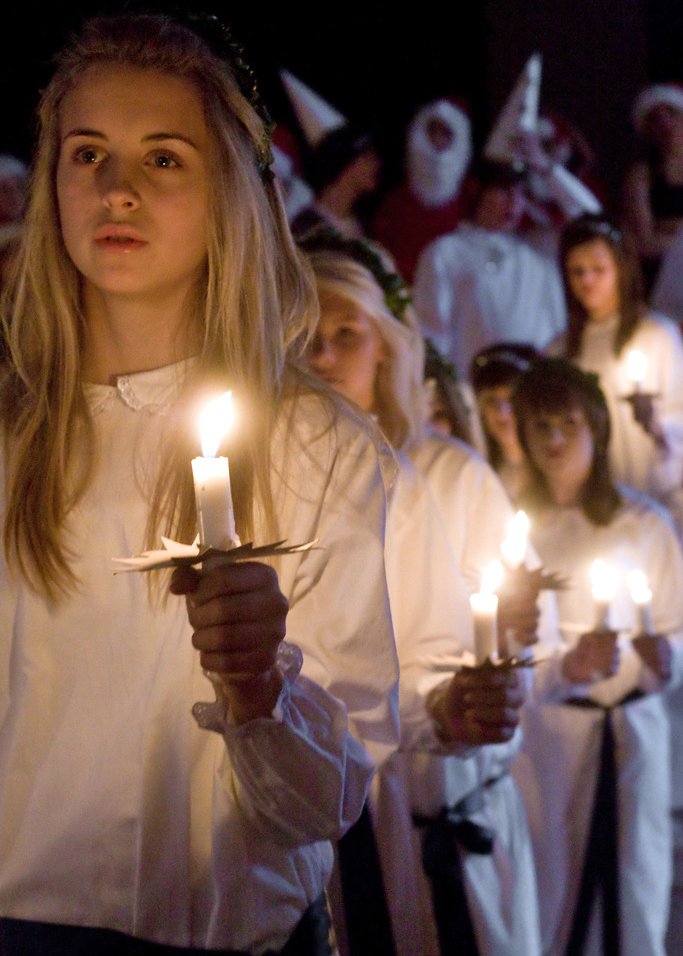
One thing I really wanted to mention, but for some reason didn’t, was St. Lucy (or Santa Lucia).  Lucy (whose name is deeply connected to the Latin “luce” or “light”) was a saint who tore out her own eyes as a demonstration of fidelity to her faith.  It’s a pretty gruesome thought, and much Christian art depicts this saint as carrying her own eyes on a silver platter.  Not exactly the type of story we think of while baking gingerbread men, right?  But St. Lucy’s Day, which falls on December 13th, is incredibly popular in Scandinavian countries.  Rather than focusing on the awful self-blinding, instead little girls wear crowns of candles and evergreens on their heads as they perform holiday parades dressed in all white gowns.  The girls then hand out sweets like gingerbread (pepparkakor) and chocolate to the people they pass, all the while, singing carols.  There’s a special type of pastry, the St. Lucia Bun, which is also made on this holiday.  In Italy, children leave out coffee or chocolate for Lucia, as well as bread and grain for her donkey.

There are still so many wonderful holiday traditions, customs, and magics out there to mention, but I’ll pause here for today.  I hope you’re enjoying the spirit of the season!

Thanks for reading!

-Cory