Blog Post 61 – What do you think?

Good morning and good Monday everyone!

We’ve got another podcast almost ready which should be up in the next day or two.  I thought I’d start off the week, though, with a set of polls for all our readers here at New World Witchery.  They’re nothing fancy, just a couple of questions about what you like best or would like to see more of with regards to the blog and podcast, and a question about whether a book on New World Witchery is something that would interest folks.

These polls are really guides for us to help make the site and show better for our listeners and readers.  The results may or may not change the content of the blog or podcast, but at the very least they will help us figure out a little bit more about what people want from us here.

Anyway, without further ado, here are the polls:

The polls will probably close in about a week, so you’ve got some time to answer.  I’ll also keep them up on the sidebar throughout the week so you don’t have to use only this post to answer.  We really appreciate your opinions, and your readership!  Thanks so much!

Be well,

Cory

Blog Post 60 – Appalachian Mountain Magic, Part III

Today I’m finishing up the introduction to the magic of Appalachia by looking at “yarb Doctors” and some of the other magical oddities of the mountains.

Yarb Doctors
The final part of the mountain magical triumvirate is the “Yarb Doctor.”  These are often seen as the male counterparts to the Granny women already discussed.  These were folks who knew enough herbal medicine to make cures and remedies for all manner of ailments.  Vance Randolph describes them thusly:

“Besides the regular and irregular physicians, who live mostly in the villages, the backwoods country swarms with ‘yarb doctors’…who have never studied medicine at all. Some of these nature doctors are women, others are preachers who do a little doctorin’ on the side, and many of them are unable to read or write. They rely mainly upon herbs, barks, roots, and the like. For internal medication these substances are steeped in hot water, and “horse doses” of the resulting teas are administered at frequent intervals. In some cases the tea is boiled down to a thick paste called ooze, or mixed with strained honey to make a syrup” (OM&F, p.92)

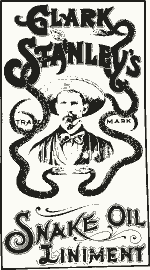
Often, this is what we think of when we talk about “snake oil salesmen.”  The yarb Doctor basically dealt in herbal formulas for treating common ailments.  Some of these formulas became fairly well-known.  When a particular yarb Doctor’s formula reached a particular level of renown (and often even if it didn’t and an unscrupulous “doctor” was simply chasing a dollar) these medicines would become a famous “patent medicine.”   This is not to say that the yarb Doctor (variously known as an “herb doctor,” “rubbing doctor,” or “nature doctor”) was simply a quack making money off of ignorant mountain folk.  In most cases, these were locals with a knack for making formulas and medicines from the indigenous flora of the area, including roots, barks, flowers, and leaves.  Some of the mixtures are still in use today, albeit changed much from their original purpose.  Root beer is a prime example of what happens when you make a patent medicine out of sarsaparilla and sassafras roots and mix it with a little sugar and soda water.  Appalachian yarb Doctors had good reason to make medicines:  they lived in the pharmaceutical breadbasket of the country.  According to Dave Tabler’s Appalachian History blog:

“Big Pharma had not yet perfected the widespread manufacture of synthetic drugs in 1932. Instead, the industry relied on ‘western North Carolina, southwestern Virginia, eastern Kentucky, and eastern Tennessee [to] furnish 75% of the crude botanical drugs which the continent of North America supplies to the drug markets of the world,’ according to an article in Economic Geography that summer”

The remedies proffered by yarb Doctors were not limited only to plants and their components, but often included a few more unusual ingredients.   For example, dealing with a toothache was a common enough problem in the mountains, where access to regular dental care was limited or non-existent:

“There were many treatments for a toothache.  Some of the more common ones were holding tobacco smoke, a sip of red oak bark decoction, or whiskey in the mouth; chewing ragweed leaves; applying cinnamon or clove oil, camphor, or persimmon juice to the tooth and gum; placing a ball of cotton soaked in paregoric, camphor, turpentine, or kerosene on top of the tooth; and holding a bag of warm ashes or salt against the cheek.  If a large cavity was present, it was stuffed with soda, salt, cow manure, spider webs, aspirin, burned alum, dried and pulverized buckeye skin, or crushed puff-balls” (FMSA, p.107)

There are a number of remedies used by these mountain medicine men which are still in common practice.  Clove oil, for example, is still used to numb the pain of a toothache.  Some methods, though, such as packing a cavity with cow dung, seem to have fallen by the wayside (I’ll not say whether I think that a good or bad thing, though I’m less than eager to put cow dung in my own mouth if I’m being entirely honest).

Other Aspects of Mountain Magic
There are, of course, many areas of mountain magic which don’t fall neatly into the three categories I’ve laid out here.  yarb Doctors and Granny women had much in common and there is a great deal of crossover in their particular lines of work.  Likewise, one who could dowse for water could usually also perform some other occult action, such as simple curing.  I have an in-law whose great-grandfather (the seventh son of a seventh son, no less) could dowse and “buy” warts off of people in order to effect a cure, for example.

Other aspects of mountain magic have already been touched on in this blog.  Some of the areas we’ve covered here which have a huge place in the folk magical practices of Appalachian peoples include:

One of the biggest areas I’ve not yet covered in detail is the Appalachian preoccupation with death, dying, corpses, and graveyards.  Edain McCoy’s In a Graveyard at Midnight includes a great deal of this lore in her chapter on “Death, Dying, and ‘Haints,’” which focuses mostly on the rituals surrounding death and burial as well as protection from the dead.  At some point, I’ll be doing a bit more on this topic, but for now I think the most important thing to note is that death and birth were—and are—the two most important events in a human life, and the mountain folk treated them with respect, awe, and not a little fear.

A final area of interest for mountain dwellers where the occult was concerned had to do with divining the future.  Rather than foreseeing events having to do with money or fame or anything like that, almost all Appalachian divinations performed in the home had to do with love.  This is, again, a topic I’ll be delving into with more depth at another time.  But often the “games” played by young girls in the mountains revolved almost entirely around divining the name, appearance, or attributes of a future husband.  And there are also plenty of tales which deal with the terrible consequences of treating these sorts of divinations lightly (such as the story of the “dumb supper” which eventually leads to a young girl’s brutal murder).  Suffice to say, Appalachian folk know that life has its dark side, and they aren’t afraid to talk about it.

That’s it for mountain magic this week.  I hope this has been a useful introduction.  This, like many of the other topics here, only scratches the surface, and I hope to return and look at Granny women, yarb Doctors, dowsers, power doctors, signs and omens, death lore, and just about everything in more depth at a later date.  But for now, I’ll wish you a happy weekend.
Thanks for reading!

-Cory

Blog Post 59 – Appalachian Mountain Magic, Part II

Today, I’m continuing the look at Appalachian mountain magic by focusing on a few of the specific “jobs” performed by mountain magicians.

Grannys, Dowsers, and Yarb Doctors

In general, the current incarnation of Appalachian magic is broken into a few categories.  Mountain witches may do only one “magical” thing all their lives, or they may perform a broad array of tasks for their communities, some magical and some not.  Often, the word “witch” never enters the picture or has a negative connotation (with one very key exception, explained below).  But the basic functions of a mountain magician can be broken down into a set of roles, as follows.

Granny Women
This is probably the best known and most ambiguously defined magical “job” in the mountains.  Granny women filled several roles in the community:

  • They acted as healers in communities where trained doctors were scarce, nonexistent, or deeply distrusted.
  • They assisted doctors when professional medicine was required, and often during childbirth.
  • They acted as midwives and postpartum caretakers for new babies and mothers.
  • They might be called upon to perform blessings for livestock or land before planting, owing to their roles as birth-helpers (thus helping the earth and one’s livestock birth the food one would eat for the coming year).
  • In some cases, they might also perform basic divinations, like determining the sex of a baby by dangling a wedding ring over the woman’s palm or belly.

Often the work done by these women was broader in scope than mere medicine.  It took into account a patient’s whole state, including spiritual or psychological.  Sometimes the work done by Grannies baffled the doctors performing the births, though they obviously were a great comfort to the mothers:

“Granny-women might perform a number of rituals which doctors found silly and irrational. Some were designed to give the mother psychological, if not physical, relief from her pain. She might give the woman her husband’s hat to hold during the ordeal, thus bringing him symbolically into the delivery room. If the labor were particularly severe, she would place an axe or knife under the bed to “cut” the pain in two. Sometimes, weather permitting, she would throw open every door and window in the house, in a symbolic representation of opening the birth canal” (from “In Defense of Granny Women,” by Janet Allured)

The term “Granny women” isn’t exactly accurate, either.  Many women were not particularly old when they learned about midwifery from their own female relatives, and even some men were known to assist during childbirth.  While much of the training to become a Granny was on-the-job, there were surprisingly sophisticated teaching materials as well:

“To train them [potential midwives], we had a very large wooden box.  At the bottom and on the top, there was a simulated abdomen and perineum—just like the mother—so we could actually teach them the mechanism of labor, and so we could teach them what was going on inside” (Foxfire 2, p.277)

Payment for a Granny woman’s services varied, often depending on the economic state of those she helped (which was usually fairly poor).  A passage from Folk Medicine in Southern Appalachia, by Anthony Cavender, illustrates the point:

“A typical fee charged by a physician in Kentucky for delivering a baby in the latter part of the nineteenth century was about $10, a substantial sum for an average farming family.  Physicians were often paid in commodities, such as corn, timber, pigs, cows, and corn mash whiskey, or labor in kind.  Some granny women charged a modest fee of a dollar or two or its equivalent in materials, but many did not” (FMSA, p.129)

These women served a vital role in their communities, and while some of them were labeled as “witches,” they seldom endured physical persecution as they were far too valuable.

Dowsers
The exception to the rule of bad “witches” were the dowsers, often called “water witches.”  These were people—most often men, though women were certainly known to perform water witching as well—who could locate underground streams through the use of various magical techniques.  The most common method was to use a forked branch cut from a witch hazel tree (some sources list other trees, like willow) and to walk slowly along a piece of property until the rod reacted by bobbing up and down or giving some other sign.  Despite being called “water witches,” there were seldom any negative connotations to the profession, as it was an absolutely necessary service in a time when digging wells was costly and difficult business.  Vance Randolph describes them thusly:

“Nearly all of the old settlers…believe that certain persons can locate underground streams by ‘cunjurin’ round’ with forked sticks. These characters are called water witches or witch wigglers, and the forked switches they carry are known as witch sticks. Despite this sinister terminology, the waterfinder has no dealings with the Devil, is not regarded as dangerous by his neighbors, and has  nothing to do with witchcraft proper…Nearly all of the really old wells…were located by witch wigglers. Even today there are many substantial farmers who would never think of drilling a well without getting one of these fellows to witch the land” (OM&F, p.82)

In addition to locating underground water currents, dowsers could also locate other materials, like oil or precious metals.  Some practiced what is called “map dowsing,” where a map would be laid out in front of the dowser and he or she would use a pendulum to figure out where to start the search for whatever material was being sought.  This practice is very well accepted in the mountains and throughout the rural parts of North America.  In Signs, Cures, & Witchery, Gerald C. Milnes  examines the widespread nature of dowsing, as well as some of its history:

“Water witching (rhabdomancy) is very common in West Virginia.  According to a study done about fifty years ago, at that time there were twenty-five thousand practicing water witches in this country.  The actual practice of divining with a forked stick, as we know it, began in the late fifteenth or early sixteenth century in Germany.  Martin Luther believed the practice violated the first commandment.  Through the ages it has been roundly denounced as the devil’s work and praised as a remarkable aid to a basic necessity of rural life—finding water.  It is often categorized with such rural customs as planting by the signs” (SC&W, p.133)

There have been many efforts to scientifically prove or disprove dowsing, all with varying degrees of success and failure.  It seems that there is something to it, but that it may have a great deal more to do with the person doing the dowsing than the actual practice itself, at least as far as science is concerned.  However, from my personal point of view, the practice of water witching is akin to pendulum divination of any kind and something worth adding to a witch’s repertoire.  In one of Peter Paddon’s Crooked Path episodes, for example, he talks about ley lines and the currents of magical energy flowing through the world.  Dowsing is a great way to help detect those currents and to tap into and work with them to improve one’s witchcraft (again, in my opinion).

Whew!  This is already getting to be a long post, so I’m going to stop here for today and save the last little bit of this topic for tomorrow.  Please feel free to add any comments or questions, and if you have any family stories about Grannies or dowsers, I’d love to hear them!

As always, thanks for reading!

-Cory
Blog Post 58 – Appalachian Mountain Magic, Part I

Today, I thought I’d start to tackle in brief a subject which deserves its own book.  Or several books.  Perhaps even a library.  I’d like to do an overview of the loose collection of occult, healing, and divinatory practices practiced by the mountain folk found in the Appalachian range.  This is not going to be a comprehensive post, just a general snapshot of the different components of mountain magic, so if I don’t cover something in detail I will likely be coming back to it again eventually.  First, though, let’s start with a little bit about where this system comes from.

History
When European settlers moved into these mountains, they found that the lore and landscape they suddenly occupied was not entirely different than what they’d left behind in Europe.  Many of the Native American tribes like the Cherokee and Shawnee already associated these ancient mountains with magic and otherworldly power.  There were even beings which very much resembled fairies living in those ridges and valleys, as illustrated in the Cherokee tale of the “Forever Boy”:

“As he looked behind him, there they were, all the Little People. And they were smiling at him and laughing and running to hug him. And they said, ‘Forever Boy you do not have to grow up. You can stay with us forever. You can come and be one of us and you will never have to grow up… Forever Boy thought about it for a long time. But that is what he decided he needed to do, and he went with the Little People” (Native American Lore Index – Legends of the Cherokee).

The presence of fairies in the mountains would have been familiar to groups like the Germans and the Scots-Irish, the latter of whom had their own tradition of “fairy doctoring” which would eventually shape a portion of Appalachian magical practice.

Germans also brought in astrology, particularly astrology associated with things like planting, healing, and weather.  Despite a strongly Christian background (and strongly Protestant and Calvinist at that), most settlers accepted a certain amount of magical living in the mountains.  As George Milnes says in his Signs, Cures, & Witchery:

“Among the early German settlers in West Virginia, religion was thoroughly mixed with not only astrology but also esoteric curing practices tied to cosmic activity.  Folk curing bridged a gap between the religious and the secular mind-set.  And forms of white magic were not disdained; in fact, they were practiced by the early German clergy” (SC&W, p. 31).

The Scots and Scots-Irish who settled in the mountains were often displaced due to land struggles back home.  After long struggles with England for an independence which clearly would never be theirs, clan leaders traveled across the Atlantic and began building new territories.  The mountains running between Georgia and West Virginia were a perfect fit for them, according to Edain McCoy:

“The Scots found the southern Appalachians very remote, like their Highland home, a place where they could resume their former lifestyle and live by their ancient values without interference from the sassenach, or outsiders.  So isolated were they that many of the late medieval speech patterns and terms remained intact in the region until well into [the 20th] century” (In a Graveyard at Midnight, p. 6).

Once these various elements were situated in the mountains together, they began to merge and blend, mixing Native and European sources to create something else.  The introduction of hoodoo elements eventually changed the mixture again, though much later, and there are still old-timers in the hills practicing many of these techniques even now, though it is unlikely the entire system will remain intact for more than a generation or two as many mountain folk are being forced by poverty or circumstance to give up their highland homes.  Still, for the moment, there are lots of people trying to get Appalachian folkways recorded and preserved before they perish from the earth (this blog being one very infinitesimal drop in the bucket as far as that goes).   So for that, at least, we can be thankful.

Okay, I’ll stop here for today.  Tomorrow, I’ll be picking up with a little bit on each of the current components of Appalachian magical practice.  Until then…

Thanks for reading!

-Cory

Blog Post 57 – An Award!

So after spending nearly a week recuperating from my “swamp virus,” I used yesterday to catch up on emails and comment replies on the blog.  Much to my great surprise and delight, someone had lobbed a shiny happy little blogging award our way.  Sarah over at Crooked Ways has tagged me as a “Kreativ Blogger,” so I figured that’s as good a way as any to start the week!  The rules are pretty straightforward:

1. You must thank the person who has given you the award.
2. Copy the logo and place it on your blog
3. Link the person who has nominated you for the award
4. Name 7 things about yourself that people might find interesting
5. Nominate 7 other Kreativ Bloggers
6. Post links to the 7 blogs you nominate
7. Let the nominated victims bloggers know they have been tagged

So first things first, Thanks Sarah!  It’s always an honor to be nominated.  As for the logo, ::twitches nose::

Here it is!

I’ve already linked Sarah, so now on to the “7 Things” segment.

  1. I grow and can my own food – I even teach classes on the subject sometimes.  I prefer to do the hot-water bath method, as most people can get a stock-pot of boiling water pretty easily, but a pressure canner’s a little harder to come by.  I love to put up things like tomatoes, pickles, jalapenos, salsas, apple butter, and brandied peaches (DELICIOUS over vanilla ice cream).
  2. I’m a published poet – My work has appeared in Raving Dove Literary Journal, Merge Poetry Review, and a couple of other places.  Why don’t I put my poetry on my blog?  Because I didn’t say I was a very good published poet.
  3. My first year of marriage was spent in Prague – My wife and I, who had not lived together before due to religious reasons, wed and moved thousands of miles away from our families and friends.  We spent almost a year there, and it was really spectacular.  Prague remains one of my favorite cities in the world.
  4. I’ve also spent time in Spain (mostly in Murcia and Valencia) and Scotland, and made short trips to Germany, Hungary, Slovakia, and London.  And I’ve visited 38 of the 50 US States.  At some point, I’d really like to go to Greece, Italy, and Turkey.  And eventually, I’d LOVE to go to Japan and possibly China (if its political climate ever calms down).  My next big trip will probably be up to the Pacific Northwest, though, as that’s where my wife really wants to go.  Really, I’d be happy to travel just about anywhere.
  5. I’m a very lazy polyglot – I learn languages and then never use them, other than to show I can remember key phrases.  I’ve taken courses in Latin, Russian, Portuguese, Czech, and Japanese, and my minor at University was Spanish.  Plus I’ve tried to independently learn Mandarin Chinese, Greek, Yiddish, and German.  Of all of them, Spanish has stuck with me enough that I’m still conversant in it, and I could probably survive in Japan long enough to begin picking that up again as well.  Despite the fact my mother, my wife, and several of our friends all speak (or have spoken) French, I’ve never tried to learn that one, though.
  6. I’m a trivia addict – I watch shows like Jeopardy! as often as I can, and I subscribe to the magazine mental_floss, which is basically full of trivia (like “10 Presidents Who Could Drink You Under the Table”).  I can make hours disappear from my life by opening a box of Trivial Pursuit cards and just sitting and reading them.  It’s kind of sad, really…
  7. I have an odd phobia of rabbits.  I’ve mentioned this before, and I’m not outright scared of them, but vaguely creeped out.  Really, I only discuss it here to give myself a reason to link to the cause of my wariness:  the cartoon version of Watership Down.  The clip shows a few of the more brutal highlights of that particular film, but if you imagine an 8-year-old seeing any movie with this stuff in it, a fear of bunnies seems much less weird.

Okay, so now on to my Seven Nominees:

  1. Sarah, the Witch of Forest Grove (of course) – She has some of the most creative work I’ve seen, and one of the most informative sites around.  Big kudos to her.
  2. Papa Toad Bone – His apotheca takes me out of the internet and puts me barefoot into the swamp, and I like that.
  3. Juniper’s Walking the Hedge site – It’s lovely and she really puts a great deal of effort into making it a nice place to just go and visit.
  4. Lady Lavona – She has two blogs that I just eat up, her main Cabinet of Curiosities site, and a Tumblr site called Witch Mountain.  Both are easy to spend oodles of time on.
  5. Jude over at Spirit Cloth always captures my attention with her amazing fabric works.  They have a tangibly magical quality that just makes me want to curl up in all her scraps of cloth and live there.
  6. My friend Saturn over at Pennies in the Well – It’s a pretty site, and her Mad Hatter episodes are fun, insightful, and just a pleasure to listen to.  All her episodes are, actually, but the Mad Hatter ones really show off her creativity.
  7. Finally, Oraia the Sphinx has a blog over at Sphinx Words that I really like, not just because she’s also my friend, but because her writing style is so familiar and pleasant.  She has a way of getting into my head sometimes that is uncanny, so big kudos to her.

So that’s that.  Again, huge thanks to Sarah at Crooked Ways (another very well-written and marvelously creative blog, if you haven’t checked it out)!  Hopefully you’ll be seeing a couple more articles from me this week as I get back up to my usual posting habits.  But for now, thanks so much for reading!

Be well,

Cory

Quick Update

Hi all,

First of all, I just want to say thank you everyone who’s been posting, emailing, and interacting here this week.  It gives me so much happiness to see that kind of discussion here at NWW.  Thank you all for that!

Secondly, I want to apologize for not posting more this week and for not answering many comments/emails.  As some of you may know, the Southeast was hit by a huge storm system last weekend which left a dozen or more people dead and has caused all sorts of problems in its wake.  One of these problems was a tremendous amount of flooding, much of which still hasn’t subsided.  While my family and I came through all of that safely with no damage to our home and are very thankful for that blessing, I wound up getting a little beat up by it on the back end.  I had to handle some flood-soaked materials for work, and stupid me didn’t think to put on a face mask (though I did at least wear gloves).

I’ve been battling some kind of bug since about Tuesday at this point (I call it a “swamp virus”) and I’m not sure how long it will take to run its course.  I’ve been pretty much on a liquid diet because my throat was so swollen shut nothing else would fit, and I finally think my fever broke for good yesterday.  I think I’ll be fine, and hopefully back in high gear by next week, but for now I wanted you all to know I’m not ignoring any of your emails or comments, I promise!  I’ll be replying to all of them as soon as I can, so please be patient as I try to drink lots of OJ and get better before responding.

Again, many thanks to all of you wonderful readers and listeners!  You make NWW awesome, and I really appreciate it!

All the best,

-Cory

Quick Update – 05/03/2010

Hi everyone,
I just wanted to let you know that we will have a podcast forthcoming this week, but it may be delayed a bit.  We had some really rough weather over the weekend and it’s thrown things into a bit of a tizzy, so please bear with us while we get things together.

There’s going to be a mini-podcast up today (a little special episode), but the normal episode probably won’t be up for another day or two.  It’s been recorded, I just need to do the editing.  We will try to have it for you as soon as possible though.

Thanks for your patience!

-Cory

Blog Post 56 – Walpurgisnacht

A caveat before I begin today’s post:  Walpurgisnacht is not terribly “New World.”  Most of it will be related to the British Isles and Europe, though I will include a little bit on New World practices, too.  But I think it’s still relevant to witchery, so I’m going to write about it anyway.  Mostly because, well, I really want to.

This is quite possibly my favorite witchy holiday, with the conditional exception of All Hallows/Halloween.  I do like May Day/Beltane celebrations, of course, but the night before is really what I love.  The association of this night with witchcraft seems to go back a long way.  The name of the holiday comes from a Catholic Saint who died in the year 777 C.E, St. Walburga.  Rosemary Ellen Guiley, in her Encyclopedia of Witches & Witchcraft, says this about the holiday:

“In the Middle Ages, Walpurgisnacht, or Walpurgis Night, was believed to be a night of witch revelry throughout Germany, the Low Countries and Scandinavia.  Witches mounted their brooms and few to the mountaintops, where they carried on with wild feasting, dancing and copulation with demons and the Devil…In Germany, the Brocken, a dominant peak in the Harz Mountains, was the most infamous site of the witch sabbats…[S]o common was the belief in the sabbats that maps of the Harz drawn in the 18th century almost always depicted witches on broomsticks converging upon the Brocken” ( EW&W, p.347)

What shifted the focus from holy martyrdom and sainthood to witch-filled revels?  Well, there’s no single reason why that I’ve found, but the date is directly opposite Halloween in the calendar year, so that might have something to do with it (what, you thought witches would be content with one night of fun a year?).

There are lots of stories about this night.  One from the Isle of Man between Scotland and Ireland tells the story of two witches and their (mis)adventures on Old May Eve.  Dennis Wheatly’s occult novel The Devil Rides Out features a Walpurgisnacht ritual rather prominently, as it does in Goethe’s Faust tragedy.  The scene at the end of the original Fantasia film featuring Mussorgsky’s “Night on Bald Mountain” also makes heavy reference to the revelries of Walpurgisnacht (I think I mentioned this in the Media Episode, too).  There are also many unusual traditions associated with this night.  When I was living in Prague, they had a tradition of building huge bonfires on hilltops on this night, and burning brooms or effigies of witches to keep evil spirits at bay, for example (it was really more of an excuse to drink around the bonfire).  Vance Randolph, in his Ozark Magic & Folklore, describes an Ozark tradition for May Eve:

“On the last night of April, a girl may wet a handkerchief and hang it out in a cornfield. Next morning the May sun dries it, and the wrinkles are supposed to show the initial of the man she is to marry. Or she may hold a bottle of water up to the light on the morning of May 1, just at sunrise, and see apicture of outline of the boy who is to be her husband” (OM&F, p.176)

My personal practice incorporates a storytelling bent, and there’s one story that I turn to every year as part of my Walpurgisnacht ritual.  “The Horned Women,” as recorded by Lady Wilde (in a collection with many tales also recorded by W.B. Yeats which I’ve mentioned before—Fairy & Folk Tales of the Irish Peasantry), is not explicitly about this wild night.  Yet certain elements—the assembly of a coven of witches, and the prominent mention of a mountain where they revel, especially—have always called to mind this tale in relation to May Eve.  I glean much in the way of magic from this story, and incorporate things from it into my workings (such as the use of “feet water” to guide all harmful forces away from my home).

Walpurgisnacht doesn’t register on everyone’s radar.  Some are definitely drawn towards the Beltane side of this holiday, and I rather love that celebration, too.  But Walpurgisnacht will always have a special place in my heart.  There’s no night I more earnestly wish I could climb on a broomstick and sail off into a moonlit sky than this one.

Thanks for reading!

-Cory

Blog Post 55 – Games

May Day is just around the corner, and since I’ve been talking about songs and riddles this week, I thought it might be fun to talk a little about games.  Sport and fun may not seem like a particularly witchcraft-tinged topic, but au contraire! I say.  There are lots of magical subtexts to games, from the sacrificial-animal nature of a colorful piñata to the gambling mojo or lucky rabbit’s foot stuffed in a card-player’s pocket.

Getting Lucky
Winning games by magic is a primary focus of many types of hoodoo workings.  Some of the various techniques for improving one’s luck include:

  • The creation of gambling mojo hands, often “fed” with a woman’s urine (because of her connection to Lady Luck)
  • The appropriately named “Lucky Hand” root, which resembles a human hand and which is reputed to bring good luck to one in games of chance
  • A buckeye with a hole bored in it, filled with liquid mercury (quicksilver), and sealed with wax was considered incredibly lucky.  WARNING:  Don’t do this.  Mercury is VERY dangerous and VERY poisonous, even in tiny amounts.  Modern root workers often use sliver Mercury-head dimes instead.
  • The popular alligator-foot or rabbit-foot keychains found in roadside stops throughout the country are considered potent gambling charms.
  • One of my favorites is the “coon dong” charm, which is a raccoon penis bone wrapped in a currency note (the higher the better, of course) to ensure continued luck.

Of course, there are lots of other hoodoo charms related to luck and good fortune.  Simply carrying a High John root in your pocket is a good way to ensure luck at all you do, including games.  Another big game-related piece of hoodoo magic comes in the form of “dream books,” which purport to help the dreamer turn symbols and images from the night’s slumber into winning lottery numbers.  Catherine Yronwode has an excellent page on this topic, so I’ll just suggest you visit her site for more on those.

Magical Games
There are many games that have interesting magical undertones (or overtones…maybe highlights or roots?).  I thought it might be fun to include a few games that you could include in your own May Day celebrations today.  I’m skipping out on the traditional Maypole as that is well documented in many places.  I hope you enjoy them!

From Central Illinois (in Richard Dorson’s Buying the Wind, paraphrased)

LONDON BRIDGE IS FALLING DOWN

Two players are named “Takers,” and each chooses an object or idea that represents him/her (such as one player being “bees” and the other “flowers,” or one the “sun” and the other “the moon.”  The Takers do not tell the other players which Taker is which object however.  The other players form a circle, and the Takers join hands, one outside the circle and one inside.  They raise their arms, and the circle begins to turn as everyone sings:

London Bridge is falling down, falling down, falling down;
London Bridge is falling down, and caught my true love in it.

The Takers can drop their arms at any point during the singing, and the circle stops.   Whoever the Takers have “trapped” must choose one of the objects and whisper it to the Takers.  The Taker whose object is named grabs the trapped player and moves them behind him/her, and then the Takers raise their joined hands again.  The singing and circling continues in this way until all the players have been caught and moved behind their chosen Taker.

The Takers keep their hands joined and each player wraps his/her hands around the player before them, forming two human chains linked by the Takers.  The game ends with a tug-of-war between the two sides.

This game could be a wonderful way to have some fun while enacting a sort of ritualized drama, such as the struggle between light and dark.  It is best with a large group of people of course, and the “prize” for winning could have to do with the losing side serving the winning side at a feast, or something to that effect.  Or winning could just be its own very fun reward.

From Appalachia (in Foxfire 6)

DEVIL IN THE PROMISED LAND

“We played a game called ‘The Devil in the Promised Land.’  A big branch went down through our pasture.  Some places it was wide and some places were narrow enough to jump across pretty good.  There’d be about eight or ten of us on one side.  We’d put one on the other side and he was the devil.  Now we had to cross the branch and go around him and jump the branch back.  Now if he caught us before we made the run around him, we had to go on to the devil’s side” (p. 282)

I love this one, and you could definitely play it without having a huge tree or creek (I’m not 100% sure what that informant meant by “branch”).  Just making a big circle with rope or setting boundaries for the “Devil’s land” with stones would be pretty easy.  You could also think of this as “a witch and her spirits,” with the Witch being the primary tagger, and her Spirits being the players she catches, who help her catch other players (I would say they can’t “tag” a player, but might help to corral the other players towards the Witch…but that’s just my take on it).

From the Southwest and Mexico

THE PINATA

The piñata has an interesting history dating back to at least Mayan times, and possibly even back to China.  There’s an excellent short history of the game here, including many traditional rhymes and songs associated with the game, such as:

“Dale, dale, dale, no perdas el tino,
porque si lo perdes, pierdes el camino.
Esta piñata es de muchas mañas, sólo contiene naranjas y cañas.”

Hit, hit, hit.
Don’t lose your aim,
Because if you lose, you lose the road.
This piñata is much manna, only contains oranges and sugar cane.”

Making paper mache representations of animals, spirits, demons, gods, stars, or almost anything magical would add to the occult significance of a game like this.  After the candy’s been collected, some of it could be turned into an offering as well, if that’s part of your tradition.  The bright colors of most piñatas make them perfect for May Day gatherings, in my opinion.

There are lots of other games you could play as well, like Nature Bingo or Horseshoes, that would fit a spring or summer gathering.  This post is already plenty long, though, so I’m going to end it here.  Feel free to share your own witchy games, if you have them!

Thanks for reading!

-Cory

Blog Post 54 – The Devil’s Nine Questions

Today’s post is going to focus on one very specific set of riddles:  The Devil’s Nine Questions.  This is a series of riddles which has been set down in the form of a folk song, and which has come over from English traditional music by way of the Appalachians and mid-Atlantic colonies.  The theme of the piece involves the Devil asking a series of nine riddles, which the song’s protagonist (“the weaver’s bonny”) must solve or be taken off to Hell.  There are numerous variants on this motif, and on this specific song.  It is recorded as one of the famous Child Ballads (#1), and you can hear a version of it here.

The version I’m posting here is not necessarily the most “authentic” or “original” version (as this song may have grown out of Elizabethan folk music and is rather hard to pin down as far as origins go).  But it is a version that I think bears examination by the inquisitive witch.

THE DEVIL’S NINE QUESTIONS

If you don’t answer my questions nine
Sing ninety-nine and ninety,
I’ll take you off to hell alive,
And you are the weaver’s bonny.

What is whiter than milk?
Sing ninety-nine and ninety;
What is softer than silk?
Say you’re the weaver’s bonny.”

Snow is whiter than milk,
Sing ninety-nine and ninety;
Down is softer than silk,
And I’m the weaver’s bonny.”

What is louder than a horn?
Sing ninety-nine and ninety;
What is sharper than a thorn?
Sing I am the weaver’s bonny.

Thunder’s louder than a horn,
Sing ninety-nine and ninety ;
Death is sharper than a thorn,
Sing I’m the weaver’s bonny.

What is higher than a tree?
Sing ninety-nine and ninety;
What is deeper than the sea?
Sing I’m the weaver’s bonny.

Heaven’s higher than a tree,
Sing ninety-nine and ninety;
And hell is deeper than the sea,
Sing I’m the weaver’s bonny.

What is innocenter than a lamb?
Sing ninety-nine and ninety;
What is worse than womankind?
Say I’m the weaver’s bonny.

A babe is innocenter than a lamb,
Sing ninety-nine and ninety ;
The devil’s worse than womankind,
Sing I’m the weaver’s bonny.”

You have answered me questions nine,
Sing ninety-nine and ninety;
You are God’s, you’re not my own,
And you’re the weaver’s bonny.”

From Bronson, Singing Traditions of Child’s Popular Ballads
Collected Mrs. Rill Martin, Virginia, 1922

Looking at this from an occult perspective, I see several things which stand out.  For instance:

  • The repetition about being “the weaver’s bonny,” which in my opinion may relate to being one of those who can change (or at least manipulate) Fate, the great weaver.
  • The efforts of the Devil to claim the “bonny” for his own reminds me a bit of the practice of initiation, which I covered recently (though in this case the person responding remains unmoved by the Devil’s efforts)
  • There’s an interesting bit of business in the part about trees, seas, Heaven, and Hell.  It’s almost a “Land, Sea, and Sky” image, but it also seems to be referencing the celestial, earthly, and underworldly realms.  Those are the realms a witch must go between, so I like to think there’s something to that part.

Of course, there are lots of other images in here which come out of Christian folklore, such as innocent lambs, the wickedness of womankind, etc.  In some of the variants, these change a bit (though usually the reference to Eve’s “original sin” remains in some form).  Some of the other variations include naming Love as softer than silk, rather than Down, and making Death “colder than the clay” instead of “sharper than the thorn.”   What I love about all of this imagery is that it relates one thing to another, connecting the senses to specific images in a very evocative way.  Associating Death with Thorns makes me think of going into the Underworld via the Hedge; Milk and Snow make me think of Mother images, like Mother Holle, who shook her downy blankets to stir up snow on earth; and thinking of Thunder as a Horn, summoning me out into a wild storm…well, let’s just say it makes my pointy hat dance on my head.

With songs like this, it’s often hard to know just what changed and when, and what the original meaning of certain parts are.  What I like about it, though, is the folkloric elements of being able to outwit the Devil and get one’s way, bending Fate to one’s will.  I would think this kind of a tune might be an excellent song for singing when gathering together with other witches, as a sort of  call-and-response as each witch is welcomed among the company (solving a riddle could serve as a “password” in effect).  Or, it could just be a good fun song to sing one night while passing a bottle around and telling jokes, stories, and riddles.  But what do you think?  Do you see anything witchy I missed?  Or do you think that dwelling on a song like this is wasting valuable time that could be devoted to a new root work herb of the week?  Is it all just a big stretch for something purely designed for entertainment?  Leave a comment and let me know!

Thanks for reading!

-Cory