Episode 23: A New Year, Anniversaries, and Birthdays

New World Witchery – Episode 23
Where we’ve been, where we’re going
New Years’ traditions
Anniversary folklore
Birthday customs
(complete shownotes at https://newworldwitchery.wordpress.com)

Quick Update – Call for Submissions

Attention all writers!

I know there are at least a few folks who read the blog or listen to the podcast and who also enjoy wordsmithing in a fictive vein.  In case you haven’t heard, Misanthrope Press is holding an open call for submissions of short fiction to be included in their upcoming Etched Offerings: Voices from the Cauldron of Story pagan fiction anthology.  They’ve extended their submission deadline to the end of April, so I highly recommend you put together your best short story with touches of the magical, the mythical, and the metaphorical and send it over to them for consideration.  Here are some of the details from their website:

“If you are reading this anywhere other than www.misanthropepress.com, we urge you to visit our website and view the full guidelines page. We have had to reject several submissions that did not fit our intended theme because people didn’t fully review the guidelines first; we don’t want you to waste your own time by being another one. Etched Offerings: Voices From the Cauldron of Story is a Pagan religion themed short fiction anthology. We are seeking stories about, or relevant to, contemporary Pagan paths and lifestyles, regardless of tradition. Stories about the gods and goddesses, about modern Wiccans, witches, shamans, and other magickal practitioners, as well as fantasy stories of myth and magick are all welcome…

Stories that retell existing myths and legends are acceptable, but there needs to be an original twist or fresh perspective in the telling…

Stories not strictly about Pagan topics, but featuring Pagan characters are very welcome…

We are not looking for stories that focus too heavily on how difficult it is to be Pagan in our society. It’s a valid issue, very much so in some geographic regions, but it’s not what we want to focus on in this anthology.  We’re looking for stories that celebrate the joys and rewards of following a Pagan path, not ones that lament the challenges we face. If your character faces such a challenge and overcomes it, and your story focuses on the triumph of that, that’s acceptable. We won’t, however, accept many stories of this nature, so keep that in mind when submitting.

Along these same lines, while we will potentially accept a very small number of stories that deal with the clash of religious beliefs and/or groups, we won’t be accepting any stories that directly criticize or bash the beliefs of another group. It’s a fine line, we realize; if you’re not confident in your ability to walk it, pick another topic for your story.”

Full guidelines are available at the Misanthrope Press site, so please head over there and throw your ink-stained hat in the ring!

Good luck, and happy writing!

-Cory

Blog Post 117 – Favorite Non-magical New Media

Hi everyone!

Today’s post is actually not much concerned with witchcraft or magic, so if you usually read for those reasons, you might want to skip it.  Instead, I thought I’d share a few of the things I’m listening to or reading when I’m not focused on purely magical pursuits.  It’s no secret I have a deep love for folklore and Americana, but I’m also deeply interested in science and history as well.  I think they’re very important because they are two of the best references for understanding the world and our place in it we have available.  They are balanced by folklore and magic, I think, and so I tend to get very into them.  So here are some of my top new media (i.e. blog and podcast) sites:

History

The History of Rome – Podcast – Mike Duncan’s magnificent podcast has been going on for well over two years now, and shows no signs of slowing down.  Each episode, which can range from 15 to 35 minutes long, covers a segment of Roman history, from the mythical origins to the military victories to the day-to-day life Romans endured or enjoyed depending on their station.  I’ve learned so much from this show.  Of particular interest to those who read this blog might be episodes 86, 87, and 88, which touch on the daily life of Romans, including their religious doings.  I cannot recommend it highly enough.
12 Byzantine Rulers – Podcast – This series from Lars Brownworth, a noted historian and also the voice behind the Norman Centuries podcast, is a wonderful overview of the Byzantine Empire.  Brownworth covers the rise and fall of one of the most interesting and oft-misunderstood empires in history with depth and narrative enthusiasm.  If all history were this interesting, we’d have a lot more historians around.  I also recommend his excellent book on Byzantium, Lost to the West.
Appalachian History – Podcast & Blog – This is a wonderful site and show which has the feel of an audio newsletter, complete with short tales, historical notes, and anecdotes about life in Appalachia, particularly during the Depression.  The production is quite nice, with little filmstrip-soundtrack bells between each segment, and a brief overview of the topics covered in audio abstract format at the top of the episode.  The site is updated more frequently than the podcast, but both are well worthwhile, and even occasionally touch on magical topics, as in the post on the Blood Verse.
The Blind Pig & the Acorn – Blog – This is a lovely and well done blog which looks at not only historical Appalachia, but modern-day mountain life, too.  There are a number of topics covered, from gardening and self-sufficiency to medicine to music to storytelling.  There’s even a wonderful series of posts about planting by the signs, which might be of interest to folks here.
Backstory with the American History Guys – Podcast – This NPR-produced show features three professors of history with different specialties (18th, 19th, and 20th centuries) tracing the course of particular topics throughout American history.  Topics have included a history of courtship and romance, a history of ghosts and the supernatural, and even a history of climate control and air conditioning!  The rapport between the hosts is stellar, and the information is always fascinating.  If you have any interest in American history, give them a listen.

Science

RadioLab – Podcast – This deeply fascinating WNYC/NPR show features two hosts with a lot of good questions tackling some very big topics in science.  For instance, shows cover topics like dreams and Sleep, conceptions of the Afterlife, the nature of Words and language, finding Limits of human performance, the wonderful world of Parasites, and Stochasticity (I’ll let you look that one up).  Jad and Robert make the universe seem like a playground, albeit a big, terrifying one sometimes, and their probing show really unearths a lot of new questions for the curious listener.  The production values are phenomenal, too!  Plus they often have great music (this is where I discovered the amazing cellist Zoe Keating, and They Might Be Giants are apparently fans of the show, too).
Earth & Sky – Podcast & Blog – This is a wonderful short series on the many different aspects of physical science that influence our daily lives.  They cover everything from asteroids and space dust to the shifting coastlines of major continents to the influence of rare earth elements on our economy.  You can subscribe to particular feeds following particular topics, or get your fill of the whole shebang if you prefer.
The Naked Scientists – Podcast – This show, which also features offshoot programs on Africa, Archaeology, Engineering, etc. is loaded with lots of short, fun, interesting segments.  It primarily deals with the basic processes of science and how they relate to understanding our world today, but there are occasional segments related to historical science as well which are quite fascinating.  They feature guests, field reports, and lecture-style deliveries on a wide range of topics, which should certainly whet the appetite of any eager science aficionados.
Nature – Podcast – A group of scientists connected with the journal of the same name host this very informative show which doesn’t focus on current events in science, but rather spends a lot of time looking at the natural world and trying to understand it.  It gets some criticism because it is definitely aimed at scientists, but usually it’s not that hard to follow and the more difficult stuff just makes me more curious.  Give it a listen if you have an interest in natural science!
Borealis Meditation – Podcast – Okay, okay, this IS a pagan podcast from one of our own, Kathleen.  But let me be frank here in saying I get a huge education in earth science every time I tune into the show, and actually find myself listening more for that angle than any other.  Great science, great host, very enjoyable show!

Folklore

The Moonlit Road – Podcast – A delightful podcast which tackles individual tales from American folklore in every episode.  Master storytellers recount these famous stories, like “Taily-po” and “The Blue Girl.”  It has relatively high production values, and always makes me happy when I see a new episode available (though I could do without the cricket noises on the webpage).  A great listen!
To the Best of Our Knowledge – Podcast – This one is not strictly folklore, but also covers things like science, sociology, literature, etc.  However, I’ll be honest, I don’t always listen to the episodes on topics I’m not interested in, so I primarily hear the information on literature and folklore.  Some of the great episodes in that vein have been the episodes on Magic and Fairy Tales.
Librivox – Audio Archive – I’m a huge fan of this project, which aims to take all public domain literature and provide volunteer-created audio recordings of it to everyone.  I’m working on getting a few tales together myself for this site, and I love listening to all sorts of folklore, including the Grimm’s Fairy Tales and the Arabian Nights.  As it is volunteer-based, the quality of the audio varies a bit, but overall it seems to be audible and there are a variety of voices to experience, which is very nice in my opinion.
Hometown Tales – Podcast – This show really focuses on listener-submitted lore, and as such, doesn’t get a whole lot of scholarly points.  However, as far as fun and interest go, this podcast is really solid.  The hosts have a good chemistry together, and the stories are presented with a little bit of humor and a sense of combined belief/unbelief that makes each topic more intriguing.  If nothing else, it usually sends me scrambling for a pen so I can look up some of the lore they present and find out more about it, which is always a good thing.
The Moth – Podcast – Another show from NPR which isn’t so much about folklore as it is about storytelling.  As such, I can’t really say it’s folklore in the way I usually mean it, but it still fits as storytelling is a major folk art and one I particularly love.  And the stories are often very fun, funny, or poignant, with occasional forays into the magical.  It’s a grab bag, really, but I think it’s worth listening to.

Religion

Speaking of Faith – Podcast – Host Krista Tippett discusses religion with some of the most fascinating religious figures out there.  If you’re into comparative religion, I highly recommend this show.  Some highlights have included episodes on ethical eating, a discussion on Ojibwe language and story, and a wonderful show about Haitian Vodou.
The SaintCast – Podcast – Dr. Paul Camerata does a marvelous job exploring the Catholic faith through the lives of the saints.  While he would probably not be thrilled to see his show linked from this particular site, I personally love his show, which features “Saint Jeopardy!” and a weekly saints calendar.  You get historical information as well as the lore surrounding the saint, often from primary sources, and it’s a lot of fun to listen to, if you happen to like saints.

I listen to a lot of podcasts, if you can’t tell, but I also have a heck of a commute to work every day.   And I’m not even including things like my foreign-language podcasts which I use to help improve my Spanish and German vocabulary!  I don’t know if this post will turn anyone on to some new listening material, but if it does, that’s great!  Of course, I’m really hoping none of these shows will replace New World Witchery on your mp3 player…but that would be impossible, right?  Right?

Thanks for reading!

-Cory

Blog Post 116 – Cursing Psalms (part II)

Staying on the dark side of things today, I’m going to continue the theme I started in my previous blog post on the biblical Psalms which have been used to curse.  In this post, I’ll be looking at several of the most commonly used Psalms, as well as some of the spells which are built around them.

To begin, let’s look at the spell that prompted this whole topic.  From Judika Illes’ Encyclopedia of 5000 Spells:

The Cursing Psalm

The power to heal can be the power to harm.  Even something as intrinsically good and sacred as a psalm may be used malevolently.  Psalm 109 has been called ‘the cursing psalm.’  It may be chanted to harm an enemy.

The psalm itself is inherently benevolent.  It’s your emotion and intention that transforms it.  Therefore the fist step is to be in the right mood.  Then start chanting and visualizing.” (p. 575)

This is certainly the most intensive of the cursing Psalms, including the admonitions:

9Let his [one’s enemy] children be fatherless, and his wife a widow.

10Let his children be continually vagabonds, and beg: let them seek their bread also out of their desolate places.

13Let his posterity be cut off; and in the generation following let their name be blotted out.

Not pleasant stuff, certainly.  This one is powerful enough that merely chanting it while focusing on an enemy should cause him or her some distress.  However, before simply writing this particular Psalm off as evil, I should point out that it also gets interpreted in more positive ways.  Ray T. Marlbrough says it is used “To protect from an enemy, persisting in bothering you” (Magic Power of the Saints).  In this light, it is not so much of a curse as a barrier against harm.  Braucher Chris Bilardi recognizes its power to be used “against a tenacious enemy,” but also says it is useful “for acquiring friends” (The Red Church).  So even the “cursing Psalm” has its upside.

Next, let’s lok at Psalm 70 in a spell from  Hyatt’s books, via the HyattSpells Yahoo! Group:

CUT LIMB FROM A TREE THAT IS WITHERING
WHILE MENTIONING WHICH LIMB OF YOUR ENEMY YOU WISH TO BE AFFECTED, OR WHILE MENTIONING OVERALL WITHERING AS YOUR INTENT;
READ THE 70TH PSALM ON YOUR ENEMY;
BURY WITHERED LIMB WITH YOUR ENEMY’S UNDERWEAR –
– TO HURT BY DRYING THEM UP

When ah want someone tuh dry up, or tuh hurt them, yo’ go to a tree an’ git a tree that’s withered all up, dryin’ up.  Yo’ don’t know the cause of the tree dryin’ up but chure not supposed tuh know how come the tree is witherin’ up yo’self tuh do this.  Yo’ jes’ git the witherin’ tree that’s dyin’, an’ yo’ cut a branch offa that tree, see.  An’ yo’ want that person – whatevah limb yo’ want that person tuh lose when yo’ cut this branch offa this tree, yo’ mention de limb that chew want ’em tuh lose, if it’s the right laig or the right arm.  It won’t work on they haid; it’ll work on a limb, yore arm or yore laig.  An’ then yo’ bury this withered tree wit some of this person’s underwear.  Until it’s found, why they’ll wither away or lose dere laig or lose they arm, whichevah yo’ say, an’ they’ll be lingerin’ from it.  Co’se if yo’ don’t want ’em tuh die like that or lose their laig or arm, yo’ would say, “Let ’em wither as dis tree withers.”  But chew would have tuh read de 70th Psalms tuh do that work.  De 70th Psalms will dry that person up, jes’ wither him up.  De 70th Psalms will dry yo’ up jes’ like a herrin’ – yo’ see, a dry herrin’.  Yo’ read de 70th Psalms on anyone an’ it will dry ’em up.

[Memphis, TN.  Informant #926 and #1538 (this is one informant, two different interview dates); B45:19-B51:1 = 1503-1509 and D96:1-D110:2 = 2779-2793.]

This is definitely a severe curse, in that it aims to cause at least semi-permanent damage to a person’s body.  Both Bilardi and the Curious Curandera also list this Psalm as one to be used for overcoming evil, particularly bad habits—the withering of a limb in this case being the withering of the wicked part of oneself that must be removed.

Some of the other Psalms that may be used in a cursing capacity include:

Psalm 7 – Used to overcome enemies, especially those who plot against one secretly

Psalm 48 – To undo envious enemies; according to Malbrough, it can also be used to “strike fear into your enemies”

Psalm 52 – Used to punish one’s enemies, especially those who use magic against one

Psalm 53 – Which can be used to curse someone who is being stubborn, or to inflict blindness (mental or physical)

Psalm 59 – Henri Gamache has a ritual “to overcome an enemy” using this Psalm and several candles (see Master Book of Candle Burning)

Psalm 93 – Used in legal cases where one has been unjustly accused in order to cross the one who brought the charges

Psalm 100 – According to Bilardi, this Psalm is for “overcoming enemies and obstacles” (TRC)

Psalm 109 – The Curious Curandera recommends this one “to overcome a strong enemy, for the ungrateful people who turn against their benefactors”

Psalm 120 – To stop gossip against one or to cross one’s enemies in court cases

Psalm 140 – Against anyone “evil,” though I think that is a fairly subjective idea.  It is also used like Psalm 52 against anyone who has worked harmful magic against one

In all of these cases, the Psalms themselves are sometimes all you need, though the more one wants to add to the process, the more potent the curse will be.   Muttering the curse over a candle with an enemy’s name carved into it would be a simple and not-terribly-visceral way to do it.  Sewing up one of these Psalms into a doll-baby containing an enemy’s hair or foot track and tossing it into a fire, burying it in the earth, or dropping it into a jar full of baneful herbs and oils would be a pretty big curse.  The mechanics of the curse really would depend upon the practitioner.

Before I finish up today, I thought I’d also look at a few of the other curse verses employed from the Bible.  Just as non-Psalmic verses (like the Blood Verse in Ezekiel 16) and extra-biblical prayers can be employed to do good works, there are a few passages which have some crossing power in them.  These are taken from a very fine book on Old Testament magic called Jewish Magic & Supersition, by Joshua Trachtenberg:

“Against an enemy: Ex. 15:5; 15:6; 15:9; 15:19; Deut. 22:6; Is. 10:14 and Prov. 1:17

To cause an enemy to die: Nu. 14:37

To cause an enemy to drown: Ex. 15:10

Against slander: Ex. 15:7

To cause a man who has sworn falsely to die within a year:  Ex. 15:12

To cause a curse to take effect: Lev. 27:29” (p. 110)

Pretty rough stuff!  All of these curses make me want to up my protection factor quite a bit.  You can’t be too careful out there, where magic is concerned.

I hope this has been useful to someone.  If you have questions, feel free to leave a comment or email me.  For now, blessings upon you for reading this (after all these curses, you might need them!).
And, of course, thanks for reading!

-Cory

Blog Post 115 – Cursing Psalms (part I)

Several months ago, I received an email from a reader/listener asking about the use of certain biblical texts in the context of cursing.  It said:

“I have been reading Judika Illes’ Encyclopedia of 5000 Spells and came across Psalms 109 being used as a hex. I did not know that you could use Bible verses as a hex. Can you give me more info of this Psalms 109 hex?”

So I thought that today I might start to look at some of the “cursing Psalms,” with an eye to their historical precedents, their place in American folk magic, and some ideas of what to do with them.  Before I get too far into the topic, however, please let me emphasize that using any curse is tricky, and biblical ones can be especially so.  Many of them are based on specific theological ideas about the Old Testament G-d and His will regarding the administration of justice.  If a curse isn’t justified, not only might it not work, it might backfire as according to the theology involved, the curse would go against G-d’s will, and thus invite destruction on the curser.   Basically, as always, be careful with curses.

To look at biblical curses historically, the first hurdle most folks have to leap is the hurdle of modern thinking.  Many who study the Bible are incredibly uncomfortable with the idea that it contains admonitions to do harm to others, yet it clearly does.  Repeatedly G-d tells his chosen people to exterminate tribes, towns, and even civilizations down to the last man, woman, and child (see Deuteronomy and I Samuel).  He inflicts suffering on even his most loyal subjects (see Job).  Some view this all as an historical account, or a gloss for political struggles in a religious context, or as something undone by New Testament theology.  Cursing in the Bible, though, is not limited to cataclysmic events on a national level or a cosmic wager between G-d and Satan—it’s often deeply personal.  There are several accounts in the Bible of G-d’s representatives dishing out curses:

2 Kings 2 – The prophet Elisha curses a group of children for calling him “bald,” and the children are eaten by a pair of bears.

Numbers 5 – A magical ritual is prescribed for determining if a woman has abeen unfaithful.  If she has and she is pregnant from her adultery, the ritual causes spontaneous abortion.

Acts 5 – Peter curses a man and woman who lied to him, and they die.

Acts 13 – Paul curses a man pretending to be an Apostle/sorcerer, and the man goes blind.

(You can read more about magic in the bible here, by the way)

It should be apparent, then, that the Bible doesn’t contain only sweetness and light and the works of a “good” G-d the way many modern people might prefer it.  Rather, it contains a mix of history, folklore, philosophy, and even some occult information straddling the line of morality on all accounts.  Rather than viewing it through the lens of today, when we might not understand why anyone would resort to cursing in the name of a higher power, it is helpful to have a little more perspective.  Theologian Tomas O Curraoin writes about curses in an article for the Irish Catholic digest The Furrow:

“The stand taken by the Old Testament was certainly uncompromising; whereas the contemporary world which influences us all is, to say the least, more accommodating. The maledictions found in the psalms are merely an expression of that fundamental attitude of the Old Testament to evil and to evil-doers. They take their origin in certain human situations, and express an attitude to God, to Life, to the cosmic struggle between good and evil, which is certainly not characteristic of the world-attitude today. In fact there is no question of justifying, in the sense of excusing, the use of curses in the psalms. The psalms are inspired, and do not need to be justified…” (from “The Malediction in the Psalms”).

(Please note here that O Curraoin makes the point that the Psalms themselves, as divine passages, do not need to be justified—I still stand by my point that the use of thes Psalms for cursing must be justified, however).  He goes on to point out that in many cases, the maledictive Psalms are really about justice for those who have no other recourse.  In a tribal system where many legal cases come down to one man’s word against another and where death is on the line for what we might consider minor transgressions, it’s not senseless to call upon G-d to smite one’s enemies before one is destroyed by them.  From a nationalist point of view, the enemy of a faithful follower is an enemy of the people, and thus of G-d, so again, a curse is a-okay.  And in the case of a curse against one who is simply acting immorally to wards his neighbors, well, that is still in line with the whole “G-d’s will” idea because the laws about morality supposedly come from G-d. Or as priest John J. Greehy puts it:

“We must be fair to the Psalmists. They had a keen sense of justice. They realized that there could be no real peace (shalom—the fullness of God’s promise in every sphere of life) unless justice, truth, freedom, even some loving were present in the land. So they invoked the divine justice against unrepentant sinners” (from “The Cursing Psalms” in The Furrow, Mar. 1978).

So, what we have is a system of last resort for someone without other recourse, backed by the most powerful forces he or she can muster.

In that vein, it shouldn’t be surprising that the poor and enslaved are the ones we find using cursing Psalms in history.  Harry M. Hyatt recorded a number of spells involving the Psalms among his Black informants, including some curses.  One particularly interesting example follows:

HOODOO PSALM SCRATCHED ON NEW TINPAN WITH NEW PIN OR NEEDLE OR NAIL TO
CONTROL

9783. Yo’ kin take a tinpan an’ control a person. Yo’ kin take a
brand-new tinpan an’ yo’ kin write – lemme see. Ah got it right heah, de
psalms yo’ find where it says “Vau – v-a-u.” Yo’ kin take that an’ write
that on a brand-new tinplate. (This psalm in which the word “Vau” is
used?) Yes Sir. It’s in psalms [the psalm of a hoodoo book] an’ yo’ kin
write that. But now yo’ don’t write it with a pencil or nuthin like
that. Yo’ take a needle or pin or new nail that’s sharp – anyting that’s
sharp except a pencil – an’ yo’ write that psalm on that tinplate. Then
yo’ kin take that tinplate an’ put it away where it won’t be disturbed
or be handled by anybody else. An’ you kin control that person if yo’
write that psalm fo’ them.

[Waycross, Ga., (1166), 1959:8.]

The Psalm in question is the acrostic Psalm 119, focusing specifically on the Hebrew letter “vau”in verses 41-48 and its portion of the overall Psalm.  From the King James Version:

41Let thy mercies come also unto me, O LORD, even thy salvation, according to thy word.

42So shall I have wherewith to answer him that reproacheth me: for I trust in thy word.

43And take not the word of truth utterly out of my mouth; for I have hoped in thy judgments.

44So shall I keep thy law continually for ever and ever.

45And I will walk at liberty: for I seek thy precepts.

46I will speak of thy testimonies also before kings, and will not be ashamed.

47And I will delight myself in thy commandments, which I have loved.

48My hands also will I lift up unto thy commandments, which I have loved; and I will meditate in thy statutes.

While this isn’t a particularly virulent bit of cursing, it is certainly not a pleasant spell, as it puts someone under the spellcaster’s control. Hyatt also records Psalms 20 and 93 being used to bind one’s enemies in a court situation, Psalms 35 and 102 being used to get rid of a troublesome enemy, and Psalm 70 to make them wither up and suffer.  I should go ahead and say that, of course, the use of cursing Psalms even in hoodoo is fairly limited compared to using Psalms for things like success, luck, love, and protection.  I generally interpret the large percentage of non-cursing spells in most folk magic practices probably indicates that curses should make up a minority of any witch’s magical work, but that’s just my perspective.

I think we’ll stop there today, as this is already a rather lengthy entry.  In my next post, I’ll be including a list of cursing Psalms and their intended effects, as well as any techniques you might use to bring them to fruition.  Until then, don’t do anything I wouldn’t do…

Thanks for reading!

-Cory

Blog Post 114- Magic Books in the American Colonies: Witch-hunting Books

This is the second part of the series on magical texts in America that I started way back in Blog Post 105.  In that article, we looked at the different criteria for “Devil’s Books” that were often cited as a key component of witchcraft during the Colonial era.  Today, we’ll be looking at a few of the tomes that were used by witchhunters in that era to determine just who was a witch, and what to do with one.

In general, witches were viewed as a very real phenomenon during the Colonial period.  In New England, the belief in witches was prevalent enough that “witchfinding” was a legitimate career, just as it was in England (Matthew Hopkins, the “Witchfinder General” being a prime example of this profession).  Other colonies, such as Virginia and Pennsylvania, took a more publically liberal stance towards witchcraft, and regarded it as “bad behavior” rather than any indication of diabolic allegiance.  William Penn once ordered a woman accused of witchcraft to simply “practice good behavior” and insisted to her accuser that there was no law against “riding a broom” (SC&W).  The Calvinist influence on the upper Appalachian colonies may have made them more willing to regard witchcraft as superstition, at least publically.  However, the prevalence of anti-witchcraft charms, talismans, and amulets in all the colonies demonstrates that in private, many folks believed much as the Puritans did—witches existed, and they were dangerous.  Naturally, those who feared malefic magic wanted to know how to figure out just who might be bewitching their cattle, stealing their milk, and spoiling their butter (an awful lot of witchcraft seemed to revolve around dairy products), and so they turned to the manuals available at the time.

Some of the key texts used to seek out, identify, and punish witches were:

The Malleus Maleficarum (Witch Hammer) –  This is probably the most famous of the witch-hunter’s manuals, a heavy tome which set out to prove witches exist, that the were dangerous, that they were (usually) women, and that they could be stopped.  Published first around 1486 in Germany by Swiss-German priest Jacob Sprenger, the Malleus was a central tool of the Inquisition as it pursued those it considered heretics.  The book may also have been co-authored (or potentially solely authored) by Heinrich Kramer, but Kramer was later denounced by the Inquisition, and so authorial attribution has generally gone to Sprenger.  The Malleus is divided into three basic sections:  the first section tries to prove that witches must exist, the second describes how witches are made or how one becomes a witch, and the third section examines methods for detecting and punishing witches.

To give you some idea of what the Malleus contained, here is a section on how one forms a “Devil’s Pact” (I like that subject, if you haven’t noticed):

“Now the method of profession is twofold. One is a solemn ceremony, like a solemn vow. The other is private, and can be made to the devil at any hour alone. The first method is when witches meet together in the conclave on a set day, and the devil appears to them in the assumed body of a man, and urges them to keep faith with him, promising them worldly prosperity and length of life; and they recommend a novice to his acceptance. And the devil asks whether she will abjure the Faith, and forsake the holy Christian religion and the worship of the Anomalous Woman (for so they call the Most Blessed Virgin MARY), and never venerate the Sacraments; and if he finds the novice or disciple willing, then the devil stretches out his hand, and so does the novice, and she swears with upraised hand to keep that covenant. And when this is done, the devil at once adds that this is not enough; and when the disciple asks what more must be done, the devil demands the following oath of homage to himself: that she give herself to him, body and soul, for ever, and do her utmost to bring others of both sexes into his power. He adds, finally, that she is to make certain unguents from the bones and limbs of children, especially those who have been baptized; by all which means she will be able to fulfil all her wishes with his help” (from the Montague Summers translation).

If any of that sounds familiar, well, that’s probably because the Malleus basically served as a repository for folklore about witches and their powers.  Based on stories and legends, an entire system of witchcraft was extrapolated, and then used to seek out and punish those who fit certain molds set by the Malleus.  Punishments for witchcraft could be relatively light, requiring the accused to produce character witnesses: “assigning to you such a day of such a month at such hour of the day, upon which you shall appear in person before us with so many persons of equal station with you to purge you of your defamation.”  Or they could be rather severe, including torture with red-hot irons and eventual execution by fire.  Folklore is serious business when it’s taken too literally, it seems.

The Discoverie of Witchcraft – Reginald Scot’s 1584 treatise on superstition and attack on the Catholic Church became central to witchcraft persecutions not because it advised how to detect and destroy witches, but rather because it set out to completely disprove them.  Scot, who considered the persecution of the poor or elderly which so often occurred during witch-hunts to be abominable, penned this small work in order to prove that any “witchcraft” being performed was pure charlatanism and that only the most foolish of magistrates and judges would subscribe to such ideas.  His method for doing this, however, was to basically lay out in detail a grimoire’s worth of magic.  As scholar Owen Davies puts it:

“Scot, a rather unusual demonological writer in that he was not a clergyman, lawyer, or physician, propounded a rationalist view of religion that went beyond [fellow demonologist] Weyer’s own more cautious view on diabolic intervention.  Yet Scot’s Discoverie of Witchcraft was a treasure trove of magical information, providing spells, Catholic prayers, exorcisms, charms, talismans, and rituals on how to communicate with angels, demons, and the spirits of the dead.  There were detailed instructions on conjuring up treasure and how to enclose a spirit in a crystal…So Scot produced what amounted to the first grimoire produced in the English language, and while he did so to prove the worthlessness of its contents he unwittingly ended up democratizing ritual magic rather than undermining it” ( Grimoires p. 70).

The Malleus Maleficarum had spelled out a number of magical rituals and spells, too, and so it seems that many of these guides to witch-hunting became, instead, roundabout guides to witchcraft.  Scot’s work, however, ran afoul of King James I of England upon his ascension to power in 1603.  James, who was a fervent believer in witches and demons (and authorized the translation of the Bible which contained the phrase “Thou shalt not suffer a witch to live” in Exodus 22:18 rather than a more accurate “sorceress” or “person who does evil magic,”  although that is neither here nor there), ordered all copies of Scot’s Discoverie burned.

Wonders of the Invisible World – What sounds like a rollicking travel guide is, in fact, a defense of one of the most notorious witch-hunters in early American history.  Cotton Mather (1663-1728) is best known for his role as a goad and “expert” during the Salem witch trials of the late 17th Century.  When his part in that particularly tragic series of events (which I hope to explore more in a future article or show) came under criticism, he wrote his work as a means of proving that honest-to-goodness witchcraft was happening in Salem and everyone was darn lucky he was there to help stop it.  After all, witches were blasphemous and diabolical creatures who not only used wicked spells—and okay, occasionally healed the sick, sure, sure—but did so as an intentional affront to Christian dignity and belief.  For example, in a section entitled “The First Curiositie,” Mather says:

“The Devil which then thus imitated what was in the Church of the Old Testament, now among Us would Imitate the Affayrs of the Church in the New. The Witches do say, that they form themselves much after the manner of Congregational Churches; and that they have a Baptism and a Supper, and Officers among them, abominably Resembling those of our Lord.

But there are many more of these Bloody Imitations, if the Confessions of the Witches are to be Received; which I confess, ought to be but with very much of Caution.

What is their striking down with a fierce Look? What is their making of the Afflicted Rise, with a touch of their Hand? What is their Transportation thro’ the Air? What is their Travelling in Spirit, while their Body is cast into a Trance? What is their causing of Cattle to run mad and perish? What is their Entring their Names in a Book? What is their coming together from all parts, at the Sound of a Trumpet? What is their Appearing sometimes Cloathed with Light or Fire upon them? What is their Covering of themselves and their Instruments with Invisibility? But a Blasphemous Imitation of certain Things recorded about our Saviour, or His Prophets, or the Saints in the Kingdom of God” (p. 246)

Mather’s book did not have quite the same effect that Scot’s book or the Malleus did.  Instead, it merely capped the end of some of the most ferocious witch-hunting in New England.  Nor did Mather’s work become a grimoire unto itself as the other texts mentioned here did.  While it certainly offered some ideas of how one might become a witch and what powers might then be gained, there was little in the way of magic actually in its pages.  All in all, that is probably for the best, as Mather seems a bit stodgy and reading a grimoire by him would probably prove a bit dull.

There are other witch-hunting manuals and texts on just how to pursue and prosecute suspected witches, of course.  James I had his own (likely ghost-written) catalogue of the supernatural, Daemonologie. The Malleus was likely influenced by other manuals of its kind like Formicarius, by Swabian priest Johannes Nider.  Modern witch-hunts in places like Africa and India tend not to rely on weighty guidebooks to the world of the unseen and diabolical, though the influence of these texts certainly lingers in the identification and punishment of supposed witches.  I have even heard well-educated American Christian missionaries returning from Tanzania describe entire villages of witches.  While they were cautious not to present witchcraft as the Harry Potter-esque phenomenon that those in the attending congregation might have mentally pictured, they absolutely believed that people with dark, uncanny powers lived in that particular enclave, and that the area was best avoided if at all possible.  Somehow, such admonitions made me want to visit that particular village.  But maybe that’s just me.

While witch-hunting manuals are, mostly, a thing of the past, it is worth noting that websites abound with information on finding and purging witches from one’s community.  I’ll not list them here, as I really don’t want to entangle this site with links to those sites, but a quick Google of terms like “how to get rid of a witch” and “neighborhood witch” will yield some results, including one site which actually says:  “I just read the first booke [sic] of Daemonolgie by King James and I found it highly instructive.”  So, in all fairness, witch-hunting manuals aren’t gone—they’ve just upgraded to digital.

At any rate, I count my blessings that for the most part I live in a place where my magical practice is an asset (albeit a fairly secretive one) rather than a genuine liability.  Hopefully books like the Malleus will one day be historical relics, rather than active references.  Until then, a few extra protection spells can’t hurt.
Thanks for reading!

-Cory

Quick Update

Hi all,

I had been hoping to do several more posts this week than I have, but unfortunately life got in the way.  My wife, who is carrying our second baby, had to go to the hospital this week due to fears about pre-term labor.  All seems well now, but she’s on a form of bedrest which means I’m having to pick up a lot of slack as far as childcare and housekeeping are concerned.  I’ll probably have less time to write (and sadly, podcast) over the next month or two, so please accept my apologies in advance for any diminished content.

I hate having to say my personal life is interfering with my passion and making any kind of announcement here, but I thought that you all should know about it.  I’ve still got several articles planned (and a few that will be popping up in non-internet sources soon, too) and Laine and I always have the podcast planned about three months out, so we’ll definitely have stuff out to you, but please be patient if things don’t come quite as frequently as they have been.

Here’s hoping all is well out there with you!  Thanks for reading, and for your support and understanding!

-Cory

Blog Post 113 – Spiritual House Cleaning

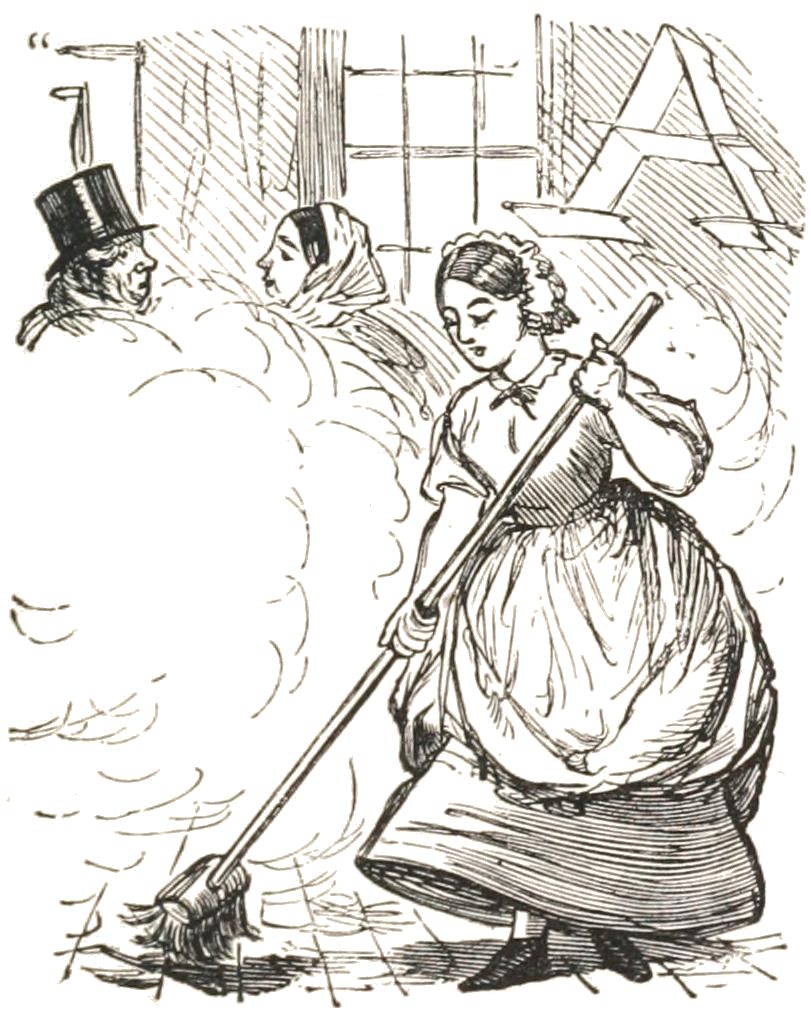
Home Sweet Home, by Douglas William Jerrold (via Wikimedia Commons)

It’s always nice to start the New Year off with a clean, well-appointed home.  In some traditions, this is not mere vanity or hygiene, but a spiritual necessity that must be done on New Year’s Eve to ensure that the home is clear and ready for the coming year.  Today, I thought I’d look at a few of the magical methods for housecleaning, as well as some of the most common cleaning agents with a magical touch.

Sweeping & Vacuuming – It has to be done.  There’s just no way of getting around it.  The floors must be kept clean, at least within reason, and usually a broom or a vacuum is employed to that end.  Workers in the conjure and hoodoo traditions tend to have specific techniques for sweeping, often going from the topmost floor of the house to the bottom and working from the back of each floor towards the front (though I’ve seen variations on that, often depending on specific needs—getting rid of a bad spirit might involve sweeping out the back door, for example).  While floor washes are the go-to method for spiritually cleansing a house and adding specific magical vibes to the area (see Mopping & Floor Washes below), you can add a degree of magic to the sweeping and vacuuming process, too.  Various powders can be sprinkled on floors and carpets and left there for a bit before sweeping.  These will absorb some spellwork and leave other magic behind.  Some good ones to try out (available at Lucky Mojo):

  • Fear Not to Walk Over Evil – A powerful anti-hex and anti-foottrack magic powder.
  • House Blessing – A simple, very peaceful powder.
  • Crown of Success or Fast Money – To encourage prosperity and abundance.
  • Chuparosa/Hummingbird – To create love and attraction between partners in the home.

Likewise, you might also opt for simple, household items to do some of your mojo work during sweeping and vacuuming.  Many spices make great conjure sweeps (and smell wonderful when taken up by a vacuum and slightly warmed by the machine’s motor—an added aromatic energy).  Some that I like to use:

  • Cinnamon – Creates a sense of prosperity and joviality.  Some use it for business success, but I find it creates more of a personal confidence and comfortability than anything purely financial.
  • Allspice – Another success spice, but also good for stimulating conversation.  I like to vacuum with cinnamon and allspice sprinkled on the carpets before guests come over to encourage a warm, friendly atmosphere.
  • Pine Needles – Good for uncrossing and refreshing a home.  Not a kitchen spice, of course, but still easily accessible.  Be careful though, as too many pine needles can gum up machinery (like vacuums) quickly!
  • Rosemary – Good for domestic bliss, as well as helping those who smell it focus and think clearly.
  • Oregano – Keeps meddlesome influences from interfering in your life.  Makes a nice “law-keep-away” substitute, and discourages nosy neighbors.
  • Garlic Skins – Kills off evil, but it will leave a distinctive odor in the air.
  • Rose Petals – Encourages love and passion when crumbled around the home and left for a bit before sweeping/vacuuming.
  • Salt – Great for stopping any hexes put upon you and removing unwanted spiritual energies from your home.  I use baking soda (a type of salt) sprinkled on carpets before vacuuming to both absorb odors and remove pesky curses.  Jim Haskins records a method of preventing unwanted guests from returning which simply involves sweeping salt after them when they leave.
  • Sugar – A little of this will add a sweetness to your home, though make sure you get it all and don’t use too much—a little sweetness may be great, but a lot of ants aren’t.

The basic method here is to sprinkle everything, let it sit for a bit (if you can stand letting it sit for 24 hours, that is lovely, but probably a little excessive—30 minutes is often plenty of time, and even a 5-minute wait will give you a quick dose of magic).

Mopping & Floor Washes – This is probably one of the best known hoodoo methods of cleansing, blessing, and enchanting a home.  Using a prepared magical floor wash to clean anything that can handle getting wet (including the walls) still makes for great spellwork.  Some of the most famous floor washes are (again from Lucky Mojo):

  • Chinese Wash – An old school formula which reputedly came out of Chinatown (though which Chinatown is not particularly clear).  It’s made from several powerful ingredients, many of which are found in Van Van (see below), with broom straws added for extra oomph.  Good for knocking out any hexes and doing purification work.
  • Van Van – We’ve covered this in Blog Post 81, but briefly this is a blend of several Asian grass extracts, chiefly lemongrass and vetiver root.  It, like Chinese Wash, cleanses and purifies.
  • Peace Water – When made in its most interesting form, peace water is beautiful to look at, with layers of blue and white/clear liquid on top of one another in a mesmerizing stasis.  When mixed up and sprinkled into a floor wash, this helps create feelings of calm, quiet, and tranquility in even very turbulent homes.
  • Rose Water – This very basic addition to a floor wash can be found in many ethnic grocery markets.  It’s not much more than a strong rose tea stabilized with alcohol, so you could easily make your own, but it’s also fairly cheap to buy.  When used in a floor wash, it helps promote feelings of love and agreement.

In addition to these specialty formulas, there are lots of common household cleaners you can use with a magical bent:

  • Pine-Sol – This commercial floor cleaner basically evolved out of hoodoo floor washes.  Cat Yronwode even suggests adding a little Van-Van to a bottle of Pine-Sol and using it as a simple substitute for Chinese Wash.  Traditional pine scent is great, of course, or you can go with…
  • Lemon Pine-Sol – Or any lemon-scented cleanser like it.  Lemons have a cut-and-clear effect on a space, and have long been associated with destroying curses and breaking hexes.  Charles Leland’s Aradia records an anti-evil-eye charm which is fundamentally a pomander made of a lemon and pins.  It leaves a lovely clean smell, too, though a fairly artificial one in most cleansers.  Feel free to add some fresh squeezed lemons to your mop bucket for a rootsier version of lemon-cleanser.
  • Ammonia Draja Mickaharic recommends a simple floor wash of ammonia and salt added to mop water, and it really makes a wonderful cleansing and protecting wash water.  It can really neutralize almost anything thrown at you, magically speaking, and it disinfects beautifully.  Mickaharic also recommends a little ammonia down every drain when you finish cleaning (just a teaspoon or so), to finish off your magical housecleaning.
  • Vinegar – Four Thieves Vinegar is popular as a counter-curse wash, and as a protective mix-in for a mop-water.  But really, any vinegar will help get rid of unwanted energies and protect the home from invaders and malicious forces.  If the scent is strong enough, it may protect you from visitors altogether.
  • Urine – This one is very traditional in hoodoo, though much frowned upon in modern use.  It has, however, been long used as a cleaning agent, and a little urine diluted in some mop water can be very powerful for “marking your territory” and protecting the home.  It can also instill a sense of good luck in the place, and ensure fidelity in your mate and passion from your lover.  If they don’t catch you doing it, of course.

There are lots of other cleaning agents out there that you can use, of course.  Almost anything scented probably has at least some tenuous connection to a magical formula, so a little homework can help you transform that bottle of Mop-N-Glo into a powerful apothecary’s potion.

Windows & Doors – You don’t do windows, you say?  Well, you should at least open them up!  Whenever you do a good house-cleansing, throwing up the windows and letting some fresh air circulate is vital to getting everything “right.”  It helps balance out all the forces in the home, allows bad spirits to leave, and refreshes the air in the house.  It’s cold to do this in winter, of course, but turning the heat off for 10 minutes and letting a little fresh air in can make all the difference in getting a home feeling good and happy again.  Likewise, the doors should be opened for a bit to let the air circulate.

When it comes to washing doors and windows, you can really use any of the same washes I talked about above in the Mopping & Floor Washes section.  You can also use a variety of other ingredients to get things right at all your entrances and exits.  For example, many folks take a little olive oil (or holy oil, which is basically blessed and sometimes lightly scented olive oil) and make a little sigil in the corner of every window, to seal that entrance against evil intrusions.  Some folks put blue bottles in the windows, or jars full of sand or marbles, in the hopes that any witches who might try to get in will be forced to count the contents of the container and be unable to do so before daybreak (when their power ends).  You can make a wash water of red brick dust, urine, and salt in warm water and use it to scrub your door to add a powerful layer of protection.  You can also sprinkle salt or brick dust lines down at the threshold and in the sills of every window to keep out unwanted spirits and spells.

Clearing the Air – Once the house has been aired out and all the windows and doors cleaned and opened for a while, some folks like to light some incense, use room sprays, or even just make a little something in the kitchen to add an element of magic to the home.  I’ve covered some of the holiday scents and their uses in Blog Post 108, and I’ve already mentioned pine and citrus scents as powerful agents for spiritual and physical cleansing.  Other odoriferous offerings to your home can include:

Fresh Bread – One of the best symbols of abundanace and prosperity.  Bake a loaf in your oven and let the scent fill the home.  Cookies are also good for this.

Floral Scents – Like jasmine, rose, or lavender.  All of these have specific uses, and add specific magical “vibrations” to an area (rose fragrances inspire love to many, for example), so look into the flowers you like and figure out what note they will set in your newly cleaned domicile.

Sweeteners – I did mention this in Blog Post 108, but I also said it’s a bit strong when burned.  If you are airing your house out, however, a little honey, brown sugar, molasses, or even table sugar might be a good thing to burn or warm on the stove, as it will provide a sublimely “sweet” feeling to the area.  Draja Mickaharic highly recommends this, and I can’t say I’m against it either.

Nailing It Down – This is a practice particular to conjure and hoodoo, though there are likely variants or similar practices in other magical systems.  The basic idea is that by pounding nails into your home’s corners (and the corners of your property), you fix it there and create a stable environment.  You also assert your ownership of the place, and help to guarantee your continued residence there.  The most commonly used nails for this are the “square-cut” kind, usually sold cheaply at hardware stores.  For doing the corners of your property, you would want to use something bigger, like old railroad spikes.  The basic idea is that you simply nail them into every corner of your home, particularly the ones along outside walls.  You can bless them with oil or holy water or anything else you feel is appropriate, or simply nail them down while saying a little prayer that you remain safe, happy, and comfortable in your home as long as the nails remain in place.  Remove them if you ever have to move away for any reason.

That’s a lot of cleaning!  But it’s always good to have a clean home, for both practical and spiritual reasons, so give some of these a go and see how they work for you!  And if you missed your New Year’s cleaning deadline, well, you can always do these things during your Spring cleaning, too.

I hope this has been useful!  Thanks for reading!

Oh, and Happy New Year!

-Cory

Blog Post 112 – 5…4…3…2… (New Year’s Traditions)

With one set of holidays just behind us, we still have a little more celebration left before the deep, dark, quiet winter sets in.  Today, I’ll be sharing some of the New Year’s traditions from North America (and to some extent, from around the world).  New Year’s has a lot of obvious components: a sense of rebirth, optimism, setting goals for improvement, and even a little romance.  Let’s look at some of the big traditions associated with this glittering and festive affair.

1)      Fireworks – These are a common component of New Year’s festivals worldwide, including the Chinese New Year which occurs later in the winter.  Aside from being a celebratory demonstration of light and wonder, the noise and fire from these explosives may serve to frighten away any lingering demons or bad spirits.  And, of course, they help keep everyone awake until the crucial midnight hour.  This also ties into other noise-making activities on New Year’s Eve, such as singing, banging cymbals, and other loud demonstrations of the party spirit.

In the Appalachians, this sometimes mixed with the mumming traditions of the Christmas season and became something known as a Shanghai Parade.  Gerald Milnes describes the practice in his book, Signs, Cures, & Witchery:

“The shanghai tradition once included music played on violins, flutes, horns, and drums in the Valley [of Greenbriar Co., West Virginia].  There is even a fiddle tune called ‘Shanghai’ that is known in West Virginia and may be connected to the shanghai ritual…people also cross-dress and put on exotic, mostly homemade costumes.  Reversal is a theme, and they generally whoop it up in the spirit of old midwinger revelry” (p. 192)

Jack Santino also describes similar uses of noise-makers, including guns, in his All Around the Year:  “In Hawaii, the custom involves the traditional beliefs of the native Hawaiians, who say that the fireworks scare off demons.  In Ohio, they are used as noisemakers, often instead of a gun, since ‘shooting in the New Year’ is the tradition” (p. 13).

2)      Kissing at Midnight – This tradition is related to others more regionally or culturally specific (such as “First Footing,” discussed below), but has become a broader practice among Occidental celebrants of the New Year.  The Snopes.com page on New Year’s superstitions has this to say on the subject:

“We kiss those dearest to us at midnight not only to share a moment of celebration with our favorite people, but also to ensure those affections and ties will continue throughout the next twelve months. To fail to smooch our significant others at the stroke of twelve would be to set the stage for a year of coldness.”

The idea of setting the stage for the coming year based on what one does on New Year’s Day ties into a lot of the other superstitions and customs related to this holiday.  With kissing, the idea seems to be that if you start the New Year off with someone you love, or at least by kissing someone attractive, you will invite positive romance into your life over the coming year.

3)       First Footing – To those of Scottish extraction, this is probably a very familiar practice.  The Scottish New Year is called Hogmany, and involves several key rituals, including house-cleaning, preparing traditional meals (see “New Year’s Food” below), and First Footing.  Sarah at Forest Grove has written an excellent entry on the Hogmany traditions, and describes First Footing thusly:

“First footing is a divinatory folk tradition where the first person who sets foot in your house in the wee hours of the New Year determines the luck and happenings of the year ahead. A man is preferred over a woman, and a man of dark hair and eye over a man of light hair and blue or green eyes. Redheads are especially unlucky to be the first to set foot across your threshold in some areas of Scotland.”

In some cases this practice requires that the first-footer be not of the household.  We received several pieces of lore in our Winter Lore Contest related to the New Year, including a bit about First Footing from listener/reader Akia: “Some of her [grandmother’s} holiday superstitions included: not letting anyone out of the house or enter until an unrelated male came into the house on New Years Day.”

4)      New Year’s Food – There are a lot of traditions about just what to eat on New Year’s Day.  Some of the most common components of a New Year’s meal are:

      • Black-Eyed Peas
      • Cabbage
      • Collard Greens
      • Ham or Pork
      • Lentils
      • Whiskey (or good, strong booze in general)
      • Potato Pancakes

Most of the foods associated with the New Year are related to prosperity and wealth in some way.  For instance, lentils and potato pancakes are shaped like coins.  Black-eyed peas have fertility and abundance going for them.  Cabbage and collards look like wads of bills waiting to be spent, etc.  Some folks recommend the addition of non-edible components to the meal, such as coins for prosperity.  Patrick W. Gainer says, “It will bring good luck if on New year’s Day you cook cabbage and black-eyed peas together and put a dime in them” (p.123).   Listener and podcaster Aria Nightengale shared her New Year’s food lore during our recent contest, saying, “[W]e always eat pork and cabbage on new year’s day.  According to my Momaw, we eat pork because pigs eat moving forward not backwards, so pork will help you move forward through the new year.  I don’t know the specific purpose of the cabbage…but Momaw cooks it with a silver dollar in it for prosperity.”

There’s a distinctly Southern dish called Hoppin’ John made from black-eyed peas, onions, and ham which can usually be found simmering away on most stovetops during the New Year.  It’s so important to our traditions that many restaurants also offer some version of it on New Year’s Day.  My wife and I have a tradition of going to one specific restaurant every year where we can get good potato pancakes and hoppin’ john to help bring in the New Year with a couple of our friends.  It makes for a nice way to spend the day, and ensures that we get our black-eyed pea requirement taken care of.

There are still many more traditions we could discuss (and I hope to!), such as cleaning practices, taboos, whether or not to give gifts, etc.  But for now, I hope this has been a nice introduction to the wonderfully lore-rich practices of New Year’s celebration.  Here’s wishing you a great day, and a great ending to the year!

All the best, and thanks for reading,

-Cory

Quick Post – Hoodoo in the Wall Street Journal

Hi all!

Not a major post today, just something I found that I thought might be interesting to you:

http://online.wsj.com/article/SB10001424052748703989004575653102537901956.html

It’s an article about hoodoo in the Wall Street Journal!  Take a look and let me know what you think!

-Cory