We discuss lunar phases, rebellious cards, the Goodman’s Croft, a witch story about a white deer, and more!
Please check out our Patreon page! You can help support the show for as little as a dollar a month, and get some awesome rewards at the same time. Even if you can’t give, spread the word and let others know, and maybe we can make New World Witchery even better than it is now.
In our cartomancy section, Laine will read for Cory, and Cory for Laine, but we’ll also share general information on the cards we pull, too. If you are interested in playing card divination, you can check out our Cartomancy post or pick up Cory’s book, 54 Devils.
Don’t forget to follow us at Twitter! And check out our Facebook page! For those who are interested, we are also on TikTok now. You can follow us on Instagram (main account, or you can follow Laine as well) or check out our new YouTube channel with back episodes of the podcast and new “Everyday Magic” videos, too (as well as most of our contest announcements)!
Promos and Music:
Title and closing music are “Runaround (AM Radio),” by Aaron Solomon, and is licensed from Audio Socket. (License #1273). Additional incidental music Kevin Macleod, from Free Music Archive and used under a CC 2.0 license.
Sound effects from Freesound.org and in the Public Domain. Additional “rooster” sound effect from Darina Evstafeva from Pixabay.
Please consider supporting us by purchasing our promotional items in the New World Witchery Threadless shop or by joining our Patreon supporters.
If you like us AND you like Buffy the Vampire Slayer, you will love our new show: Myth Taken: A Buffy the Vampire Slayer Podcast, now available through all the podcatchers! You can also check out Cory’s folklore show, Chasing Foxfire, where he explores the intersection of folklore and topics like history, medicine, science, nature, literature, pop culture, and more!
Please think about checking out our Audible Trial program. Visit Audibletrial.com/newworldwitchery to get your free trial of Audible, where you can download over 180,000 titles (including some narrated by Cory). Your purchases help support this show, and there’s no obligation to continue after the free trial
Summary: This time we speak with Taren S, founder and educator in the House of Witchcraft. We discuss the ways we can learn a magical landscape, how teaching can change our relationship with witchery, and why dirt is such an overlooked magical ingredient.
Please check out our Patreon page! You can help support the show for as little as a dollar a month, and get some awesome rewards at the same time. Even if you can’t give, spread the word and let others know, and maybe we can make New World Witchery even better than it is now.
Producer for this show: This episode is sponsored in part by listener Brandy. We thank you Brandy, for your patronage, and are sending our delegation of magical gratitude scorpions your way with our appreciation.
The transcript for this episode is available on our Transcripts page.
Some publications from us:
Please consider ordering our collaborative book Conjuring the Commonplace: A Guide to Everyday Enchantment and Junk Drawer Magic from 1000Volt Press! It’s available for purchase on Bookshop, Amazon, or from your local bookstore!
Please note that clicking on links may provide some monetary compensation to New World Witchery.
Image via Pixabay (Used under CC 2.0 License, modified by New World Witchery). Additional image credit Alexei Harlamov, CC BY-SA 4.0 https://creativecommons.org/licenses/by-sa/4.0, via Wikimedia Commons
Promos and Music: Title music is “Woman Blues,” by Paul Avgerinos. All music is licensed from Audio Socket (#35954).
Please consider supporting us by purchasing our promotional items in the New World Witchery Threadless shop or by joining our Patreon supporters. If you like us AND you like Buffy the Vampire Slayer, you will love our new show: Myth Taken: A Buffy the Vampire Slayer Podcast, now available through all the podcatchers! Please think about checking out our Audible Trial program. Visit Audibletrial.com/newworldwitchery to get your free trial of Audible, where you can download over 180,000 titles (including some narrated by Cory). Your purchases help support this show, and there’s no obligation to continue after the free trial
Summary: We begin digging into the dunes and exploring desert-based regional folk magic. We talk about sand, salt (a LOT about salt), cacti, cactus cats, and so much more!
Please check out our Patreon page! You can help support the show for as little as a dollar a month, and get some awesome rewards at the same time. Even if you can’t give, spread the word and let others know, and maybe we can make New World Witchery even better than it is now.
Producer for this show: This episode is sponsored in part by listener Brandy. We thank you Brandy, for your patronage, and are sending our delegation of magical gratitude scorpions your way with our appreciation.
The transcript for this episode is available on our Transcripts page.
Some upcoming publications from us:
Please consider ordering our collaborative book Conjuring the Commonplace: A Guide to Everyday Enchantment and Junk Drawer Magic from 1000Volt Press! It’s available for purchase on Bookshop, Amazon, or from your local bookstore!
Promos and Music: Title music is “Woman Blues,” by Paul Avgerinos. All music is licensed from Audio Socket (#35954).
Please consider supporting us by purchasing our promotional items in the New World Witchery Threadless shop or by joining our Patreon supporters. If you like us AND you like Buffy the Vampire Slayer, you will love our new show: Myth Taken: A Buffy the Vampire Slayer Podcast, now available through all the podcatchers! Please think about checking out our Audible Trial program. Visit Audibletrial.com/newworldwitchery to get your free trial of Audible, where you can download over 180,000 titles (including some narrated by Cory). Your purchases help support this show, and there’s no obligation to continue after the free trial
You can blame this one on the book club. We recently finished reading and discussing Robin Wall Kimmerer’s Braiding Sweetgrass for our Patreon book club, which is a beautiful series of essays on ecology, indigeneity, motherhood, science, spirit, and stewardship that I thoroughly recommend. Kimmerer is a botanist by trade, and a bryologist by specific discipline, which means she specializes in the study of mosses. I listened to a fascinating interview with her on the podcast Ologies with Allie Ward in which she describes the miniscule rain forests that exist within the carpeted world of mosses and their cousins, lichens.
Spending the time with Kimmerer through her work and her hypnotic voice (seriously, go listen to her interviews or essays) must have put me in a receptive mood, because I’ve been noticing mosses and lichens popping up in my folklore texts a lot recently. So today I thought I’d share a bit about that folklore from a more magical perspective. I’m also rolling in ferns, since both can be found together in forests, as well. It also helps that ferns have a good deal of magical lore, too. I should also note that my aim here is not a strict botanical examination of these plants, so there are going to be some “mosses” and “fern” related items that might not strictly fit the scientific classifications.
I will, however, start with a scientific note. One of the first points to address is some of the most common lore about mosses: that you can always figure out what direction north is since moss always grows on the north side of trees. Strictly speaking, this is not universally true. What mosses like is moisture, and moisture lingers longest in shady spots rather than sunny ones. As Tristan Gooley puts it in his excellent guide to observing the natural landscape entitled The Lost Art of Reading Nature’s Signs, “[m]osses need water to reproduce and so are a dependable indicator of places that retain moisture…shady places are moister than sunny ones; these are more common on north-facing surface and so, if you have eliminated other causes of moisture, then mosses can point the way north” (my emphasis). So yes, if you’re lost in the woods, moss is better than nothing, but remember there’s potentially a lot of moisture around and the moss should be only one tool in your natural-compass arsenal. An interesting bit of lore from Harry M. Hyatt’s Folklore from Adams County, Illinois inverts the north-growing moss trope and says that “A hard winter always follows the appearance of moss on the South side of trees in autumn.” Moss also helped predict weather based upon its own moisture content, at least in this snippet of lore: “When the mountain moss is soft and limpid, expect rain. When mountain moss is dry and brittle, expect clear weather” (Daniels, p. 819)
Moss is also used as folk medicine by some. In Pennsylvania German folk practices, one remedy for diarrhea recommends boiling tree moss in red wine and drinking it to relieve the problem (Harms/Hohman, p. 68). Its soft, spongy nature also made it useful for dressing wounds in some situations, as well. That texture also makes it a popular filling for dolls and poppets, too. One of the best known applications of this is the use of Spanish moss in the creation of doll baby spells in Southern folk magic. Strictly speaking, Spanish moss isn’t actually a moss, but a flowering plant, but in folk thought if it looks like a moss and squishes like a moss, well…I mean just look at the name! (Of course, it’s also not Spanish in origin, so maybe don’t look too closely at the name).
(Spanish Moss draped from trees. Photo by Huron H. Smith, 1908. via Wikimedia Commons)
One of the more interesting magical connections is between moss and the dead. Several bits of folklore describe gathering “skull moss,” which is simply moss or lichen scraped off of a gravestone or human remains. Scott Cunningham recommends carrying moss scraped from a gravestone for good luck, “especially financial luck” (p. 156). This lore is echoed in The Encyclopedia of Superstitions and the Occult as well, which also notes that An old superstition says that when a robin redbreast finds a dead body, it will cover up at least the face, with leaves or moss” (p. 687). Moss softens and blankets, which may contribute to this lore, and offering the dead a bit of comfort in the form of moss may be where the luck aspect of this comes from. Stranger still is a fragment of North Carolina folklore that notes “White moss from the skull of a murdered man, picked in a graveyard at the full o the moon, and tied in a piece of blue cotton cloth around the neck, will win any man” (Brown, p. 574).
(Image (c) Cory Thomas Hutcheson, CC 2.0 License)
Moss also shows up in the famed “Language of Flowers,” and is used to encode messages to recipients who understood the meaning of different kinds of moss in a bouquet or arrangement:
Iceland moss represented health
Wood moss represented maternal love or ennui
Lichen represented dejection and solitude (Daniels, p. 794-95)
The widely varying range of meanings here may have something to do with the many varieties of moss, but it could also be rooted in the way moss appears to interact with its environment–the green lushness of moss could signify health for many people, for example, while the way lichens can “hide” on trees and rocks could connect to the solitude meaning. The clinging nature of moss also makes it fit the feelings of connection and love. We’ve already mentioned that Irish moss is sometimes put in the corners of shops to make them more prosperous in our post on occupational folk magic, largely because of the way Irish moss feels abundant.
(Ferns are often associated with fairy folklore, especially around Midsummer. Photo: Antoni Piotrowski, Public domain, via Wikimedia Commons)
Ferns are also richly folkloric, and connect to the Otherworld, although more through the realms of Faerie than the dead specifically. In renowned folklorist Katherine Briggs’ work, Pale Hecate’s Team which examines fairy lore in England, she notes that “fern-seed” was considered to be a powerful magical ingredient: “A famous herb[…] was fern-seed, which, gathered at the right time and with the right ceremonies, made the man who wore some about him invisible.” She also points out that its power came with risks, because “It seems to have been almost as difficult to secure fern-seed as to draw up a mandrake from the ground, a herb even more renowned than fern-seed” (p. 169-70). Anyone who knows about ferns knows that they don’t actually have seeds, though. Instead they reproduce using spores released from the undersides of their leaves, which may be what “fern-seed” refers to. Possessing fern-seed offered you a number of powers. Invisibility, as mentioned above, was one of the most common, and is even mentioned as common lore in Shakespeare’s Henry IV, Part I. Other lore indicated that it would allow you to understand the language of fairies. In much lore, the fern-seed had to be procured specifically at midnight on Midsummer’s Eve (the night before the Summer Solstice, although it is also popularly celebrated on June 23rd). One bit of lore also said that this magical supply, when brought by the Devil for the price of one human soul on Christmas night, would make ap person as strong as “twenty or thirty men” (Daniels, p. 784). One should be careful when gathering fern, however, as plucking it at times other than prescribed will invite thunderstorms in Polish lore, or even cause one to be pursued by snakes and serpents.
Fern could also be used to ward off witchcraft and evil. One superstition says that “It was formerly customary for waggoners to place a bunch of fern over the horse’s ears or on the horse-collar, to ‘keep the devil away’ and to ‘baffle witches’” (Opie & Tatem, p. 147). Cunningham notes that “Ferns can be planted inside or outside the home for protection, thrown on hot coals to exorcize evil spirits or worn to guide the bearer to treasure” (p. 102). Ferns, despite their association with fairies and devils, can also be used to drive them away, and kept on one’s person can break illusion spells and render incantations powerless, too.
(Ferns were thought to be useful for everything from warding off witches to enhancing beauty to improving dental health. Image (c) Cory Thomas Hutcheson, CC 2.0 License)
Maidenhair fern has its own unique lore associated with beauty, likely owing to its name and appearance. Cunningham describes putting maidenhair fern in water, then using the water as a sprinkle to endow one with grace, beauty and charm. It could also be turned into a rinse for hair to make it silkier and more lustrous.
One of the better-known ferns is the popular Rose of Jericho (also known as the Resurrection Plant). This fern can dry out completely and curl itself into a tight brown ball, almost like a tumbleweed. Then, when given water, it will bloom over the course of a day or so and become verdant and lively again. Using the water from a Rose of Jericho–which would symbolically be infused with vivacity and not a little bit of the miraculous what with the resurrecting bit–is thought to boost prosperity when sprinkled around cash registers or shop doors. Catherine yronwode notes that the water should be added to the plant on Fridays, and then used throughout the week.
(The Rose of Jericho fern is also known as the Resurrection Plant and can survive long periods without water. Image (c) Cory Thomas Hutcheson, CC 2.0 License)
One final bit of lore about fern strangely connects it with teeth. A piece of Tyrolean superstition says that placing fern over one’s door ensures that you will have good dental health all year. Cornish lore states that “if you bite with your teeth from the ground the first fern you see in the spring, you will have no toothache all the year” (Daniels, p. 784).
I’ll close with a little rhyme that doesn’t seem to be directly related to any fern lore, but which is too charming to resist:
“When the fern is as high as a spoon
You may sleep an hour at noon,
When the fern is as high as a ladle,
You may sleep as long as you’re able,
When the fern begins to look red,
Then milk is good with brown bread.”
(Daniels, p. 784)
So if you head out into the forest for a hike this summer (or visit a moss-grown graveyard), keep your eyes peeled for ferns and mosses. You never know what kind of magic you’ll find, even in the humblest of plants.
We talk about planetary arcs, Hermit cards, St. John’s Eve revels in New Orleans, and flower crowns this time!
Please check out our Patreon page! You can help support the show for as little as a dollar a month, and get some awesome rewards at the same time. Even if you can’t give, spread the word and let others know, and maybe we can make New World Witchery even better than it is now.
In our cartomancy section, Laine will read for Cory, and Cory for Laine, but we’ll also share general information on the cards we pull, too. If you are interested in playing card divination, you can check out our Cartomancy post or pick up Cory’s book, 54 Devils.
Don’t forget to follow us at Twitter! And check out our Facebook page! For those who are interested, we are also on TikTok now. You can follow us on Instagram (main account, or you can follow Laine as well) or check out our new YouTube channel with back episodes of the podcast and new “Everyday Magic” videos, too (as well as most of our contest announcements)!
Promos and Music:
Title and closing music are “Runaround (AM Radio),” by Aaron Solomon, and is licensed from Audio Socket. (License #1273). Additional incidental music Kevin Macleod, from Free Music Archive and used under a CC 2.0 license.
Sound effects from Freesound.org and in the Public Domain. Additional “rooster” sound effect from Darina Evstafeva from Pixabay.
Please consider supporting us by purchasing our promotional items in the New World Witchery Threadless shop or by joining our Patreon supporters.
If you like us AND you like Buffy the Vampire Slayer, you will love our new show: Myth Taken: A Buffy the Vampire Slayer Podcast, now available through all the podcatchers! You can also check out Cory’s folklore show, Chasing Foxfire, where he explores the intersection of folklore and topics like history, medicine, science, nature, literature, pop culture, and more!
Please think about checking out our Audible Trial program. Visit Audibletrial.com/newworldwitchery to get your free trial of Audible, where you can download over 180,000 titles (including some narrated by Cory). Your purchases help support this show, and there’s no obligation to continue after the free trial
We speak to folk practitioner, artist, ‘zine writer, and author Vlasta Pilot of Gentle Hearts Unite about the nature of Slavic folk belief, the joy of handmade things, choosing bears, and how to avoid being a “cranberry.”
Of bears and klyukva
Summary: We speak to folk practitioner, artist, ‘zine writer, and author Vlasta Pilot of Gentle Hearts Unite about the nature of Slavic folk belief, the joy of handmade things, choosing bears, and how to avoid being a “cranberry.”
Please check out our Patreon page! You can help support the show for as little as a dollar a month, and get some awesome rewards at the same time. Even if you can’t give, spread the word and let others know, and maybe we can make New World Witchery even better than it is now.
Producer for this show: This episode is sponsored in part by listener Anna. Anna, we are proud to have you supporting us, and we’ll be arriving shortly to tattoo our gratitude on you in the form of a “thank you” sigil on your forehead (don’t worry, it’s like super-cute and kind of looks like an axolotl so you’ll loooove it).
The transcript for this episode is available on our Transcripts page.
Some upcoming publications from us:
Please consider ordering our collaborative book Conjuring the Commonplace: A Guide to Everyday Enchantment and Junk Drawer Magic from 1000Volt Press! It’s available for purchase on Bookshop, Amazon, or from your local bookstore!
Please note that clicking on links may provide some monetary compensation to New World Witchery.
Image via Pixabay (Used under CC 2.0 License, modified by New World Witchery). Additional image credit Alexei Harlamov, CC BY-SA 4.0 https://creativecommons.org/licenses/by-sa/4.0, via Wikimedia Commons
Promos and Music: Title music is “Woman Blues,” by Paul Avgerinos. All music is licensed from Audio Socket (#35954).
Please consider supporting us by purchasing our promotional items in the New World Witchery Threadless shop or by joining our Patreon supporters. If you like us AND you like Buffy the Vampire Slayer, you will love our new show: Myth Taken: A Buffy the Vampire Slayer Podcast, now available through all the podcatchers! Please think about checking out our Audible Trial program. Visit Audibletrial.com/newworldwitchery to get your free trial of Audible, where you can download over 180,000 titles (including some narrated by Cory). Your purchases help support this show, and there’s no obligation to continue after the free trial
We look at several magical alphabets and scripts this time, from runes to ogham to Enochian
Cursing with Cursive
Summary: We look at a few of the better (and some lesser) known magical alphabets and scripts this time, discussing runes, ogham, hieroglyphics, Enochian, and more!
Please check out our Patreon page! You can help support the show for as little as a dollar a month, and get some awesome rewards at the same time. Even if you can’t give, spread the word and let others know, and maybe we can make New World Witchery even better than it is now.
Producer for this show: This episode is sponsored in part by listener Anna. Anna, we are proud to have you supporting us, and we’ll be arriving shortly to tattoo our gratitude on you in the form of a “thank you” sigil on your forehead (don’t worry, it’s like super-cute and kind of looks like an axolotl so you’ll loooove it).
An important note: one of our Patreon listeners with early access to the episode alerted us that Diana Paxson–whom we reference in this episode for her book on runes–has recently been removed from inclusive Heathenry group The Troth. We weren’t aware of that when we recorded this, and while we do believe her book has valuable information, we cannot endorse supporting her given the circumstances that led to her removal.
Other sources that might prove to be valuable on the topic include:
The transcript for this episode is available on our Transcripts page.
Some upcoming publications from us:
Please consider ordering our collaborative book Conjuring the Commonplace: A Guide to Everyday Enchantment and Junk Drawer Magic from 1000Volt Press! It’s available for purchase on Bookshop, Amazon, or from your local bookstore!
Promos and Music: Title music is “Woman Blues,” by Paul Avgerinos. All music is licensed from Audio Socket (#35954).
Please consider supporting us by purchasing our promotional items in the New World Witchery Threadless shop or by joining our Patreon supporters. If you like us AND you like Buffy the Vampire Slayer, you will love our new show: Myth Taken: A Buffy the Vampire Slayer Podcast, now available through all the podcatchers! Please think about checking out our Audible Trial program. Visit Audibletrial.com/newworldwitchery to get your free trial of Audible, where you can download over 180,000 titles (including some narrated by Cory). Your purchases help support this show, and there’s no obligation to continue after the free trial
We’re back with another Folk Magician’s Notebook, covering our monthly moon phases, card readings, some floral folk magic, and a fairy tale to get your May going strong.
Please check out our Patreon page! You can help support the show for as little as a dollar a month, and get some awesome rewards at the same time. Even if you can’t give, spread the word and let others know, and maybe we can make New World Witchery even better than it is now.
In our cartomancy section, Laine will read for Cory, and Cory for Laine, but we’ll also share general information on the cards we pull, too. If you are interested in playing card divination, you can check out our Cartomancy post or pick up Cory’s book, 54 Devils.
Don’t forget to follow us at Twitter! And check out our Facebook page! For those who are interested, we are also on TikTok now. You can follow us on Instagram (main account, or you can follow Laine as well) or check out our new YouTube channel with back episodes of the podcast and new “Everyday Magic” videos, too (as well as most of our contest announcements)!
Promos and Music:
Title and closing music are “Runaround (AM Radio),” by Aaron Solomon, and is licensed from Audio Socket. (License #1273). Additional incidental music Kevin Macleod, from Free Music Archive and used under a CC 2.0 license.
Sound effects from Freesound.org and in the Public Domain. Additional “rooster” sound effect from Darina Evstafeva from Pixabay.
Please consider supporting us by purchasing our promotional items in the New World Witchery Threadless shop or by joining our Patreon supporters.
If you like us AND you like Buffy the Vampire Slayer, you will love our new show: Myth Taken: A Buffy the Vampire Slayer Podcast, now available through all the podcatchers! You can also check out Cory’s folklore show, Chasing Foxfire, where he explores the intersection of folklore and topics like history, medicine, science, nature, literature, pop culture, and more!
Please think about checking out our Audible Trial program. Visit Audibletrial.com/newworldwitchery to get your free trial of Audible, where you can download over 180,000 titles (including some narrated by Cory). Your purchases help support this show, and there’s no obligation to continue after the free trial
We look at history, etymology, and magical philosophy to understand magical dualism and where it came from
Dualism, Maleficum, and…jugglers?
Summary: In this crossover episode with our Buffy the Vampire Slayer podcast, Myth-Taken, we chat about the history, etymology, and philosophy of magical dualism. We look in to necromancy, alchemy, and strangely juggling all to try to understand where these dichotomies came from.
Please check out our Patreon page! You can help support the show for as little as a dollar a month, and get some awesome rewards at the same time. Even if you can’t give, spread the word and let others know, and maybe we can make New World Witchery even better than it is now.
Producer for this show: This episode is brought to you by Listener Elle. We have invoked and assigned a guardian angel in honor of your patronage Elle, and you should be visited by your multi-eyed fire-engulfed new BFF very soon!
The transcript for this episode is available on our Transcripts page.
Some upcoming publications from us:
Please consider ordering our collaborative book Conjuring the Commonplace: A Guide to Everyday Enchantment and Junk Drawer Magic from 1000Volt Press! It’s available for purchase on Bookshop, Amazon, or from your local bookstore!
Promos and Music: Title music is “Woman Blues,” by Paul Avgerinos. All music is licensed from Audio Socket (#35954).
Please consider supporting us by purchasing our promotional items in the New World Witchery Threadless shop or by joining our Patreon supporters. If you like us AND you like Buffy the Vampire Slayer, you will love our new show: Myth Taken: A Buffy the Vampire Slayer Podcast, now available through all the podcatchers! Please think about checking out our Audible Trial program. Visit Audibletrial.com/newworldwitchery to get your free trial of Audible, where you can download over 180,000 titles (including some narrated by Cory). Your purchases help support this show, and there’s no obligation to continue after the free trial
We hope you’ve survived the eclipse in one piece and are looking forward to the moon waning again.
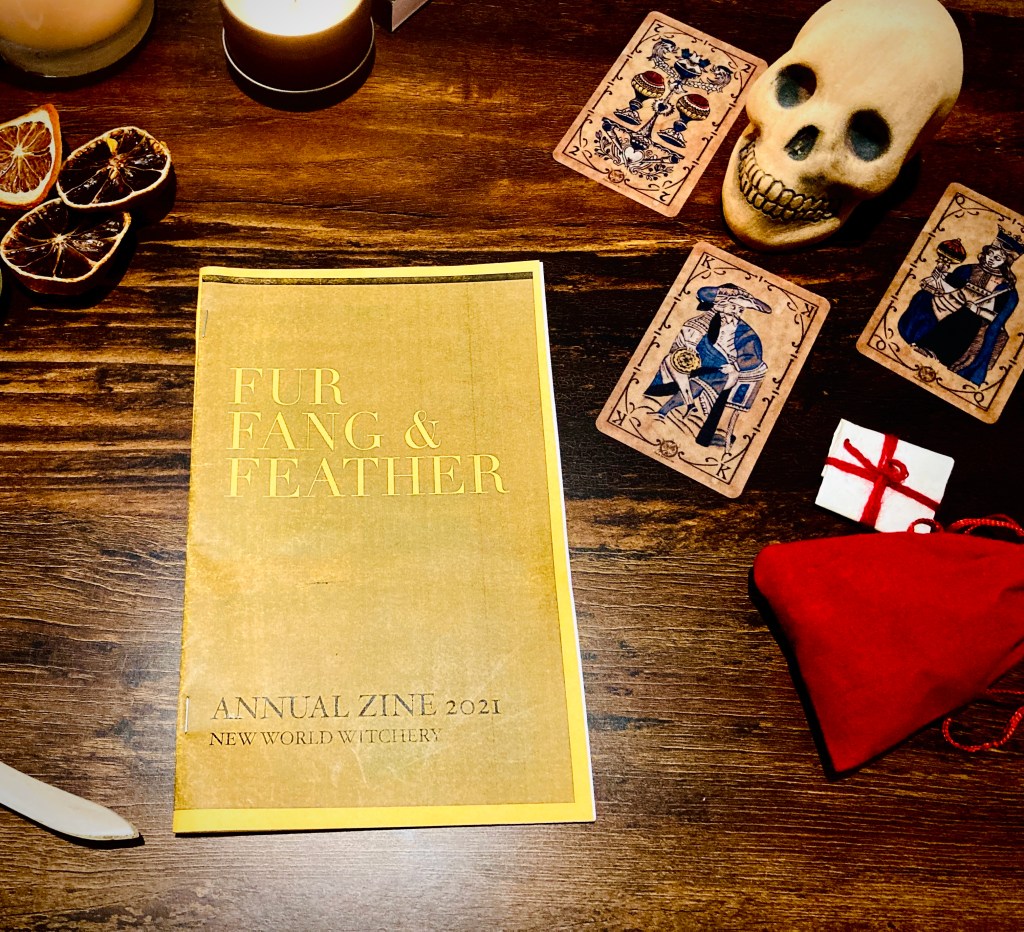
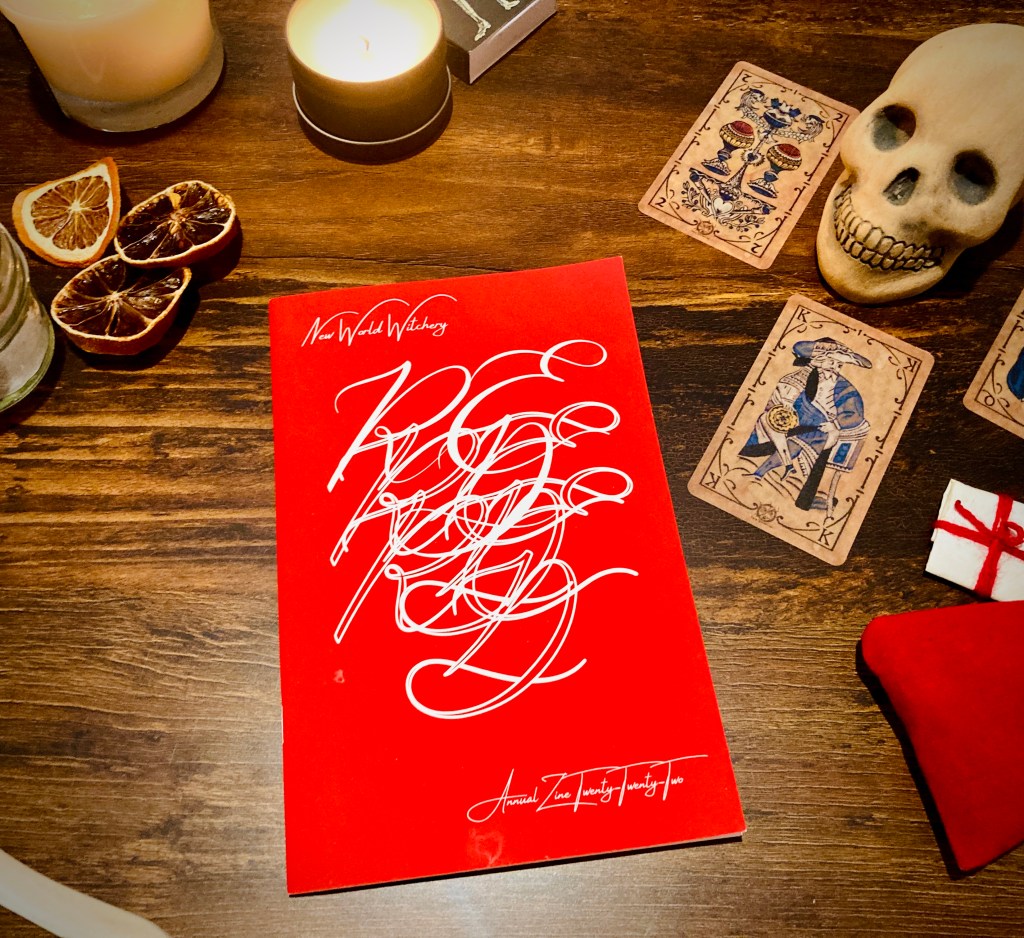
Since we’re in the celebrating spirit and all, we wanted to share with you that we’ve got something new going on. For those of you who support us on Patreon, you know that we usually produce something called an Annual ‘Zine for our patrons (typically sometime in the Spring, and yes, we know what 90s kids we are). Patrons at the $5 level get a digital copy of it, and patrons at the $10+ levels get a physical copy mailed to them. We’re in the midst of sending out our 2023 and 2024 ‘zines (we missed last year due to life circumstances but did a double ‘zine this year to make up for it), and until now we’ve made the ‘zines something available only to patrons as a bonus perk of supporting us. However, in order to support some of our efforts and the rising costs associated with our work, we have decided to put ‘zines from previous years on sale in case anyone in the general public is interested in acquiring them.
We are selling both digital copies of the ‘zines (for $5 each) and physical copies (price varying by materials). The physical copies are from our overstock, so quantities are limited there and once they are gone, they are gone. They are available on our Etsy shop (just because that’s the easiest place to sell them from). Right now we’re selling two Annual ‘Zines:
Fur, Fang, & Feather (2021) – A look at animals and magic including a personal essay from Laine, some bird folklore, animal-based charms, and a “trash familiar manifesto” from Cory. It’s 23 pages long and the physical copy is printed on good ole standard ‘zine copier paper. Digital copies are $5 and physical copies are $10 plus shipping.
RED (2022) – Our look at the folklore and magic of a crimson hue. We talk about red thread in magic, review some red-themed divination decks, look at a few (in)famous red books in magic, examine the housle or Red Meal in traditional witchcraft, and more. It’s a 31-page long ‘zine printed on recycled 80lb paper with a red paperboard cover. Digital copies are $5 and physical copies are $13 plus shipping.
These are definitely a limited-quantity offering, so if you’re interested in them please check them out sooner rather than later!
We will eventually make our 2023 and 2024 overstocks available, too, but we’re making sure everyone who was a supporter prior to the cutoff date gets a copy first. If you want to make sure you don’t miss a future ‘zine (and that you get a discount on purchasing past ‘zines), you can always join our supporters on Patreon, too!
Even if you don’t buy a ‘zine, we’re grateful to you for being a part of our readership and listenerhood (is that a word? well, it is now…). Thank you for your ongoing encouragement and support, and happy reading!








 New World Witchery - The Search for American Traditional Witchcraft