We hope you’ve survived the eclipse in one piece and are looking forward to the moon waning again.
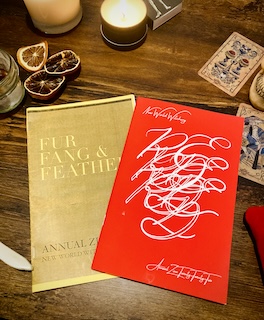
Since we’re in the celebrating spirit and all, we wanted to share with you that we’ve got something new going on. For those of you who support us on Patreon, you know that we usually produce something called an Annual ‘Zine for our patrons (typically sometime in the Spring, and yes, we know what 90s kids we are). Patrons at the $5 level get a digital copy of it, and patrons at the $10+ levels get a physical copy mailed to them. We’re in the midst of sending out our 2023 and 2024 ‘zines (we missed last year due to life circumstances but did a double ‘zine this year to make up for it), and until now we’ve made the ‘zines something available only to patrons as a bonus perk of supporting us. However, in order to support some of our efforts and the rising costs associated with our work, we have decided to put ‘zines from previous years on sale in case anyone in the general public is interested in acquiring them.
We are selling both digital copies of the ‘zines (for $5 each) and physical copies (price varying by materials). The physical copies are from our overstock, so quantities are limited there and once they are gone, they are gone. They are available on our Etsy shop (just because that’s the easiest place to sell them from). Right now we’re selling two Annual ‘Zines:
Fur, Fang, & Feather (2021) – A look at animals and magic including a personal essay from Laine, some bird folklore, animal-based charms, and a “trash familiar manifesto” from Cory. It’s 23 pages long and the physical copy is printed on good ole standard ‘zine copier paper. Digital copies are $5 and physical copies are $10 plus shipping.
RED (2022) – Our look at the folklore and magic of a crimson hue. We talk about red thread in magic, review some red-themed divination decks, look at a few (in)famous red books in magic, examine the housle or Red Meal in traditional witchcraft, and more. It’s a 31-page long ‘zine printed on recycled 80lb paper with a red paperboard cover. Digital copies are $5 and physical copies are $13 plus shipping.
These are definitely a limited-quantity offering, so if you’re interested in them please check them out sooner rather than later!
We will eventually make our 2023 and 2024 overstocks available, too, but we’re making sure everyone who was a supporter prior to the cutoff date gets a copy first. If you want to make sure you don’t miss a future ‘zine (and that you get a discount on purchasing past ‘zines), you can always join our supporters on Patreon, too!
Even if you don’t buy a ‘zine, we’re grateful to you for being a part of our readership and listenerhood (is that a word? well, it is now…). Thank you for your ongoing encouragement and support, and happy reading!
We look at several magical alphabets and scripts this time, from runes to ogham to Enochian
Cursing with Cursive
Summary: We look at a few of the better (and some lesser) known magical alphabets and scripts this time, discussing runes, ogham, hieroglyphics, Enochian, and more!
Please check out our Patreon page! You can help support the show for as little as a dollar a month, and get some awesome rewards at the same time. Even if you can’t give, spread the word and let others know, and maybe we can make New World Witchery even better than it is now.
Producer for this show: This episode is sponsored in part by listener Anna. Anna, we are proud to have you supporting us, and we’ll be arriving shortly to tattoo our gratitude on you in the form of a “thank you” sigil on your forehead (don’t worry, it’s like super-cute and kind of looks like an axolotl so you’ll loooove it).
An important note: one of our Patreon listeners with early access to the episode alerted us that Diana Paxson–whom we reference in this episode for her book on runes–has recently been removed from inclusive Heathenry group The Troth. We weren’t aware of that when we recorded this, and while we do believe her book has valuable information, we cannot endorse supporting her given the circumstances that led to her removal.
Other sources that might prove to be valuable on the topic include:
The transcript for this episode is available on our Transcripts page.
Some upcoming publications from us:
Please consider ordering our collaborative book Conjuring the Commonplace: A Guide to Everyday Enchantment and Junk Drawer Magic from 1000Volt Press! It’s available for purchase on Bookshop, Amazon, or from your local bookstore!
Promos and Music: Title music is “Woman Blues,” by Paul Avgerinos. All music is licensed from Audio Socket (#35954).
Please consider supporting us by purchasing our promotional items in the New World Witchery Threadless shop or by joining our Patreon supporters. If you like us AND you like Buffy the Vampire Slayer, you will love our new show: Myth Taken: A Buffy the Vampire Slayer Podcast, now available through all the podcatchers! Please think about checking out our Audible Trial program. Visit Audibletrial.com/newworldwitchery to get your free trial of Audible, where you can download over 180,000 titles (including some narrated by Cory). Your purchases help support this show, and there’s no obligation to continue after the free trial
We’re back with another Folk Magician’s Notebook, covering our monthly moon phases, card readings, some floral folk magic, and a fairy tale to get your May going strong.
Please check out our Patreon page! You can help support the show for as little as a dollar a month, and get some awesome rewards at the same time. Even if you can’t give, spread the word and let others know, and maybe we can make New World Witchery even better than it is now.
In our cartomancy section, Laine will read for Cory, and Cory for Laine, but we’ll also share general information on the cards we pull, too. If you are interested in playing card divination, you can check out our Cartomancy post or pick up Cory’s book, 54 Devils.
Don’t forget to follow us at Twitter! And check out our Facebook page! For those who are interested, we are also on TikTok now. You can follow us on Instagram (main account, or you can follow Laine as well) or check out our new YouTube channel with back episodes of the podcast and new “Everyday Magic” videos, too (as well as most of our contest announcements)!
Promos and Music:
Title and closing music are “Runaround (AM Radio),” by Aaron Solomon, and is licensed from Audio Socket. (License #1273). Additional incidental music Kevin Macleod, from Free Music Archive and used under a CC 2.0 license.
Sound effects from Freesound.org and in the Public Domain. Additional “rooster” sound effect from Darina Evstafeva from Pixabay.
Please consider supporting us by purchasing our promotional items in the New World Witchery Threadless shop or by joining our Patreon supporters.
If you like us AND you like Buffy the Vampire Slayer, you will love our new show: Myth Taken: A Buffy the Vampire Slayer Podcast, now available through all the podcatchers! You can also check out Cory’s folklore show, Chasing Foxfire, where he explores the intersection of folklore and topics like history, medicine, science, nature, literature, pop culture, and more!
Please think about checking out our Audible Trial program. Visit Audibletrial.com/newworldwitchery to get your free trial of Audible, where you can download over 180,000 titles (including some narrated by Cory). Your purchases help support this show, and there’s no obligation to continue after the free trial
We look at history, etymology, and magical philosophy to understand magical dualism and where it came from
Dualism, Maleficum, and…jugglers?
Summary: In this crossover episode with our Buffy the Vampire Slayer podcast, Myth-Taken, we chat about the history, etymology, and philosophy of magical dualism. We look in to necromancy, alchemy, and strangely juggling all to try to understand where these dichotomies came from.
Please check out our Patreon page! You can help support the show for as little as a dollar a month, and get some awesome rewards at the same time. Even if you can’t give, spread the word and let others know, and maybe we can make New World Witchery even better than it is now.
Producer for this show: This episode is brought to you by Listener Elle. We have invoked and assigned a guardian angel in honor of your patronage Elle, and you should be visited by your multi-eyed fire-engulfed new BFF very soon!
The transcript for this episode is available on our Transcripts page.
Some upcoming publications from us:
Please consider ordering our collaborative book Conjuring the Commonplace: A Guide to Everyday Enchantment and Junk Drawer Magic from 1000Volt Press! It’s available for purchase on Bookshop, Amazon, or from your local bookstore!
Promos and Music: Title music is “Woman Blues,” by Paul Avgerinos. All music is licensed from Audio Socket (#35954).
Please consider supporting us by purchasing our promotional items in the New World Witchery Threadless shop or by joining our Patreon supporters. If you like us AND you like Buffy the Vampire Slayer, you will love our new show: Myth Taken: A Buffy the Vampire Slayer Podcast, now available through all the podcatchers! Please think about checking out our Audible Trial program. Visit Audibletrial.com/newworldwitchery to get your free trial of Audible, where you can download over 180,000 titles (including some narrated by Cory). Your purchases help support this show, and there’s no obligation to continue after the free trial
Doomsdays, weather forecasts, making noise, and hidden treasures
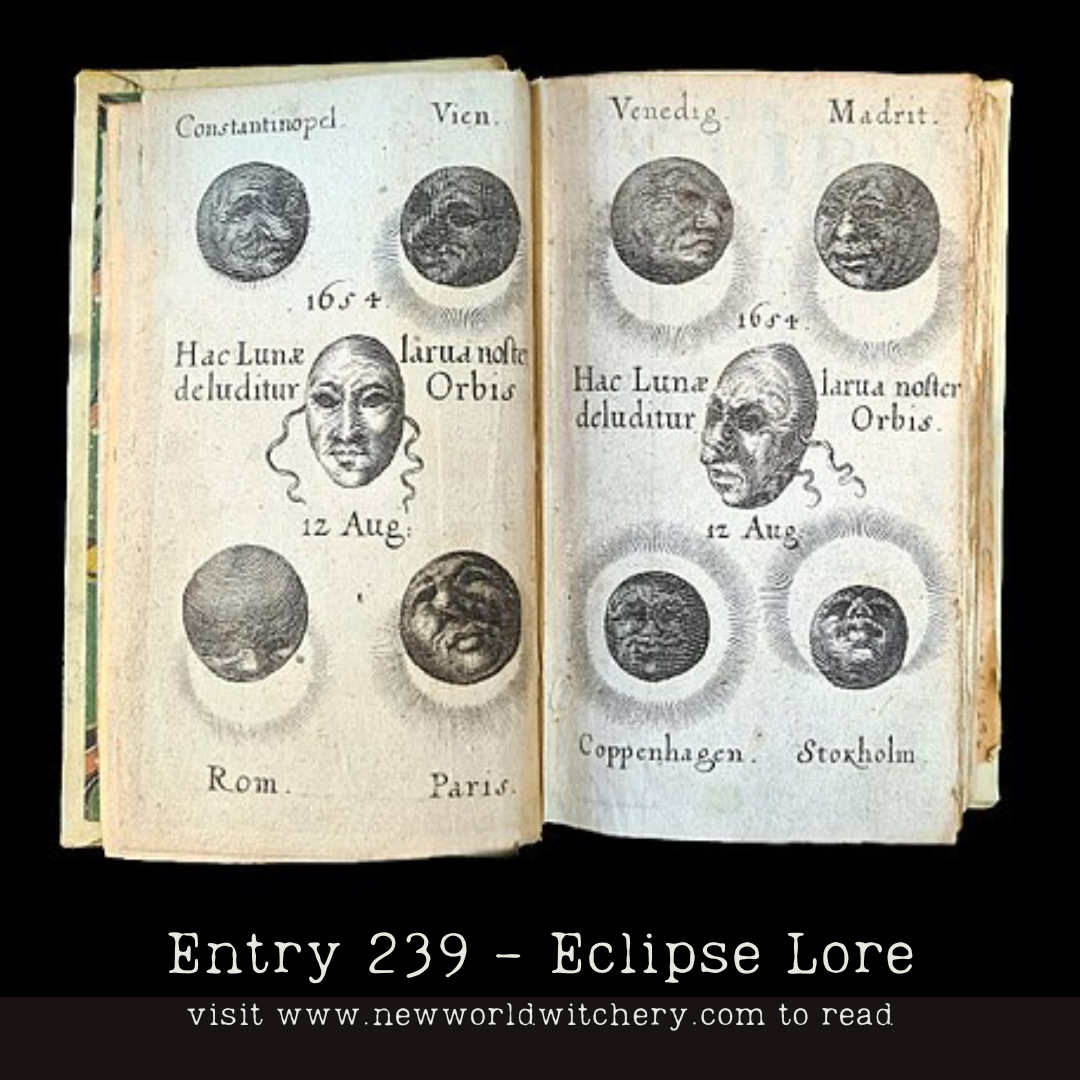
(Image source: Conrad Heingartner (Main), Public domain, via Wikimedia Commons)
On April 8, 2024, contiguous North America will get its last glimpse of a full solar eclipse for twenty years (the next one is due 2044). When we last had the opportunity to glimpse this astronomical wonder in 2017, Laine and I put out an episode focusing on some of the lore and significance of eclipses, and we just released an episode of our Folk Magician’s Notebook that features a lot of eclipse lore as well. We thought it might also be a good idea to compile some of that lore for readers, too, who would be interested in having it to hand as the big day approaches (or just in general out of folkloric curiosity, which is often the best reason to do anything!). So today we’re sharing a few of our favorite tidbits of eclipse-based lore. We should note that much of this material will reference eclipses broadly, so they could be solar or lunar, although we’ll try to be as specific as we can when sources allow. Let’s do some shadow-dancing, then!
Probably the single most pervasive belief about eclipses is that they are portents of some kind. In most cases, they seem to be viewed as fearsome ones, forewarning of doom or calamity of some kind to follow. Biblical prophecies regarding eclipses lean into this, as any Ghostbusters fan knows:
And I beheld when he had opened the sixth seal, and, lo, there was a great earthquake; and the sun became black as sackcloth of hair, and the moon became as blood (Revelation 6:12, KJV)
And when I shall put thee out, I will cover the heaven, and make the stars thereof dark; I will cover the sun with a cloud, and the moon shall not give her light. (Ezekiel 32:7, KJV)
In these contexts eclipses are associated with wrath and judgment and destruction and just generally a bad time had by all. It’s important to note, though, that Christianity hardly has a monopoly on eclipses and doomsaying. According to Joshua Trachtenberg’s book, Jewish Magic and Superstition, the Jewish people also get quite anxious about eclipses: “Eclipses of the moon were taken to be especially ominous for the Jewish people. Eclipses of the sun which occurred on October 26, 1147 and September 4, 1187 threw German Jewry into consternation; later it was learned that on these days German crusaders had suffered serious reverses in Palestine” (pp. 251-52).
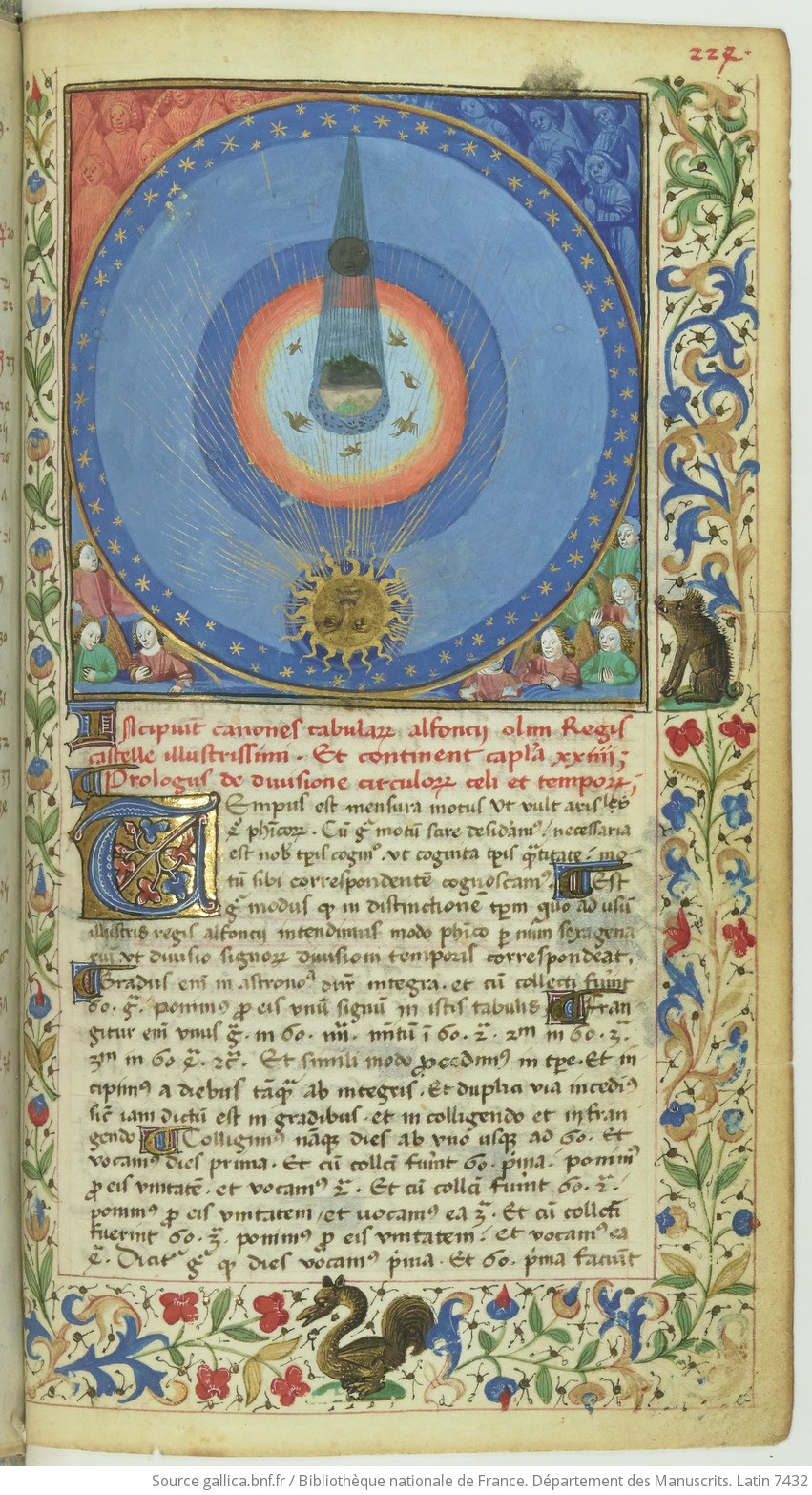
One particularly colorful Christian belief about eclipses has to do with a secret planet full of saints:
“There is a planet called Adamida, on which reside the unborn spirits of saints, martyrs and believers. There they remain, awaiting their time to be born into this world. When a martyr is recognized by us, we know that he came from Adamida, the planet of unborn souls. At the crucifixion, Uriel, the angel of the sun, was ordered to interpose this planet between the earth and the sun, thus producing a total eclipse. This is mentioned in the description by the apostles. They say ‘the sun was darkened’”
That may seem like a LOT to derive from a four word biblical passage, but then there has been plenty of ink (and blood) spilled over any number of scriptural excerpts, so a magical planet full of holy people that occasionally blocks out the sun seems somehow almost charming.
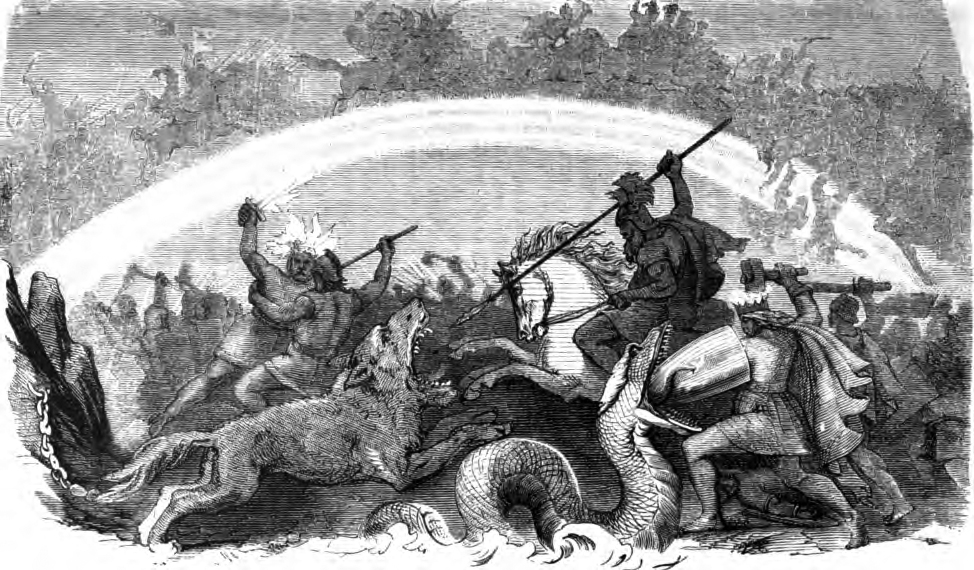
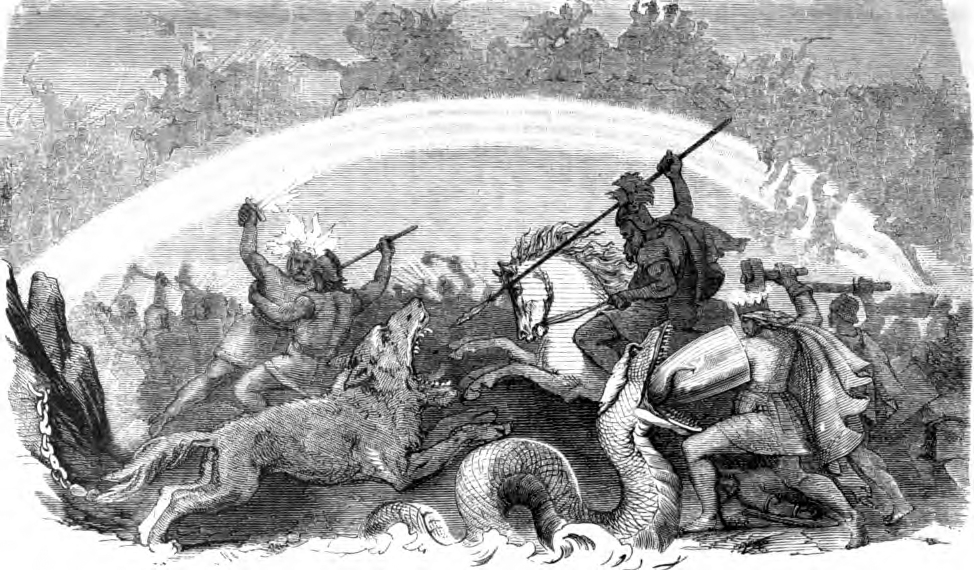
Less charming, of course, is the end of the world. Norse mythology features an eclipse event associated with Ragna Rok, or the Doom of the Gods, in the Prose Edda. A volva (seeress) prophecies that as the gods begin to clash with one another, “Then happens what will seem a great miracle, that the wolf devours the sun, and this will seem a great loss. The other wolf will devour the moon, and this too will cause great mischief. The stars shall be hurled from heaven. Then it shall come to pass that the earth and the mountains will shake so violently that trees will be torn up by the roots, the mountains will topple down, and all bonds and fetters will be broken and snapped” (Abridged from the Prose Edda, Penguin Edition, Trans. by Rasmus B. Andersen). As we pointed out during the reading of this passage in our podcast episode, though, the Ragnarok section is immediately followed by a Regeneration section that foresees a renewed earth emerging “green and fair.”
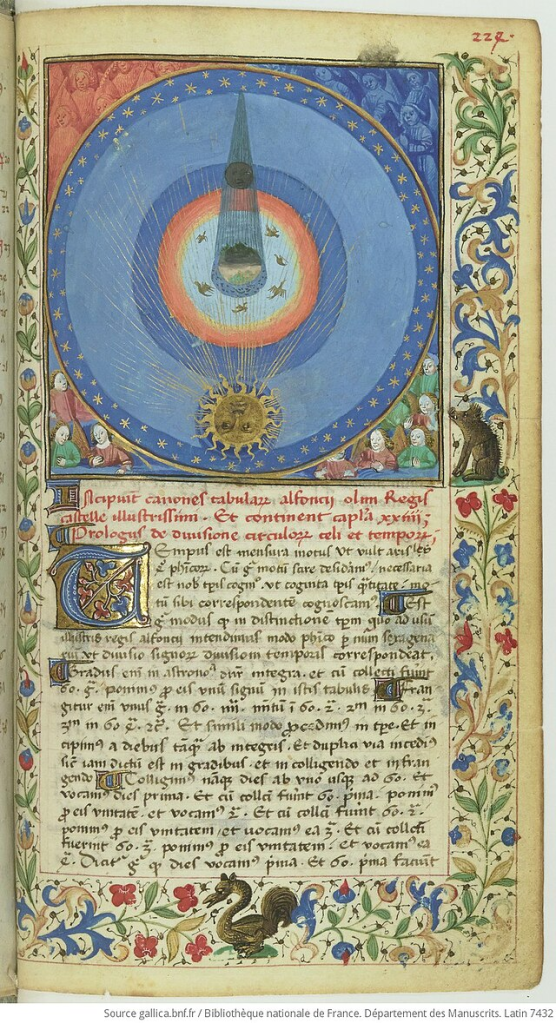
(Image source: Friedrich Wilhelm Heine (1845-1921)., Public domain, via Wikimedia Commons)
Other religions shared this approach, connecting eclipses with mighty powers but not dwelling on them as fearsome. In Islam, a sunnah (saying of the Prophet Muhammad) collected in the third century by an historian named Bukhari noted that the Prophet once said that “The sun and the moon do not eclipse because of the death of someone from the people but they are two signs amongst the signs of Allah. When you see them stand up and pray” (Volume 2, Book 18, Number 151).
Still, in the minds of the folk, eclipses frequently meant one thing: trouble. In the Frank C. Brown Collection of North Carolina Folklore, one entry puts it quite succinctly, saying “When the sun goes into eclipse, it is a sign of some great disaster.” This sentiment gets echoed in folklore collections from Canada to Mexico and back again, although the nature of the disaster is often not specified. In at least one case, an eclipse on 13 April 1140 was taken as a portent that the current king, King Stephen, would soon be removed from rule. An eclipse followed by a “halo” around the sun or moon in the following days was also thought at one time to portend diseases soon to follow (Daniels 941-43).
(Image source: By Ji-Elle – Own work, CC BY-SA 4.0, Wikimedia Commons)
Some of the lore, however, does tie eclipses to specific events, namely weather-related ones:
In addition to an association with storms, there’s a rather “stormy” character associated with eclipses in North American nautical lore (do eclipses also improve segues? So it seems!). In tales of Alfred Bulltop Stormalong, also known asOld Stormy, a character who was the sailing equivalent to John Henry, the legendary mariner is said to continue working the docks and seas well into the afterlife. According to the Encyclopedia of American Folklore:
Even in the afterlife, Old Stormalong is said to be building ships in the sky, where he carries on his maritime career navigating the heavens rather than the oceans. For this reason, some tales explain that an eclipse is caused by the shadow cast by Old Stormalong’s great ship, and shooting stars occur when they are struck by the movement of Stormalong’s harpoon (Watts)
Leaving aside Old Stormy, what could a person do if an eclipse did seem like a portent of doom to them? Fortunately, numerous cultures came to the same conclusion about what to do: get loud. To forestall any negative eclipse effects, you can beat your pots and pans loudly and shout to scare away anything that might be trying to unleash some wickedness in your home–this is a method used in Ancient Rome, Ancient China, France, Ireland, and Wales. In at least one account of Hindu eclipse beliefs, the text notes that eclipses were a time to give alms to the poor, which would help “relieve the pain which the sun and moon [endure] while being swallowed” (Daniels 943).
(Image source: Joseph Norman Lockyer, Public domain, via Wikimedia Commons)
There are also a few activities that benefit from eclipses. The same source that describes Hindu almsgiving and the pot-and-pan noisemaker methods also says that while starting a lawful enterprise during an eclipse would doom it to failure, starting something illicit would ensure its success. Additionally, beginning a journey during an eclipse (lunar or solar) ensured its success. And finally, you might just get rich if you had the right bouquet on you:
“During an eclipse, all hidden treasures are open, and if you are wise enough to carry a primrose with you, you will be able to help yourself to any of them”
(Daniels 941)
So that’s a brief look at some of the widespread folklore around eclipses. We hope that you’ll go enjoy this year’s celestial obscuring with care and caution, but also a bit of wonder as you think about what they might mean to you as well. And maybe keep a primrose or two handy, just in case there’s some buried treasure nearby.
Thanks for reading!
-Cory
References
Anderson, Rasmus B. The Prose Edda. Penguin Books/Sacred-Texts, 1936.
This month we’re focusing on the April 8th eclipse! We talk about eclipse folklore, look at the story of Ragnarok, share a poppy seed spell, and more!
Please check out our Patreon page! You can help support the show for as little as a dollar a month, and get some awesome rewards at the same time. Even if you can’t give, spread the word and let others know, and maybe we can make New World Witchery even better than it is now.
You can find a transcript of this episode at our Transcripts page.
This month we’re sharing the story of Ragnarok from the Prose Edda (trans. by Rasmus B. Anderson)
In our cartomancy section, Laine will read for Cory, and Cory for Laine, but we’ll also share general information on the cards we pull, too. If you are interested in playing card divination, you can check out our Cartomancy post or pick up Cory’s book, 54 Devils.
Don’t forget to follow us at Twitter! And check out our Facebook page! For those who are interested, we are also on TikTok now. You can follow us on Instagram (main account, or you can follow Laine as well) or check out our new YouTube channel with back episodes of the podcast and new “Everyday Magic” videos, too (as well as most of our contest announcements)!
Promos and Music:
Title and closing music are “Runaround (AM Radio),” by Aaron Solomon, and is licensed from Audio Socket. (License #1273). Additional incidental music Kevin Macleod, from Free Music Archive and used under a CC 2.0 license.
Sound effects from Freesound.org and in the Public Domain. Additional “rooster” sound effect from Darina Evstafeva from Pixabay.
Please consider supporting us by purchasing our promotional items in the New World Witchery Threadless shop or by joining our Patreon supporters.
If you like us AND you like Buffy the Vampire Slayer, you will love our new show: Myth Taken: A Buffy the Vampire Slayer Podcast, now available through all the podcatchers! You can also check out Cory’s folklore show, Chasing Foxfire, where he explores the intersection of folklore and topics like history, medicine, science, nature, literature, pop culture, and more!
Please think about checking out our Audible Trial program. Visit Audibletrial.com/newworldwitchery to get your free trial of Audible, where you can download over 180,000 titles (including some narrated by Cory). Your purchases help support this show, and there’s no obligation to continue after the free trial
We’re speaking with author, witch, Yoruban initiate, and activist Elhoim (Elo) Leafar about his new book Dream Witchery, growing up surrounded by Indigenous spirituality, and discovering the intersection of multiple magical and spiritual paths
The Crossroads of Traditions
Summary: This time we’re speaking with author, witch, Yoruban initiate, and activist Elhoim (Elo) Leafar about his new book Dream Witchery, growing up surrounded by Indigenous spirituality, and discovering the intersection of multiple magical and spiritual paths.
Please check out our Patreon page! You can help support the show for as little as a dollar a month, and get some awesome rewards at the same time. Even if you can’t give, spread the word and let others know, and maybe we can make New World Witchery even better than it is now.
Producer for this show: This episode is brought to you by listener Bree. We appreciate your support and will be visiting you with an important message in your dreams soon. Yes, the talking horse wearing the party hat is us.
You can find out much more about Elo and his work at his website. You might also want to follow him on Instagram to keep up with his work and activism.
Elo’s latest book is Dream Witchery, published by Llewellyn.
The transcript for this episode is available on our Transcripts page.
Some upcoming publications from us:
It’s here! You can now order our collaborative book Conjuring the Commonplace: A Guide to Everyday Enchantment and Junk Drawer Magic from 1000Volt Press! It’s available for purchase on Bookshop, Amazon, or from your local bookstore!
Promos and Music: Title music is “Woman Blues,” by Paul Avgerinos. All music is licensed from Audio Socket (#35954).
Please consider supporting us by purchasing our promotional items in the New World Witchery Threadless shop or by joining our Patreon supporters. If you like us AND you like Buffy the Vampire Slayer, you will love our new show: Myth Taken: A Buffy the Vampire Slayer Podcast, now available through all the podcatchers! Please think about checking out our Audible Trial program. Visit Audibletrial.com/newworldwitchery to get your free trial of Audible, where you can download over 180,000 titles (including some narrated by Cory). Your purchases help support this show, and there’s no obligation to continue after the free trial
In this month’s Folk Magician’s Notebook, we run through our astrological outlook, hear some straight-shooting card readings, grow some divination magic, follow a wandering bear, and much more!
Please check out our Patreon page! You can help support the show for as little as a dollar a month, and get some awesome rewards at the same time. Even if you can’t give, spread the word and let others know, and maybe we can make New World Witchery even better than it is now.
In our cartomancy section, Laine will read for Cory, and Cory for Laine, but we’ll also share general information on the cards we pull, too. If you are interested in playing card divination, you can check out our Cartomancy post or pick up Cory’s book, 54 Devils.
Don’t forget to follow us at Twitter! And check out our Facebook page! For those who are interested, we are also on TikTok now. You can follow us on Instagram (main account, or you can follow Laine as well) or check out our new YouTube channel with back episodes of the podcast and new “Everyday Magic” videos, too (as well as most of our contest announcements)!
Promos and Music:
Title and closing music are “Runaround (AM Radio),” by Aaron Solomon, and is licensed from Audio Socket. (License #1273). Additional incidental music Kevin Macleod, from Free Music Archive and used under a CC 2.0 license.
Sound effects from Freesound.org and in the Public Domain. Additional “rooster” sound effect from Darina Evstafeva from Pixabay.
Please consider supporting us by purchasing our promotional items in the New World Witchery Threadless shop or by joining our Patreon supporters.
If you like us AND you like Buffy the Vampire Slayer, you will love our new show: Myth Taken: A Buffy the Vampire Slayer Podcast, now available through all the podcatchers! You can also check out Cory’s folklore show, Chasing Foxfire, where he explores the intersection of folklore and topics like history, medicine, science, nature, literature, pop culture, and more!
Please think about checking out our Audible Trial program. Visit Audibletrial.com/newworldwitchery to get your free trial of Audible, where you can download over 180,000 titles (including some narrated by Cory). Your purchases help support this show, and there’s no obligation to continue after the free trial
Laine and Cory discuss long-term magical workings, maintaining magical altars and tools, and Laine’s fear of stage magicians. Plus we answer emails about the Golden Ratio and Leap Day traditions!
Enchantment for the long haul
Summary: Laine and Cory discuss long-term magical workings, maintaining magical altars and tools, and Laine’s fear of stage magicians. Plus we answer emails about the Golden Ratio and Leap Day traditions!
Please check out our Patreon page! You can help support the show for as little as a dollar a month, and get some awesome rewards at the same time. Even if you can’t give, spread the word and let others know, and maybe we can make New World Witchery even better than it is now.
Producer for this show: This episode is brought to you by 1000Volt Press, publishers of the Voices of the Dead series, Verona Green, the Renegade Tea Cookbook, and our book Conjuring the Commonplace! We offer our gratitude by generously filling your mailbox with all the leftover ketchup, taco sauce, and relish packets we found in our junk drawer. Not the horseradish sauce though. That’s ours.
The transcript for this episode is available on our Transcripts page.
Some upcoming publications from us:
It’s here! You can now order our collaborative book Conjuring the Commonplace: A Guide to Everyday Enchantment and Junk Drawer Magic from 1000Volt Press! It’s available for purchase on Bookshop, Amazon, or from your local bookstore!
Promos and Music: Title music is “Woman Blues,” by Paul Avgerinos. All music is licensed from Audio Socket (#35954).
Please consider supporting us by purchasing our promotional items in the New World Witchery Threadless shop or by joining our Patreon supporters. If you like us AND you like Buffy the Vampire Slayer, you will love our new show: Myth Taken: A Buffy the Vampire Slayer Podcast, now available through all the podcatchers! Please think about checking out our Audible Trial program. Visit Audibletrial.com/newworldwitchery to get your free trial of Audible, where you can download over 180,000 titles (including some narrated by Cory). Your purchases help support this show, and there’s no obligation to continue after the free trial





 New World Witchery - The Search for American Traditional Witchcraft