Blog Post 96 – Critters 2 (Magical Animals, Part II)

Hi all!

This is a continuation from the last post about magical animals, so you may want to look at that one before diving into this one.  Or not.  It’s up to you really.  Either way, here’s some more on North American animals showing up in magical folklore.

(More) American Magical Animals

Deer – Legends about magical deer are hardly new, nor are they limited to the New World.  White stags appear in Arthurian legends, and the label of Jagermeister liqueur bears the image of an enchanted cervid.  Charlemagne also had a stag legend associated with him.   In American folktales, they retain similar significance, though often they lead hunters astray or into mischief.  In a tale from Gilmer Co., WV, a normally gifted hunter encounters a doe he can’t shoot, even at close range when he knows he should be able to.  He decides to try shooting it with a silver bullet and succeds in hitting it in the leg, and then follows the blood trail back to a cabin where an old woman is nursing her bleeding leg, thus revealing her as a shape-shifting witch (Gainer p.157).  In New York State, there’s also the tale of “Auntie Greenleaf and the White Deer,” which bears a strong resemblance to the Gainer tale.  The Huichol natives of Mexico engage in a type of spiritual quest called the Peyote Hunt in which the peyote (a type of hallucinogenic cactus) is treated as a magical deer to be caught:

The Hunt is a symbolic re-creation of “original times” before the present separation occurred between man, the gods, plants and animals; between life and death; between natural and supernatural; be-tween the sexes. On the Peyote Hunt, the men who return to their homeland become the gods, and at the climatic moment of the ceremony, they slay and eat the peyote, which is equated with the deer and with maize (“The Deer-Maize-Peyote Symbol Complex…” by Barbara G. Myerhoff, Anthropological Quarterly, Apr. 1970)

It’s not surprising that a continent whose inhabitants until only fairly recently depended upon deer for food would assign it such a high mythical value, and there are plenty of good stories about witch deer or helper deer to be found in every region.

Rabbit/Hare – This is the animal most associated with witches in folklore (other than perhaps the black cat).  North American magical tales are no exception, and there are a plethora of rabbit-related witch stories out there.  As I mentioned in the Spiders/Insects section, Anansi has an avatar in the form of a rabbit in the New World, a form probably best known and realized through his appearance in Joel Chandler Harris’s Uncle Remus stories.  The Trickster Rabbit of these tales became so ingrained in our cultural psyche that we turned him into an icon recognized worldwide, even though he is distinctly American in attitude:  Bugs Bunny.  Native American legends also provide Trickster Rabbit stories, such as “Rabbit Plays Tug-of-War” from the Creek tribe.  Hares could also be less mirthful magical creatures, and often appear in American folklore as witches in disguise.  Richard Dorson records a tale in Buying the Wind of a witch-hare that could not be caught or killed by anyone.  Even when they trapped it and set everything around it on fire, the rabbit still managed to escape.  Finally a hunter thought that perhaps this hare might be a witch in disguise, and so drew a picture of it and shot it in the leg with a silver bullet.  Not long after, he found out that a local woman with a rather witchy reputation had fallen and broken her leg while sweeping the floor.  The hare was not seen again (Dorson, p. 316-17).  Stories like this are echoed in the Deer and Cat stories mentioned above and other tales of witches becoming hares can be found in the collections from Patrick W. Gainer and Hubert J. Davis, too.

Bear – The figure of the Bear is a mainstay in several traditions of American lore.  He appears as Brother/Brer Bear in the aforementioned Uncle Remus tales, where he comes off as a bit of a brute.  The bear is a key figure in Native American lore, appearing as a spiritual totem animal for chiefs and warriors, as in the tale of the “Spirit Lodge” from the Nariticong people in the northeastern U.S. A curious tale from the Pacific Northwest features a comical (and obviously fictional) encounter between a Sasquatch, a black bear, and a river boat captain.   In northern Mexico, the story of “The Bear’s Son” describes a mytho-magical quest undertaken by a brave young man.  The repeated motif of strength and battle seems to be the bear’s primary contribution to North American folklore.  Yet occasionally bears appear as guides or wise teachers as well—even unintentional ones, as in the Maine tale of “The Fisherman and the Bear,” in which a clever ursine demonstrates a remarkably effective method of fishing to a hungry human.

Birds – This is a pretty broad category, and there are many different types of birds which appear in American magical tales.  The most common appearances of birds are as magical omens or forerunners of good and bad luck.  We touched a bit on this in our Weather Lore posts, but we also had to leave a number of bits out, so I’ll share a couple of them here:

  • A bird building a nest out of your hair will cause madness or headaches.
  • A bird building a nest in any piece of your clothing (shoes, hat, pockets, etc.) means you should prepare to die within the year.
  • Loons portend bad weather (because they are the souls of dead sailors).
  • Whippoorwills calling indicate death or bad luck soon to follow (I prefer Gillian’s interpretation of this, which is that a whippoorwill call means that you’ve done a good day’s work).
  • Killing barn swallows will cause your cows to give bloody milk.
  • To cure a backache, wait until you hear a whippoorwill call then roll on the ground three times.
  • It is bad luck for a hen to crow.

(These examples are taken from Ozark Magic & Folklore by Vance Randolph, Witches, Ghosts, & Signs by Patrick Gainer, and “Odds & Ends of North American Folklore on Birds” by W. L. McAtee [in Midwest Folklore, 1955])

There are truly endless numbers of folk spells, omens, signs, stories, and legends regarding animals in North America.  And there are plenty of animals I didn’t cover here that probably deserve some attention.  Critters like possums, raccoons, gators, eagles, buffalo, cattle, sheep, pigs, mountain lions, and any number of other animals all have abundant magical lore surrounding them, which I will hopefully be able to cover someday.  For now, though, I hope this couple of posts has helped open up some areas for you to explore with regards to animals and magic.  I’m hoping to get at least one more post out this week or early next week focusing on animal parts in magic, so stay tuned for that, too.  And if you have animal lore you’d like to share, feel free to comment on the blog or email us!

And thanks for reading!

-Cory

Blog Post 79 – Lucky Rabbit’s Foot

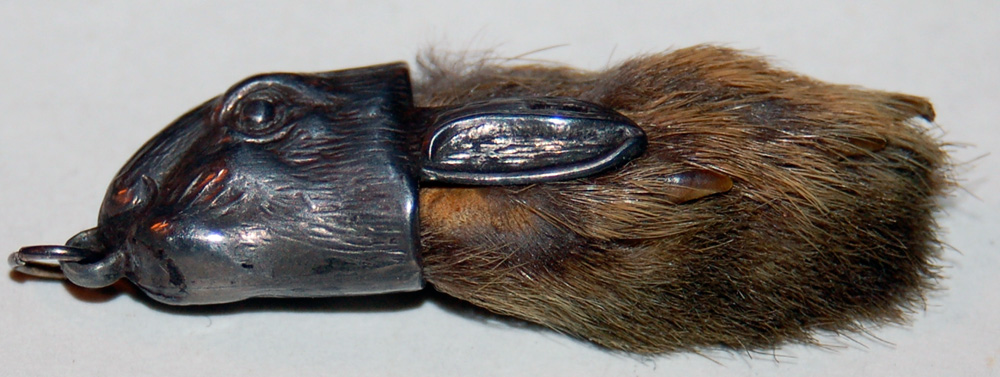
For today’s post, I’m looking at the folklore and magic surrounding one of the most ubiquitous pieces of conjure paraphernalia, the rabbit’s foot.  There are plenty of theories about this particular luck charm, but not much that can be definitely put down regarding its origin or provenance.  Rabbit foot charms have been around since at least the mid-to-late 19th century in North America, and likely predate the Civil War.  They are used for general luck, gambling aids, love enhancers, and other areas where a bit of extra luck might help.

A quick word of warning, however.  Many of the sources I’ll be citing in this post also date from earlier eras, and thus have a great deal of offensive material in them.  There are words that appear here which would likely incite violence if used lightly today, so please understand that I present them here as a piece of the folklore to which they belong.  Just as a smart modern magician finds a reasonable substitution for liquid quicksilver/mercury (and thus avoids madness and poisoning), a wise student of folklore and folk magic remembers that just because a sentiment appears in print doesn’t make it right or appropriate.

There, now let’s move on to some of the good stuff about rabbits’ feet.

Catherine Yronwode provides information on the rabbit’s foot on her Lucky W Amulet Archive, describing  the foot as catalogue offerings from the early-to-mid twentieth century:

As for the foot itself, a circa-1940 mail order catalogue from the Standard O and B Supply Company, a Chicago-based distributor of African-American hoodoo material, offered undyed rabbit foot charms “made with a metal band and a link to attach on chain.” The Johnson-Smith Novelty Company offered identical charms in its 1941 catalogue. The advertisement shown here goes these one better and promises a free vial of Van Van oil with each rabbit’s foot; the formula is a Louisiana hoodoo favourite that “clears away that evil mess” and increases the strength of any good luck charm to which it is applied. Since none of the older catalogues or ads mention any colour when describing rabbit’s foot charms, it can be assumed that the items were undyed and came only in natural tan or white.

She goes on to talk about her uncertainty regarding why a rabbit’s foot might be so lucky:

Why is the rabbit foot lucky? I am not sure. Rabbits are swift and they reproduce prolifically, but the luck of the rabbit foot is monetary and sexual; as far as i know, it is not related to swiftness or fertility. There is considerable evidence that the lucky rabbit foot is a remnant of an African clan totem, an importation related somehow to Br’er Rabbit, the famous protagonist of an African trickster-god myth-cycle.

Yronwode points out that the rabbit’s foot appears in the famous Uncle Remus stories, written by Joel Chandler Harris in 1881.  In a tale entitled “Brother Rabbit and his Famous Foot,” Uncle Remus describes the tricky Br’er (or Brother) Rabbit’s prosperity-drawing mojo bag (which he refers to as a money purse, or dialectically a “money-pus”):

Brer Wolf look at de money-pus, en see w’at in it. Hit ‘uz one er deze yer kinder money-pus wid tossle on de een’ en shiny rings in de middle. Brer Wolf look in afar fer ter see w’at he kin see. In one een’ dey wuz a piece er calamus-root en some collard-seeds, en in de tier een’ dey wuz a great big rabbit foot (Harris p. 223)

So even a rabbit carries a rabbit’s foot for luck and money.  How’s that for strange?  But why is it so lucky?  In a 1973 thesis on conjuration in the works of African-American author (and somewhat accidental folklorist) Charles Chestnutt, Bettye Jo Crisler Carr uncovers some possible reasons behind this talisman:

One might have expected Chesnutt to refer to ghosts who haunt graves, to witches ‘riding’ their hapless victims by night, to conjurers tying bits of roots in tiny bags to ward off evil. But surely his reference to the efficacy of ‘de lef hin’ foot er a graveya’d rabbit, killt by a cross-eyed nigger on a da’k night in de full er de moon’—surely that is something Chesnutt (or Uncle Julius, who seems equally real) has made out of whole cloth.

An examination of folklore sources, however, justifies Chesnutt’s requirements for the rabbit-foot good-luck charm. An informant from Atlanta states that the talisman must, indeed, be the ‘left hind foot of a graveyard rabbit.  Mary Owen, recording her collected tales prior to 1893, adds to the requirement that it must be ‘de lef hine-foot ob er grabe-yahd rabbit kilt in de dahk o’ de moon.’ A Memphis informant states further that the graveyard rabbit must have been killed by a cross-eyed person. Louise Pendleton, also writing before the publication of Chesnutt’s stories, comments that the use of the rabbit foot for good luck ‘may be traced to the fetishism, or worship of guardian spirits dwelling in inanimate objects, of their African ancestors.’ (Carr,  “Charles Chestnutt & the Doctrine of Conjuration”)

So now we can see the process of making the charm has something to do with its luck associations.  If a cross-eyed person could catch a rabbit in a graveyard in the dark, he would indeed have to be very lucky, and thus his luck might transfer to the animal’s foot (this is a bit of a stretch for a reason, in my opinion, but there certainly seems to be a specific tradition involved in collecting this talisman).  Much of this lore is corroborated by Harry M. Hyatt in his five-volume compendium on African-American folk magic, Hoodoo – Conjuration – Witchcraft – Rootwork.   Two prime examples are included here:

Vol.2,p.1541

A RABBIT’S LEFT HIND LEG, TAKEN WHILE THE ANIMAL IS STILL WARM
AND SEWN INTO A BAG, SHOULD BE CARRIED WITH YOU AT ALL TIMES,
AND KEPT UNDER YOUR PILLOW AT NIGHT FOR LUCK.

If yo’ wanta go git a job agin, yo’ could use a rabit’s foot – yo’ use a rabbit’s left foot. Ketch a rabbit, if yo’ kin kill him; if yo’ can’t ketch it, kill it. Well, befo’ he gits cold, take de left laig of dis rabbit off. (Front or back?) De back laig. Take de back laig off while it’s warm an’ yo’ sew it up in some cloth an’ when yo’ go tuh bed at night, yo’ jes’ carry it an’ push it in yore pillah. If yo’ git up tuh go in de daytime, wear it in yore pocket or either yo’ could have it in yore stockin’. Put it in yore hat or shoe or anything an’ jes’ keep it wit chew all de time. Yo’ll have good luck wit de rabbit’s left hind laig. (When you are going out to get a job?) Yes sir.

[Savannah, GA; Madam Pauline; Informant #1274. C575:1-C586:10 = 2136-2167.]

Vol.2,pp.1486-7

A CHARM TO CARRY

BURY THE RIGHT FRONT FOOT OF A RABBIT IN THE CEMETERY.
AFTER NINE DAYS AND NINE NIGHTS, DISINTER IT.
WEAR IT ON A CHAIN OR FASHION IT INTO SOMETHING SIMILAR TO WEAR
AND CARRY IT WITH YOU.

You take off his right feet, yo’ bury it in de cemetery – let it stay dere fo’ nine days an’ nights. Yo’ go an’ git it out from under dere an’ make yo’ a chain an’ put it on yo’ fo’ a locket or either, yo’ know, yo’ kin jes’ have it made into somethin’ den – yo’ know, somethin’-like. Dat’s de rabbit foot. [She laughs.] Den y’ jis’
tote it wit yo’ or either place it fo’ a watch charm or anythin’ like dat – right feet, jes’ one, de front.

[Waycross, GA; Informant # 1125 (Contact man Edwards’s landlady); Cylinder C235:4-C250: 1 = 1816-1831, and C384:1-C392: 5 = 1965-1973]

One of the common threads to the rabbit’s foot seems to be an intimacy with death or the dead.  The rabbit must be freshly killed (or “warm”) or found in a cemetery.  This may have something to do with its luck.  The dead are able to provide luck to the living in some folkloric accounts, and a magical animal like a rabbit which becomes tied to the dead may well be “running” luck back and forth from them to you.  If you are interested in more spells like the two immediately above, by the way, you can find many of Hyatt’s spells transcribed in the Hyatt Spells Yahoo! Group.  If you manage to find actual text volumes of his work and you have an interest in folk magic, buy them.  They will be worth it.

Finally, Ozark folklorist Vance Randolph records a couple of uses of the rabbit’s foot charm in his Ozark Magic & Folklore:

  • Some healers claim to cure hiccoughs by rubbing a rabbit’s foot on the back of the patient’s neck unexpectedly.
  • I recall a girl near Lanagan, Missouri, who wore a peach stone love-charm on one garter and a rabbit’s foot fastened to the other.

This particular lucky charm can be found throughout North America, often sold in roadside stores, children’s candy-and-prize machines, and even gas stations.   It’s commonly rubbed to actually activate the luck, and “fed” with an oil like Fast Luck or Van Van on a regular basis.  If you happen to have one of these in keychain or charm form, I’d love to hear your experiences with it.  Have rabbit’s feet ever brought you extra luck?  Or, as the joke is often made, is it just “unlucky for the rabbit”?

Thanks for reading (and reading and reading)!

-Cory
Blog Post 72 – Book Review

Hi everyone,

I’d like to recommend a book today which falls firmly into the “fiction” category, but which has an amazing amount of conjure-related material in it.  It’s called Mojo: Conjure Stories, and is edited by Nalo Hopkinson.  I say “edited by” because this is a collection of short stories, and every one revolves around some deep South magical topic.  Some are okay, some are quite good, and many are superb.  The book features authors like science-fiction maven Barbara Hambly, African-American author devorah major, and dark fantasy genius Neil Gaiman.

Here are just a sampling of the stories in this excellent tome:

“Daddy Mention and the Monday Skull” by Andy Duncan – An aged convict contacts an alligator swamp spirit in order to get a beautiful singing voice (and consequently a chance at freedom), but winds up biting off a good deal more than he can chew.

“Heartspace” by Steven Barnes – A man goes to visit his estranged and dying father, only to walk into the middle of a conflict between his fiery half-sister and his father’s new wife—a Gullah woman with some powerful tricks up her sleeve.

“The Skinned” by Jarla Tangh – An old man who knows the secret behind the terrifying monsters lurking in his neighborhood decides he will confront the beasts, only to endanger his very soul in doing so.

“Death’s Dreadlocks,” by Tobias S. Buckell – The children of an African village caught in the crossfire of several warlords turn to Old Ma, who teaches them to see the ropy strands of Death’s hair all around them and avoid fatality.  The children decide to follow the hair back to its source and put an end to Death once and for all.

“The Horsemen and the Morning Star” by Barbara Hambly – The Old Gods from across the sea ride their “horses” (slave devotees) in order to battle a plantation owner and his sorcerous friend, who are conjuring up their own forces—Satan himself—using the slave children as sacrifices to do so.

“Cooking Creole” by A. M. Dellamonica – A man who’s tried his hand at gambling, guitar playing, and other “gifted” talents decides to go to the crossroads one last time.  He thinks he’s finally found his calling:  he wants to learn to be a Cajun cook.  But he doesn’t know just what this cooking school will cost him.

“Shining through 24/7” by devorah major – This strange tale revolves around a woman who tries to steal from a hoodoo woman.  A hoodoo woman who happens to live near a chemical storage facility.  A radioactive chemical storage facility.   A strange but delightful story.

And these are only about half of the wonderful tales collected in this book.  I picked it up out of my local library and loved it.  If you have any interest in Southern folk magic, African-American religious practices, fairy tales and fantasy, or just plain old good storytelling, I highly recommend getting this book.

Thanks for reading!

Cory

Blog Post 68 – Be Our Guest?

So running with an idea (and a title lovingly borrowed) from Juniper over at Walking the Hedge and Standing Stone and Garden Gate, I’m putting out a call for submissions to our wonderful readers.  I know we probably have at least a couple of writers out there as well, and we’d love to have you do a guest post for New World Witchery.

We’re going to have about 6-8 weeks of low posting from me, and we’d like to be able to post at least 3 articles per week if possible.  So that means we need 18-24 well-written, proofread, researched, reasoned, resonant, and remarkable entries.  Something tells me we’ve got a few folks who might just be up to the task, so if you’re interested, here’s the submissions guide:

1)      Each article should be no less than 300 words, and no more than 2000.  500-800 words is usually ideal length, but there is some flexibility.
2)      MS Word (.doc) attachments are ideal, with inline email text being a secondary preference.
3)      Please include all links with your submission.  I may have to tweak them slightly to get them on the site, but I definitely can’t chase down links for you.  Footnotes or endnotes should be similarly included.
4)      Any artwork must be in the public domain (try Wikimedia Commons to start) or your own original picture/art with authorization to use it on the site.
5)      All work must be your own.  Citations are fine, along with short passages of material presented in a scholarly fashion, but please, no plagiarism.
6)      Please proofread your work.  Excessive typos and grammar snafus will not be corrected or posted.
7)      You retain all publication rights to your material other than the first-time online publication rights.  In other words, you’re free to submit this on a site like Witchvox or to a print publication, as long as you say that it was first published on this site.  (I’ll also assume the right to reprint passages or references to your work in future publications, but I will not publish your article in its entirety without your permission).

Of course, I’m always happy to get nice, scholarly articles on the topics of hoodoo, pow-wow, curanderismo, witchcraft, etc.  But what I’d really like is to get articles on the following topics, specifically:

  • Personal or family magical lore (such as magical practices, divinations, weather signs, etc.).  Please include your family background (such as region or ethnic heritage), too, so we know where these things come from.
  • Regional magical lore, including things like witch stories, magical places, spells, famous witches, etc.  Of course, please let us know which region you’re writing about (you don’t have to be too specific—“Appalachia” or “New England” would be sufficient).
  • Spell-work hits and misses.  Tell us about spells you’ve done, ingredients you’ve used, charms you’ve said and what your results were.
  • Botanical or animal curios and your personal experiences with them.  Are there ones you favor?  Ones you shy away from?
  • Favorite spells and practices.  Do you particularly like working with the dead?  Do you have a favorite way to communicate with the Ancestors?  Are you a sharp-shooter when it comes to love mojos?  Tell us what you do and how you got so dang good at it!
  • Magical book reviews are also welcome, especially ones dealing with North American folk magic and witchcraft (not Wicca—there are lots of reviews on Wiccan books, so we don’t really want those here).  History, folklore, and regionally specific spellbooks (like conjure or brujeria books) are all excellent candidates for review.

Other topics are welcome; just email and ask about them first.  Not every article may get published on the site, so if we don’t select yours or if we suggest some revisions first, please don’t take it personally.

“Geez!” you say.  “That’s an awful lot of work for not getting paid!”  Ah, but there’s the twist in the plot!  While we’re still a relatively poor blog and podcast, we’re gearing up for another contest.  Anyone who writes a guest article that we post on New World Witchery will be entered for that contest.   We’ve still got to work out just what we’re going to give out, but right now we’re looking at having three winners drawn at random.  If you submit multiple posts and we publish them, you get an entry for every article we put up!  Each winner will get a different, unique prize, so this could shape up to be a very interesting contest.

So, yes, technically you’re still not getting paid exactly, but you may wind up with something cool in the end.  And you’ll be adding to the wealth of knowledge found here, so you are benefitting a whole wide world of witchy folk.  Isn’t that a nice feeling?

So, if you’re interested in being a part of New World Witchery, email us your articles and maybe win a prize in the process!  In case you can’t get the email from that link, it’s compassandkey@gmail.com.

Many thanks, and we look forward to hearing from you!

-Cory

Blog Post 66 – The Moon

In a lot of modern Pagan religions, such as Wicca and Druidism, there is a certain amount of emphasis placed on the moon.  Phases of our celestial companion become symbolic stand-ins for various god and goddess figures, or particular aspects of those figures (as in the famous Maiden/Mother/Crone cycle).  With the full moon upon us, I thought I might take a little look at just how American witchcraft interacts with that lovely sphere.

There is a great deal of lunar lore found in Native American legends.  In one tale from the Kalispel Tribe of Idaho, the moon is equated with the famous trickster/father figure, Coyote:

“Once there was no Moon for someone had stolen it. The people asked “Who will be the Moon?” The Yellow Fox agreed to give it a try but he was so bright it made the Earth hot at night. Then the people asked Coyote to try and he agreed. The Coyote was a good moon, not to bright – not to dim. But from his vantage point in the sky the Coyote could see what everyone was doing. Whenever he saw someone doing something dishonest he would shout “HEY! That person is stealing meat from the drying racks!” or “HEY! That person is cheating at the moccasin game!” Finally, the people who wished to do things in secret got together and said “Coyote is too noisy. Let’s take him out of the sky.” So someone else became the moon. Coyote can no longer see what everyone else is doing but he still tries to snoop into everyone else’s business” (WWU Planetarium American Indian Starlore page).

The Cherokee thought of the Moon as brother to the Sun (an instance of the moon being seen as male, which appears in several cultures).

The image of the Man in the Moon is frequently found in American folklore.  Many of these traditions hail from European lore, including poems found in Mother Goose:

THE MAN IN THE MOON
The Man in the Moon came tumbling down,
And asked the way to Norwich;
He went by the south, and burnt his mouth
With eating cold pease porridge.
(from The Real Mother Goose)

In other cultures, the moon contains figures less familiar to most Americans.  The Old Farmer’s Almanac includes examples of the moon seen as a woman with child, a toad, a giant, a rabbit, and a boy and a girl carrying a bucket (as in “Jack and Jill”).

There are also particular moons associated with particular months.  A good list of them can be found at the Farmer’s Almanac site, here.  Many are linked with agricultural cycles (such as Green Corn Planting Moon or Harvest Moon), and some are clearly linked to hunting (like the Buck Moon).

There is a plethora of magical lore associated with the moon.  My earlier posts on planting by lunar signs and weather lore both have lunar connections within them.  Likewise, the witch initiations post mentions the practice of shooting at the moon to become a witch.  Edain McCoy, in her book In a Graveyard at Midnight, also has a fun bit of moon magic:

“To remove a curse from your home, you can try shooting your shotgun out an open window at the full moon, while shouting a curse at the Devil.  However, don’t try this if you live in a city or populated area, or you will likely find the police at your door” (McCoy, p. 107)

There are also beliefs about marriage and courtship dates associated with lunar phenomena – waxing-to-full moons are best for “tomcattin’” according to Vance Randolph’s Ozark Magic & Folklore.

Of course, witches can find lots to do under a full moon.  Personally I find it to be an ideal time for:

  • Storytelling gatherings (especially around a campfire)
  • Divination and fortune-telling
  • Working with Otherworld entities like spirits, ghosts, fairies, etc.
  • Possession-based magic and shapeshifting
  • Love and beauty magic
  • Crafting magical tools and supplies

These are only my thoughts on the subject, of course, and there are plenty of great sources on lunar folklore out there.  And, of course, your mileage may vary when it comes to making the most of a full moon.  I’d love to hear what you all do with regards to lunar-linked magic.  Please feel free to share your methods, practices, ideas, and thoughts with us here!

Until next time, thanks for reading!

-Cory

Podcast Special – The Horned Women

-SHOWNOTES FOR SPECIAL – THE HORNED WOMEN-

Summary

A very short special in which Cory reads the fairy tale “The Horned Women,” then discusses a bit of the witchcraft in it.  Happy Walpurgisnacht/May Eve/Beltane everyone!

Play:

Download:  New World Witchery – Podcast Special – The Horned Women

-Sources-

“The Horned Women,” from Fairy & Folk Tales of the Irish Peasantry, by W.B. Yeats and Lady Gregory.

Music

“Grifos Muertos” by Jeffery Luck Lucas, from his album What We Whisper, on Magnatune.com

Blog Post 56 – Walpurgisnacht

A caveat before I begin today’s post:  Walpurgisnacht is not terribly “New World.”  Most of it will be related to the British Isles and Europe, though I will include a little bit on New World practices, too.  But I think it’s still relevant to witchery, so I’m going to write about it anyway.  Mostly because, well, I really want to.

This is quite possibly my favorite witchy holiday, with the conditional exception of All Hallows/Halloween.  I do like May Day/Beltane celebrations, of course, but the night before is really what I love.  The association of this night with witchcraft seems to go back a long way.  The name of the holiday comes from a Catholic Saint who died in the year 777 C.E, St. Walburga.  Rosemary Ellen Guiley, in her Encyclopedia of Witches & Witchcraft, says this about the holiday:

“In the Middle Ages, Walpurgisnacht, or Walpurgis Night, was believed to be a night of witch revelry throughout Germany, the Low Countries and Scandinavia.  Witches mounted their brooms and few to the mountaintops, where they carried on with wild feasting, dancing and copulation with demons and the Devil…In Germany, the Brocken, a dominant peak in the Harz Mountains, was the most infamous site of the witch sabbats…[S]o common was the belief in the sabbats that maps of the Harz drawn in the 18th century almost always depicted witches on broomsticks converging upon the Brocken” ( EW&W, p.347)

What shifted the focus from holy martyrdom and sainthood to witch-filled revels?  Well, there’s no single reason why that I’ve found, but the date is directly opposite Halloween in the calendar year, so that might have something to do with it (what, you thought witches would be content with one night of fun a year?).

There are lots of stories about this night.  One from the Isle of Man between Scotland and Ireland tells the story of two witches and their (mis)adventures on Old May Eve.  Dennis Wheatly’s occult novel The Devil Rides Out features a Walpurgisnacht ritual rather prominently, as it does in Goethe’s Faust tragedy.  The scene at the end of the original Fantasia film featuring Mussorgsky’s “Night on Bald Mountain” also makes heavy reference to the revelries of Walpurgisnacht (I think I mentioned this in the Media Episode, too).  There are also many unusual traditions associated with this night.  When I was living in Prague, they had a tradition of building huge bonfires on hilltops on this night, and burning brooms or effigies of witches to keep evil spirits at bay, for example (it was really more of an excuse to drink around the bonfire).  Vance Randolph, in his Ozark Magic & Folklore, describes an Ozark tradition for May Eve:

“On the last night of April, a girl may wet a handkerchief and hang it out in a cornfield. Next morning the May sun dries it, and the wrinkles are supposed to show the initial of the man she is to marry. Or she may hold a bottle of water up to the light on the morning of May 1, just at sunrise, and see apicture of outline of the boy who is to be her husband” (OM&F, p.176)

My personal practice incorporates a storytelling bent, and there’s one story that I turn to every year as part of my Walpurgisnacht ritual.  “The Horned Women,” as recorded by Lady Wilde (in a collection with many tales also recorded by W.B. Yeats which I’ve mentioned before—Fairy & Folk Tales of the Irish Peasantry), is not explicitly about this wild night.  Yet certain elements—the assembly of a coven of witches, and the prominent mention of a mountain where they revel, especially—have always called to mind this tale in relation to May Eve.  I glean much in the way of magic from this story, and incorporate things from it into my workings (such as the use of “feet water” to guide all harmful forces away from my home).

Walpurgisnacht doesn’t register on everyone’s radar.  Some are definitely drawn towards the Beltane side of this holiday, and I rather love that celebration, too.  But Walpurgisnacht will always have a special place in my heart.  There’s no night I more earnestly wish I could climb on a broomstick and sail off into a moonlit sky than this one.

Thanks for reading!

-Cory

Blog Post 54 – The Devil’s Nine Questions

Today’s post is going to focus on one very specific set of riddles:  The Devil’s Nine Questions.  This is a series of riddles which has been set down in the form of a folk song, and which has come over from English traditional music by way of the Appalachians and mid-Atlantic colonies.  The theme of the piece involves the Devil asking a series of nine riddles, which the song’s protagonist (“the weaver’s bonny”) must solve or be taken off to Hell.  There are numerous variants on this motif, and on this specific song.  It is recorded as one of the famous Child Ballads (#1), and you can hear a version of it here.

The version I’m posting here is not necessarily the most “authentic” or “original” version (as this song may have grown out of Elizabethan folk music and is rather hard to pin down as far as origins go).  But it is a version that I think bears examination by the inquisitive witch.

THE DEVIL’S NINE QUESTIONS

If you don’t answer my questions nine
Sing ninety-nine and ninety,
I’ll take you off to hell alive,
And you are the weaver’s bonny.

What is whiter than milk?
Sing ninety-nine and ninety;
What is softer than silk?
Say you’re the weaver’s bonny.”

Snow is whiter than milk,
Sing ninety-nine and ninety;
Down is softer than silk,
And I’m the weaver’s bonny.”

What is louder than a horn?
Sing ninety-nine and ninety;
What is sharper than a thorn?
Sing I am the weaver’s bonny.

Thunder’s louder than a horn,
Sing ninety-nine and ninety ;
Death is sharper than a thorn,
Sing I’m the weaver’s bonny.

What is higher than a tree?
Sing ninety-nine and ninety;
What is deeper than the sea?
Sing I’m the weaver’s bonny.

Heaven’s higher than a tree,
Sing ninety-nine and ninety;
And hell is deeper than the sea,
Sing I’m the weaver’s bonny.

What is innocenter than a lamb?
Sing ninety-nine and ninety;
What is worse than womankind?
Say I’m the weaver’s bonny.

A babe is innocenter than a lamb,
Sing ninety-nine and ninety ;
The devil’s worse than womankind,
Sing I’m the weaver’s bonny.”

You have answered me questions nine,
Sing ninety-nine and ninety;
You are God’s, you’re not my own,
And you’re the weaver’s bonny.”

From Bronson, Singing Traditions of Child’s Popular Ballads
Collected Mrs. Rill Martin, Virginia, 1922

Looking at this from an occult perspective, I see several things which stand out.  For instance:

  • The repetition about being “the weaver’s bonny,” which in my opinion may relate to being one of those who can change (or at least manipulate) Fate, the great weaver.
  • The efforts of the Devil to claim the “bonny” for his own reminds me a bit of the practice of initiation, which I covered recently (though in this case the person responding remains unmoved by the Devil’s efforts)
  • There’s an interesting bit of business in the part about trees, seas, Heaven, and Hell.  It’s almost a “Land, Sea, and Sky” image, but it also seems to be referencing the celestial, earthly, and underworldly realms.  Those are the realms a witch must go between, so I like to think there’s something to that part.

Of course, there are lots of other images in here which come out of Christian folklore, such as innocent lambs, the wickedness of womankind, etc.  In some of the variants, these change a bit (though usually the reference to Eve’s “original sin” remains in some form).  Some of the other variations include naming Love as softer than silk, rather than Down, and making Death “colder than the clay” instead of “sharper than the thorn.”   What I love about all of this imagery is that it relates one thing to another, connecting the senses to specific images in a very evocative way.  Associating Death with Thorns makes me think of going into the Underworld via the Hedge; Milk and Snow make me think of Mother images, like Mother Holle, who shook her downy blankets to stir up snow on earth; and thinking of Thunder as a Horn, summoning me out into a wild storm…well, let’s just say it makes my pointy hat dance on my head.

With songs like this, it’s often hard to know just what changed and when, and what the original meaning of certain parts are.  What I like about it, though, is the folkloric elements of being able to outwit the Devil and get one’s way, bending Fate to one’s will.  I would think this kind of a tune might be an excellent song for singing when gathering together with other witches, as a sort of  call-and-response as each witch is welcomed among the company (solving a riddle could serve as a “password” in effect).  Or, it could just be a good fun song to sing one night while passing a bottle around and telling jokes, stories, and riddles.  But what do you think?  Do you see anything witchy I missed?  Or do you think that dwelling on a song like this is wasting valuable time that could be devoted to a new root work herb of the week?  Is it all just a big stretch for something purely designed for entertainment?  Leave a comment and let me know!

Thanks for reading!

-Cory

Blog Post 50 – A Witch’s Initiation

For my 50th blog post, I thought I’d do something special, something that really tickles my fancy.  I’ll be talking about the various types of witch initiations found in New World folklore.   I’ve already touched on this in Blog Post 45 – Witches, but today let’s expand a little bit on the concept.

In general, witch initiations in North American folklore share a few commonalities:

  • The renunciation of Christianity, often through a ritual like repeating the Lord’s Prayer backwards
  • The giving of oneself to an otherworldly entity, such as the Devil or a “Man in Black” in exchange for magical powers
  • An act of exposure, such as being naked or sexual union of some kind, though in some cases this is not necessary
  • A sign or omen of the candidate’s acceptance as a witch
  • The transmission of magical knowledge in a ceremonial way, and/or the presentation of a familiar or fetch animal

Not all of these components are found in every case, of course, and the nature of the witch may be such that he or she is not an “initiated” practitioner, but merely someone who has picked up magic throughout his or her life.  This last circumstance is often found in places where magic is prevalently mixed with Christian practice, such as in the Appalachians (Granny magic) or among the Pennsylvania-Dutch (Pow-wow).  Of course, in these cases, the magical worker is seldom called a “witch,” though sometimes the term “witch doctor” is used.  It’s funny, to me anyway, to think about how a witch is “made” through initiation, much like someone can be “made” in the Mafia.  But I digress…

Now let’s take a look at how witches were/are initiated according to specific folklore examples.  From German Appalachian lore, there are stories of witches being initiated by obtaining a “Black Bible.”  Scholar Gerald C. Milnes links this tome to the Key of Solomon, a grimoire with many reputed magical properties and a host of instructions  on how to accomplish various magical tasks.  One of his informants outlines the basic ritual thusly:

“Now say you’re going to be a witch.  Okay, now I don’t know where you get ‘em, but they call e’m the little Black Bible.  Take that little Bible and you go to a spring where it’s a-running from the sun…not towards the sun, away from the sun…Take that little Black Bible and go to that stream, strip off, and wash in there—take a bath in that water—and tell God you’re as free from him as the water on your body” (Signs, Cures, & Witchery, p. 162).

Milnes also describes a similar Appalachian rite of this nature involves taking dirt and shaking it off of a plate or dish while stating aloud that you are as clear of Jesus Christ as the dish is of dirt.  Something more is added to this folklore:

“If, through a pact, the devil is granted your soul in exchange for some talent, gift, or magical power, it is thought that he then receives some gift of the body in return.  This could be a fingernail or even a withered finger” (SC&W, p.164).

Such a “sacrifice” is not uncommon in witch-lore, with the physical offering being anything from a bit of blood to sign a pact to a body part like a finger or toe to—at the extreme end—the death of a loved one.  This is a story commonly applied to many chthonic cult deities or spirits.  Santa Muerte in the Latin-American magical traditions has also been accused of this sort of thing.

I outlined one type of witch-initiation culled from Hubert Davis’s The Silver Bullet in Blog Post 45, an initiation which involved a type of blood offering in exchange for the presentation of a magical imp.  That version of initiation is only one of many methods presented by Davis.  Here’s another one, from Wise County, Virginia:

“She [Granny, the narrator of the tale] began: ‘I’ve been told thet annuder way to git to be a witch is to fust go to the top of a high mountain, throw rocks at the moon and cuss God Almighty.  Then, go find a spring where the water runs due east.  Take a brand new knife and wash hit in the spring just as the sun rises.  Say, “I want my soul to be as free from the savin’ blud of Jesus Christ as this knife is of sin.”  Do this fer twelve days in a row.  Effen on the thirteenth day the sun rises a drippin’ blud, hit’s a shore sign thet you’re becomin’ a witch’” (TSB, p. 11).

This variant is interesting, to me, because of a few elements.  First, in this initiation, the spring must flow east (or towards the rising sun, though against the natural path of the sun), which seems to be different than in the Milnes version.  In this initiation, too, the witch isn’t naked, but a new knife is washed in the stream while a renunciation is made.  Finally, the bloody sunrise is a sign to the witch indicating acceptance or denial of the initiation—this feature is common in several variations of the rite.  Davis also mentions another witch-making method which bears some of the trademarks of the process:

“He [the potential witch] then waited until Friday the thirteenth and returned to the spring as the morning turned gray over the ridge.  He dipped some water from the spring with his ram’s horn and poured it over the pewter plate.  He did this seven times and repeated the verses Liz [a witch] had taught him:

‘As I dip the water with a ram’s horn,
Cast me cruel with a heart of thorn,
As I now to the Devil do my soul lease…
May my black and evil soul be
Of Christian love and grace free
As this plate is of grease’ (TSB, p. 24).

This, to me, bears a strong similarity to the dirt-and-plate version of the ritual outlined in Signs, Cures, & Witchery.

I mentioned a ritual involving the reversed Lord’s Prayer from Vance Randolph’s Ozark Magic & Folklore in my post the other day.  Randolph discusses several other ways of becoming a witch in that work, some simple, and some more complicated:

  • A woman could fire a silver bullet at the moon and “mutter two or three obscene old sayin’s” (p. 265)
  • Repeating the Lord’s Prayer backwards and firing seven silver bullets at the moon will do the trick
  • Magical information can only passed across gender lines (man-to-woman or vice versa), or between partners united by sexual intercourse
  • Widows were the best candidates for becoming witches, as they only had to learn “the Devil’s language,” whatever that might be.

Randolph goes on to say that the transformation of a person into a witch was a moving one, and often one with a morbid downside:

“I am told, by women who claim to have experienced both, that the witch’s initiation is a much more moving spiritual crisis than that which the Christians call conversion. The primary reaction is profoundly depressing, however, because it inevitably results in the death of some person near and dear to the Witch” (OM&F, p. 268).

In this case, the lost loved one is called a “Witch’s sixpence,” and is the “price” paid for the witch’s powers.  This is not a universal belief, however, as many witches do not lose anyone close to them, and instead gain a new friend:  the familiar, fetch, or imp.  I’ll be doing something more extensive on this aspect of witchcraft in the future, so for now, I will just say that the familiar of the witch is a big subject with as much (often conflicting) information floating around about it as, well, the subject of initiation.

Finally, here are some examples of witch-induction from Kentucky.  I’ve gleaned these from the book Kentucky Superstitions, by Daniel and Lucy Thomas.

  • To become a witch, go to a mountain top at dawn, shoot through a handkerchief at the rising sun, curse Jehovah three times, and own the Devil as master. When you shoot through the handkerchief, blood will fall from it (Mountains, #3773)
  • To become a witch: the candidate goes with the Devil to the top of the highest hill at sunrise nine successive days and curses God; the Devil then places one hand on the candidate’s head and one on his feet, and receives the promise that all between his hands shall be devoted to his service.  (Mountains, #3774)
  • To become a witch, you shoot at the moon nine times with a silver bullet, cursing God each time (Mountains, #3775)
  • You can become a witch by taking a spinning-wheel to the top of a hill, giving yourself up to the Devil, and waiting until the wheel begins to turn. The witches will then come to instruct you (Mountains, #3776)

These are similar to other folkloric initiation ceremonies already discussed, with the exception of the last one.  The inclusion of the spinning wheel here is interesting to me, because it seems to be connected to an idea I find very witchy: the threads of Fate.  It also reminds me of the Irish folktale “The Horned Women,” which is a story I glean much in the way of witchery from.  In this case, the wheel’s turning is much like the rising of a bloody sun—it provides an omen that the witch has been accepted into the fold of witches before her.

So what do I make of all of this?  Well, my own opinion (and I stress that it is only my take on the phenomenon of witch initiations, and no one else’s) is that each of these stories contains little pieces of initiatory lore, but always with a layer of sensationalism on top.  These folk tales were intended to amuse and spark curiosity, after all, so it doesn’t surprise me that a small offering of blood, say on an new witch’s cingulum or a few drops in a cup of wine poured out to the god, gods, or spirits to which the witch is binding herself, has become exaggerated into the death of a family member or the withering of a limb.  I think that initiations have a profound impact on those that undergo them, and that many of the common elements (the renunciation, the vow to serve a witch-god/goddess/devil/etc., and the granting of magical gifts like certain charms or familiars) are profound acts that may well belong in an initiation ceremony. Many of these features are also found in other initiation ceremonies and Traditional Witchcraft works, such as Paul Huson’s Mastering Witchcraft or Nigel Jackson’s Call of the Horned Piper. I also think that some elements are overlooked in these sorts of folkloric imaginings of “witch-making”.  For instance, one thing Sarah at Forest Grove mentioned in her post on initiations is that once one becomes a witch (or takes initiation), one finds “Growth and strength of abilities and experiences the more one practices and keeps their promises.”  Most stories about witches seem to either end at the oaths taken upon becoming a witch, or to start in medias res of a witch’s career, showing a witch operating in one way, unchanging, until she is (inevitably) defeated.  That makes for good storytelling, but perhaps not for so much good practical witchery.  Witchcraft is wonderful in that the more you do it, the better it gets!

In the end, I like this topic, but I should say one more thing.  I don’t think that a person-to-person initiation is necessary to practice witchcraft.  If you’ve not taken an initiation, or don’t ever plan to, but find you are good at witchcraft anyway, keep doing it.  You certainly don’t need anyone to validate your magic if it’s working, and if whatever forces you draw your magic from one day choose to initiate you, I have a feeling that much like Don Corleone, they’ll make you an offer you can’t refuse.

My apologies if this post has been overlong, but I hope it’s useful to somebody out there.   If nothing else, you’ve worked out your scrolling finger for today.

All the best, be well, and thanks for reading!

-Cory

Blog Post 48 – Comparing Tales

Greetings everyone!  On Podcast 8, I mentioned two stories which share remarkable similarities.  I was speaking of a story in the W. B. Yeats collection Fairy & Folk Tales of the Irish Peasantry, specifically a story called “The Witches’ Excursion” (I incorrectly called it something like “James and the Red Cap” on the podcast…my apologies to Yeats and anyone who went poring over that tome looking for that non-existent title).  For comparison, I cited the tale “Greasy Witches,” in The Granny Curse, by Randy Russell.  You can read most of that story here, on Google Books (though I can’t guarantee how long that much of the book will remain free to read).  Briefly, I thought it might be fun to go over a few of the similarities and commonalities found in these tales, for the sake of seeing how Old World witch lore migrates and transforms in the New World.

In the Appalachian version, the cabin is located on Roan Mountain.  In this case, I think that the “roan” referred to could be tied into the “red” of the red cap being used to induce magical flight in the Yeats tale.  Or, “roan” could be a variant on “rowan,” which is a mountain ash tree (which derives its name from its red berries, and thus could still have the “red” connection).  The rowan tree is loaded with magical significance—some of the most potent anti-witchcraft charms are crosses made from rowan twigs bound with red thread.  However, it could also be used to make magical tools as well, such as wands or staves.  Oh, I should also point out that Roan Mountain is actually a real mountain on the Tennessee/North Carolina border.  (Side note:  would there be any interest in me doing a sort of “Witch’s Travel Guide” to various parts of the US?  Places with strong witch lore or with a history of magical activity, perhaps?  Comment/email and let us know!)

There’s a strong indication that the Dobbs sisters use a powerful sleeping draught on Riley the same way that Madge and her cohorts attempted to drug James in the Irish version of the story.  I’m not sure if I’d prefer my witch-administered pharmaceuticals via nightcap or squirrel soup, though.

The unguent used in both stories seems to be, basically, a flying ointment.  In the version from Yeats, I would lean towards a mixture that uses amanita muscaria, but I base that almost entirely on the fact that the “red cap” is a key feature of the tale.  It’s not unthinkable that such entheogens  would grow on Roan Mountain, but it is a bit less likely.  In both stories, the mixture is activated by the recitation of a short, rhyming phrase, which seems to be a common enough way to trigger witch-flight in many stories.  In some tales, the non-witch makes a mistake, it causes some sort of comic misfortune, like being lifted up and dropped to the floor unexpectedly.

An interesting difference between the two tales comes during the heavy drinking portion of the tale (don’t all interesting things come during the heavy drinking portion of the tale?).  In the Irish story, Red James never tries to go home once he starts drinking—he just passes out.  Riley, in the American version, does try to leave (which is when he notices his body “felt like feathers or fur,” a sure sign of shape-shifting.  Another difference worth noting is that in the Old World version, James knows his witch-lore and remains silent while in flight, but in the “Greasy Witches” variant, Riley has to say additional magical words while in flight to follow the Dobbs sisters.  I’ve had a gifted witch tell me that when making a profound crossing like this, silence is better, and I trust that idea.   But there’s clearly some flexibility, too.

The stories end quite differently, with Riley finally having to do what the witches have been manipulating him into doing the whole time:  marrying one of them.  Red James faces no such fate, but merely gets his red cap back and flies off at the last possible moment, avoiding his hanging in dramatic fashion.  But they do both get away, and both with a little magical aid from witchcraft.  It’s nice to know we witches are good for something other than breaking-and-entering, right?

I’m interested in your opinions on these tales.  Is it all just metaphorical hedgewitchery?  Do you think these sorts of events might have happened?  And most importantly, do you think that as these stories evolve, anything is being lost or gained in the process?  I personally love how much alike they are, but I also find myself pausing over the differences, too.  What about you?

Thanks for reading!

-Cory