Blog Post 70 – Elder

I’ve been noticing a lot of the elder trees blooming in my neck of the woods lately, so I thought I might take a stab at sharing some information on that particular plant.

Elder is a tree that has a long history with humanity.  Its uses are broad, including medicinal, culinary, and magical aspects.  Generally speaking, elder comprises anything in the genus Sambucus, with species names like nigra, canadensis, peruviana, etc. depending on region and appearance.  Elders can be very shrubby, or full-grown trees reaching up to 25 feet tall.  They have white flowers which bloom in the summer in bunches called corymbs (these are very prominent, so much so in fact that I felt compelled to write a blog post on them).  The blue-black berries, which appear in late summer and early fall, are a foodstuff used in everything from jams to vinegars.  The shoots of the elder have even been used as toys.  According to Botanical.com:

“The popular pop-gun of small boys in the country has often been made of Elder stems from which the pith has been removed, which moved Culpepper to declare: ‘It is needless to write any description of this (Elder), since every boy that plays with a pop-gun will not mistake another tree for the Elder.’ Pliny’s writings also testify that pop-guns and whistles are manufactures many centuries old!”

Medicinally, elders different parts have different uses (a quick note:  I am not a medical professional.  Please seek professional medical advice before using any plant medicinally).  The flowers have been used in tisanes to help alleviate all manner of ailments: sore throats, swollen tonsils, flu symptoms, etc.  The cooled elder tea could also be used topically on sunburns or to alleviate sore eyes.  The leaves of the elder can be used as a poultice or turned into an unguent to treat bruises, cuts, and abrasions.  The bark can be used as a potent purgative, though the inner bark is better for this than the outer.

As food, elder berries are most commonly consumed as elderberry jam.  They can also be turned into a syrup, and made into a delicious cordial for the adults in the crowd.  A sweet and slightly spicy wine can also be made from the berries, which seems to be very popular among the brew-it-yourself crowd.  I remember an old herbal book of mine which also contained a recipe for drinks like elderberry fizz and elderberry flip, which are essentially cocktails made from either the wine or the cordial.

Magically, elder has appeared in many cultures with many different purposes.  Some of the Old World magical associations with elder include:

  • Driving away evil spirits (Russian)
  • Magically removing fever (Czech)
  • Protection against witchcraft (English)
  • Good luck at weddings (Serbian)
  • Preventing theft (Sicilian)
  • Bad luck if burned (Romany)

The Danes believe that furniture made from elder wood is haunted by a spirit called Hylde-Moer (or “Elder Mother”), who may bear a connection to Mother Holle in Teutonic mythology.

On this side of the Atlantic, elder shows up in several systems.  John George Hohman’s Long Lost Friend recommends frying elder leaves with tobacco leaves in butter to make a healing salve.  In hoodoo, elder is used primarily for protection.  Hung in a bag near the entrance to the home, elder wood and flowers prevents intruders from coming in.  When mixed with the potent devil’s shoestring herb, it can prevent any unwanted guest from getting close to your home.  Catherine Yronwode’s Hoodoo Herb & Root Magic recommends elder as part of a Law-Keep-Away spell:

“Determine how many ways there are to enter the place where you conduct your business, and for each way, cut an elder stick five inches long, and get a small piece of John the Conqueror root.  On each elder stick carve five notches, one-half inch apart, then cut a sharpened point on each stick.  About fifty feet down each path leading to the place, drive a hole into the ground.  Put a piece of John the Conqueror root at the bottom of the hole, followed by an elder stick, pointed end down, with all the notches facing North.  It is said that no law officer will walk or drive over those elder pegs”  (HHRM p.90).

Yronwode also recommends drawing a circle around oneself with an elder branch and making a wish.  If you try this out, I’d love to hear your results!

There are probably dozens of other things I’m missing about elder, but hopefully this is a good start.  If you have uses of elder or experiences with the plant you’d like to share, please feel free to do so!

Thanks for reading,

-Cory

Blog Post 64 – City Spirits

Today’s post is going to be a little different.  I’m not going to cite any outside sources (at least, I don’t think I will…I may not be able to fight the urge).  Instead, I’m going to present some thoughts I have had which were spurred on by discussions about modernization last week, and in particular a comment from Crystal on Podcast 10.  She mentioned that as a city witch, she often feels the pull to get back to nature, which got me thinking:  can cities, buildings, and skylines be a part of nature, too?

Now, I know this isn’t an original thought, and that there are deeper philosophical questions here about whether people are a part of nature and therefore whether their creations are also a part of nature, but that’s not really what I’m getting at.  When I talk about “nature” above, I really mean the whole of nature, encompassing the spiritual dimension as well.  I’m thinking more in terms of whether the Otherworld might well have city elements in it.

Do buildings have specific spirits?  Like spirits of the land do?  Can you tap into a building’s spirit and use it in magic?  These are the questions that are swirling about in my head.  For example, there are definite precedents in hoodoo for using things like dirt from a courthouse or a bank or a hospital, because it’s assumed that the land upon which those structures reside will have absorbed a particular type of energetic influence which the root worker can then use for his or her own ends.  Is using that energy akin to using a little bit of the spirit of those places, or is the conjurer simply using accumulated human energy?

Even more to the point, are there places in cities that echo the kind of spiritual resonance found in locations like the Rollright Stones or Stonehenge?  After all, those structures were, at least to some extent, man-made (though I won’t begin to deny that they may be sitting on top of very particularly powerful places that have nothing to do with people).  But why can’t the Empire State Building or Beacon Hill in Boston or the Ryman Auditorium in Nashville have their own resident spirit (or spirits)?  And moreover, why not use places like that to do magic—not just in terms of collecting dirt or knick-knacks for spells, but actually deploying spells there, or finding subtle ways to contact spirits and interact with them in those locations?

For me, train stations have always had this very powerful Otherworldly significance.  I imagine that after death, there’s this sort of “waiting” place which always seems like a train platform to me.  Trains come and go, taking each person off to different post-mortem existences, or sometimes allowing them to just ride and enjoy the scenery for a bit.  There are food cars, drinks, other passengers to play cards with if being dead gets boring…er, at least, that’s how I envision it.  But lately I’m thinking that going to a train station is a lot like going to the Crossroads in traditional hoodoo practice.  I think I may try out a few things at our city train station and see how it goes.  If I do, I’ll be sure to post on that and let y’all know about it.

This is, of course, not an extensive discussion of this idea.  And there are probably lots of better sources for reading and thinking about urban magical practice than our little blog.  In fact, Velma Nightshade over at Witches Brewhaha recently did an episode discussing city witchery that’s well worth checking out (I couldn’t resist the opportunity to link to something).  But I just had to let some of these thoughts out, as they were making a lot of noise in my head and the gerbil that lives there was getting upset.

What about your thoughts and opinions?  Any strong inclinations on city magic?  Does it depend upon specific places?  Is there some way to turn a city landscape of concrete and steel into the same kind of magical place an ancient grove might be?   Do you practice this kind of city magic yourself?  Inquiring minds want to know!

Thanks for reading!

-Cory

PS – I will be closing the current polls at 5pm today, so if you still haven’t voted, please do!  See the top right of the sidebar to vote.

Blog Post 63 – Black Pepper

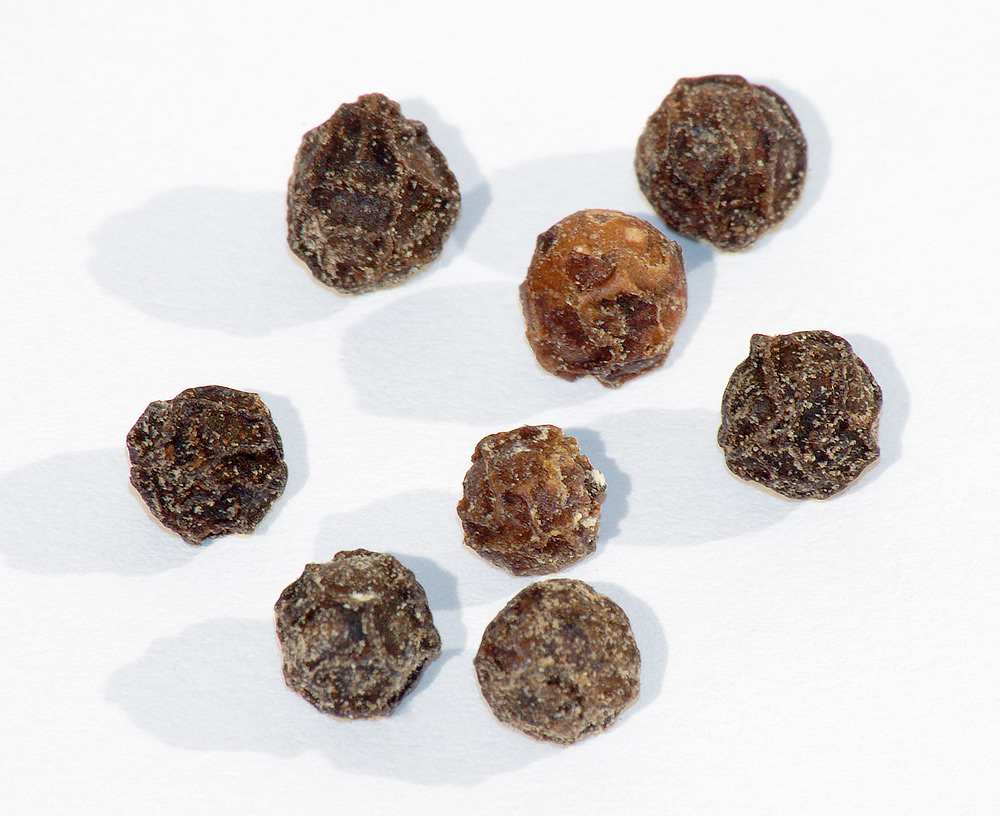
Today I thought I’d take a brief look at a magical ingredient which most everyone has on hand:  Black Pepper.  There are many uses for this dried fruit of the Piper nigrum plant.  Of course it’s valued for its ability to enhance food with a bit of heat, but it also has medicinal properties, and is very common in hoodoo practice as well.

Botanical.com lists the black peppercorn’s medicinal properties as being a febrifuge (fever reducer) and a stimulant and carminative.  For those with enflamed throats or ailments of the uvula, the site recommends using an infusion of black peppercorns as a gargle, and also suggests using the herb for constipation and urinary troubles.

In Appalachian practice, Granny women would sometimes use an infusion of black pepper to help induce labor in an expectant mother, because of its stimulatory nature.  They might also have the mother “snuff” or “quill” black pepper for the same results:

“Snuffing entailed having the mother sniff black pepper…from a plate placed under her nose; quilling involved blowing the same substances directly into the mother’s nostrils or throat with a goose quill, reed, or rolled piece of paper.  Either way, the objective was to cause a violent sneezing attack that would induce labor” (Folk Medicine of Southern Appalachia p.130).

In hoodoo, the black peppercorn is used primarily to harm or protect.  It’s often added to things like Hot-Foot powders or crossing tricks to facilitate an uncomfortable “heat” in the target’s life.  Catherine Yronwode also notes that black pepper can be used to stave off a jinx, particularly one which has been stepped in:

“To shield yourself from anyone doing these things [poisoning you through the feet via powder or other foot-track magic]…sprinkle black pepper powder or a mixture of black pepper and Fear Not to Walk Over Evil Powder in your shoes.  It is said that your track will be invisible or invulnerable to harm, and even if someone does throw for you or lift your foot track, they won’t be able to affect you in any way” (HHRM, p.53).

She also mentions that black pepper can be mixed with salt and thrown after someone when they leave your home to prevent them from ever returning or doing you harm.  Since salt and pepper are rather easy to come by in most homes, doing a spell like this is simple, and because the ingredients are so common most people don’t think twice about seeing them on the ground.  In fact, a light sprinkling of these ingredients would probably go unnoticed even in a busy apartment complex, and would be easily vacuumed up later, which makes a spell like this good for the urban root worker or witch (in my opinion, of course).  I’d combine it with the practice of leaving a broom behind the door just to double up the protection from unwanted visitors, too.

There are several potent curses which can be levied using black pepper, too.  Catherine Yronwode’s Hoodoo Herb & Root Magic book has an excellent entry on these, so I’ll not rehash everything in her entry here.  I will say that the spell she mentions involving a black candle and 99 peppercorns taken to a crossroads sounds particularly nasty, and would be well worth learning, if only to have an idea how to undo it should someone do it to you.

That’s it for today!  I wish you all a wonderful weekend.  Please don’t forget to vote in our polls, too!  They’ll be open through the weekend, and you can find them in Blog Post 61 or at the top right of the sidebar.  Thanks for voting, and as always, thanks for reading!

-Cory

Blog Post 62 – More Ideas for Urban Witchcraft

Greetings everyone!

Following on yesterday’s topic of urban conjure and rootwork, I thought today it might be fun to take a look at some spells that have roots in traditional American folk magic, but which use certain modern adaptations to accommodate contemporary life.

Courtcase Spell
In the past, courthouses were often wooden-floored buildings outfitted with spittoons for the convenience of trial attendees with a chaw of tobacco in their mouths.  Hoodoo developed a fairly ingenious way to exert some influence over a case by taking advantage of the spitting habit so prevalent in that day and age.  A defendant would keep a gob of Little John to Chew (the root known as galangal now—readily available in Asian markets) in his or her cheek, and then spit the juice onto the courthouse floor while ostensibly aiming for a spittoon nearby.  This sort of contagious magic would then bring favor in the case from anyone who walked on or near the spit.

Nowadays, spitting in court is probably a good way to lose your case.  Most courthouses are kept fairly secure, and tobacco products are seldom allowed in any government building (not that Little John is a tobacco product, but it’s supposed to look like it is, so either way, it’s out).  But there’s still a fairly simple way to work a spell in your favor:

1)      Get some dirt or water from the courthouse area – This can be dirt from a flower bed, from near the back of the building, or even from a potted plant somewhere on the premises if you can manage it.  Or, if the courthouse has a fountain out front, you can collect water from that, or fill a drinking bottle with water from the drinking fountain in the courthouse (or from the bathroom, etc.).  Barring all of these options, you  can scrape the side of the building and try to gather even just a little bit of dust from it, then mix it with soil from the closest source you can find.

2)      Take some Little John to Chew (galangal root) and work up a good bit of spit.  Spit the juice into the dirt or water, while reciting a petition or prayer appropriate to your situation (such as Psalm 35, “Contend, O Lord, with those who contend with me…”).  If you have only a little bit of dirt, you can add the dirt to some water and make a sort of “tea” out of it and the spit.  If you have only a little bit of water, you can dilute it with some more water (add a little whiskey to it to give it a kick).

3)      Take the dirt or water and go back to the courthouse.  Sprinkle your mixture in a circle around the building, as close as you can get (if you have to walk a block, sprinkling a little as you go, that’s fine—just make sure the entire building is encircled).  Whenever the judge who tries your case crosses that line, he will be disposed to favor you.

This trick relies on the same contagious magic as the older trick.  Why not just chew and spit at the front steps to the courthouse, you ask?  Well, you can’t be sure that your judge will come up those steps, and you need him to come into contact with your trick.  Unless he or she lives somewhere in the courthouse, your judge will have to cross the ring you make around the area in order to get inside, and so you should be able to affect him or her that way.

Git-Gone! Spell
Hot Footing someone to get rid of them is an old hoodoo trick.  In the past, it was accomplished by either mixing dirt from someone’s footprint with a special mixture of potent spices called “Hot Foot Powder” (see here, here, and here to buy) or by sprinkling that powder where a target would walk over it.  While it’s still possible to work the latter trick in a modern setting without much trouble, getting someone’s footprint-dirt isn’t easy anymore.  Additionally, the older version of the trick requires deployment in running water or throwing it away on a road heading out of town.

To bring a trick like this into the modern age, however, is not difficult.  City dwellers who can’t pick up dirty foot-tracks can work around that requirement by laying hold of a sock or shoe (or any article of clothing from the target, really).  Once you have something of theirs, you simply mix the Hot Foot Powder and wrap it in their clothing (or in the case of a shoe, give the sole a good sprinkling).

Deploying the trick can be done a couple of ways.  The simplest is to return the clothing to the target and hope they wear it without noticing the powder first (this is best with shoes).  Often, in apartment buildings, this kind of work is fairly easy to do because people will leave wet shoes in the hallway to dry out (much to the chagrin of their neighbors on warm days).

If giving the item of clothing back seems like it would cause raised eyebrows, or just doesn’t strike you as the best method, there are a couple of other distinctly modern deployment techniques that might be worth considering.  Since deployment in running water is a traditional method, consider chucking the Hot Footed sock into a sewer (which contains running water, after all, along with all manner of nastiness to help convince your target the time to leave is now).  Or, instead of finding a road out of town, you could go down to a train yard or a bus station and toss the sock onto a boxcar or bus heading out of the city.  In a lot of ways, a bus station is like a modern-age crossroads with the constant traffic coming and going, so sending someone away via outbound bus is actually a pretty smart way to go about your work.  I’d also suggest the same is true of airports, but sneaking things onto planes is a BAD idea, especially right now.  You’d really be asking for more trouble than a trick like this is worth.  Stick with bus stations and trains.

Send Away Your Troubles
There’s a bit of American folk magic that involves a rather sneaky method for healing common ailments.  The person with the disease (usually something like boils, warts, or corns) creates a small packet and “passes” the disease to the materials in the packet.  Then he or she drops the bundle in a road.  Whoever finds and opens it then receives the disease, and the person who passed the disease is cured of it.  Vance Randolph describes the procedure in conjunction with warts:

“Another way to ‘pass’ a wart is to spit on it, rub a bit of paper in the spittle, fold the paper, and drop it in the road; the wart is supposed to pass to the first person who picks up the paper and unfolds it. Children are always trying this, and one can find these little folded papers in the road near most any rural schoolhouse” (OM&F, p.127).

In the modern age, very few folks are walking along our roads, and few of those are going to stop to pick up a strange packet.  Motorists zooming by at high speeds never see them and people walking through cities for the most part avoid picking up litter from the walkways.  So how can one adapt this sort of spell to work today?

The United States Postal Service processes over 500 million pieces of mail per day (according to their website).  So why not put that big, churning system to work for you?  Here’s what I suggest:

1)      Just like in the old version of the spell, take a piece of paper and rub it against the afflicted part of your body.  If you want, you can even write a short petition on the paper asking that it remove illness from you and carry it far away.

2)      When you feel like you’ve imbued the paper with the disease, put it in an envelope.  Address the envelope, either by selecting a real person to send it to (which I actually don’t recommend—it just seems like an awfully trite way to get vengeance on an enemy and it certainly doesn’t make you any friends) or by writing a “dead letter.”  A dead letter is addressed to someone fictional (like Santa Claus, Professor Moriarty, Xenu, etc.) or someone dead (this could be an ancestor or just a spirit you think might be willing to help you by taking your disease off of you and into the grave).

3)      Don’t use a return address, and post the letter from a public mailbox.  You might, for example, send your disease to:

Mephistopheles
First Circle
Hell, the Universe

This letter will then carry your disease away from you and into a sort of “limbo” space.

The only downside to this method is the same one that comes with the old method:  if someone ever does open up your letter, they may catch your illness.  But all magic comes with risk, so if it sounds like a useful spell to you, please feel free to use it.

That’s it for today.  I’d love to hear from other city witches and urban rootworkers if you have suggestions for tricks that might be traditional-yet-modern.  Feel free to comment or email us.

Thanks for reading!

-Cory

Podcast 10 – Urban Conjure and an Interview with Rootworker Stephanie Palm

-SHOWNOTES FOR EPISODE 10-

Summary
In this episode, we share some thanks with our listeners and readers.  Then, we have an interview with urban rootworker Stephanie Palm.  We finish things up with our WitchCraft and Spelled Out segments

Play:

Download:  New World Witchery – Episode 10

-Sources-

Interview
Music City Mojo – The online store for our guest, Stephanie.   It features products and services as well as contact information.

WitchCraft
Drag Me to Hell – We mention this comedy/horror movie as a source of button-lore.

Magic Spelled Out
Lucky Mojo Freezer Spells – This has a good, concise history of the “Shut Your Mouth” tongue/freezer spells.

Promos & Music
Title music:  “Homebound,” by Jag, from Cypress Grove Blues.  From Magnatune.
Promo 1 – Witchery of One
Promo 2- Standing Stone and Garden Gate Podshow
Promo 3 – Inciting a Riot (a custom-made promo from wunderkind and friend of NWW, Fire Lyte!)

Blog Post 49 – Snakes

I hope you’ve got your good boots on today, because we’re getting into the tall grass and looking for snakes!  Snakes have had a place in magical lore for a very long time.  In Ancient Greece, Artemis and Apollo were sometimes associated with snakes.  Apollo was famous for slaying the great serpent Python (see Ovid’s Metamorphoses, Book I), and his priestesses were ever afterwards known as the Pythia.  Artemis, offended by King Admetus’s oversight of an offering due her, filled his bed with serpents.  In Vodoun tradition, the Creator figure is a great serpent, Damballah.  Stories of creation and snakes seem to go hand in hand across many cultures.

In the New World, snakes have a mixed significance.  On the one hand, the biblical story of Eden in Genesis lays a lot of the blame for humanity’s disobedience on the serpent in the garden.  At the same time, humanity would be without knowledge without the snake, so there’s more than one way to look at the story.  However, if you ask many Christians today who the snake was, they will answer “the Devil” or “Satan,” so for all intents and purposes, mainstream culture takes a fairly negative view of these slithering creatures.  That does not mean, however, that all snakes are viewed as little devils, and many folks actually like them.  Farmers like snakes because they keep rodent populations down in barns and fields, for example.

In magic, snakes are one of the most potent animals you can use.  There are several different magical traditions surrounding snakes or their various parts and pieces.  Catherine Yronwode notes that “the blood, eggs, heads, flesh, sheds, and skins of all species of snakes are used in jinxing and crossing” and the manufacture of various hoodoo mixtures, like Goofer Dust or Live Things In You poisons (HHRM p. 186).  She also mentions that the sheds can be used to calm one’s mind.  Other hoodoo-related uses of snake sheds and bones include situations where cunning might be needed, or for luck and power.  In this last case, rattlesnake bones and rattles are often used.  Musicians who wish to play well and win contests often keep a rattle with their instruments, according to Yronwode.

In the case of the Live Things In You curse, powdered snake parts—usually eggs or sheds—are mixed into a victim’s food.  The target then feels as though the creature is wriggling around in his body, causing him pain and distress, as well as the feeling that he might be going crazy.  You can read more about this kind of baleful working in Superstitions & Folklore of the South, by Charles W. Chestnutt, at the University of Virginia website.

Vance Randolph recorded several bits of magical lore concerning snakes in his Ozark Magic & Folklore:

  • To cause a rain, a snake could be hung belly-up on a fence (p. 30)
  • Burning shoes in the fireplace will drive away snakes (p. 68)
  • Snake-skin soaked in vinegar is applied to boils to reduce them (p. 101)
  • Snake-bites treated by doctors will always ache on the anniversary of the bite (p. 159)

Randolph also mentions the snake-handling “Holy Roller” churches sometimes found in rural areas of the South.  These churches base their practice on an admonition in Mark 16: 17-18:   “And these signs shall follow them that believe; In my name shall they cast out devils; they shall speak with new tongues; They shall take up serpents; and if they drink any deadly thing, it shall not hurt them; they shall lay hands on the sick, and they shall recover” (KJV).

A final tale from the Ozarks concerns a family that had a secret method of dealing with snakes:

“Miss Jewell Perriman, of Jenkins, Missouri, tells me that her Uncle Bill had a secret method of curing snake bite, and people came from miles around for treatment. Uncle Bill belonged to a family of which it was said ‘them folks don’t kill snakes.’ This is very unusual in the Ozarks, where most people do kill every snake they see. When a large copperhead was found in the Perriman house, Uncle Bill caught it with the tongs, carried it out into the orchard, and released it unharmed. His cure for snake bite was known in the family for at least a hundred years…The secret is lost now, for Uncle Bill is long dead, and his son died suddenly without issue. All that Miss Perriman knows of the snake-bite cure is that the snake must not be injured, and that Uncle Bill had a strip of ancient buckskin in which he tied certain knots as part of the treatment. She showed me the buckskin. It was about half an inch wide, perhaps twelve inches long, carefully rounded at the ends. Three knots had been tied in it, one in the middle and one at either end” (Randolph, Ozark Magic & Folklore, p. 159).

Wouldn’t you love to know what that secret was?  I sure would!

I suspect that snakes will always have a place in magical lore.  They have the ability to slide between upper and lower worlds easily.  Some can kill with a bite, but also provide useful services to us in many ways.  They seem to show up everywhere in the world (except Ireland…but that’s a completely different subject) and they always connect to something primal in us: fear, knowledge and gnosis, or even sexuality.  I’ll be keeping my good boots on when dealing with them, but I definitely have a particular love for these critters.

Thanks for reading!

-Cory

Blog Post 42 – Five-finger Grass

Catherine Yronwode calls this “the most popular green, leafy herb in hoodoo” (HHRM, p. 95).  It’s known by several names, including Cinquefoil and Tormentil (which is actually a particular species in the broader genus of Potentilla, which also includes Five-finger Grass).  This herb, which is not actually a grass, is one of the best to keep around.  It’s fairly easy to grow from seed, or from root cuttings as it is a rhizome.

The value of this herb has been known for a long time.  Sir Francis Bacon noted that it seemed to attract a particular type of wildlife, saying “The toad will be much under Sage, frogs will be in Cinquefoil” (The Works of Sir Francis Bacon, p. 548).  John George Hohman mentions it in his The Long Lost Friend, saying “If you call upon another to ask for a favor, take care to carry a little of the five-finger grass with you,

and you shall certainly obtain that you desired” (Hohman, #14).

This particular herb is a very positive one.  It’s used for protection because of its hand-like shape (imagine a hand held up to halt evil in its tracks), but also in love spells, money and luck workings, and even travel magic.  Here are some of the basic ways to use it:

  • Take a pinch of cinquefoil and put it behind a mirror (in the space between the mirror and its backing).  Then hang the mirror where it faces your front, or main, door.  A landlord or debt collector will be unable to force you from your home, and anyone coming to see you will be predisposed to show you kindness.
  • Carried with Comfrey Root and Lodestone in a black bag and dressed with Commanding Oil, it prevents you from getting lost in your travels (this spell is from Catherine Yronwode, HHRM, p. 95)
  • According to Judika Illes’ Encyclopedia of 5000 Spells, burning Cinquefoil as incense before bed will let you dream of your lover
  • Mixed with Deer’s Tongue and Calamus root and powdered, it can be used to dress love letters in order to encourage loving thoughts from your intended.
  • Putting a pinch of the grass in your wallet or purse will keep you lucky with your money, helping you to spend it wisely, find good bargains, and have luck when you risk it at games of chance.
  • Add it to a mojo bag with a Lucky Hand Root and an Alligator Foot or Rabbit Foot charm, then feed the bag with Hoyt’s Cologne or another lucky scent for help when you’re playing cards.
  • Made into a strong tea and used as a floor wash (or combined with another floor treatment like Chinese Wash) Five-finger Grass will remove curses put upon your household.  You can also add other protective herbs like Rue or Rosemary to help with this.

Botanical.com mentions that the herb has also had reputed healing qualities ascribed to it for quite some time.  In days of yore, it was used to heal aches and sores (esp. those which were ulcerous, such as sores in the mouth), and also to help ease coughs.  Today, they say that “the dried herb is more generally now employed, for its astringent and febrifuge properties.”

You can grow or buy this herb, and it’s definitely a good one to have around your front door (remember the protective qualities; it might even keep the Jehovah’s Witnesses away!), if there’s a sunny spot for it—it prefers full sun and does well in rock gardens.  It’s got very pretty little yellow flowers, similar to a strawberry plant’s.  However you get it, I definitely recommend having it on hand if you are going to be doing hoodoo for luck or money.  Or any number of other spells, for that matter.  I hope you’ve enjoyed this herb, and this week’s posts!

Thanks for reading!

-Cory

Blog Post 38 – High John

Howdy all!

I hope you had a great weekend!  This week, I’m going to be focusing on herbs, roots, and curios used in various American magical practices.  I’m starting with one of the most common and most important roots in hoodoo:  High John the Conqueror.

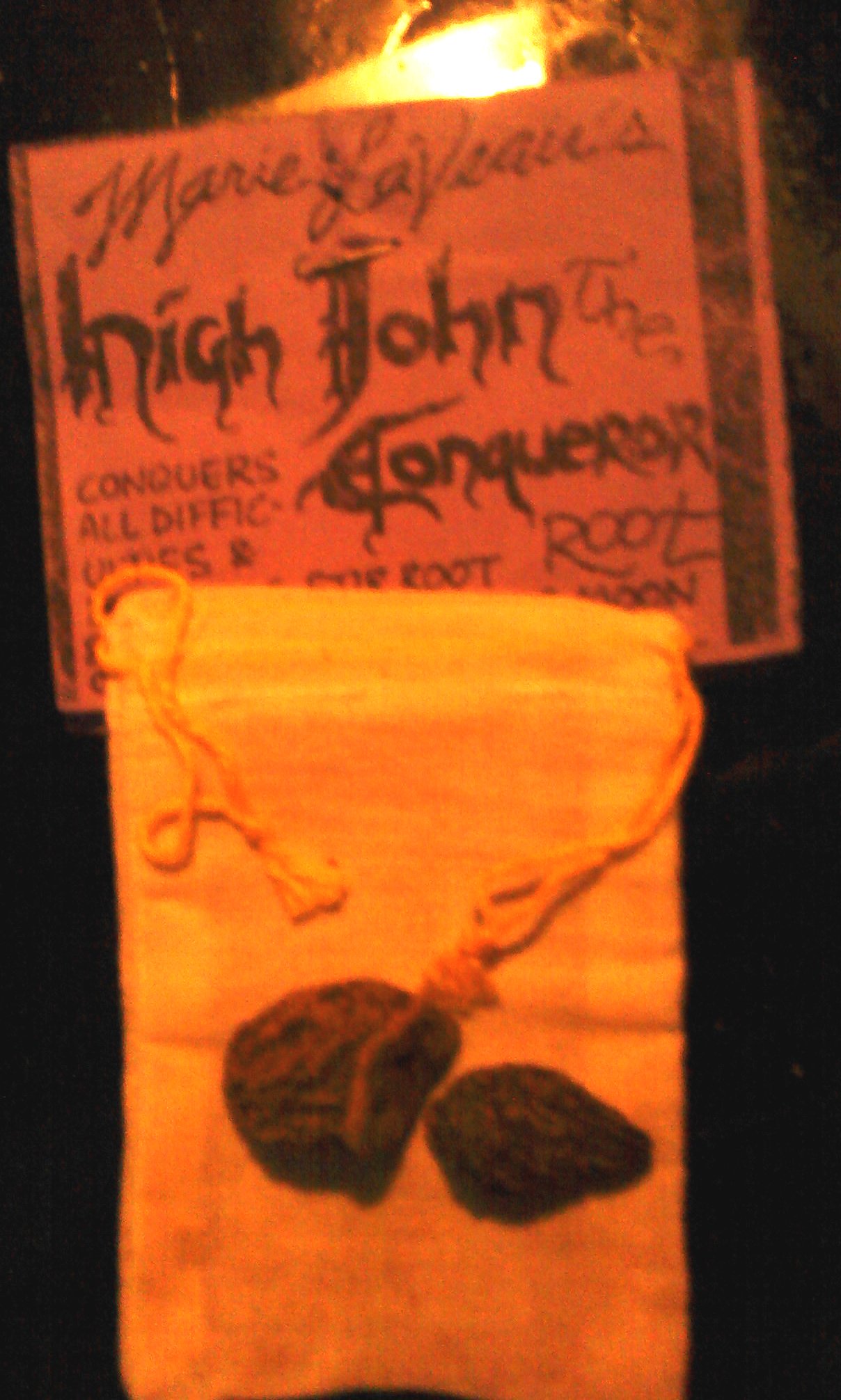
This shriveled root is part of the Ipomoea genus, and is a relative of the Morning Glory.  Its resemblance to a shrunken testicle has made it a powerful symbol of potency and virility.   I consider it to be one of the quintessential hoodoo herbs (which is the reason I included it in my “hoodoo kit” post).  Catherine Yronwode says of the root in her Hoodoo Herb and Root Magic book, “ A person possessing a John the Conqueror Root will never be long without money or a lover and will be extremely lucky in games of chance and business” (HHRM p. 111).

Some of the most common ways to use this root are to put it into a jar of neutral oil (such as safflower or olive) and let it sit for a few weeks, occasionally shaking the jar.  The resulting oil (which will have little to no smell and to which you should add some vitamin E or tincture of benzoin to prevent rancidity) can be used to anoint anything that needs more power.  Rubbed on your hands and feet, it adds personal power to everything you do.  Rubbed on money kept in your wallet, it helps you be more successful in luck and business endeavors.  Rubbed (very lightly) on the penis, it restores male virility and enhances sexual prowess.

Another key way to use this root is to keep a whole root in your pocket, either by itself or wrapped in a red cloth bag as a mojo hand.  Fed regularly (once a week at least) with whiskey or the High John Oil I just described, it keeps you empowered and potent at all times.  According to the lore, money comes easier, luck favors you, love finds you, and sex is better than ever.

You can also add John the Conqueror (by the way, you say it “John the Con-ker”) chips or oil to other mojo hands to increase their potency as well.  I like to add them to success and business workings, because they tend to work faster and require less finagling on my part after my initial efforts.

The High John root has appeared in pop culture several times, too.  Whenever hoodoo comes up in songs, a mention of this root is seldom far behind.  For example, in the Allman Brothers Band remake of Willie Dixon’s “Hoochie Coochie Man,” radio audiences of the 70’s heard the lyrics:

“Got a John the Conquerer root and got some mojo too,
We got a black cat bone, we’re gonna slip it to you.”

Considering the libertine behavior the singer boasts of elsewhere in the song, having a little magic keeping his virility charged certainly seems like a good idea (I’ll address the black cat bone reference in another post).  Muddy Waters (who worked with Willie Dixon quite a lot) also recorded a blues song featuring the hoodoo charm, entitled (appropriately) “My John the Conqueror Root.”

There are lots of places to find this root on the web, and if you have a local botanica of some kind, they will also likely carry this curio.  I highly recommend anyone looking into American magic familiarize him/herself with High John.  Who couldn’t use a magical boost from such a potent little root?

Thanks for reading!

-Cory

Podcast 6 – Hoodoo and an Interview with Conjure-man Papa Toad Bone

-SHOWNOTES FOR EPISODE 6-

Summary
In this episode, we discuss hoodoo and rootwork, particularly our experiences with it.  Then we have an interview with esteemed conjurer Papa Toad Bone.

Play:

Download:  New World Witchery – Episode 6

-Sources-

Websites
Lucky Mojo Co. – A site with lots of hoodoo information
Toad’s Bone Apotheca – Our guest’s marvelously funky and fantastic online curio shop
Mississippi Cunning + Conjure – A forum space for those interested in Southern magic and Traditional sorcery
Scarespite – A repository of Traditional Witchcraft and Sorcerous folklore

Promos & Music

Title music:  “Homebound,” by Jag, from Cypress Grove Blues.  From Magnatune.
Promo 1-Inciting a Riot Podcast
Promo 2- Druidcast
Promo 3- Podcast Appalachia

Blog Post 33 – A Hoodoo Starter Kit (Intro, Part V)

For my final post this week, I’m putting up my idea of what a beginning rootworker might want to have on hand.  Think of it as a sort of “first aid kit” for getting your hands dirty in hoodoo.  This is only my opinion, by the way, so your mileage may vary according to different conjure practices.  If you have any questions, please feel free to email me or to add a comment to this blog page and I’ll do my best to answer them.  Now, onto the kit!

Candles – I keep lots of these on hand, in several different sizes.  They’re good for doing most types of simple jobs where all that’s required is a quick dressing and a little time to burn them.  You can use color correspondences, if you like, but I find plain white (or beeswax candles with a  golden tint to them) work just fine for me.

Candlesticks/Holders (at least two) – I say at least two because you never know when you’ll need to burn for two things at the same time (say a separation working and then a protection one to help a woman in a bad relationship get out safely and stay safe).  There are some candle burnings, too, where progressively moving the candles closer together or further apart is part of the job being done.

High John root(s) and/or oil – This is the quintessential hoodoo root.  It’s small, brown, and not very impressive to look at, but man it packs a punch.  Anything that needs extra potency can benefit from High John.  There are plenty of folks who simply carry one in their pocket, feeding it regularly with whiskey or oil, to help them always be performing at their best, whatever they do.

Small assortment of condition oils – If I’m being really 100% honest, you don’t need these the way you might need other things on this list.  And you can certainly make your own versions of them rather than buying them from a store.  I like to have some of the basics on hand (especially Van Van and Fiery Wall) because it’s easy to dress a candle with them and do a quick burning, or to dress a mojo bag with them quickly.

Uncrossing – This one’s great for removing hexes and jinxes.
Attraction – Can draw love, money, luck, and other positive things into your life.
Van Van – This oil is a general use oil, good at removing obstacles, increasing luck, finding love, and many other things.
Compelling/Commanding – If you intend to do this kind of work, these are good to have. Compelling makes your target do what they say they will do, and Commanding makes them do what you want.
Blessing – This one is important for cleansing and blessing homes, marriages, children, etc.
Fiery Wall of Protection – A vital oil if you want really good protection for a person or place.

Whiskey (or other alcohol) – When you feed your mojos or other work, the typical offering is whiskey.  It’s also a good offering for working with ancestors and spirits (though some Native American spirits do NOT like it, apparently).  Some who do not use alcohol in their magic will use oils or holy water instead.

Salt – Good for setting protective barriers, for use in spiritual baths (especially to remove harmful influences), and adding to certain jobs where you are trying to neutralize someone else’s work.

Pepper (black and red) – Both are used to make things “hot” for a target, and also in the Hot Foot jobs a rootworker may be called upon to do.  They can be used in other work, as well, particularly if you’re trying to make things “fiery” for any reason (protection, sex, etc.).

Four Theives Vinegar – This is a centuries-old formula and there’s no need to buy it.  Just take good quality cider vinegar (or wine vinegar if you prefer) and add black and red pepper, garlic, and mustard seeds, then let it sit in a dark place, shaking it daily.  After about two weeks, voila!, Four Thieves Vinegar.  There are variations on the recipe (I use rue in mine), so find one that works for you.  It’s good for protection and hexing jobs, and it tastes delicious on a salad!

Honey/Molasses/Sugar/etc. – This is for any kind of sweetening work you do.  You can also add it to certain spiritual baths to help make things sweeter for you in general.  Choose a sweetener that is regionally appropriate—molasses is good in the South, while in Vermont maple syrup would be good.

Red cloth squares – For making mojo hands.  This doesn’t have to be anything fancy.  Flannel and linen are fairly traditional, but whatever is available in your local fabric store’s remnant bin will probably be just fine.  Or cut up an old red t-shirt.  In a pinch, white cloth can be used for most jobs, too.

Bottles/jars – Keep these on hand for doing Honey Jars or Vinegar Jars, as well as making protective bottle spells (like Witch Bottles) or even just as a back-up candle holder.  I save old baby food jars for this kind of work.  If you have a Sharpie, you can even draw or write on the glass, if you feel so inclined.

Envelopes/plastic baggies/etc. – For collecting ingredients or gathering spent spell materials for proper deployment (at a crossroads, in running water, etc.).  I will also confess I usually keep little paper envelopes on hand so that if I’m visiting someone that will be a target for a job and I use their bathroom…well, let’s just say most people leave things like hairbrushes pretty much out in the open…

Bible or other holy book – I’m not saying you have to thump it, sell it, buy it, preach it, or even believe in all of it, but the precedent for using Scripture in hoodoo is long-standing.  I’m not Christian but I use the Psalms in my work fairly often.  If you have a vehement dislike of Christian religion, and the Bible in particular, find another holy book that does work for you, such as the Koran, the Bhagavad Gita, or the poems of Rumi.  My only admonition here is that if the book isn’t spiritual in nature, I would avoid using it in rootwork.  There seems to be something very profoundly sacred about the relationship between a holy book and a magic spell, something that the spirits on the other side respond to.  That’s just my opinion, of course, so if you don’t believe me, I can live with that.

So that’s it for this week’s Introduction to Hoodoo!  I hope you’ve been enjoying this series.  We’ll be doing plenty more with rootwork in the future, including having a guest on our next podcast  who is a professional rootworker!   That episode should be out next week, and hopefully we’ll have a couple of other neat treats for you then, too.
Thanks for reading!

-Cory