Blog Post 154 – Buckeyes

I imagine that I’ll get a sharp increase in visitors from Ohio with this article. Today’s featured botanical is the buckeye, which is both the name of the tree and the fruit (or nut) of that tree. It grows in a wide variety of locations, including all over Europe and North America, and is also frequently referred to as a “horse chestnut” (which is actually a very specific species within the bigger buckeye family). Since you can find a great deal of botanical information on the tree elsewhere (like at the USDA Plants database), I’ll narrow my focus here to the folklore and magical uses of the nut.

T.F. Thiselton-Dyer, author of the botanical mythography classic The Folk-lore of Plants, makes the following observations about the horse-chestnut:

“A Worcestershire name for a horse-chestnut is the ‘oblionker tree.’ According to a correspondent of Notes and Queries (5th Ser. x. 177), in the autumn, when the chestnuts are falling from their trunks, boys thread them on string and play a ‘cob-nut’ game with them. When the striker is taking aim, and preparing for a shot at his adversary’s nut, he says:—

‘Oblionker!

My first conker (conquer).’

The word oblionker apparently being a meaningless invention to rhyme with the word conquer, which has by degrees become applied to the fruit itself.” (CH XVIII)

Already I love this plant, don’t you? Essentially they seem to be used as marbles in children’s games (give them one point for that), and they also have a nice phonetic connection to the powerful hoodoo charm, John the Conqueror root, which is frequently called John de Conker (and that’s another point to the buckeye!). They actually look llike smoother versions of High John roots in some ways, so it doesn’t surprise me to find that they sometimes get substituted in for their powerful underground counterpart:

“Buckeye nuts are believed by some hoodoo “doctors” to increase a man’s sexual power. Shaped like miniature testicles, they are sometimes carried in the pants pockets as charms to bring men “good fortune in sexual matters.” In the southern and eastern regions of the United States, buckeyes are carried in mojo bags to cure or prevent such ailments as arthritis, rheumatism, and migraine headaches” (Gerina Dunwich, Herbal Magic, 86).

Cat Yronwode similarly cites buckeyes as charms for increasing male potency. Both Yronwode and Dunwitch, however, make it clear that a buckeye’s primary powers are to aid as a gambling charm and to help stave off aches and pains—particularly rheumatism and headaches. This view is heavily supported by a number of folklore sources:

From Newbell Niles Puckett, Folk Beliefs of the Southern Negro

  • Where the left hind foot of a graveyard rabbit, a buckeye, a horse chestnut, and a luck bone from a pig ham are put together for good luck [A charm for good luck] (316)
  • A buckeye carried in the pocket will surely bring one good luck (314)
  • A buckeye carried in the left pocket is generally supposed to work a cure for rheumatism as well as for piles, a belief apparently English (360)
  • Red pepper rubbed up and down the back ‘warms up de system,’ as does also a new domestic sack half full of salt into which nine grains of red pepper and four buckeyes have been put. Wear this around your waist and you will never again be bothered with chills (366)
  • In Mississippi and Alabama it is believed that if one carries buckeyes in the pocket he will have no chills through the year (366)

From Harry M. Hyatt, Folklore of Adams Co., Illinois

  • 1328. “My brother always carries a buckeye in his pocket to get money.” (28)
  • 1329. “I always carry three buckeyes in my pocket to always have money. My grandfather did this through the Civil War, my mother did this, and I am carrying three buckeyes too.” (28)
  • 4534. The person who carries a buckeye in the pocket never becomes sick. (99)
  • 4688. The person who carries a buckeye in the pocket never suffers from backache. (103)
  • 5233. A buckeye carried in your pocket or the band of your hat prevents headache. (118)
  • 5588. As a treatment for piles, a buckeye is worn: in the pocket (usually the left), or one in each pocket, or one pinned to the underclothes, or one round the neck, or one rolled in the top of each stocking. (126)
  • 5684. One buckeye is worn in one of several places as a rheumatism remedy: about the neck, on the breast, in a pocket (especially a hip pocket), round the waist, and under the bend of the knee.  Sometimes, they say buckeyes are ineffective for rheumatism, unless you begin by using an unripe one. Moreover, it is occasionally said, to lose this nut in the process of curing yourself brings bad luck. And finally, because a buckeye is also called a horse chestnut, the real chestnut is worn as a substitute, but this seems to be rare. (129)
  • 5685. Buckeyes used for curing rheumatism should always be carried in pairs. This also makes you lucky at the same time. (129)
  • 5686. “If you carry three buckeyes in a sack so they will be on your skin, good for rheumatism; if the buckeyes dry all up when wearing, then they are doing you good; but if they don’t dry all up, they are doing you no good.” (129)
  • 11073. It is lucky to keep a buckeye in your purse, on your person, or in your house. (262)
  • 13443. Keep a buckeye in your pocket while playing baseball and you will have good luck. (310)
  • 13984. You obtain good luck for a card game, if a buckeye is worn in your right pocket. (319)

From Daniel & Lucy Thomas, Kentucky Superstitions:

  • 1224 – One subject to a headache may prevent it by carrying a buckeye in his pocket (105)
  • 1288 – Carry a horse chestnut [another name for a buckeye] in the pocket, to avert piles (110)
  • 1299 – To avert rheumatism, carry a horse-chestnut in the pocket (111)
  • 2887 – You will have good luck if you carry a horse-chestnut (219)

Kentucky Superstitions also has this rather fantastic bit of lore about the good ole horse-chestnut:

  • 2889 – If one eats a buckeye, his head will turn around (219)

Vance Randolph devotes a sizeable amount of space to the folklore of buckeyes among the hillfolk of the Ozarks, also pointing out their strong associations with healing and protection from painful diseases. He relates an excellent story about just how deeply ingrained the belief in buckeye powers was in the mountains:

There is an old saying that no man was ever found dead with a buckeye in his pocket, but this is not to be taken seriously. Most people who carry buckeyes regard them as a protection against rheumatism, or hemorrhoids. One of the most successful physicians in southwest Missouri always carries a buckeye ; when it was mislaid once he was very much disturbed and let an officeful of patients wait until his pocket piece was recovered. It is very bad luck to lose a buckeye. I asked this doctor about it once. “No, I’m not superstitious,” he said grinning, “I just don’t want to get the rheumatism!” (Ozark Magic & Folklore, 153)

There is some excellent lore about the buckeye and just why it became the namesake for Ohio from the Ohio Department of Natural Resources website. They mention the lucky association, likening it to a four-leaf clover or rabbit’s foot, and links the state nickname to William Henry Harrison or alternatively to Col. Ebenezer Sproat (a simply fantastic name), both Ohioans of historic and heroic stature.

Probably my favorite bit of folklore concerning the lovely horse-chestnut comes from an online forum I found while researching this topic. You can read the full thread here, but I simply cannot fail to mention this fantastic tidbit:

There is a belief by some that only half the buckeye is poisonous, and that only squirrels know which half that might be in a particular nut. Squirrels do sometimes eat a part of the nut.

There you have it: squirrels are smarter than we are. But I’ve known that for a while (at least in my case it’s true).

At any rate, the buckeye can be carried as a lucky charm or worked into other magical preparations, and it has a huge body of lore associated with it. So much, in fact, that I’ve barely (prepare for pun) cracked the shell here. If you know of great buckeye lore and magic, I’d love to hear about it! Or if you just want to pelt me with horse-chestnuts for making bad puns, I’ll be here all day.

Thanks for reading!

-Cory

Blog Post 145 – Wart Charming

The image of the fairy-tale witch often comes complete with a big, nasty wart perched at the end of her nose. The association of witches with warts could come from a variety of folk beliefs and superstitions: the close ties between warty toads and witches, the idea of a ‘devil’s mark’ which the witch uses to suckle her familiar, or even just a desire to make a something ugly out of something ‘evil.’ The association is not always a purely negative one, however. Folk magicians in the New World (as well as those in the old, though I’ll not be addressing them here) have a long-standing history of curing warts through magical means. In fact, that is frequently one of the most commonly found magical services provided by a community magician (or faith-healer, traiteur, pow-wow, etc.).

Today I thought it would be good to look at a few different methods, stories, and charms associated with wart-removal in American folk magic. I’d like to start in Pennsyvlania-Dutch country, with some of the wart charms found in Chris Bilardi’s The Red Church:

WARTS, CORNS (GEWECKS, GEWEX, WARZ)

[Do whole body Brauche treatment to eliminate any root causes of warts. Bilardi then gives an extensive treatment involving the mimicking of cutting the wart off using an imaginary knife, a process I will refrain from detailing here as it is somewhat lengthy and I’d rather encourage you to buy his book by leaving a little mystery to it…]

To remove warts using the moon: instruct the patient to go somewhere s/he can observe the moon. This is one of the very few wart charms that utilize the waxing moon. Once the moon in in sight, the afflicted wil say:

‘Was ich raib, nem ab; was ich sen, nem tsu.’
English, ‘What I rub, decrease; what I see, increase.’

The Brauche is done three nights in a row. This is begun two nights prior to the moon being full (251).

In the braucherei tradition, then, there is a sense that warts have a spiritual side, hence the full-body treatment before the specific attempt to cure the wart and the influence of lunar cycles on wart growth or removal. Yet they are also a practical matter, dealt with by simple folk magic and a relatively unassuming charm. Other methods listed in The Red Church:

  • Rubbing warts with cloths that have touched a dead body
  • Scratching a wart with a coffin nail
  • Rubbing the wart with a freshly killed eel or rooster, then burying the body part under the eaves of one’s house
  • Rubbing the wart with pebbles which are then thrown into a grave
  • Using a red string with as many knots as there are warts, rubbing each wart with a knot, then burying the string under the house’s eaves (252-3):

Moving down into the Appalachians, there are a number of variant methods for dealing with warts that parallel—if they don’t exactly duplicate—the methods described by Bilardi. In the hills of West Vriginia, we find these wart cures from Patrick W. Gainer’s Witches, Ghosts, & Signs:

  • To cure warts, wash your hands in stump water.
  • A ninth son can remove warts.
  • Drop dirt from a newly-made grave on a wart and the wart will disappear.
  • To cure warts, pick them with a pin and bury the pin.
  • To cure warts, take a hair from the tail of a gray horse and wind the hair around the warts.
  • To cure warts, steal a dishrag and rub it on the warts, then bury the dishrag. When it rots, the wart will disappear.
  • To cure warts, cut as many notches in a stick as there are warts, throw the stick in a swamp, then bury the dishrag.
  • To cure warts, rub a rock ovr the warts, wrap it in a neat package and throw it away. Whoever finds the package will get the warts.

Already we can see some patterns developing in wart cures. There are essentially three methods which appear over and over again: 1) Rubbing the wart with something and burying it to decay the wart, 2) Scratching or pricking the wart and disposing of either the scratching implement or something marked with blood from the wart, and 3) Passing the warts to someone else in a variant of magical commerce. There are exceptions or variations in each of these, of course. The corpse-touching method might be seen as a way of passing the wart to the corpse, but it may also be seen as symbolically burying it. The stump water method doesn’t fit neatly into any of these categories. And the notion of a ninth son removing warts is strange, as it does not indicate exactly how they are able to do this (I mentioned in the post on Coins that my brother-in-law’s grandfather could charm warts using pennies because he was the seventh son of a seventh son, but that may be more specific to our region).  From these three methods, most other treatments become variants, though exceptions do still occur.

Exchanging the Appalachians for the Ozarks, we find more variants of this type, and a few new tricks. From Vance Randolph’s Ozark Magic & Folklore:

  • He mentions the notched stick method referenced above, but also adds “bury the stick on the north side of the cabin and never mention it to a living soul”
  • Suggests using an onion for a wart cure: cut the onion in half, rub the wart with one half and bury it, then eat the other half. When the onion rots, the wart disappears.
  • Spitting on a hot stovelid, once for each wart, gets rid of them
  • Letting a grasshopper or katydid bite a wart will make it go away
  • Touching a wart with the hand of a corpse will remove them

Here again we have the burial method, the pricking/bleeding method (with the grasshoppers), and the transference method (with the corpse). But we also have the novel stove-top method, which is interesting to me because of the mixture of sympathetic and contagious magic it contains: the spittle on the hot stove looks like a wart sizzling away into nothingness (sympathetic) and it is the spit of the person with the wart which is evaporated (a sort of inverted contagious magic).  Randolph also includes an interesting charm associated with the corpse method:

At the funeral of a close friend, a ‘warty feller’ is supposed to touch his warts and repeat the following jingle:

They are ringing the funeral bell,
What I now grasp will soon be well,
What ill I have do take away
Like jn the grave does lay.

This is believed to benefit tumors, sores, boils, and even cancers as well as warts. (131)

In my Apples post, I cited some Kentucky lore about using that fruit to do the rubbing-and-burial method. A reader mentioned that they had heard something similar to that technique, only using potatoes (which I’ve also heard as well, especially in relation to Irish folk magic or some Appalachian charms). The book I cited, Kentucky Superstitions, mentions the potato method, and also has these interesting variants on wart charming:

  • There are a number of ‘burying’ charms, involving the interment of things like beans, steak, bacon, peach tree leaves, potatoes, walnuts, etc.
  • ‘Picking’ cures are also popular, in which a wart is bled by puncturing it with a brass pin, corn kernels, needles, etc.
  • A variety of substances, including cat’s blood, coffee grounds, dandelion juice, eggs, fish, goose feathers, chicken gizzards, etc. are also rubbed on warts to remove them
  • One of the most popular and common cures involves bleeding the wart, dabbing the blood on corn kernels, then feeding those to chickens—especially a neighbor’s hens—to remove the offending blemish
  • Lemon juice or milkweed are supposed to be good cures for warts
  • Warts can be charmed off by some people with a gift for doing so; some are able to ‘count’ warts off, others can pray them off, and still others ‘buy’ the warts off of someone
  • Warts can be magically passed to another person by leaving them at a crossroads; simply leave a paper spotted with blood from the wart in the middle of the crossing, and walk away without looking back; whoever picks up the paper picks up the warts
  • The stick-notch method or knotted cord method are two popular remedies for warts in which the number of warts is counted by notching a stick or tying a cord, then the burying it or dropping it into running water (121-30)

The corn method is something I found in several places, including Harry M. Hyatt’s Folklore of Adams County. In many cases, the corn must be fed to a neighbor’s chicken, which makes me think it is another technique for passing the warts to someone else, just in a very roundabout way. Hyatt also mentions many of these cures in his books, and offers an interesting addition to the bark-notch method of curing: “I know this works, for my daughter had a wart. She tried several things, and this took her wart away: walk up to a young apple tree — if you have a wart — walk around to the opposite side and cut two notches in the bark, then rub your wart over the two notches, then walk back the same way you came; when the bark grows over the cut places, your wart will be gone” (146).

As always, there’s much more to say on the subject of charming warts, but hopefully this gives a nice broad look at the subject. I need to be very clear, of course, that none of the charms, lore, techniques, or superstitions here are presented as medical advice—a good doctor can freeze a wart off without making you go through the trouble of finding an eel to kill or figuring out which of your neighbors might have some hungry chickens around. But for those interested, wart charming seems to be a simple way to get into traditional folk magic, and who knows, you might just have a knack for it. At the very least, hopefully the warts on that old witch’s nose in the storybook won’t seem so scary anymore.

Thanks for reading!

-Cory

Blog Post 141 – Witch Hazel

Today’s entry is not about the crazed cartoon sorceress from Warner Bros. cartoons (voiced by the inimitable June Foray), but instead we’ll be looking at the remarkable fall-blooming witch hazel tree. Really, the Hamamelis virginiana is not exactly a tree, but a woody shrub which can be found growing near water sources or in forest undergrowth throughout the Eastern United States (as well as in parts of Europe). It bears gorgeous yellow flowers in fall which look almost like a deep yellow honeysuckle bloom or a spidery golden star. It has a number of medical applications (you can usually find an astringent extract of the same name in your pharmacy), and has been used as a tea, poultice, extract, and tincture to treat bleeding wounds for a long time, according to botanical.com.  The handy little book Folk Medicine in Southern Appalachia names witch hazel as a topical treatment for hemorrhoids and sunburn, and mentions it as an infusion for treating menstrual discomfort.

But you’re probably not here for the medical qualities of the plant (although I should quickly make my regular disclaimer that nothing herein contained is intended as medical/legal advice and you should see professional guidance when using any herb, plant, or botanical). So let’s look at the folklore surrounding this plant.

The name is a good jumping-off point. Wikipedia (forgive me, please) indicates that the appellation of “witch” to this plant is related to an Old English word meaning “bendable” or “pliant,” due to witch hazel’s extremely flexible branches. It also tangentially relates it to its folkloric use as a dowsing tool. Since being able to dowse for water or other hidden substances is often referred to as “witching” for such things, connecting the tree name to its application makes some sense. Essentially this could be a chicken-and-egg argument about which idea came first, so I’ll just leave the question hovering in the ether for you to contemplate.

Since we’re mentioning witch hazel’s connection to dowsing, let’s look at one method of using it in this way, from Vance Randolph’s Ozark Magic & Folklore:

“Well, I just cut me a green fork off a peach tree some fellows use witch hazel or redbud, but peach  always works better for me and take one prong in each hand. Then I walk slowly back and forth, holding the fork in front of me, parallel with the ground. When I cross an underground stream the witch stick turns in my hands, so that the main stem points down toward the water. Then I drive a stake in the ground to mark the place, and that’s where I tell ’em to dig their well” (p.83)

In this example, the informant shows a preference to peach branches over witch hazel (which I found in several other sources as well, particularly those focused on the American Southeast). Another informant of Randolph’s, one Mr. A.M. Haswell of Joplin, Missouri, espouses a staunch preference for witch hazel. Regardless of the tree, the technique remains the same. This account does not mention the holding method, which usually involves a palms-up grip, with the thumbs pointing out and away from the body. The stick ‘turning’ is a violent bobbing action, and truly accomplished dowsers can count the bobs to indicate approximately how deep the well is (thirty bobs equals thirty feet, for example).

Witch hazel can be used for other magical applications, too. A technique which seems—to me, anyway—related to its pharmaceutical properties involves using hazel branches to cure warts, scars, or blemishes. The patient takes a hazel stick, cuts three notches into it, applies some blood from the afflicted body part, and casts it into running water (Folklore of Adams County, Hyatt). One version of this method recorded in Folk Medicine by William Black involves writing one’s name on the branch and filling those grooves with blood.

The plant can also be used in protection magic. Randolph mentions that Ozark hillfolk would tie hazel twigs into little crosses and hung on their walls to guard against disease, especially in barns to safeguard the animals (p.284). This is somewhat like the rowan tree charm, which involves crosses of rowan twigs bound by red thread used as protective aids.

So as you are out on your autumn evening walks, keep an eye out for this gorgeous and rather useful magical plant.  Try your hand at dowsing, or just make some healing or protective charms. But make friends with the poor, sweet witch hazel. She gets awfully lonely, and we don’t want her out hunting wabbits, do we?


Thanks for reading!

-Cory

Blog Post 140 – Pins and Needles

Really, this entry should be called “pins & needles & spikes & nails & all other kinds of spiky things,” but that would have been an overly long title, so I’m standing by my choice. What I’ll be looking at today are folkloric occurrences of piercing devices as magical tools. This will probably overlap a bit with my entry on iron, but I’ll attempt to cover more new ground than old.

Probably one of the first things to come to mind when looking at sharp-and-pointy things is the popular “voodoo doll,” which is essentially a European-style poppet. These poppets are stuffed with botanicals, curious, dirt, rags, and/or personal items from the intended target and then manipulated to control him or her. Films and television frequently portray only harmful magic being done through these dolls, but a witch or conjurer can also use them to cast love spells, healing spells, or even health and wellness spells. I’ll probably try to do a separate entry on doll magic another time, but it’s worth a mention here, too, I think.

There are some African roots to the voodoo doll phenomenon,  including the minkisi minkondi, which were little wooden dolls from Kongo where spirits were thought to live. The doll’s owner would drive a spike into it to “provoke the forces within them” and then the owners would be able to command the spirit to perform certain tasks (Chireau, Black Magic: Religion & the African American Conjuring Tradition). Other cultures have certainly used small effigies of human beings to cause hurt or help, as well. Denise Alvarado has a book which examines these dolls in detail, including a look at corn dollies, fetishes, Greek kolossoi, and other similar magical poppets.

Of course pins and other sharp objects can be used to cause magical harm even without the use of a doll (which makes sense according to the Doctrine of Signatures, which has tremendous influence on much folk magic). Zora Neale Hurston recorded a sinister curse which involved taking nine new pins and nine new needles and boiling them in a nefarious formula called “Damnation Water” in order to cross one’s enemy (Hurston, Hoodoo in America). An old-world carry-over (likely from England, but found in Southern communities where conjure is common) says that burying a pin taken from the clothes of a living person with a dead person will cause the target to die within a year (William G. Black, Folk Medicine).

Probably the most One of the more gruesome application of pin-and-needle magic had little to  do with the magical effects of these tools, and all too much to do with their physical dangers: “One instance is given [in an account from 1895] of ‘toad heads, scorpion heads, hair, nine pins and needles baked in a cake and given to a child who became deathly sick’” (“Conjuring and Conjure-Doctors in the Southern United States,” Journal of American Folklore, p. 143). Curing magical maladies often involved finding pins used in spellwork and disposing of them in a ritual way: “He went at once to the hearth, took up a brick, and found sticking in a cloth six pins and needles. He took them up, put salt on them, and threw them in the river. The needles and pins were said to be the cause of so many pains”( “Conjuring…”, JAF, p.145).

A number of ‘Shut-up’ spells—tricks that involve tying the tongue of a gossip or potential witness against you in court—involve taking a slit tongue from an animal like a cow or sheep, packing it with hot peppers, vinegar, and/or salt along with the name paper of the target, and pinning it up with a number of pins and needles (usually nine, but not infrequently more).

Not all piercing spells used metal points. An account of Clara Walker, a former slave from Arkansas, describes her getting help from a rootworker who made a mud effigy of her master and ran a thron through the back of it, causing severe back pain in him (Chireau, Black Magic…)

Pins and needles needn’t be solely used in malicious work, however. A healing spell from England resembles wart charms in Appalachia and some of the rootworker cures from Hyatt’s Folklore of Adams County, requiring pins that have been used to poke or pierce a wart to be sealed in a bottle and buried in a newly-dug grave (Black, Folk Medicine).  An account of a mojo bag from the days of slavery tells of “a leather bag containing ‘roots, nuts, pins and some other things,’ which was given to [the slave] by an old man” (Chireau, Black Magic…). The purpose of this bag was to prevent whippings on the plantation where the slave toiled, which could be quite severe.

Pins are also frequently used in witch-bottle spells, which cover a number of different magical traditions, including this version from hoodoo: “Bottles of pungent liquids, pins, and needles were interred by practitioners or strung on trees as a snare for invisible forces” (Chireau, Black Magic…). It would be an egregious error of me not to at least mention coffin nails, too, which are frequently applied in hoodoo and conjure preparations. Usually these are used to inscribe candles with signs, figures, names, etc., but they can also be included in things like war water mixtures or mojo bags to cause hurt and violence. Interestingly, they can be used for protection and health, too. Binding two or four nails into a cross with a little wire or red thread creates a powerful anti-evil charm. Vance Randolph recorded that “nails taken from a gallows [not the same as coffin nails, but rather similar] are supposed to protect a man against venereal disease and death by violence” (OM&F). He also describes these nails being turned into rings by blacksmiths to be worn as protective amulets.

Another hoodoo application involves the use of a series of nails of increasing size, starting with little ‘brad’ nails and getting progressively bigger until you use railroad spikes at the end. The spell is often referred to as “nailing down the house” and requires a practitioner to start by putting the small brads into the corner of each room, and nailing them down, while speaking magic words about protection, prosperity, and stability. Then the conjurer takes bigger nails and nails down the four corners of the house, again praying the magic words. This pattern continues until the conjurer reaches the four corners of the property and nails down iron railroad spikes into the dirt, thus sealing the home from harm and ensuring that the owner will remain in the home and not be evicted. I’ve heard one rootworker say that adding a little urine to each of the nails helps with this work, too, as a way of “marking one’s territory.”

Sewing needles or hairpins can also be used in love spells, as in these from Adams County, Illinois:

  • 9641. The significance of a bending needle is a hug for the sewer.
  • 9650. If a girl tries on a dress pinned for a fitting, each pin catching in her petticoat or slip will represent a kiss before the day is over.
  • 9654. Before going to bed on January 21, a girl may tear off a row of pins (from a new package according to some) , say Let me see my future husband tonight as she pulls out each pin, and then stick them in the sleeve of her nightgown; that night he will be seen in her dream.
  • 9655. If a pin found on the floor or street is picked up and stuck in your coat, you will have a date before the week ends.
  • 9656. The girl who finds and picks up a pin pointing toward her will see her beau that day.
  • 9657. A girl finding and picking up a pin will be dated that night; the man will come from the direction towards which the pin points.
  • 9666. For luck in love a girl may secretly put one of her hairpins in her beau’s left hip pocket; this is also supposed to hold him.
  • 9669. If while walking along you pick up a large safety pin and name it a man you want to see, he will soon be seen; if a small safety pin and
  • name it a girl, she will soon be seen.

The binding power of pins in love spells makes a good bit of sense, and seems deeply entrenched in popular culture; think of high-schoolers being “pinned” (an antiquated notion, I know) or of the description of Cupid shooting arrows or darts to cause romantic feelings in his victim…er..targets. Amorous magic incorporating prickly things is not all lettermen jackets and floating nekkid babies, however. A somewhat heavier love spell from Zora Neale Hurston prevents a lover from straying:

Use six red candles. Stick sixty pins in each candle – thirty on each side. Write the name of the person to be brought back three times on a small square of paper and stick it underneath the candle. Burn one of these prepared candles each night for six nights. Make six slips of paper and write the name of the wanderer once on each slip. Then put a pin in the paper on all four sides of the name. Each morning take the sixty pins left from the burning of the candle. Then smoke the slip of paper with the four pins in it in incense smoke and bury it with the pins under your door step. The piece of paper with the name written on it three times (upon which each candle stands while burning) must be kept each day until the last candle is burned. Then bury it in the same hole with the rest. When you are sticking the pins in the candles, keep repeating:

‘Tumba Walla, Bumba Walla, bring (name of person desired) back to me.’ (Hurston, Hoodoo in America)

There are several agricultural spells which involve driving iron nails or spikes into trees to prevent fruit from dropping off of it (see Randolph, Hyatt, etc.). There’s a lovely bit of distinctly American folklore that says two iron nails driven into your bat will make you a better batter (in the game of baseball, that is).

Finally, I wanted to share an adorably sweet childhood rhyme does not use actual pins, but merely the words as part of a wishing spell performed when two people accidentally speak the same words at the same time. From Hyatt’s Folklore of Adams Co.:

8643. After two persons speak the same thing at the same time, the little finger of the one is held crooked about the little finger of the other and these words spoken alternately:
‘Needles, Pins,
Triplets, Twins,
When a man marries,
His troubles begin,
What goes up the chimney,
Smoke, Knives,
Forks, Longfellow,
Shortfellow.’
They then make a wish and together say Thumbs.

I know there are dozens more applications of pins-and-pokey-bits magic I am not listing here, but hopefully this gives you some idea of what you can do with a simple sewing needle or a couple of iron nails. Magical tools are everywhere, if you know what you’re looking for, and how to use them. But for now, I’ve waxed on long enough about this topic, so let’s stick a pin in it and call it done.

Thanks for reading!

-Cory

Blog Post 128 – Iron

North American history has a funny relationship with iron.  On the one hand, iron is largely behind the early expansion that allowed Europeans to dominate the continent so completely with weapons, locomotives, and durable goods and architecture.  On the other hand, it has also been a curse used to inflict injury and death on undeserving people and leading others to rip the very soil of the land apart in search of it.  So maybe it’s not so much of a “funny” relationship as it is one fraught with difficulty and complexity.

American folklore, however, has largely good things to say about iron.  It’s a powerful anti-witchcraft charm and can be used to repel things like wicked fairies attempting to replace a baby with a changeling.  It can come in the form of nails, railroad spikes, horseshoes, or even just random flakes falling as refuse from a blacksmith’s anvil.

Today I thought I’d look at a few of the bits of folklore regarding iron.  Before we look at the New World side of things, though, let’s look at iron in a slightly older context: Roman superstition.

“The taboo on iron dates from the beginning of the Iron Age when religious conservatism forbade the use of the strange new material in place of the usual bronze. It has been suggested that the magic significance of iron arose from its susceptibility to magnetism which, as the superstitious Romans often believed, it derived from witchcraft” (from Taboo, Magic, Spirits, by E.E. Burriss)

Here we see that iron is associated with witchcraft and has a somewhat negative reputation.  Even the Romans, though, were not averse to using witchcraft to fight witchcraft, and so iron became a de facto tool for combating wicked witchery, and by extension, any other harmful supernatural force (ghosts, demons, fairies, etc.).

Other cultures picked up the thread (or started their own threads), seeing iron as a powerful magical tool.  African, pan-Celtic, and Northern European cultures all had particular beliefs about iron and its more enchanted properties, so it probably surprises no one that the Old World traditions regarding iron became the standard beliefs in the New World.

So what are those New World beliefs?  Let’s look at some examples from a few different areas:

From the Colonial Period, South Carolina
In the Joshua Gordon “Witchcraft Book,” (also sometimes called a Commonplace Book) dated from 1784, there is an example of the type of charm typically imported to the colonies from places like England and Ireland in which a heated iron is used to scald milk from a bewitched cow in order to undo witchcraft:

“A cow losing milk could be cured if its owners would ‘take a heather belonging to a box Iron, put it in the fire, and make it Red hot [and then] take the milk of the cows thats hurt [and] power [i.e., pour] on the hot iron repeating the names of the blessed trinity’” (from “ Magic, Astrology, and the Early American Religious Heritage, 1600-1760,” by Jon Butler in The American Historical Review).

This method is commonly found in folktales from Appalachia, such as the next entry.

From the late 19th- or early 20th-century, Tennessee (Appalachian foothills)
Again, a hot iron is used to scald milk and thus undo bewitchment:

“Another case of the use of heat, combined with iron and steel, is shown in the following account, also resulting in injury to the witch and her exorcism. Lewis Hopkins, formerly of Big Creek just beyond the park bounds [The Great Smoky Mountains National Park] told this unusual tale:
My grandmother’s folk had a cow and she give bloody milk.  An old lady, a Phillips, was accused of being a witch. So they got to talkin’ to Sam Evans who said he was a witch doctor and knowed about witches. The witch doctor told the folks to put a baker lid [i.e., the lid of a Dutch oven] in the fire. So they pecked it on with a reap hook [like a scythe or sickle]. So this old women Phillips come to this old man Evans and raised a fuss with him about tellin’ him what to do. They got into a fight and this old man pulled her dress up and they saw the pecks where they was a reap hook a-hackin’ at her. [But] she jumped out and got away from him” (from A Tennessee Folklore Sampler, by Ted Olson, et al).

Other cases of heated irons being used to procure magical results also abound, as we shall see momentarily.

From the 19th-century, Mississippi
In some places, iron implements are not so much valued as remnants of iron from a blacksmith’s shop.  Here is one account of “anvil dust” as it relates to Southern conjure practices:

“Anvil dust is also greatly valued as conjure material. One educated blacksmith of Columbus, Miss., tells me that people are constantly coming into his shop to get the black flakes that fall from the hot iron when it is pounded, although they always look ashamed and give a fictitious reason as to why they want it” (from Folk Beliefs of the Southern Negro by Newbell N. Puckett).

This anvil dust is basically iron filings or flakes, and can be found in hoodoo practice as food for magically empowered lodestones.  Or it can be used to help create a cursing formula known as War Water (I’ll hopefully address the creation of this product in a separate post).  Interestingly, these two uses would seem diametrically opposed, with one being the food for an attracting magical fetish, and the other being an ingredient in a banishing potion. I would assert, however, that in these cases the iron serves a similar function on a magical level—with the lodestone it helps broaden the field of attraction for the stone while simultaneously running bad luck away, and in the War Water it’s repelling evil.  So in both cases, there is an element of something being turned away.  That is simply a way for me to reconcile these differences, however, and my come down to rationalization.

From the 19th– or 20th– Century, Ozark Mountains
Old favorite of New World Witchery, Vance Randolph, lists several methods for using iron as a magical tool (I omit the horseshoe lore which I have previously covered in another post, however):

  • “Nails taken from a gallows are supposed to protect a man against venereal disease and death by violence. Country blacksmiths used to secure these nails and hammer them out into finger rings”
  • “A little iron wire worn as a necklace, according to some power doctors, will protect a child from whooping cough”
  • “The water in which a blacksmith cools his irons is supposed to be good for witched cattle and is  sometimes given to human beings also, particularly children” (from Ozark Magic & Folklore, by Vance Randolph)

The last method mentioned is one I found repeated in several sources.  The power and provenance of “anvil water” or “slack water” seems to be well known across several cultures.

From the 20th-century, Illinois
To illustrate my point from the last section, I thought I’d share a bit of folklore from the Midwest, collected by ethnographer Harry M. Hyatt (who famously collected much of the lore about Southern conjure and hoodoo practices):

  • “A piece of old iron hung over the front and back door prevents the spirit of the recent dead from haunting you”
  • “Five nails driven into the trunk prevent the fruit from falling off the tree.  ‘My father did this when fruit was dropping off: drive those old- fashion square iron nails in the tree to hold the fruit on the tree. Never use wire nails; it must be the old iron nails’”
  • “Water from the tub in which a blacksmith cools hot iron is a good wash for the sore udders of a cow”
  • “A broken-winded horse (a horse with heaves) becomes well, if given water in which a blacksmith cools hot iron”
  • “Your looks will be improved if you wash your face frequently with the water in which a blacksmith cools hot iron”
  • “Slack-water, the water in which a blacksmith cools hot iron, is a good wash for poison ivy” (from Folklore of Adams County, by Harry M. Hyatt).

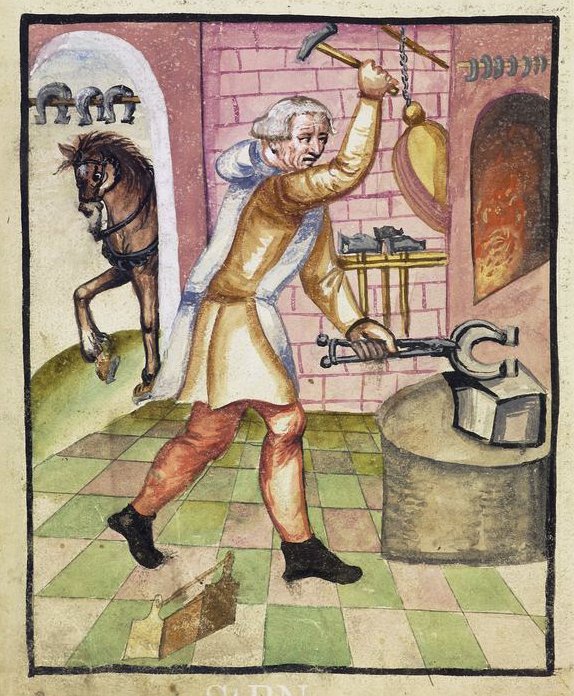
The first two bits are interesting, especially with the death connection, but the last four show that the slack water was considered a sort of cure-all magical formula.  I don’t know about you, but I think I need to make friends with a blacksmith, and quickly!

That’s it for iron, for now at least.  What I’ve written here is only the tip of a very large and ferrous iceberg.  As I said, I didn’t get into the related topic of War Water in the hopes it will appear in another post at a later date.  And I also didn’t touch on the lore of blacksmiths, specifically, as I hope to cover that in some depth later (our next podcast will have a bit about them, in fact).

If you have any local or family lore regarding iron and its magical properties, I would love to hear them!

Thanks for reading,

-Cory

Podcast 29 – An American Shaman

-SHOWNOTES FOR EPISODE 29-

Summary
Today we talk with author and American folk magician/shaman Jack Montgomery.  Then we have some listener feedback and a few announcements.

Play:

Download:  New World Witchery – Episode 29

-Sources-
American Shamans, by Jack Montgomery
Strange Experience: The Autobiography of a Hexenmeister, by Lee Gandee
Fifty Years as a Low Country Witch Doctor, by Sheriff J. E. McTeer
High Sheriff of the Low Country, by Sheriff J. E. McTeer

If you would like to donate to the Japanese relief effort, here is the Peter Dybing page we mentioned in the show.
Please also consider donating to the Red Cross Disaster Relief Fund, which is currently helping victims of the Alabama Tornado.

Promos & Music
Title music:  “Homebound,” by Jag, from Cypress Grove Blues.  From Magnatune.
Promo 1 – Irish & Celtic Music Podcast
Promo 2 – Dr. E’s Conjure Doctor Products
Promo 3 – Magick & Mundane
Promo 4 – Forest Grove Botanica

Blog Post 69 – Charmed Again


Today I’m going to add to Blog Post 67’s charm list and look at a few other simple, word-based spells.  Most of these are rooted in Pow-wow practices, but they are also found throughout other systems as well.  A caveat before I begin, however:  do not take these charms in place of medical advice.  They have their uses and are worth learning, but I am not a medical professional and you should not construe these bits of folk life as prescribed physiological recommendations.  If you get burned or are bleeding badly, seek professional help.

Okay, now on to the charms!

Dealing with Enemies

Overcoming an Enemy (Pow-wow)
This charm to gain advantage over someone who is trying to bully you comes from Hohman’s text, and again I have had little occasion to use it but I rather like the poetry of it:

A CHARM TO GAIN ADVANTAGE OF A MAN OF SUPERIOR STRENGTH.
I [name] breathe upon thee. Three drops of blood I take from thee: the first out of thy heart, the other out of thy liver, and the third out of thy vital powers; and in this I deprive thee of thy strength and manliness.

This particular spell veers very close to a curse, though it also falls into a “self-defense” category, I think.  You don’t, of course, get the three drops of blood from them, though I imagine if you could it would make this spell something much more powerful and possibly much more dangerous.

Healing Charms

Blood-stopping Verse (Pow-wow, Granny Magic, Mountain Magic)
This may be one of the best known mountain charms.  When spoken, this little spell stops a bleeding wound (a non-critical one that is…serious wounds require medical attention!).  There are a few variations on it, and the rules change a bit from person to person, but the words are pretty much the same:

“And when I passed by thee, and saw thee polluted in thine own blood, I said unto thee when thou wast in thy blood, Live; yea, I said unto thee when thou wast in thy blood, Live.”

Those of you who are Bible-savvy probably know this already, but this is simply a passage from Ezekiel 16:6.  It is similar, though not the same as, Psalmic magic (see below).  This charm is mentioned in The Red Church by Chris Bilardi, and has also been featured on Dave Tabler’s excellent Appalachian History blog.  The passage of this charm is typically supposed to be from male-to-female, though it seems there are ways around this restriction (such as “telling” the charm to an inanimate object while someone else in the room is listening).  As to effectiveness, all I can say is that I’ve used it three times and all three times it has worked.

Another Blood-stopping Charm (Pow-wow)
Here’s a different blood-stopping verse from Hohman’s Long Lost Friend:

TO STOP BLEEDING.
I walk through a green forest;
There I find three wells, cool and cold;
The first is called courage, p. 34
The second is called good,
And the third is called stop the blood.

Hohman actually lists about half-a-dozen blood-stopping charms, so I highly recommend looking into his book for more information on the topic.

Stopping Burns (Pow-wow, Mountain Magic)
Here are two charms used to help heal burns and alleviate the pain associated with them (both from Hohman):

HOW TO CURE A BURN.
Three holy men went out walking,
They did bless the heat and the burning;
They blessed that it might not increase;
They blessed that it might quickly cease!

+ + +

(The “+++” means that you make the sign of the cross with your hand over the burn three times)

ANOTHER REMEDY FOR BURNS.
Clear out, brand, but never in; be thou cold or hot, thou must cease to burn. May God guard thy blood and thy flesh, thy marrow and thy bones, and every artery, great or small. They all shall be guarded and protected in the name of God against inflammation and mortification, in the name of God the Father, the Son, and the Holy Ghost. Amen.

I’ve used the first of these charms a couple of times, and noticed a temporary effect.  The pain may not go away entirely but it’s a lot less and the burns didn’t scar, so that might be a good sign.  Or a placebo effect of some kind.  But I leave it up to you to figure it out for yourself.

Psalms (Curanderismo, Pow-wow, Hoodoo, Mountain Magic, most American folk magic systems)

Finally, I thought I’d list a few Psalm fragments which can be written and carried or spoken aloud in times of need.   I personally LOVE Psalmic magic.  You can feel free to use the whole Psalm or just the pertinent portions depending on your spell, but I highly recommend this method of magic.  The Bible, I seem to find more and more, is just loaded with magic, if you know where to look.  And almost no one questions you if you happen to say or write a Bible verse.  Of course, if you have problems with Judeo-Christian religion, this might not be the course for you.  You can find a great list of Psalms and their uses in the Appendix to Chris Bilardi’s The Red Church, the Curious Curandera’s Library Page, and the Lucky Mojo site has a good list, too.

Here’s a sample of Psalms as charms:
Headaches Psalm 3 – “Thou, O LORD, art a shield for me; my glory, and the lifter up of mine head”
Protection & PeacePsalm 22 – “be not thou far from me, O LORD: O my strength, haste thee to help me” (This is the Psalm Jesus sang upon the cross)
Against EnemiesPsalm 35 – “Contend, O GOD, with those that contend with me”
Success & Good FortunePsalm 65 – “Thou crownest the year with thy goodness; and thy paths drop fatness”
Safe TravelsPsalm 121 – “I will lift up mine eyes unto the hills, from whence cometh my help”

The topic of Psalm magic could be a post in itself, or a book even.  Several books, actually.  In fact, there are plenty of wonderful books on this subject, and I recommend tracking them down if you can.

That’s it for today’s charmed life.   If you have any charms to share, please feel free to do so!

Thanks for reading!

-Cory

Blog Post 62 – More Ideas for Urban Witchcraft

Greetings everyone!

Following on yesterday’s topic of urban conjure and rootwork, I thought today it might be fun to take a look at some spells that have roots in traditional American folk magic, but which use certain modern adaptations to accommodate contemporary life.

Courtcase Spell
In the past, courthouses were often wooden-floored buildings outfitted with spittoons for the convenience of trial attendees with a chaw of tobacco in their mouths.  Hoodoo developed a fairly ingenious way to exert some influence over a case by taking advantage of the spitting habit so prevalent in that day and age.  A defendant would keep a gob of Little John to Chew (the root known as galangal now—readily available in Asian markets) in his or her cheek, and then spit the juice onto the courthouse floor while ostensibly aiming for a spittoon nearby.  This sort of contagious magic would then bring favor in the case from anyone who walked on or near the spit.

Nowadays, spitting in court is probably a good way to lose your case.  Most courthouses are kept fairly secure, and tobacco products are seldom allowed in any government building (not that Little John is a tobacco product, but it’s supposed to look like it is, so either way, it’s out).  But there’s still a fairly simple way to work a spell in your favor:

1)      Get some dirt or water from the courthouse area – This can be dirt from a flower bed, from near the back of the building, or even from a potted plant somewhere on the premises if you can manage it.  Or, if the courthouse has a fountain out front, you can collect water from that, or fill a drinking bottle with water from the drinking fountain in the courthouse (or from the bathroom, etc.).  Barring all of these options, you  can scrape the side of the building and try to gather even just a little bit of dust from it, then mix it with soil from the closest source you can find.

2)      Take some Little John to Chew (galangal root) and work up a good bit of spit.  Spit the juice into the dirt or water, while reciting a petition or prayer appropriate to your situation (such as Psalm 35, “Contend, O Lord, with those who contend with me…”).  If you have only a little bit of dirt, you can add the dirt to some water and make a sort of “tea” out of it and the spit.  If you have only a little bit of water, you can dilute it with some more water (add a little whiskey to it to give it a kick).

3)      Take the dirt or water and go back to the courthouse.  Sprinkle your mixture in a circle around the building, as close as you can get (if you have to walk a block, sprinkling a little as you go, that’s fine—just make sure the entire building is encircled).  Whenever the judge who tries your case crosses that line, he will be disposed to favor you.

This trick relies on the same contagious magic as the older trick.  Why not just chew and spit at the front steps to the courthouse, you ask?  Well, you can’t be sure that your judge will come up those steps, and you need him to come into contact with your trick.  Unless he or she lives somewhere in the courthouse, your judge will have to cross the ring you make around the area in order to get inside, and so you should be able to affect him or her that way.

Git-Gone! Spell
Hot Footing someone to get rid of them is an old hoodoo trick.  In the past, it was accomplished by either mixing dirt from someone’s footprint with a special mixture of potent spices called “Hot Foot Powder” (see here, here, and here to buy) or by sprinkling that powder where a target would walk over it.  While it’s still possible to work the latter trick in a modern setting without much trouble, getting someone’s footprint-dirt isn’t easy anymore.  Additionally, the older version of the trick requires deployment in running water or throwing it away on a road heading out of town.

To bring a trick like this into the modern age, however, is not difficult.  City dwellers who can’t pick up dirty foot-tracks can work around that requirement by laying hold of a sock or shoe (or any article of clothing from the target, really).  Once you have something of theirs, you simply mix the Hot Foot Powder and wrap it in their clothing (or in the case of a shoe, give the sole a good sprinkling).

Deploying the trick can be done a couple of ways.  The simplest is to return the clothing to the target and hope they wear it without noticing the powder first (this is best with shoes).  Often, in apartment buildings, this kind of work is fairly easy to do because people will leave wet shoes in the hallway to dry out (much to the chagrin of their neighbors on warm days).

If giving the item of clothing back seems like it would cause raised eyebrows, or just doesn’t strike you as the best method, there are a couple of other distinctly modern deployment techniques that might be worth considering.  Since deployment in running water is a traditional method, consider chucking the Hot Footed sock into a sewer (which contains running water, after all, along with all manner of nastiness to help convince your target the time to leave is now).  Or, instead of finding a road out of town, you could go down to a train yard or a bus station and toss the sock onto a boxcar or bus heading out of the city.  In a lot of ways, a bus station is like a modern-age crossroads with the constant traffic coming and going, so sending someone away via outbound bus is actually a pretty smart way to go about your work.  I’d also suggest the same is true of airports, but sneaking things onto planes is a BAD idea, especially right now.  You’d really be asking for more trouble than a trick like this is worth.  Stick with bus stations and trains.

Send Away Your Troubles
There’s a bit of American folk magic that involves a rather sneaky method for healing common ailments.  The person with the disease (usually something like boils, warts, or corns) creates a small packet and “passes” the disease to the materials in the packet.  Then he or she drops the bundle in a road.  Whoever finds and opens it then receives the disease, and the person who passed the disease is cured of it.  Vance Randolph describes the procedure in conjunction with warts:

“Another way to ‘pass’ a wart is to spit on it, rub a bit of paper in the spittle, fold the paper, and drop it in the road; the wart is supposed to pass to the first person who picks up the paper and unfolds it. Children are always trying this, and one can find these little folded papers in the road near most any rural schoolhouse” (OM&F, p.127).

In the modern age, very few folks are walking along our roads, and few of those are going to stop to pick up a strange packet.  Motorists zooming by at high speeds never see them and people walking through cities for the most part avoid picking up litter from the walkways.  So how can one adapt this sort of spell to work today?

The United States Postal Service processes over 500 million pieces of mail per day (according to their website).  So why not put that big, churning system to work for you?  Here’s what I suggest:

1)      Just like in the old version of the spell, take a piece of paper and rub it against the afflicted part of your body.  If you want, you can even write a short petition on the paper asking that it remove illness from you and carry it far away.

2)      When you feel like you’ve imbued the paper with the disease, put it in an envelope.  Address the envelope, either by selecting a real person to send it to (which I actually don’t recommend—it just seems like an awfully trite way to get vengeance on an enemy and it certainly doesn’t make you any friends) or by writing a “dead letter.”  A dead letter is addressed to someone fictional (like Santa Claus, Professor Moriarty, Xenu, etc.) or someone dead (this could be an ancestor or just a spirit you think might be willing to help you by taking your disease off of you and into the grave).

3)      Don’t use a return address, and post the letter from a public mailbox.  You might, for example, send your disease to:

Mephistopheles
First Circle
Hell, the Universe

This letter will then carry your disease away from you and into a sort of “limbo” space.

The only downside to this method is the same one that comes with the old method:  if someone ever does open up your letter, they may catch your illness.  But all magic comes with risk, so if it sounds like a useful spell to you, please feel free to use it.

That’s it for today.  I’d love to hear from other city witches and urban rootworkers if you have suggestions for tricks that might be traditional-yet-modern.  Feel free to comment or email us.

Thanks for reading!

-Cory

Blog Post 26 – Gravel Root/Joe Pye Weed

Today I’d like to discuss an ingredient found in both Native American medicinal practices and Southern conjure and root work.  The flowering herb known as both Gravel Root and Joe Pye Weed can be found throughout most of the eastern half of North America, including portions of Canada, Texas, and Florida.  Its botanical name is Eupatorium purpureum, and it is also sometimes known as Purple Boneset or Queen of the Meadow.

The story behind Joe Pye Weed stems back to a Native American named, aptly enough, Joe Pye, who used the root to heal typhus.  It’s been used in tisane form—both root and flower—to help with kidney problems (though I will recommend here that if you are considering drinking ANY tea made from an herb to consult with a health professional and be SURE you know what you’re drinking).  Foxfire 11 gives some good information on the traditional medicinal use of this wild herb.

The plant itself is often found as a wildflower in fields and “waste” spaces like construction zones (though it doesn’t last as long here).  It’s a perennial so if you cultivate it instead of wildcrafting you should see it coming back regularly.  Joe Pye can reach heights around four feet, so take that into account when planting it.  It can also reseed, so you might want to thin them occasionally.  It has flowers which range from white to pinkish to lavender and purple, and butterflies love it.

Its magical uses tend to be split depending on what part of the plant you’re using.  The leaves and flowers are considered “Queen of the Meadow,” and are not particularly used in traditional hoodoo, though I’ve seen it show up in a spell for success.  Catherine Yronwode mentions putting the flowers in a glass of water next to a burning candle to attract spirits and visions.  The root, which is often the most sought-after part of the plant, is a fantastic help in job-search, success, and luck magic.  I recently used a bit of Gravel Root in a mojo hand along with High John and a copy of Psalm 65 in order to help procure some magical aid with an academic pursuit, which turned out very well.

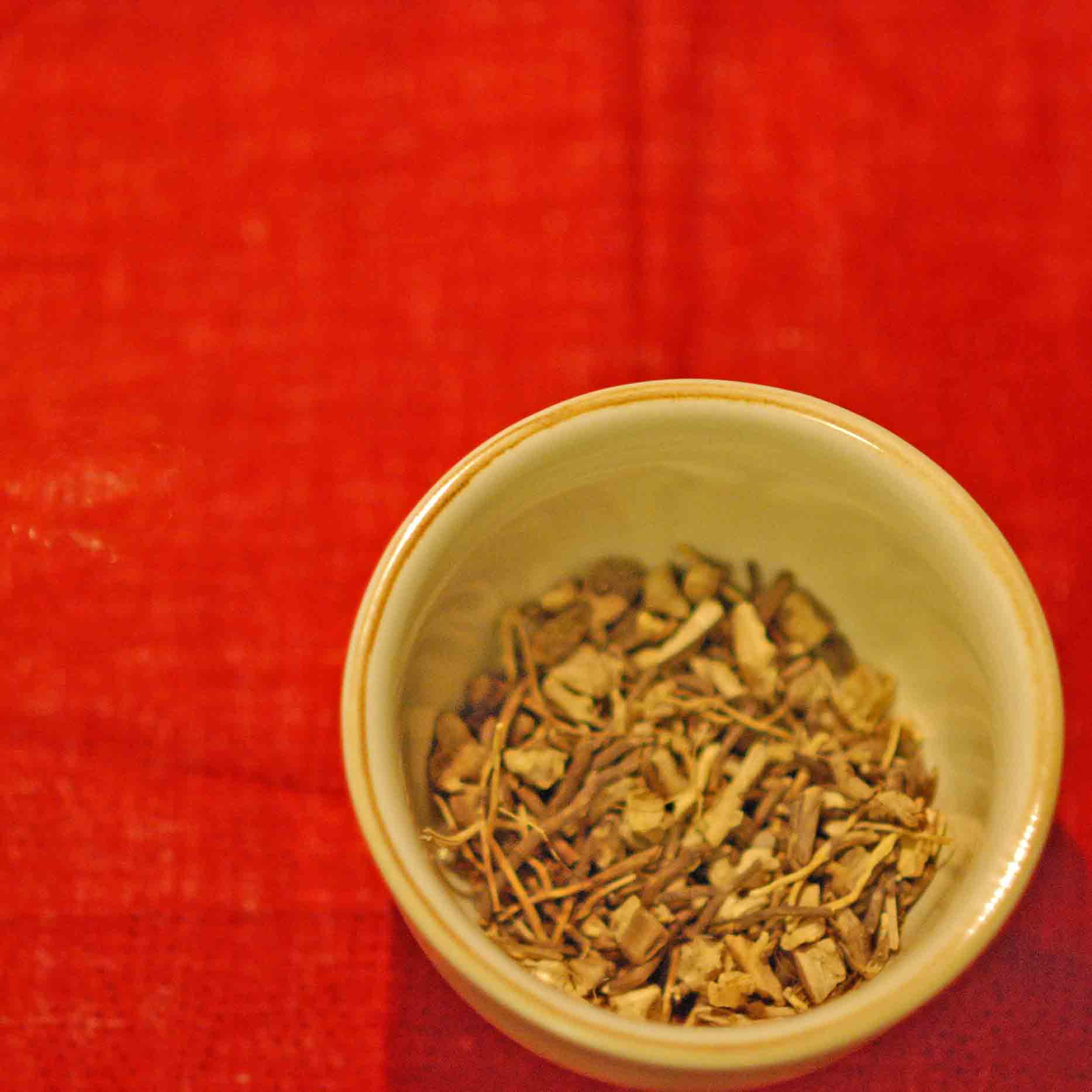
Joe Pye Root

You can find more on this herb/root in Catherine Yronwode’s Hoodoo Herb and Root Magic, as well as the websites listed below.

Thanks for reading!

-Cory

More information:

Medicinal and identification information – http://www.altnature.com/gallery/joe_pye_weed.htm

Cultivation and propagation information – http://oldfashionedliving.com/joe-pye-weed.html

Folklore and Appalachian history – http://appalachianhistory.blogspot.com/2007/08/queen-of-meadow-cures-all.html