This is the second part of the series on magical texts in America that I started way back in Blog Post 105. In that article, we looked at the different criteria for “Devil’s Books” that were often cited as a key component of witchcraft during the Colonial era. Today, we’ll be looking at a few of the tomes that were used by witchhunters in that era to determine just who was a witch, and what to do with one.
In general, witches were viewed as a very real phenomenon during the Colonial period. In New England, the belief in witches was prevalent enough that “witchfinding” was a legitimate career, just as it was in England (Matthew Hopkins, the “Witchfinder General” being a prime example of this profession). Other colonies, such as Virginia and Pennsylvania, took a more publically liberal stance towards witchcraft, and regarded it as “bad behavior” rather than any indication of diabolic allegiance. William Penn once ordered a woman accused of witchcraft to simply “practice good behavior” and insisted to her accuser that there was no law against “riding a broom” (SC&W). The Calvinist influence on the upper Appalachian colonies may have made them more willing to regard witchcraft as superstition, at least publically. However, the prevalence of anti-witchcraft charms, talismans, and amulets in all the colonies demonstrates that in private, many folks believed much as the Puritans did—witches existed, and they were dangerous. Naturally, those who feared malefic magic wanted to know how to figure out just who might be bewitching their cattle, stealing their milk, and spoiling their butter (an awful lot of witchcraft seemed to revolve around dairy products), and so they turned to the manuals available at the time.
Some of the key texts used to seek out, identify, and punish witches were:
The Malleus Maleficarum (Witch Hammer) – This is probably the most famous of the witch-hunter’s manuals, a heavy tome which set out to prove witches exist, that the were dangerous, that they were (usually) women, and that they could be stopped. Published first around 1486 in Germany by Swiss-German priest Jacob Sprenger, the Malleus was a central tool of the Inquisition as it pursued those it considered heretics. The book may also have been co-authored (or potentially solely authored) by Heinrich Kramer, but Kramer was later denounced by the Inquisition, and so authorial attribution has generally gone to Sprenger. The Malleus is divided into three basic sections: the first section tries to prove that witches must exist, the second describes how witches are made or how one becomes a witch, and the third section examines methods for detecting and punishing witches.
To give you some idea of what the Malleus contained, here is a section on how one forms a “Devil’s Pact” (I like that subject, if you haven’t noticed):
“Now the method of profession is twofold. One is a solemn ceremony, like a solemn vow. The other is private, and can be made to the devil at any hour alone. The first method is when witches meet together in the conclave on a set day, and the devil appears to them in the assumed body of a man, and urges them to keep faith with him, promising them worldly prosperity and length of life; and they recommend a novice to his acceptance. And the devil asks whether she will abjure the Faith, and forsake the holy Christian religion and the worship of the Anomalous Woman (for so they call the Most Blessed Virgin MARY), and never venerate the Sacraments; and if he finds the novice or disciple willing, then the devil stretches out his hand, and so does the novice, and she swears with upraised hand to keep that covenant. And when this is done, the devil at once adds that this is not enough; and when the disciple asks what more must be done, the devil demands the following oath of homage to himself: that she give herself to him, body and soul, for ever, and do her utmost to bring others of both sexes into his power. He adds, finally, that she is to make certain unguents from the bones and limbs of children, especially those who have been baptized; by all which means she will be able to fulfil all her wishes with his help” (from the Montague Summers translation).
If any of that sounds familiar, well, that’s probably because the Malleus basically served as a repository for folklore about witches and their powers. Based on stories and legends, an entire system of witchcraft was extrapolated, and then used to seek out and punish those who fit certain molds set by the Malleus. Punishments for witchcraft could be relatively light, requiring the accused to produce character witnesses: “assigning to you such a day of such a month at such hour of the day, upon which you shall appear in person before us with so many persons of equal station with you to purge you of your defamation.” Or they could be rather severe, including torture with red-hot irons and eventual execution by fire. Folklore is serious business when it’s taken too literally, it seems.
The Discoverie of Witchcraft – Reginald Scot’s 1584 treatise on superstition and attack on the Catholic Church became central to witchcraft persecutions not because it advised how to detect and destroy witches, but rather because it set out to completely disprove them. Scot, who considered the persecution of the poor or elderly which so often occurred during witch-hunts to be abominable, penned this small work in order to prove that any “witchcraft” being performed was pure charlatanism and that only the most foolish of magistrates and judges would subscribe to such ideas. His method for doing this, however, was to basically lay out in detail a grimoire’s worth of magic. As scholar Owen Davies puts it:
“Scot, a rather unusual demonological writer in that he was not a clergyman, lawyer, or physician, propounded a rationalist view of religion that went beyond [fellow demonologist] Weyer’s own more cautious view on diabolic intervention. Yet Scot’s Discoverie of Witchcraft was a treasure trove of magical information, providing spells, Catholic prayers, exorcisms, charms, talismans, and rituals on how to communicate with angels, demons, and the spirits of the dead. There were detailed instructions on conjuring up treasure and how to enclose a spirit in a crystal…So Scot produced what amounted to the first grimoire produced in the English language, and while he did so to prove the worthlessness of its contents he unwittingly ended up democratizing ritual magic rather than undermining it” ( Grimoires p. 70).
The Malleus Maleficarum had spelled out a number of magical rituals and spells, too, and so it seems that many of these guides to witch-hunting became, instead, roundabout guides to witchcraft. Scot’s work, however, ran afoul of King James I of England upon his ascension to power in 1603. James, who was a fervent believer in witches and demons (and authorized the translation of the Bible which contained the phrase “Thou shalt not suffer a witch to live” in Exodus 22:18 rather than a more accurate “sorceress” or “person who does evil magic,” although that is neither here nor there), ordered all copies of Scot’s Discoverie burned.
Wonders of the Invisible World – What sounds like a rollicking travel guide is, in fact, a defense of one of the most notorious witch-hunters in early American history. Cotton Mather (1663-1728) is best known for his role as a goad and “expert” during the Salem witch trials of the late 17th Century. When his part in that particularly tragic series of events (which I hope to explore more in a future article or show) came under criticism, he wrote his work as a means of proving that honest-to-goodness witchcraft was happening in Salem and everyone was darn lucky he was there to help stop it. After all, witches were blasphemous and diabolical creatures who not only used wicked spells—and okay, occasionally healed the sick, sure, sure—but did so as an intentional affront to Christian dignity and belief. For example, in a section entitled “The First Curiositie,” Mather says:
“The Devil which then thus imitated what was in the Church of the Old Testament, now among Us would Imitate the Affayrs of the Church in the New. The Witches do say, that they form themselves much after the manner of Congregational Churches; and that they have a Baptism and a Supper, and Officers among them, abominably Resembling those of our Lord.
But there are many more of these Bloody Imitations, if the Confessions of the Witches are to be Received; which I confess, ought to be but with very much of Caution.
What is their striking down with a fierce Look? What is their making of the Afflicted Rise, with a touch of their Hand? What is their Transportation thro’ the Air? What is their Travelling in Spirit, while their Body is cast into a Trance? What is their causing of Cattle to run mad and perish? What is their Entring their Names in a Book? What is their coming together from all parts, at the Sound of a Trumpet? What is their Appearing sometimes Cloathed with Light or Fire upon them? What is their Covering of themselves and their Instruments with Invisibility? But a Blasphemous Imitation of certain Things recorded about our Saviour, or His Prophets, or the Saints in the Kingdom of God” (p. 246)
Mather’s book did not have quite the same effect that Scot’s book or the Malleus did. Instead, it merely capped the end of some of the most ferocious witch-hunting in New England. Nor did Mather’s work become a grimoire unto itself as the other texts mentioned here did. While it certainly offered some ideas of how one might become a witch and what powers might then be gained, there was little in the way of magic actually in its pages. All in all, that is probably for the best, as Mather seems a bit stodgy and reading a grimoire by him would probably prove a bit dull.

There are other witch-hunting manuals and texts on just how to pursue and prosecute suspected witches, of course. James I had his own (likely ghost-written) catalogue of the supernatural, Daemonologie. The Malleus was likely influenced by other manuals of its kind like Formicarius, by Swabian priest Johannes Nider. Modern witch-hunts in places like Africa and India tend not to rely on weighty guidebooks to the world of the unseen and diabolical, though the influence of these texts certainly lingers in the identification and punishment of supposed witches. I have even heard well-educated American Christian missionaries returning from Tanzania describe entire villages of witches. While they were cautious not to present witchcraft as the Harry Potter-esque phenomenon that those in the attending congregation might have mentally pictured, they absolutely believed that people with dark, uncanny powers lived in that particular enclave, and that the area was best avoided if at all possible. Somehow, such admonitions made me want to visit that particular village. But maybe that’s just me.
While witch-hunting manuals are, mostly, a thing of the past, it is worth noting that websites abound with information on finding and purging witches from one’s community. I’ll not list them here, as I really don’t want to entangle this site with links to those sites, but a quick Google of terms like “how to get rid of a witch” and “neighborhood witch” will yield some results, including one site which actually says: “I just read the first booke [sic] of Daemonolgie by King James and I found it highly instructive.” So, in all fairness, witch-hunting manuals aren’t gone—they’ve just upgraded to digital.
At any rate, I count my blessings that for the most part I live in a place where my magical practice is an asset (albeit a fairly secretive one) rather than a genuine liability. Hopefully books like the Malleus will one day be historical relics, rather than active references. Until then, a few extra protection spells can’t hurt.
Thanks for reading!
-Cory

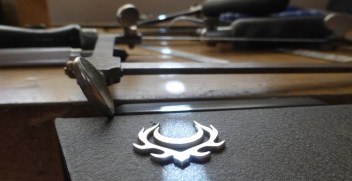 Talismanic Jewelry by Aidan Wachter (Photo from http://www.aidanwachter.com)