Episode 265 – The Magic of Verity Vox with Don Martin

We’re Cursed Send Help!
We’re Cursed Send Help!

Summary:

We sit down to chat with one of our favorite people, Don Martin, whose NY Times bestselling book Verity Vox and the Curse of Foxfire appeared on bookstore shelves last month. We discuss the book’s origins in Appalachian history and folklore, the joys of podcasting for the past 15 years, and what lies ahead.

Please check out our Patreon page! You can help support the show for as little as a dollar a month, and get some awesome rewards at the same time. Even if you can’t give, spread the word and let others know, and maybe we can make New World Witchery even better than it is now.

Producer for this show:

New World Witchery is a Patreon supported podcast. This episode is sponsored in part by listener MissV. We appreciate all you do for us and we’ll gladly send our resident witch-in-training to come help out with your household chores!

Play: Episode 265 – The Magic of Verity Vox with Don Martin
Stream: https://open.spotify.com/episode/1v6wLWVCAr7NnNFF8DDkGj?si=I3edUOz6SDK9XG1FKzIWnw

Sources

You can find Verity Vox and the Curse of Foxfire anywhere books are sold now! Or preorder his book on loneliness, Where Did Everybody Go? You can also check out Don’s previous books of poetry, The Playground and While I Wait to Be a God Again, as well as his witchcraft primer The Dabbler’s Guide to Witchcraft.

Some of the other titles/authors recommended on this show included:

Books and Things:

Please consider ordering our collaborative book Conjuring the Commonplace: A Guide to Everyday Enchantment and Junk Drawer Magic from 1000Volt Press! It’s available for purchase on Bookshop, Amazon, or from your local bookstore!

You can buy Cory’s book, New World Witchery: A Trove of North American Folk Magic! (also available from Amazon) and the Llewellyn’s Complete Book of North American Folk Magic as well (also available on Amazon)!

Please note that clicking on links may provide some monetary compensation to New World Witchery.

Image via Pixabay (Used under CC 2.0 License, modified by New World Witchery)

If you have feedback you’d like to share, email us at compassandkey@gmail.com or newworldwitcherypodcast@gmail.com or leave a comment at the website: www.newworldwitchery.com . We’d love to hear from you! Don’t forget to follow us at Twitter! And check out our Facebook page! For those who are interested, we are also on TikTok now. You can follow us on Instagram (main account, or you can follow Laine as well) or check out our new YouTube channel with back episodes of the podcast and new “Everyday Magic” videos, too (as well as most of our contest announcements)!

Promos and Music: Title music is “Woman Blues,” by Paul Avgerinos. All music is licensed from Audio Socket (#35954).

Please consider supporting us by purchasing our promotional items in the New World Witchery Threadless shop or by joining our Patreon supporters. If you like us AND you like Buffy the Vampire Slayer, you will love our new show: Myth Taken: A Buffy the Vampire Slayer Podcast, now available through all the podcatchers! Please think about checking out our Audible Trial program. Visit Audibletrial.com/newworldwitchery to get your free trial of Audible, where you can download over 180,000 titles (including some narrated by Cory). Your purchases help support this show, and there’s no obligation to continue after the free trial
Blog Post 55 – Games

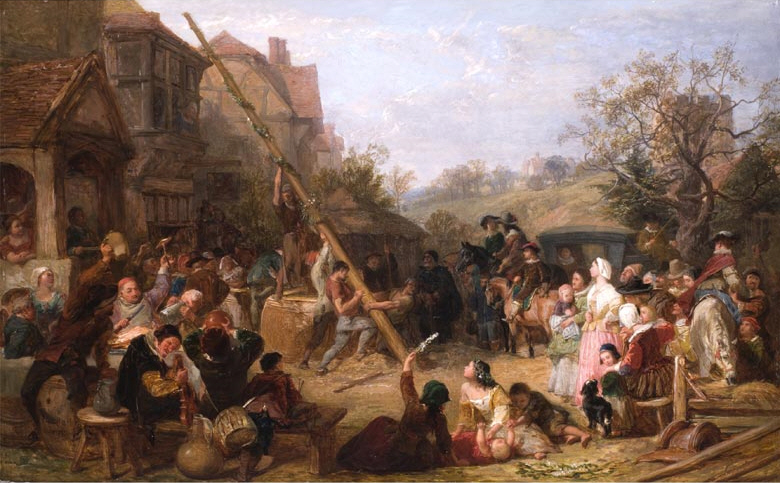
May Day is just around the corner, and since I’ve been talking about songs and riddles this week, I thought it might be fun to talk a little about games.  Sport and fun may not seem like a particularly witchcraft-tinged topic, but au contraire! I say.  There are lots of magical subtexts to games, from the sacrificial-animal nature of a colorful piñata to the gambling mojo or lucky rabbit’s foot stuffed in a card-player’s pocket.

Getting Lucky
Winning games by magic is a primary focus of many types of hoodoo workings.  Some of the various techniques for improving one’s luck include:

  • The creation of gambling mojo hands, often “fed” with a woman’s urine (because of her connection to Lady Luck)
  • The appropriately named “Lucky Hand” root, which resembles a human hand and which is reputed to bring good luck to one in games of chance
  • A buckeye with a hole bored in it, filled with liquid mercury (quicksilver), and sealed with wax was considered incredibly lucky.  WARNING:  Don’t do this.  Mercury is VERY dangerous and VERY poisonous, even in tiny amounts.  Modern root workers often use sliver Mercury-head dimes instead.
  • The popular alligator-foot or rabbit-foot keychains found in roadside stops throughout the country are considered potent gambling charms.
  • One of my favorites is the “coon dong” charm, which is a raccoon penis bone wrapped in a currency note (the higher the better, of course) to ensure continued luck.

Of course, there are lots of other hoodoo charms related to luck and good fortune.  Simply carrying a High John root in your pocket is a good way to ensure luck at all you do, including games.  Another big game-related piece of hoodoo magic comes in the form of “dream books,” which purport to help the dreamer turn symbols and images from the night’s slumber into winning lottery numbers.  Catherine Yronwode has an excellent page on this topic, so I’ll just suggest you visit her site for more on those.

Magical Games
There are many games that have interesting magical undertones (or overtones…maybe highlights or roots?).  I thought it might be fun to include a few games that you could include in your own May Day celebrations today.  I’m skipping out on the traditional Maypole as that is well documented in many places.  I hope you enjoy them!

From Central Illinois (in Richard Dorson’s Buying the Wind, paraphrased)

LONDON BRIDGE IS FALLING DOWN

Two players are named “Takers,” and each chooses an object or idea that represents him/her (such as one player being “bees” and the other “flowers,” or one the “sun” and the other “the moon.”  The Takers do not tell the other players which Taker is which object however.  The other players form a circle, and the Takers join hands, one outside the circle and one inside.  They raise their arms, and the circle begins to turn as everyone sings:

London Bridge is falling down, falling down, falling down;
London Bridge is falling down, and caught my true love in it.

The Takers can drop their arms at any point during the singing, and the circle stops.   Whoever the Takers have “trapped” must choose one of the objects and whisper it to the Takers.  The Taker whose object is named grabs the trapped player and moves them behind him/her, and then the Takers raise their joined hands again.  The singing and circling continues in this way until all the players have been caught and moved behind their chosen Taker.

The Takers keep their hands joined and each player wraps his/her hands around the player before them, forming two human chains linked by the Takers.  The game ends with a tug-of-war between the two sides.

This game could be a wonderful way to have some fun while enacting a sort of ritualized drama, such as the struggle between light and dark.  It is best with a large group of people of course, and the “prize” for winning could have to do with the losing side serving the winning side at a feast, or something to that effect.  Or winning could just be its own very fun reward.

From Appalachia (in Foxfire 6)

DEVIL IN THE PROMISED LAND

“We played a game called ‘The Devil in the Promised Land.’  A big branch went down through our pasture.  Some places it was wide and some places were narrow enough to jump across pretty good.  There’d be about eight or ten of us on one side.  We’d put one on the other side and he was the devil.  Now we had to cross the branch and go around him and jump the branch back.  Now if he caught us before we made the run around him, we had to go on to the devil’s side” (p. 282)

I love this one, and you could definitely play it without having a huge tree or creek (I’m not 100% sure what that informant meant by “branch”).  Just making a big circle with rope or setting boundaries for the “Devil’s land” with stones would be pretty easy.  You could also think of this as “a witch and her spirits,” with the Witch being the primary tagger, and her Spirits being the players she catches, who help her catch other players (I would say they can’t “tag” a player, but might help to corral the other players towards the Witch…but that’s just my take on it).

From the Southwest and Mexico

THE PINATA

The piñata has an interesting history dating back to at least Mayan times, and possibly even back to China.  There’s an excellent short history of the game here, including many traditional rhymes and songs associated with the game, such as:

“Dale, dale, dale, no perdas el tino,
porque si lo perdes, pierdes el camino.
Esta piñata es de muchas mañas, sólo contiene naranjas y cañas.”

Hit, hit, hit.
Don’t lose your aim,
Because if you lose, you lose the road.
This piñata is much manna, only contains oranges and sugar cane.”

Making paper mache representations of animals, spirits, demons, gods, stars, or almost anything magical would add to the occult significance of a game like this.  After the candy’s been collected, some of it could be turned into an offering as well, if that’s part of your tradition.  The bright colors of most piñatas make them perfect for May Day gatherings, in my opinion.

There are lots of other games you could play as well, like Nature Bingo or Horseshoes, that would fit a spring or summer gathering.  This post is already plenty long, though, so I’m going to end it here.  Feel free to share your own witchy games, if you have them!

Thanks for reading!

-Cory

Blog Post 19 – More on Folk Astrology and Gardening

I know I’ve promised a walkthrough of a sign-based planting, and that is still coming, but I thought that today it might be good to provide a couple of quotes and citations regarding just who practices this astrological agriculture.

These practices tended to be broadly found, and not relegated to just one or two American magical systems.  There are slight variances between regions, but that could also have less to do with the magical system in place and much more to do with local climate, latitude, and longitude in relation to the stars.

In the southern hills of Appalachia, one Mary “Granny” Cabe is noted to have been quite skilled with astrology and planting.  Foxfire interviewers tell how she “[p]atiently, with the use of several calendars…explained its [planting by the signs] basic principles and gave us several of the rules” (Foxfire p. 221).  She did more than describe the general system, however.  She also explained how specific plants fared in relation to astrological changes:

“’Take taters.  On th’ dark of th’ moon or th’ old of th’ moon—that’s th’ last quarter,’ she explained, ‘they make less vine; and on th’ light of th’ moon they makes more vine and less tater…Don’t plant in th’ flowers [the sign of Virgo, often seen as a virgin bearing flowers].  A plant blooms itself to death and th’ blooms falls off” (p. 221)

There were also many people in the Appalachians who didn’t believe in this method of planting.  The interviewers record that these were mostly “educated people…[with] college degrees, and held positions of great respect in the community” (p. 225).  One informant makes the excellent point that “if someone’s going to be careful enough to plant by the signs and watch and harvest the crop that carefully, then the chances are he will have a good crop, regardless” (p.225).  Still, the stories persist and the practice of planting by the signs continues in the mountains and hills around that area even now.  The Appalachian heritage blog The Blind Pig and the Acorn records its author’s attempt at sign-planting and several of his commenters speak of doing so, too.

Gerald Milnes, in his Signs, Cures, and Witchery, also discusses planting by the signs in the northern parts of Appalachia and Pennsylvania-Dutch territory:

“Astrologic traditions still exist as more than just quaint curiosities among Appalachian people.  It is noted that these practices declined within English society and in New England before the Revolution.  New England’s almanac makers were under withering attack, religious condemnation, and mockery by the mid-seventeenth century, but over three centuries later continued folk practice based on this cosmology is still easy to ascertain” (Milnes, Signs, Cures, & Witchery, p.32).

Milnes makes the case that much of this preservation of astrological folk culture had to do with the availability of almanacs (he also points out one I completely forgot to mention yesterday, but which is supposed to be excellent for New England climes:  Gruber’s).  Many of these almanacs are the same ones which helped preserve the Pow-wow magic I’ve spoken about in previous posts.

Lest you think the phenomenon of sign-planting is relegated to the Appalachian Mountains, here are a few quotes from Pennsylvania-Dutch planting lore:

“Plant peas and potatoes in the increase of the moon”
“If trees are to sprout again they should be felled at the increase of the moon”
“When sowing radish seed say: as long as my arm and as big as my ass”
-(Dorson, Buying the Wind, pp.124-125)

Okay, so that last one wasn’t really about planting by the signs, but it’s fun anyway.

Thanks for reading!

-Cory