
Blog Post 38 – High John

Howdy all!

I hope you had a great weekend!  This week, I’m going to be focusing on herbs, roots, and curios used in various American magical practices.  I’m starting with one of the most common and most important roots in hoodoo:  High John the Conqueror.
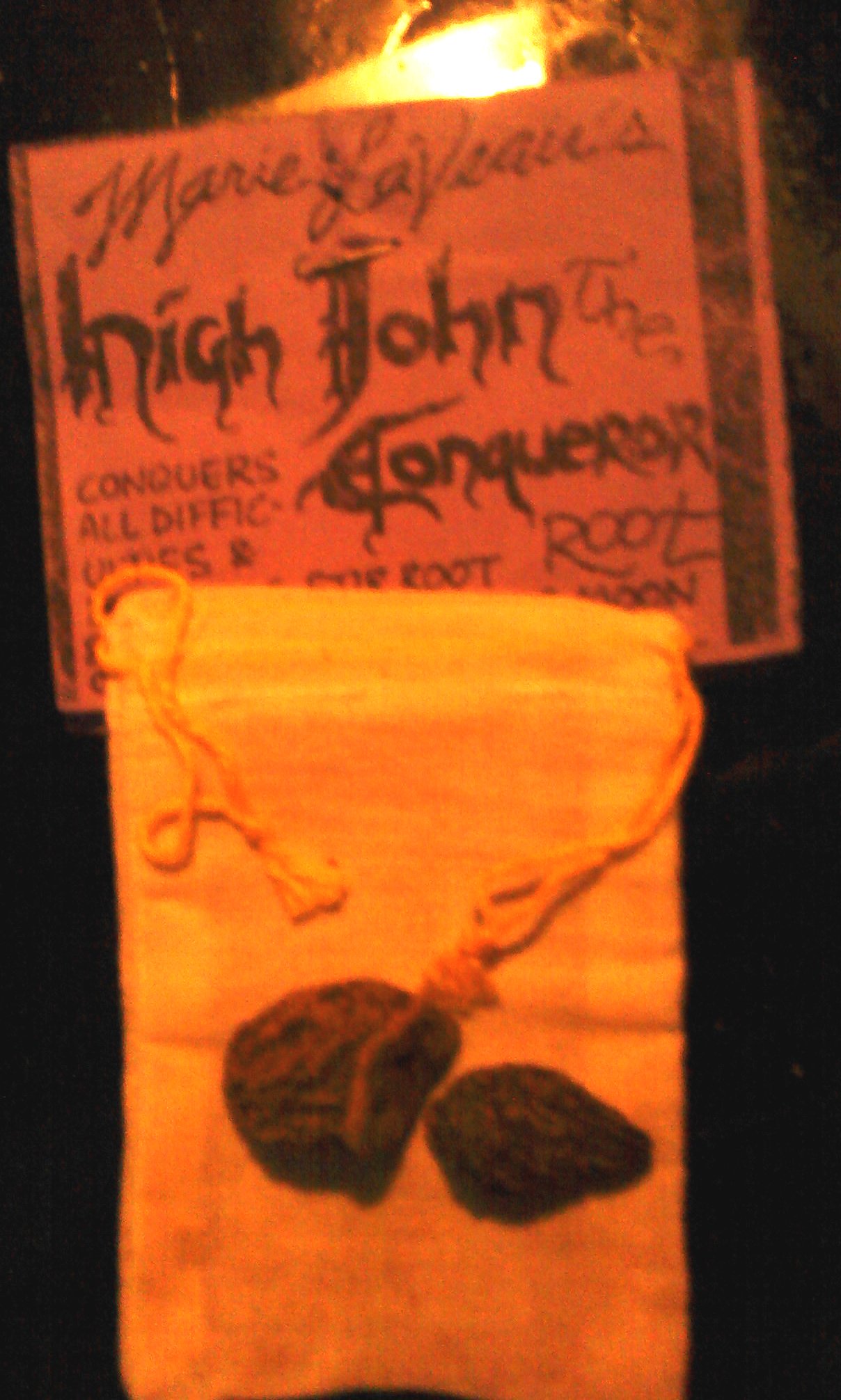
This shriveled root is part of the Ipomoea genus, and is a relative of the Morning Glory.  Its resemblance to a shrunken testicle has made it a powerful symbol of potency and virility.   I consider it to be one of the quintessential hoodoo herbs (which is the reason I included it in my “hoodoo kit” post).  Catherine Yronwode says of the root in her Hoodoo Herb and Root Magic book, “ A person possessing a John the Conqueror Root will never be long without money or a lover and will be extremely lucky in games of chance and business” (HHRM p. 111).

Some of the most common ways to use this root are to put it into a jar of neutral oil (such as safflower or olive) and let it sit for a few weeks, occasionally shaking the jar.  The resulting oil (which will have little to no smell and to which you should add some vitamin E or tincture of benzoin to prevent rancidity) can be used to anoint anything that needs more power.  Rubbed on your hands and feet, it adds personal power to everything you do.  Rubbed on money kept in your wallet, it helps you be more successful in luck and business endeavors.  Rubbed (very lightly) on the penis, it restores male virility and enhances sexual prowess.

Another key way to use this root is to keep a whole root in your pocket, either by itself or wrapped in a red cloth bag as a mojo hand.  Fed regularly (once a week at least) with whiskey or the High John Oil I just described, it keeps you empowered and potent at all times.  According to the lore, money comes easier, luck favors you, love finds you, and sex is better than ever.

You can also add John the Conqueror (by the way, you say it “John the Con-ker”) chips or oil to other mojo hands to increase their potency as well.  I like to add them to success and business workings, because they tend to work faster and require less finagling on my part after my initial efforts.

The High John root has appeared in pop culture several times, too.  Whenever hoodoo comes up in songs, a mention of this root is seldom far behind.  For example, in the Allman Brothers Band remake of Willie Dixon’s “Hoochie Coochie Man,” radio audiences of the 70’s heard the lyrics:

“Got a John the Conquerer root and got some mojo too,
We got a black cat bone, we’re gonna slip it to you.”

Considering the libertine behavior the singer boasts of elsewhere in the song, having a little magic keeping his virility charged certainly seems like a good idea (I’ll address the black cat bone reference in another post).  Muddy Waters (who worked with Willie Dixon quite a lot) also recorded a blues song featuring the hoodoo charm, entitled (appropriately) “My John the Conqueror Root.”

There are lots of places to find this root on the web, and if you have a local botanica of some kind, they will also likely carry this curio.  I highly recommend anyone looking into American magic familiarize him/herself with High John.  Who couldn’t use a magical boost from such a potent little root?

Thanks for reading!

-Cory

Podcast 6 – Hoodoo and an Interview with Conjure-man Papa Toad Bone

-SHOWNOTES FOR EPISODE 6-

Summary
In this episode, we discuss hoodoo and rootwork, particularly our experiences with it.  Then we have an interview with esteemed conjurer Papa Toad Bone.

Play:

Download:  New World Witchery – Episode 6

-Sources-

Websites
Lucky Mojo Co. – A site with lots of hoodoo information
Toad’s Bone Apotheca – Our guest’s marvelously funky and fantastic online curio shop
Mississippi Cunning + Conjure – A forum space for those interested in Southern magic and Traditional sorcery
Scarespite – A repository of Traditional Witchcraft and Sorcerous folklore

Promos & Music

Title music:  “Homebound,” by Jag, from Cypress Grove Blues.  From Magnatune.
Promo 1-Inciting a Riot Podcast
Promo 2- Druidcast
Promo 3- Podcast Appalachia

Blog Post 33 – A Hoodoo Starter Kit (Intro, Part V)

For my final post this week, I’m putting up my idea of what a beginning rootworker might want to have on hand.  Think of it as a sort of “first aid kit” for getting your hands dirty in hoodoo.  This is only my opinion, by the way, so your mileage may vary according to different conjure practices.  If you have any questions, please feel free to email me or to add a comment to this blog page and I’ll do my best to answer them.  Now, onto the kit!

Candles – I keep lots of these on hand, in several different sizes.  They’re good for doing most types of simple jobs where all that’s required is a quick dressing and a little time to burn them.  You can use color correspondences, if you like, but I find plain white (or beeswax candles with a  golden tint to them) work just fine for me.

Candlesticks/Holders (at least two) – I say at least two because you never know when you’ll need to burn for two things at the same time (say a separation working and then a protection one to help a woman in a bad relationship get out safely and stay safe).  There are some candle burnings, too, where progressively moving the candles closer together or further apart is part of the job being done.

High John root(s) and/or oil – This is the quintessential hoodoo root.  It’s small, brown, and not very impressive to look at, but man it packs a punch.  Anything that needs extra potency can benefit from High John.  There are plenty of folks who simply carry one in their pocket, feeding it regularly with whiskey or oil, to help them always be performing at their best, whatever they do.

Small assortment of condition oils – If I’m being really 100% honest, you don’t need these the way you might need other things on this list.  And you can certainly make your own versions of them rather than buying them from a store.  I like to have some of the basics on hand (especially Van Van and Fiery Wall) because it’s easy to dress a candle with them and do a quick burning, or to dress a mojo bag with them quickly.

Uncrossing – This one’s great for removing hexes and jinxes.
Attraction – Can draw love, money, luck, and other positive things into your life.
Van Van – This oil is a general use oil, good at removing obstacles, increasing luck, finding love, and many other things.
Compelling/Commanding – If you intend to do this kind of work, these are good to have. Compelling makes your target do what they say they will do, and Commanding makes them do what you want.
Blessing – This one is important for cleansing and blessing homes, marriages, children, etc.
Fiery Wall of Protection – A vital oil if you want really good protection for a person or place.

Whiskey (or other alcohol) – When you feed your mojos or other work, the typical offering is whiskey.  It’s also a good offering for working with ancestors and spirits (though some Native American spirits do NOT like it, apparently).  Some who do not use alcohol in their magic will use oils or holy water instead.

Salt – Good for setting protective barriers, for use in spiritual baths (especially to remove harmful influences), and adding to certain jobs where you are trying to neutralize someone else’s work.

Pepper (black and red) – Both are used to make things “hot” for a target, and also in the Hot Foot jobs a rootworker may be called upon to do.  They can be used in other work, as well, particularly if you’re trying to make things “fiery” for any reason (protection, sex, etc.).

Four Theives Vinegar – This is a centuries-old formula and there’s no need to buy it.  Just take good quality cider vinegar (or wine vinegar if you prefer) and add black and red pepper, garlic, and mustard seeds, then let it sit in a dark place, shaking it daily.  After about two weeks, voila!, Four Thieves Vinegar.  There are variations on the recipe (I use rue in mine), so find one that works for you.  It’s good for protection and hexing jobs, and it tastes delicious on a salad!

Honey/Molasses/Sugar/etc. – This is for any kind of sweetening work you do.  You can also add it to certain spiritual baths to help make things sweeter for you in general.  Choose a sweetener that is regionally appropriate—molasses is good in the South, while in Vermont maple syrup would be good.

Red cloth squares – For making mojo hands.  This doesn’t have to be anything fancy.  Flannel and linen are fairly traditional, but whatever is available in your local fabric store’s remnant bin will probably be just fine.  Or cut up an old red t-shirt.  In a pinch, white cloth can be used for most jobs, too.

Bottles/jars – Keep these on hand for doing Honey Jars or Vinegar Jars, as well as making protective bottle spells (like Witch Bottles) or even just as a back-up candle holder.  I save old baby food jars for this kind of work.  If you have a Sharpie, you can even draw or write on the glass, if you feel so inclined.

Envelopes/plastic baggies/etc. – For collecting ingredients or gathering spent spell materials for proper deployment (at a crossroads, in running water, etc.).  I will also confess I usually keep little paper envelopes on hand so that if I’m visiting someone that will be a target for a job and I use their bathroom…well, let’s just say most people leave things like hairbrushes pretty much out in the open…

Bible or other holy book – I’m not saying you have to thump it, sell it, buy it, preach it, or even believe in all of it, but the precedent for using Scripture in hoodoo is long-standing.  I’m not Christian but I use the Psalms in my work fairly often.  If you have a vehement dislike of Christian religion, and the Bible in particular, find another holy book that does work for you, such as the Koran, the Bhagavad Gita, or the poems of Rumi.  My only admonition here is that if the book isn’t spiritual in nature, I would avoid using it in rootwork.  There seems to be something very profoundly sacred about the relationship between a holy book and a magic spell, something that the spirits on the other side respond to.  That’s just my opinion, of course, so if you don’t believe me, I can live with that.

So that’s it for this week’s Introduction to Hoodoo!  I hope you’ve been enjoying this series.  We’ll be doing plenty more with rootwork in the future, including having a guest on our next podcast  who is a professional rootworker!   That episode should be out next week, and hopefully we’ll have a couple of other neat treats for you then, too.
Thanks for reading!

-Cory

Blog Post 29 – An Introduction to Hoodoo, Part I

This week I’ll be focusing on something that seems to generate a lot of interest:  hoodoo.  This is one of my personal favorites when it comes to magical systems, because it is incredibly practical and anyone can do it.  Plus, it doesn’t shy away from the less savory side of magic, but fully acknowledges that curses exist and must be dealt with (and sometimes dealt out when other attempts at justice have failed).

A (VERY Brief) History
Let’s start by getting the confusing terminology out of the way.  Often, the terms “hoodoo,” “conjure,” and “root work” or “rootwork” will appear as synonyms.  Adding to the confusion, most people also mix “voodoo” into this lexical stewpot.  Hoodoo, however, is NOT Voodoo/Vodoun—the former is a magical system not particularly affiliated with any specific religion, and the latter is a very distinct religion.  The confusion between the two stems from the fact that both are outgrowths of something called African Traditional Religion (or ATR for short).  There are other ATR’s which exist, primarily in South America and the Caribbean, but I’ll leave a discussion of those to someone more knowledgeable than myself.  When African slaves were brought to the West Indies, their native religion mixed with the folk practices of the indigenous tribes on the islands and the Christianity of their European captors.  Vodoun evolved over time, primarily in places like Haiti, as well as coming onto American soil through places like New Orleans.

Many modern Vodoun practitioners are very committed to the ATR religious powers, such as Legba, Oshun, and Yemaya (variants on spelling and pronunciation occur depending on where you are and to whom you’re speaking).  The Voodoo which grew up in New Orleans is quite different from the Vodoun in Haiti, though they do share many common elements.  Zora Neale Hurston’s excellent book Mules and Men details much of this overlap (though I advise readers to take this book with a grain of salt, as some of her folklore is a bit embellished and may not present an accurate picture of her subjects).

A big part of Voodoo, though, was a belief in magic and animism.  While Catholicism (dominant in the islands and French-and-Spanish-influenced Southern coastal regions) was fairly adoptive of these ideas so long as they were couched in terminology like “miracles” and “Saints,” slaves transplanted to Protestant-dominated areas found the religious side of Voodoo quashed.  The numerous spirits and beings found in Voodoo’s pantheon were stripped away, and what was left was a magical system detached from its religious side.  Other ATR’s also met the same fate as they moved into the white, Protestant-dominated sections of the United States.  Beliefs in “witchcrafting” and other magical practices go back to at least the beginning of the 19th century among African-American populations, completely removed from any ATR associations, or any deeply religious connection at all.  Only the practical side of the work was still available to the slaves brutally oppressed in Colonial America, as it was often their only real recourse to justice in any way.

Once this practical magic started working its mojo, so to speak, it began to grow in new ways.  It encountered new herbs via contact with another overrun people, the Native Americans.  European folklore, especially German and Anglo-Irish tales, provided new fodder for the developing system.  And the availability of particular regional curios and ingredients shaped the evolving practice.

So is it Hoodoo, Conjure, or Root Work?
In general, the terms “hoodoo,” “conjure,” and “root  work” still get used interchangeably.  “Hoodoo” is common in the gulf coastal regions, “conjure” in places like Memphis and the mid-South, and “root work” in the Atlantic coastal regions.  All terms, however, can be generally found in all places, so don’t be surprised at the overlap.  Additionally, spelling may vary (I’ve seen at least one WPA folklore collection from Tennessee showing this practice called “cunjur” instead of “conjure”).

In my own mind, I do see a slight difference in the three terms:

  • Hoodoo is the general name for the system of African-American and Southern magic using herbs, roots, and everyday objects to influence people and events in one’s life.
  • Conjure is more specifically related to working with spirits, but also uses much of the same magic hoodoo does.  It also relates to faith-healing (to me, anyway).
  • Root work has to do with the crafting of herbal and curio-filled spell objects, or with the use of such things to heal or harm a target.

There’s not a single consensus on where the actual term “hoodoo” comes from.  Some think it is a corruption of “Voodoo,” but this is not a majority opinion.  Catherine Yronwode has a great discussion of this topic on her website, outlining much of this history in more detail.

Hoodoo Now
During the early-to-mid twentieth century, hoodoo underwent another evolution.  It moved, along with Southern blacks, into cities and became urbanized.  Many merchants began to supply hoodoo practitioners with the oils, herbs, candles and other items they needed to do their work.  A number of these suppliers were Jewish, and a strong Jewish presence can still be seen in hoodoo, mostly in the use of talismans and charms imported from European grimoires like The Black Pullet.  Some, such as scholar Eoghan Ballard, have even made convincing arguments that the word “hoodoo” comes from a particular pronunciation of the word “Jewish.”

The terms Voodoo and hoodoo are still confused, even by those who are in the know.  The very reputable and knowledgeable author Jim Haskins even titled his book about hoodoo Voodoo and Hoodoo.

Modern hoodoo is still growing and changing.  Some of the major centers of hoodoo are Forestville, CA (where Cat Yronwode runs her Lucky Mojo Curio Co.), the Gullah region of South Carolina (discussed in Jack Montgomery’s American Shamans in the section on Sheriff McTeer), cities like Memphis and Savannah, and of course New Orleans.  It is also present in rural areas, like the swamps of Mississippi.  And the general practice of root work seems to have spread to other countries as well, as Sarah from the Forest Grove Botanica in Canada uses many root working techniques in her magic.

As this week goes on, we’ll get into more on those techniques, as well as the specific herbs, roots, and curios found in hoodoo.  For now, though, I think I’ll stop before I write a whole book here.

Thanks for reading!

-Cory