Blog Post 79 – Lucky Rabbit’s Foot

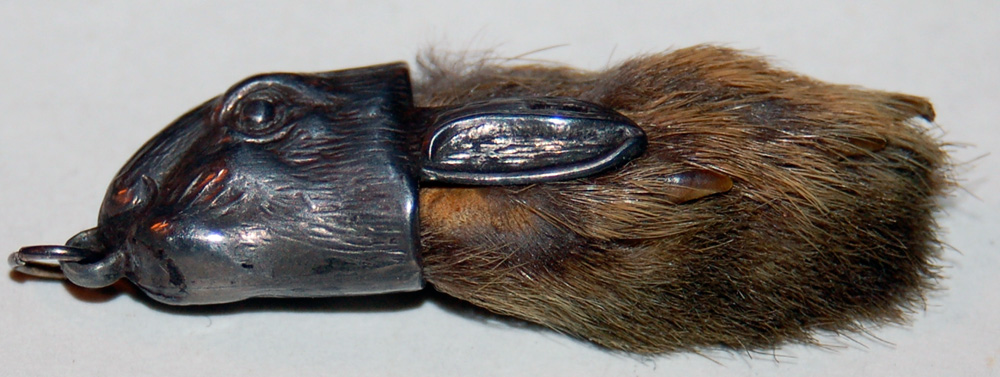
For today’s post, I’m looking at the folklore and magic surrounding one of the most ubiquitous pieces of conjure paraphernalia, the rabbit’s foot.  There are plenty of theories about this particular luck charm, but not much that can be definitely put down regarding its origin or provenance.  Rabbit foot charms have been around since at least the mid-to-late 19th century in North America, and likely predate the Civil War.  They are used for general luck, gambling aids, love enhancers, and other areas where a bit of extra luck might help.

A quick word of warning, however.  Many of the sources I’ll be citing in this post also date from earlier eras, and thus have a great deal of offensive material in them.  There are words that appear here which would likely incite violence if used lightly today, so please understand that I present them here as a piece of the folklore to which they belong.  Just as a smart modern magician finds a reasonable substitution for liquid quicksilver/mercury (and thus avoids madness and poisoning), a wise student of folklore and folk magic remembers that just because a sentiment appears in print doesn’t make it right or appropriate.

There, now let’s move on to some of the good stuff about rabbits’ feet.

Catherine Yronwode provides information on the rabbit’s foot on her Lucky W Amulet Archive, describing  the foot as catalogue offerings from the early-to-mid twentieth century:

As for the foot itself, a circa-1940 mail order catalogue from the Standard O and B Supply Company, a Chicago-based distributor of African-American hoodoo material, offered undyed rabbit foot charms “made with a metal band and a link to attach on chain.” The Johnson-Smith Novelty Company offered identical charms in its 1941 catalogue. The advertisement shown here goes these one better and promises a free vial of Van Van oil with each rabbit’s foot; the formula is a Louisiana hoodoo favourite that “clears away that evil mess” and increases the strength of any good luck charm to which it is applied. Since none of the older catalogues or ads mention any colour when describing rabbit’s foot charms, it can be assumed that the items were undyed and came only in natural tan or white.

She goes on to talk about her uncertainty regarding why a rabbit’s foot might be so lucky:

Why is the rabbit foot lucky? I am not sure. Rabbits are swift and they reproduce prolifically, but the luck of the rabbit foot is monetary and sexual; as far as i know, it is not related to swiftness or fertility. There is considerable evidence that the lucky rabbit foot is a remnant of an African clan totem, an importation related somehow to Br’er Rabbit, the famous protagonist of an African trickster-god myth-cycle.

Yronwode points out that the rabbit’s foot appears in the famous Uncle Remus stories, written by Joel Chandler Harris in 1881.  In a tale entitled “Brother Rabbit and his Famous Foot,” Uncle Remus describes the tricky Br’er (or Brother) Rabbit’s prosperity-drawing mojo bag (which he refers to as a money purse, or dialectically a “money-pus”):

Brer Wolf look at de money-pus, en see w’at in it. Hit ‘uz one er deze yer kinder money-pus wid tossle on de een’ en shiny rings in de middle. Brer Wolf look in afar fer ter see w’at he kin see. In one een’ dey wuz a piece er calamus-root en some collard-seeds, en in de tier een’ dey wuz a great big rabbit foot (Harris p. 223)

So even a rabbit carries a rabbit’s foot for luck and money.  How’s that for strange?  But why is it so lucky?  In a 1973 thesis on conjuration in the works of African-American author (and somewhat accidental folklorist) Charles Chestnutt, Bettye Jo Crisler Carr uncovers some possible reasons behind this talisman:

One might have expected Chesnutt to refer to ghosts who haunt graves, to witches ‘riding’ their hapless victims by night, to conjurers tying bits of roots in tiny bags to ward off evil. But surely his reference to the efficacy of ‘de lef hin’ foot er a graveya’d rabbit, killt by a cross-eyed nigger on a da’k night in de full er de moon’—surely that is something Chesnutt (or Uncle Julius, who seems equally real) has made out of whole cloth.

An examination of folklore sources, however, justifies Chesnutt’s requirements for the rabbit-foot good-luck charm. An informant from Atlanta states that the talisman must, indeed, be the ‘left hind foot of a graveyard rabbit.  Mary Owen, recording her collected tales prior to 1893, adds to the requirement that it must be ‘de lef hine-foot ob er grabe-yahd rabbit kilt in de dahk o’ de moon.’ A Memphis informant states further that the graveyard rabbit must have been killed by a cross-eyed person. Louise Pendleton, also writing before the publication of Chesnutt’s stories, comments that the use of the rabbit foot for good luck ‘may be traced to the fetishism, or worship of guardian spirits dwelling in inanimate objects, of their African ancestors.’ (Carr,  “Charles Chestnutt & the Doctrine of Conjuration”)
So now we can see the process of making the charm has something to do with its luck associations.  If a cross-eyed person could catch a rabbit in a graveyard in the dark, he would indeed have to be very lucky, and thus his luck might transfer to the animal’s foot (this is a bit of a stretch for a reason, in my opinion, but there certainly seems to be a specific tradition involved in collecting this talisman).  Much of this lore is corroborated by Harry M. Hyatt in his five-volume compendium on African-American folk magic, Hoodoo – Conjuration – Witchcraft – Rootwork.   Two prime examples are included here:

Vol.2,p.1541

A RABBIT’S LEFT HIND LEG, TAKEN WHILE THE ANIMAL IS STILL WARM
AND SEWN INTO A BAG, SHOULD BE CARRIED WITH YOU AT ALL TIMES,
AND KEPT UNDER YOUR PILLOW AT NIGHT FOR LUCK.

If yo’ wanta go git a job agin, yo’ could use a rabit’s foot – yo’ use a rabbit’s left foot. Ketch a rabbit, if yo’ kin kill him; if yo’ can’t ketch it, kill it. Well, befo’ he gits cold, take de left laig of dis rabbit off. (Front or back?) De back laig. Take de back laig off while it’s warm an’ yo’ sew it up in some cloth an’ when yo’ go tuh bed at night, yo’ jes’ carry it an’ push it in yore pillah. If yo’ git up tuh go in de daytime, wear it in yore pocket or either yo’ could have it in yore stockin’. Put it in yore hat or shoe or anything an’ jes’ keep it wit chew all de time. Yo’ll have good luck wit de rabbit’s left hind laig. (When you are going out to get a job?) Yes sir.

[Savannah, GA; Madam Pauline; Informant #1274. C575:1-C586:10 = 2136-2167.]

Vol.2,pp.1486-7

A CHARM TO CARRY

BURY THE RIGHT FRONT FOOT OF A RABBIT IN THE CEMETERY.
AFTER NINE DAYS AND NINE NIGHTS, DISINTER IT.
WEAR IT ON A CHAIN OR FASHION IT INTO SOMETHING SIMILAR TO WEAR
AND CARRY IT WITH YOU.

You take off his right feet, yo’ bury it in de cemetery – let it stay dere fo’ nine days an’ nights. Yo’ go an’ git it out from under dere an’ make yo’ a chain an’ put it on yo’ fo’ a locket or either, yo’ know, yo’ kin jes’ have it made into somethin’ den – yo’ know, somethin’-like. Dat’s de rabbit foot. [She laughs.] Den y’ jis’
tote it wit yo’ or either place it fo’ a watch charm or anythin’ like dat – right feet, jes’ one, de front.

[Waycross, GA; Informant # 1125 (Contact man Edwards’s landlady); Cylinder C235:4-C250: 1 = 1816-1831, and C384:1-C392: 5 = 1965-1973]

One of the common threads to the rabbit’s foot seems to be an intimacy with death or the dead.  The rabbit must be freshly killed (or “warm”) or found in a cemetery.  This may have something to do with its luck.  The dead are able to provide luck to the living in some folkloric accounts, and a magical animal like a rabbit which becomes tied to the dead may well be “running” luck back and forth from them to you.  If you are interested in more spells like the two immediately above, by the way, you can find many of Hyatt’s spells transcribed in the Hyatt Spells Yahoo! Group.  If you manage to find actual text volumes of his work and you have an interest in folk magic, buy them.  They will be worth it.

Finally, Ozark folklorist Vance Randolph records a couple of uses of the rabbit’s foot charm in his Ozark Magic & Folklore:

  • Some healers claim to cure hiccoughs by rubbing a rabbit’s foot on the back of the patient’s neck unexpectedly.
  • I recall a girl near Lanagan, Missouri, who wore a peach stone love-charm on one garter and a rabbit’s foot fastened to the other.

This particular lucky charm can be found throughout North America, often sold in roadside stores, children’s candy-and-prize machines, and even gas stations.   It’s commonly rubbed to actually activate the luck, and “fed” with an oil like Fast Luck or Van Van on a regular basis.  If you happen to have one of these in keychain or charm form, I’d love to hear your experiences with it.  Have rabbit’s feet ever brought you extra luck?  Or, as the joke is often made, is it just “unlucky for the rabbit”?

Thanks for reading (and reading and reading)!

-Cory

Blog Post 78 – More Mojos for Success

Back in Blog Post 76, I mentioned that I’d be following up with some other types of success mojos.  Academic success is fantastic, but if you’re not in school it’s probably not going to help you much.  So today I thought I’d take that scholastic success mojo hand and rework it for a few other needs.  I hope it helps!

Building upon the basic Crown of Success mojo, which would generally include a John the Conqueror root in a red flannel sack anointed with Crown of Success oil, you could vary your specific ingredients for particular results:

Better Business – Add herbs like sassafras, five-finger grass, or cinnamon, plus a lodestone and magnetic sand.  Try to use an odd number of ingredients.  Pray Psalm 8 or a similar prayer.

Gentle Judge – A court-case success hand.  Use gravel root, little John to chew/galangal, cascara sagrada  bark, sugar, and tobacco.  Pray Psalm 36 or a similar prayer.

High Rollers – This is a gambling success mojo.  Use Job’s tears, a gator paw, a badger or gator tooth, a raccoon penis bone, a rabbit’s foot, and/or a four-leaf clover charm (primarily use curios for this one).  Pray Psalm 41 or Psalm 62 or a similar prayer.

Lucky in Love – With this success hand, it’s less about attracting a new love and more about strengthening one that exists (say, for example, during the process of courtship and marriage).  Add angelica root, violets, and roses (if trying to court a woman) or vanilla, tobacco, and dragon’s blood resin (for courting a man).  You can use lavender if you’re courting someone of the same sex, as well.  Pray Psalm 139 or a similar prayer.

Make It Rain Money – Add cinnamon, collard seeds, beans or peas, lucky hand root, rice, and/or rose of Jericho (things like seeds, beans, peas, and rice all signify abundance).  Add a lucky penny or a silver dime if you like, or a silver charm like a four-leaf clover.  Pray Psalm 126 or a similar prayer.

There are so many variations on these types of mojos, so please try them out and experiment.  I’ve had a lot of success (and the irony of that is not lost on me) working with these types of hands, so I encourage everyone to give them a try.

I’d like to close this post by sharing something one of our wonderful readers mentioned to me.  Odom of the Evil Eye recently wrote me about an academic success hand he’s working on, and he included an ingredient that struck me as just perfect for that kind of work:  coffee.  He made an excellent point that as a stimulant coffee can help keep one awake and alert, and that the university coffee house is such a ubiquitous piece of the college landscape it almost serves as a shrine to this kind of work.  So good eye for that connection, Odom!

Thanks for reading,
-Cory

Blog Post 76 – Making an Academic Crown of Success Mojo

Today I thought I’d share some of the nuts and bolts (or roots and herbs, rather) I used in my recent Crown of (Academic) Success mojo bag.  The hand I made was specifically designed for help with schoolwork, and focused on memory, hard work, a strong will, and a little bit of luck.  After I go over this basic bag, I’ll try to offer some alternatives for various situations not related to school, but which could use a shot of success.

The ingredients:

  • High John root (a whole one, but you could use chips if that’s all you’ve got)
  • Gravel Root
  • Rosemary (dried)
  • Sage (dried)
  • Frankincense tears
  • Small psalm scroll*
  • Red flannel square
  • Twine
  • Crown of Success oil

(*In most general Crown of Success workings, I use a passage from Psalm 65: “You crown the year with success; your paths drip fatness,” which would be fine.  But after discussing it with commenter Odom the other day, I’m reasonably sure I used Psalm 119, specifically the verses “I have declared myself and you heard me; teach me your statutes/make me to understand your ways so I may tell of your wondrous works”)

The herb and root ingredients all relate to success (gravel root, High John, Crown of Success oil), focus and concentration (sage, frankincense, rosemary), wisdom (sage, frankincense), luck (gravel root, Crown of Success oil), memory and calm (rosemary), and study (sage).  I know that some folks out there would chide me for using rosemary as a memory herb when Cat Yronwode’s book doesn’t provide that association, but its longstanding folk association with that quality made me comfortable with using it in that capacity.  And since I spent a good deal of time studying Shakespeare over the summer, I’ll back up my claim by quoting Ophelia in Hamlet, Act IV, scene v: “There’s rosemary; that’s for remembrance.”  So, yeah.  That’s that.

When I did this spell, I dressed a small candle with Crown of Success and burned it while I combined the ingredients in the center of the red flannel square.  Once I had the herbs and roots together, I wrote out the psalm scroll and added it to the ingredients.  I bundled it all up and wrapped the bag’s “neck” up with the twine.  I prayed Psalm 119 over it three times (that’s an acrostic psalm, so I only read the pertinent section of it), then singed the ends of the twine in the candle flame.  I dressed the bag with the Crown of Success oil and blew out the candle, and voila!  One back-to-school mojo!

I fed the bag every day I had class, just before leaving my room.  I alternated using Crown of Success oil and whiskey to splash the bag, and I recited Psalm 65 every time I did it (mostly because that’s the one I remember better—you may have more luck with Psalm 119).

Now that I’m done with it for this year, I’ve got it sitting by my bedside (though I should probably put it in my altar desk instead).  I’ll bring it back out next year, or if I do some intensive studying (as I’m prone to do every few months), I may use it again, then.  When my time at school is done, I’ll probably bury it somewhere on campus.

So that’s the Scholar’s Success bag.  I hope that was of some use to someone out there—well, other than me, of course.  If you do this spell or something similar, post a comment and let us all know about it!  I know I’d like to hear any tips for succeeding in education, especially before next summer when I go back to school!

Thanks for reading!

-Cory

Podcast 12 – Spell Failures

-SHOWNOTES FOR EPISODE 12-

Summary
This episode is a follow-up to our recent special on spell successes.  We look at spells that have not ended successfully, and discuss how we reacted to these failures.  In WitchCraft, Laine looks at the magic of calligraphy, and in Spelled Out, Cory examines the Green Devil Pay Me Now Spell.

Play:

Download:  New World Witchery – Episode 12

-Sources-
Our own experiences, of course!

We also mentioned the book Encyclopedia of 5000 Spells by Judika Illes again.
Laine mentioned the book Learn Calligraphy, by Margaret Shepherd in the WitchCraft segment.
Cory referenced the Lucky Mojo site as a source for things like the green devil figural candles and Pay Me incense in the Spelled Out segment.
Other sites to find Pay Me-type products (many don’t have “Pay Me Now” oil, but various kinds of commanding and money-drawing incenses and oils, which can be used in a similar way):  Queen of Pentacles Conjure, Music City Mojo, Forest Grove Botanica, Toads Bone Apotheca, and The Conjure Doctor.

Promos & Music
Title music:  “Homebound,” by Jag, from Cypress Grove Blues.  From Magnatune.
Promo 1 – Inciting a Riot
Promo 2-  Pennies in the Well

Blog Post 74 – Sassafras

While passing by the cemetery on campus one day, I noticed a few little sprouted saplings with very particularly-shaped leaves.  I got very excited when I moved in closer and saw the definitive “mitten” shape of some of the leaves.  I pinched one and sniffed, smelling a strong spicy aroma almost immediately.  I knew at that point I was dealing with sassafras.

Sassafras is one of those herbs that you can’t avoid in the South.  It grows in all sorts of adverse environments:  roadsides, hedgerows, waste spaces, etc.  It can be short and bushy in its early years of development, but becomes a full-sized tree given enough time.  The roots and bark have long been used in culinary and medicinal applications.  If you’ve ever had a root beer, there’s a chance that you have tasted this plant, as sassafras and sarsaparilla were the two primary flavors in that drink for a long time.  In recent years (since 1960), active ingredient in sassafras, called safrole, has been officially banned by the USDA as potential carcinogen.  So most of the root beer sold now uses artificial flavors to reproduce the sassafras and sarsaparilla taste.  The leaves of sassafras also feature in Cajun cooking; dried and powdered, they become file powder, which is used to thicken stews like gumbo.

Medicinally, sassafras is a tricky root to use.  According to botanical.com, “Oil of Sassafras is chiefly used for flavouring purposes, particularly to conceal the flavour of opium when given to children. In the United States of America it is employed for flavouring effervescing drinks…Aromatic, stimulant, diaphoretic, alterative. It is rarely given alone, but is often combined with guaiacum or sarsaparilla in chronic rheumatism, syphilis, and skin diseases.”  It also seems to have a strong effect on women’s reproductive systems, easing menstrual pain, but also potentially causing abortions.  Several health problems have been connected to consuming overdoses of safrole, including vomiting, collapse, pupil dilation, and cancer.  WARNING!  Consult a physician before taking ANY herb or root internally!  Sassafras is NO EXCEPTION!

Sassafras bark and root have long been made into teas in the Appalachians.  In Foxfire 4, informant Pearl Martin showed students Bit Carver and Annette Sutherland how to gather the herb and make the drink:

“Sassafras is a wild plant that grows in the Appalachians…The spicy, distinct flavor of sassafras makes the tea a popular beverage, served hot or cold…Pearl told us that she could gather roots any time of the year without affecting the taste of the tea.  However, the roots should be gathered young, so they will be tender…She chops the roots from the plants, then washes the roots in cold water.  Next she scrapes off the outer layer of bark and discards it.  Either the roots or the bark can be used in making the tea, but Pearl prefers the roots.  They can be used dried or green.  She brings the roots to a boil in water.  The longer they are boiled, the stronger the tea.  To make a gallon of tea, she boils four average-sized roots [which appear to be about a foot long and an inch thick] in a gallon of water for fifteen to twenty minutes.  She then strains it, and serves it either hot or iced, sweetened with either sugar or honey” ( p. 444).

While the safrole content of the tea is relatively low, again you should consult with a physician before drinking this tea.

Magically speaking, sassafras is a money root.  It attracts business success and material wealth.  Putting a little sassafras root in one’s wallet or purse keeps money from running out.  Catherine Yronwode has several good charms in her Hoodoo Herb & Root Magic book, including a business attracting sidewalk scrub made from sassafras, allspice, and cinnamon (which has the added bonus of a pleasant aroma), and this powerful little Money-Stay-with-Me mojo hand:

“Jam a silver dime into an alligator foot [available from Lucky Mojo and other botanicas and curiosity shops] so that it looks like the ‘gator is grabbing the coin.  Wrap it tightly with three windings around of red flannel, sprinkling sassafras root chips between each layer as you wind, and sew it tight.  Just as the alligator foot holds the coin and won’t let go, so will you be able to save instead of spend” (p. 179).

Sounds like a pretty wonderful charm to know, in my opinion.  I’ve not seen anything particularly about burning sassafras as incense, but I did find a book called A Collection of Folklore by Undergraduate Students of East Tennessee State University edited by Thomas G. Burton and Ambrose N. Manning which records a bit of superstition claiming that bad luck comes if you “burn sassafras wood” (p. 74).  The lore in this particular collection is all from first-hand sources, so I tend to think it’s got some weight.  A similar folklore collection from Kentucky elaborates on this point, saying, “If you burn sassafras wood or leaves, a horse or a mule of yours will die within a week” (from Kentucky Superstitions, #2993).  I tend to think this refers to burning wood in a fire or fireplace as opposed to using a little bit of it as incense, but take your chances as you see fit.  Particularly if your horses or mules are dear to you.

I hope this post has been of some use to you!  Enjoy the slowly waning summer, and get out in the woods to find some sassafras and other plants!

Thanks for reading,

-Cory

Blog Post 73 – Book Review

I know, I know, two book reviews in a row may seem excessive, but I spent a lot of time reading over the past few weeks, so bear with me.  Plus, you may find some new books to investigate!

Today’s book is Blue Roots by Roger Pinckney.  It’s about rootwork, hoodoo, and conjure, but not the broad, general kind so often discussed in other books and on blogs and webpages (including this one).  Instead, Pinckney focuses on the healing and magical traditions of one particular group:  the Gullahs.  Primarily associated with the Savannah, Georgia area, the Gullah people inhabit a large swathe of the lower Atlantic seaboard, especially the islands just off the coast of George and South Carolina.   They are often referenced as an “untouched” enclave of African-American culture, and portrayed as a sort of quaint and folksy pocket of rural Americana.

Pinckney does little to disabuse the reader of those notions, creating a fairly warm, nostalgic book about folk healing practices (and a little bit of magic, too) found on the Southern Atlantic coast.  The author also spends a good bit of time examining the spiritual practices of the Gullah, with an emphasis on spirits, the dead, ancestors, and African Diaspora remnants.  From a section on the “haint blue” paint commonly found around doors, windows, and porches in the Southeast:

“Prior to the [American] Revolution when coastal plantations produced indigo dye for English cloth, planters gave their slaves the dregs from the boiling pots, which the slaves used to decorate window frames and porch posts, in the believe the blue color kept the plentiful spirits at bay.  When indigo cultivation declined in the 1780s, Gullah slaves continued the custom with blue paint.  It is a practice that survives to this day, perhaps no longer for a spiritual repellent, but as a tradition, nevertheless” (p. 72).

The book generally does a good job of highlighting some of the beliefs and practices associated with the Gullah, and also pays wider homage to the Southern incarnations of hoodoo and African religion.  Pinckney sometimes seems uncomfortable with rootwork as a magical practice, and prefers to refer to those who use herbs, roots, and animal parts as “root doctors” rather than “conjurers.”  His attitude in general is that of a journalist who does not believe most of what he’s told, but who really wants to.  He explains a lot of rootwork’s more magical components as methods of psychological intimidation.  In his chapter “The Power of the Root,” he describes an hypothetical visit to a root doctor in detail, then concludes with this sentiment:

“And will the root actually help him?  Probably so.  If rootwork were not effective, the practice would have died out centuries ago.  Most likely, one of the man’s [the client] confidants will mention the conjuration to another, and the news will go whispering through the community until the rejected woman [the target] hears that she has been rooted.  And since she knows in her heart that all her subversion was wrong in the first place, she will immediately desist her sundry annoyances” (p. 62).

This perspective is not one I particularly endorse, as I truly think rootwork has power in and of itself, and that the spiritual and magical components are far greater than the psychological ones, but it is certainly not an invalid point of view.

Some of the best chapters in this book are about Sherriff J. E. McTeer and his battles with the infamous Dr. Buzzard.  I mentioned both of these famous conjure men in my post on Who’s Who in Hoodoo, Part II, and they both feature prominently in Jack Montgomery’s work, American Shamans.  Pinckney spends a lot of time on their lore and their recorded history, which sometimes differ quite a bit.  Actually, the lore he presents in most of his chapters is quite good, and he uses a journalist’s nose for facts to substantiate or repudiate certain points, while never discounting the broader nature of a story’s “truth.”

This is a book that I recommend to those interested in Southern rootwork, particularly its history and social relevance.  It’s not one you can learn a lot of new tricks from, but you can certainly pick up a few things as you read.  If nothing else, Pinckney has a deep love and reverence for the Gullah, the South, and rootworkers at large, so the book feels like a conversation with a good friend.  If you think hoodoo, particularly the kind found in the Carolina/Georgia islands, is your thing, check out Blue Roots.

Blog Post 72 – Book Review

Hi everyone,

I’d like to recommend a book today which falls firmly into the “fiction” category, but which has an amazing amount of conjure-related material in it.  It’s called Mojo: Conjure Stories, and is edited by Nalo Hopkinson.  I say “edited by” because this is a collection of short stories, and every one revolves around some deep South magical topic.  Some are okay, some are quite good, and many are superb.  The book features authors like science-fiction maven Barbara Hambly, African-American author devorah major, and dark fantasy genius Neil Gaiman.

Here are just a sampling of the stories in this excellent tome:

“Daddy Mention and the Monday Skull” by Andy Duncan – An aged convict contacts an alligator swamp spirit in order to get a beautiful singing voice (and consequently a chance at freedom), but winds up biting off a good deal more than he can chew.

“Heartspace” by Steven Barnes – A man goes to visit his estranged and dying father, only to walk into the middle of a conflict between his fiery half-sister and his father’s new wife—a Gullah woman with some powerful tricks up her sleeve.

“The Skinned” by Jarla Tangh – An old man who knows the secret behind the terrifying monsters lurking in his neighborhood decides he will confront the beasts, only to endanger his very soul in doing so.

“Death’s Dreadlocks,” by Tobias S. Buckell – The children of an African village caught in the crossfire of several warlords turn to Old Ma, who teaches them to see the ropy strands of Death’s hair all around them and avoid fatality.  The children decide to follow the hair back to its source and put an end to Death once and for all.

“The Horsemen and the Morning Star” by Barbara Hambly – The Old Gods from across the sea ride their “horses” (slave devotees) in order to battle a plantation owner and his sorcerous friend, who are conjuring up their own forces—Satan himself—using the slave children as sacrifices to do so.

“Cooking Creole” by A. M. Dellamonica – A man who’s tried his hand at gambling, guitar playing, and other “gifted” talents decides to go to the crossroads one last time.  He thinks he’s finally found his calling:  he wants to learn to be a Cajun cook.  But he doesn’t know just what this cooking school will cost him.

“Shining through 24/7” by devorah major – This strange tale revolves around a woman who tries to steal from a hoodoo woman.  A hoodoo woman who happens to live near a chemical storage facility.  A radioactive chemical storage facility.   A strange but delightful story.

And these are only about half of the wonderful tales collected in this book.  I picked it up out of my local library and loved it.  If you have any interest in Southern folk magic, African-American religious practices, fairy tales and fantasy, or just plain old good storytelling, I highly recommend getting this book.

Thanks for reading!

Cory

Podcast Special – Spellcasting Greatest Hits

-SHOWNOTES FOR SPECIAL – SPELLCASTING GREATEST HITS-

Summary
This mid-hiatus special is all about successful spellcasting.  We discuss our most effective spells, our favorite techniques, and some of the philosophy and mechanics of potent magical practice.

Play:

Download:  New World Witchery – Podcast Special – Spellcasting Greatest Hits

-Sources-
*The Lucky Mojo page on “Honey Jars” contains great information on this lovely little family of spells.
*Here are a few pages on lost item spells, particularly the St. Anthony charm mentioned by Cory.
*John George Hohman’s Long Lost Friend contains the Pow-wow spells mentioned in this show.
*The Encyclopedia of 5000 Spells, by Judika Illes, contains many wonderful spells, and is a book we both turn to often.

Music
“Grifos Muertos” by Jeffery Luck Lucas, from his album What We Whisper, on Magnatune.com

Podcast 11 – Magical Tools

-SHOWNOTES FOR EPISODE 11-

Summary
Today we announce the upcoming break due to Cory’s grad school (don’t worry, we’ll be back sooner than you think!).  Then we talk about magical tools in American witchcraft, and we have our WitchCraft and Spelled Out segments.

Play:

Download:  New World Witchery – Episode 11

-Sources-
Mules & Men, by Zora Neale Hurston – mentioned in the show
Lucky Mojo site – particularly rabbits’ feet, gator parts, and raccoon bones
Hoodoo Root & Herb Magic, by Catherine Yronwode – lots of info on magical curios
Mojo:  Conjure Stories, by Nalo Hopkinson – the book I’m reading now which I mentioned when discussing gator heads

Promos & Music
Title music:  “Homebound,” by Jag, from Cypress Grove Blues.  From Magnatune.
Promo 1 – Iron Powaqa
Promo 2-  Witches’ Brewhaha

Podcast 10 – Urban Conjure and an Interview with Rootworker Stephanie Palm

-SHOWNOTES FOR EPISODE 10-

Summary
In this episode, we share some thanks with our listeners and readers.  Then, we have an interview with urban rootworker Stephanie Palm.  We finish things up with our WitchCraft and Spelled Out segments

Play:

Download:  New World Witchery – Episode 10

-Sources-

Interview
Music City Mojo – The online store for our guest, Stephanie.   It features products and services as well as contact information.

WitchCraft
Drag Me to Hell – We mention this comedy/horror movie as a source of button-lore.

Magic Spelled Out
Lucky Mojo Freezer Spells – This has a good, concise history of the “Shut Your Mouth” tongue/freezer spells.

Promos & Music
Title music:  “Homebound,” by Jag, from Cypress Grove Blues.  From Magnatune.
Promo 1 – Witchery of One
Promo 2- Standing Stone and Garden Gate Podshow
Promo 3 – Inciting a Riot (a custom-made promo from wunderkind and friend of NWW, Fire Lyte!)