Episode 261 – Cunning Folk with Tabitha Stanmore

Best. Road Trip. Ever.

Best. Road Trip. Ever.

Summary:

We get to sit down and chat with Dr. Tabitha Stanmore, author of Cunning Folk and historian of folk magic and service magicians in the Early Modern period! We chat about missing spoons, modern service magic, and just which of the cunning folk she’d slap with a fish given the opportunity. It’s a wonderful chat so we hope you enjoy!

Please check out our Patreon page! You can help support the show for as little as a dollar a month, and get some awesome rewards at the same time. Even if you can’t give, spread the word and let others know, and maybe we can make New World Witchery even better than it is now.

Producer for this show:

This episode is sponsored in part by listener Pretty Poisons Witch. We’ll be sending along several itinerant magicians with our thanks to perform some spells on your behalf shortly! Thank you for your support!

Play: Episode 261 – Cunning Folk with Tabitha Stanmore
Download (open and then click “download” to save): Episode 261 – Cunning Folk with Tabitha Stanmore

Sources

Links for our guest:

Books and Things:

Please consider ordering our collaborative book Conjuring the Commonplace: A Guide to Everyday Enchantment and Junk Drawer Magic from 1000Volt Press! It’s available for purchase on Bookshop, Amazon, or from your local bookstore!

You can now buy Cory’s book, New World Witchery: A Trove of North American Folk Magic! (also available from Amazon) and the recent release Llewellyn’s Complete Book of North American Folk Magic as well (also available on Amazon)!

Please note that clicking on links may provide some monetary compensation to New World Witchery.

Image via Pixabay (Used under CC 2.0 License, modified by New World Witchery)

If you have feedback you’d like to share, email us at compassandkey@gmail.com or newworldwitcherypodcast@gmail.com or leave a comment at the website: www.newworldwitchery.com . We’d love to hear from you! Don’t forget to follow us at Twitter! And check out our Facebook page! For those who are interested, we are also on TikTok now. You can follow us on Instagram (main account, or you can follow Laine as well) or check out our new YouTube channel with back episodes of the podcast and new “Everyday Magic” videos, too (as well as most of our contest announcements)!

Promos and Music: Title music is “Woman Blues,” by Paul Avgerinos. All music is licensed from Audio Socket (#35954) or used under CC 2.0 license (from Kevin Macleod).

Please consider supporting us by purchasing our promotional items in the New World Witchery Threadless shop or by joining our Patreon supporters. If you like us AND you like Buffy the Vampire Slayer, you will love our new show: Myth Taken: A Buffy the Vampire Slayer Podcast, now available through all the podcatchers! Please think about checking out our Audible Trial program. Visit Audibletrial.com/newworldwitchery to get your free trial of Audible, where you can download over 180,000 titles (including some narrated by Cory). Your purchases help support this show, and there’s no obligation to continue after the free trial

Episode 248 – Desert Magic Part II

Curanderas, Cain, and Cowboys

Curanderas, Cain, and Cowboys

Summary: We’re continuing our discussion of desert folk magic with some listener feedback, Mormon folklore about Bigfoot, a look at some regional healing and magical methods, and we learn why roping a smokestack on a train is an effective hangover cure.

Please check out our Patreon page! You can help support the show for as little as a dollar a month, and get some awesome rewards at the same time. Even if you can’t give, spread the word and let others know, and maybe we can make New World Witchery even better than it is now.

Producer for this show: This episode is sponsored in part by listener Conjured Cardea. We are greatly thankful for your support, and promise that the desert sasquatch we’ve sent your way to offer you our gratitude is friendly! Just, maybe don’t make direct eye contact or any sudden movements.

Play: Episode 248 – Desert Magic Part II
Stream:

Sources

Some of our sources for this episode include:

Thanks to our listener feedback from Priestess_AP and Nicole for this episode, too!

The transcript for this episode is available on our Transcripts page.

Some upcoming publications from us:

Please consider ordering our collaborative book Conjuring the Commonplace: A Guide to Everyday Enchantment and Junk Drawer Magic from 1000Volt Press! It’s available for purchase on Bookshop, Amazon, or from your local bookstore!

You can now buy Cory’s book, New World Witchery: A Trove of North American Folk Magic! (also available from Amazon) and the recent release Llewellyn’s Complete Book of North American Folk Magic as well (also available on Amazon)!

Please note that clicking on links may provide some monetary compensation to New World Witchery.

Image via Pixabay (Used under CC 2.0 License, modified by New World Witchery)

If you have feedback you’d like to share, email us at compassandkey@gmail.com or newworldwitcherypodcast@gmail.com or leave a comment at the website: www.newworldwitchery.com . We’d love to hear from you! Don’t forget to follow us at Twitter! And check out our Facebook page! For those who are interested, we are also on TikTok now. You can follow us on Instagram (main account, or you can follow Laine as well) or check out our new YouTube channel with back episodes of the podcast and new “Everyday Magic” videos, too (as well as most of our contest announcements)!

Promos and Music: Title music is “Woman Blues,” by Paul Avgerinos. All music is licensed from Audio Socket (#35954).

Please consider supporting us by purchasing our promotional items in the New World Witchery Threadless shop or by joining our Patreon supporters. If you like us AND you like Buffy the Vampire Slayer, you will love our new show: Myth Taken: A Buffy the Vampire Slayer Podcast, now available through all the podcatchers! Please think about checking out our Audible Trial program. Visit Audibletrial.com/newworldwitchery to get your free trial of Audible, where you can download over 180,000 titles (including some narrated by Cory). Your purchases help support this show, and there’s no obligation to continue after the free trial

Episode 246 – Desert Magic Part I

The Joy of Dry Spells

The Joy of Dry Spells

Summary: We begin digging into the dunes and exploring desert-based regional folk magic. We talk about sand, salt (a LOT about salt), cacti, cactus cats, and so much more!

Please check out our Patreon page! You can help support the show for as little as a dollar a month, and get some awesome rewards at the same time. Even if you can’t give, spread the word and let others know, and maybe we can make New World Witchery even better than it is now.

Producer for this show: This episode is sponsored in part by listener Brandy. We thank you Brandy, for your patronage, and are sending our delegation of magical gratitude scorpions your way with our appreciation.

Play: Episode 246 – Desert Magic Part I
Stream:

Sources

Some of our sources for this episode include:

The transcript for this episode is available on our Transcripts page.

Some upcoming publications from us:

Please consider ordering our collaborative book Conjuring the Commonplace: A Guide to Everyday Enchantment and Junk Drawer Magic from 1000Volt Press! It’s available for purchase on Bookshop, Amazon, or from your local bookstore!

You can now buy Cory’s book, New World Witchery: A Trove of North American Folk Magic! (also available from Amazon) and the recent release Llewellyn’s Complete Book of North American Folk Magic as well (also available on Amazon)!

Please note that clicking on links may provide some monetary compensation to New World Witchery.

Image via Pixabay (Used under CC 2.0 License, modified by New World Witchery)

If you have feedback you’d like to share, email us at compassandkey@gmail.com or newworldwitcherypodcast@gmail.com or leave a comment at the website: www.newworldwitchery.com . We’d love to hear from you! Don’t forget to follow us at Twitter! And check out our Facebook page! For those who are interested, we are also on TikTok now. You can follow us on Instagram (main account, or you can follow Laine as well) or check out our new YouTube channel with back episodes of the podcast and new “Everyday Magic” videos, too (as well as most of our contest announcements)!

Promos and Music: Title music is “Woman Blues,” by Paul Avgerinos. All music is licensed from Audio Socket (#35954).

Please consider supporting us by purchasing our promotional items in the New World Witchery Threadless shop or by joining our Patreon supporters. If you like us AND you like Buffy the Vampire Slayer, you will love our new show: Myth Taken: A Buffy the Vampire Slayer Podcast, now available through all the podcatchers! Please think about checking out our Audible Trial program. Visit Audibletrial.com/newworldwitchery to get your free trial of Audible, where you can download over 180,000 titles (including some narrated by Cory). Your purchases help support this show, and there’s no obligation to continue after the free trial

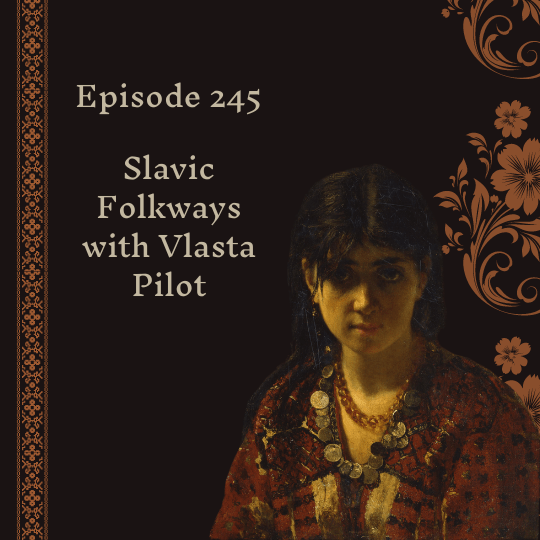
Episode 245 – Slavic Folkways with Vlasta Pilot

We speak to folk practitioner, artist, ‘zine writer, and author Vlasta Pilot of Gentle Hearts Unite about the nature of Slavic folk belief, the joy of handmade things, choosing bears, and how to avoid being a “cranberry.”

Of bears and klyukva

Summary: We speak to folk practitioner, artist, ‘zine writer, and author Vlasta Pilot of Gentle Hearts Unite about the nature of Slavic folk belief, the joy of handmade things, choosing bears, and how to avoid being a “cranberry.”

Please check out our Patreon page! You can help support the show for as little as a dollar a month, and get some awesome rewards at the same time. Even if you can’t give, spread the word and let others know, and maybe we can make New World Witchery even better than it is now.

Producer for this show: This episode is sponsored in part by listener Anna. Anna, we are proud to have you supporting us, and we’ll be arriving shortly to tattoo our gratitude on you in the form of a “thank you” sigil on your forehead (don’t worry, it’s like super-cute and kind of looks like an axolotl so you’ll loooove it).

Play: Episode 245 – Slavic Folkways with Vlasta Pilot
Stream:

Sources

We were delighted to speak with Vlasta Pilot, whose work you can find at the following places:

The transcript for this episode is available on our Transcripts page.

Some upcoming publications from us:

Please consider ordering our collaborative book Conjuring the Commonplace: A Guide to Everyday Enchantment and Junk Drawer Magic from 1000Volt Press! It’s available for purchase on Bookshop, Amazon, or from your local bookstore!

You can now buy Cory’s book, New World Witchery: A Trove of North American Folk Magic! (also available from Amazon) and the recent release Llewellyn’s Complete Book of North American Folk Magic as well (also available on Amazon)!

Please note that clicking on links may provide some monetary compensation to New World Witchery.

Image via Pixabay (Used under CC 2.0 License, modified by New World Witchery). Additional image credit Alexei Harlamov, CC BY-SA 4.0 https://creativecommons.org/licenses/by-sa/4.0, via Wikimedia Commons

If you have feedback you’d like to share, email us at compassandkey@gmail.com or newworldwitcherypodcast@gmail.com or leave a comment at the website: www.newworldwitchery.com . We’d love to hear from you! Don’t forget to follow us at Twitter! And check out our Facebook page! For those who are interested, we are also on TikTok now. You can follow us on Instagram (main account, or you can follow Laine as well) or check out our new YouTube channel with back episodes of the podcast and new “Everyday Magic” videos, too (as well as most of our contest announcements)!

Promos and Music: Title music is “Woman Blues,” by Paul Avgerinos. All music is licensed from Audio Socket (#35954).

Please consider supporting us by purchasing our promotional items in the New World Witchery Threadless shop or by joining our Patreon supporters. If you like us AND you like Buffy the Vampire Slayer, you will love our new show: Myth Taken: A Buffy the Vampire Slayer Podcast, now available through all the podcatchers! Please think about checking out our Audible Trial program. Visit Audibletrial.com/newworldwitchery to get your free trial of Audible, where you can download over 180,000 titles (including some narrated by Cory). Your purchases help support this show, and there’s no obligation to continue after the free trial

Episode 244 – Magical Alphabets and Scripts

We look at several magical alphabets and scripts this time, from runes to ogham to Enochian

Cursing with Cursive

Summary: We look at a few of the better (and some lesser) known magical alphabets and scripts this time, discussing runes, ogham, hieroglyphics, Enochian, and more!

Please check out our Patreon page! You can help support the show for as little as a dollar a month, and get some awesome rewards at the same time. Even if you can’t give, spread the word and let others know, and maybe we can make New World Witchery even better than it is now.

Producer for this show: This episode is sponsored in part by listener Anna. Anna, we are proud to have you supporting us, and we’ll be arriving shortly to tattoo our gratitude on you in the form of a “thank you” sigil on your forehead (don’t worry, it’s like super-cute and kind of looks like an axolotl so you’ll loooove it).

Play: Episode 244 – Magical Alphabets and Scripts
Stream:

Sources

An important note: one of our Patreon listeners with early access to the episode alerted us that Diana Paxson–whom we reference in this episode for her book on runes–has recently been removed from inclusive Heathenry group The Troth. We weren’t aware of that when we recorded this, and while we do believe her book has valuable information, we cannot endorse supporting her given the circumstances that led to her removal.

Other sources that might prove to be valuable on the topic include:

The transcript for this episode is available on our Transcripts page.

Some upcoming publications from us:

Please consider ordering our collaborative book Conjuring the Commonplace: A Guide to Everyday Enchantment and Junk Drawer Magic from 1000Volt Press! It’s available for purchase on Bookshop, Amazon, or from your local bookstore!

You can now buy Cory’s book, New World Witchery: A Trove of North American Folk Magic! (also available from Amazon) and the recent release Llewellyn’s Complete Book of North American Folk Magic as well (also available on Amazon)!

Please note that clicking on links may provide some monetary compensation to New World Witchery.

Image via Pixabay (Used under CC 2.0 License, modified by New World Witchery)

If you have feedback you’d like to share, email us at compassandkey@gmail.com or newworldwitcherypodcast@gmail.com or leave a comment at the website: www.newworldwitchery.com . We’d love to hear from you! Don’t forget to follow us at Twitter! And check out our Facebook page! For those who are interested, we are also on TikTok now. You can follow us on Instagram (main account, or you can follow Laine as well) or check out our new YouTube channel with back episodes of the podcast and new “Everyday Magic” videos, too (as well as most of our contest announcements)!

Promos and Music: Title music is “Woman Blues,” by Paul Avgerinos. All music is licensed from Audio Socket (#35954).

Please consider supporting us by purchasing our promotional items in the New World Witchery Threadless shop or by joining our Patreon supporters. If you like us AND you like Buffy the Vampire Slayer, you will love our new show: Myth Taken: A Buffy the Vampire Slayer Podcast, now available through all the podcatchers! Please think about checking out our Audible Trial program. Visit Audibletrial.com/newworldwitchery to get your free trial of Audible, where you can download over 180,000 titles (including some narrated by Cory). Your purchases help support this show, and there’s no obligation to continue after the free trial

Episode 243 – Black and White Magic

We look at history, etymology, and magical philosophy to understand magical dualism and where it came from

Dualism, Maleficum, and…jugglers?

Summary: In this crossover episode with our Buffy the Vampire Slayer podcast, Myth-Taken, we chat about the history, etymology, and philosophy of magical dualism. We look in to necromancy, alchemy, and strangely juggling all to try to understand where these dichotomies came from.

Please check out our Patreon page! You can help support the show for as little as a dollar a month, and get some awesome rewards at the same time. Even if you can’t give, spread the word and let others know, and maybe we can make New World Witchery even better than it is now.

Producer for this show: This episode is brought to you by Listener Elle. We have invoked and assigned a guardian angel in honor of your patronage Elle, and you should be visited by your multi-eyed fire-engulfed new BFF very soon!

Play: Episode 243 – Black and White Magic
Stream:

Sources

Cory gets pretty nerdy in this one, and uses a lot of sources including:

The transcript for this episode is available on our Transcripts page.

Some upcoming publications from us:

Please consider ordering our collaborative book Conjuring the Commonplace: A Guide to Everyday Enchantment and Junk Drawer Magic from 1000Volt Press! It’s available for purchase on Bookshop, Amazon, or from your local bookstore!

You can now buy Cory’s book, New World Witchery: A Trove of North American Folk Magic! (also available from Amazon) and the recent release Llewellyn’s Complete Book of North American Folk Magic as well (also available on Amazon)!

Please note that clicking on links may provide some monetary compensation to New World Witchery.

Image via Pixabay (Used under CC 2.0 License, modified by New World Witchery)

If you have feedback you’d like to share, email us at compassandkey@gmail.com or newworldwitcherypodcast@gmail.com or leave a comment at the website: www.newworldwitchery.com . We’d love to hear from you! Don’t forget to follow us at Twitter! And check out our Facebook page! For those who are interested, we are also on TikTok now. You can follow us on Instagram (main account, or you can follow Laine as well) or check out our new YouTube channel with back episodes of the podcast and new “Everyday Magic” videos, too (as well as most of our contest announcements)!

Promos and Music: Title music is “Woman Blues,” by Paul Avgerinos. All music is licensed from Audio Socket (#35954).

Please consider supporting us by purchasing our promotional items in the New World Witchery Threadless shop or by joining our Patreon supporters. If you like us AND you like Buffy the Vampire Slayer, you will love our new show: Myth Taken: A Buffy the Vampire Slayer Podcast, now available through all the podcatchers! Please think about checking out our Audible Trial program. Visit Audibletrial.com/newworldwitchery to get your free trial of Audible, where you can download over 180,000 titles (including some narrated by Cory). Your purchases help support this show, and there’s no obligation to continue after the free trial

Blog Post 149 – Witch Wars

The term “witch wars” comes up frequently in discussions about neo-Pagan community infighting, as shorthand for the feuding and vitriolic verbal sparring that happens periodically between rival groups. Such wars, however, have not always been barbs exchanged over message boards or smear campaigns between unfriendly covens. The nature of magical practice has almost guaranteed that so long as one witch could cast a spell, another could undo it.

So how do witches fight witches? With magic, of course, but so many of these tales involve what seems to be a battle of wills between two equally gifted magical workers. Strangely, while a witch might attack a person or family, when the witch-doctor enters the picture and counter-attacks the witch, the witch-doctor is seldom targeted back during the battle. Most of the witch-doctor’s services are more geared towards revealing the identity of a witch and providing victims a way to remediate their own problems. This is true in both New World and Old, as scholar Owen Davies demonstrates in his seminal text on English cunning folk, Popular Magic:

“The cure of witchcraft could be effected in three main ways: by going straight to the source and tackling the witch either physically or through the law courts; by breakin the spell at a distance via magical rituals; or by using a mix of herbs and charms to expel the witchcraft from the patient’s body. Cunning-folk were instrumental in facilitating all these methods,and they sometimes employed a combination of all three…the client saw what they wanted to see; in other words, the person they already suspected. The process was one of confirmation rather than detection…” (Popular Magic, Davies, 106-7)

The biggest step in fighting a witch was determining who he or she was. Then, a magical remedy would be applied to disrupt the spell which was affecting the victim. This might involve scalding milk from a bewitched churn, shooting an image of the witch with a silver bullet, etc. Then, in a critical step, the witch would attempt to come to the property of the victim and either enter the home or take something from the house. There seems to be a uniform understanding that such an act must be prevented, or else the witch’s power would remain or perhaps grow stronger over the victim. Davies gives one such example from England:

“In 1682 the parents of a bewitched girl named Mary Farmer were advised by ‘Dr Bourn’ to burn her clothes. He assured them ‘that then the witch which had done her the hurt, would come in.’ The parents testified in court that, having done this, a neighbor, Joan Butts entered their house, ‘and tumbled down, wallowing on the ground, making a fearful and dismal noise.’” (Davies, 109)

In this case, further magical action must be taken, including smoking a cow’s heart in the chimney, to break the witch’s spell.

The magical battles took place between malevolent witches and the community-sanctioned (or at least tolerated) ‘white witches’ or ‘witch-doctors’ indicate that those who could fight a curse were usually fairly well known to their community. A story from Hubert J. Davis’ The Silver Bullet tells of one such struggle, which occurred when a family sought to alleviate its suffering and bewitchment by calling in a man gifted at ‘overlooking’ or breaking curses. To break the curse placed on the family’s child, Tim and Ada consult with this ‘Quaker doctor’ (most likely a Pow-wow/braucher), who provides them with a stoppered bottle into which the family’s nail parings, hair, etc. are gathered, then left under the burning embers of the fire. Adding in some prayers, including a candle burning which ends with the traditional “In the name of the Father and the Son and the Holy Ghost” (further indication of Pennsylvania Dutch magical practice), the “tall, stinguished looking man with thick white hair and a well-trimmed moustache [and] kindly blue eyes” forbids them from letting anyone into their house for three days. Sure enough, an old woman by the name of Old Betty Orts attempts to come in, revealing her as the witch. At that point, the father strikes her head, drawing blood (which immediately saps the power of a witch), and the curse is broken (“The Quaker Doctor and His Magic Bottle,” Davis, 56-8).  The pattern of curse, diagnosis, prescription, attempted incursion, and final defeat of the witch is maintained.

In another account of Appalachian witch warring, an interesting and somewhat unusual battle occurs between two men (in most of these tales at least one of the magicians is female). Patrick W. Gainer recounts the battle between Uncle Johnnie and Uncle Jimmie Webb which took place over the use of a butterchurn. Uncle Johnnie, when denied use of the churn—and here it should be pointed out that the woman he wished to borrow from had two churns available, thus demonstrating the lack of social hospitality mentioned in my earlier post on the Witch’s Ire—enchants it so that he may steal her butter. Uncle Jimmie then helps the churn’s owner, Eliza Morris, to break the spell by whipping it with switches while churning with his left hand. This, in turn, causes Uncle Johnnie to suffer welts and undoes the enchantment (“Uncle Johnnie Bewitches the Cows,” Witches Ghosts & Signs, Gainer, 142-4).

This is not, of course, a wholly good vs. evil phenomenon. Scholar Emma Wilby notes that magical folk in England often employed their magic as the situation dictated, being neither entirely helpful nor entirely harmful:

“Although some cunning folk had a reputation for being wholly good, a large proportion of them were considered ambivalent, that is, they could employ their magical powers to both help and harm…The trial records of East Lothian cunning woman Beigis Tod, who was accused of witchcraft in 1608, echo this popular perception when they claim that Beigis was known to be skilled in both ‘on-laying and af-taiking of seiknes’. [Wilbiy’s italics, short for “laying on and taking off of sickness”].” (Cunning Folk & Familiar Spirits, Wilby, 54)

These mixed talents were often set against each other, with one magical practitioner putting a spell on a person, place, or group of people, and another showing up to take it off. Sometimes this un-bewitching was done for free, but frequently a fee would be charged, which led some to suspect that the ‘bad’ witches and the ‘good’ witches were in league with each other and splitting the profits. One such example is the tale of “Mont and Duck” from Hubert J. Davis, in which an old couple moves into an area which suddenly begins experiencing oubreaks of illness. The community blames the newcomers, of course, but the response is interesting:

“[O]ne of their neighbors accused Mont and Duck of having cast a spell on their sick cow. Old Mont awed his accuser by readily admitting that his wife, Duck, had the power of evil, and that he could break the spells. Shortly after this, he began to offer to cure ailing animals by removing the spells on them in return for a bushel of potatoes or some other vegetables, or even a piece of meat” (“Mont and Duck,” The Silver Bullet, Davis, 214).

One family that refuses to pay for relief from magical attack experiences a death in this story, and the entire community takes their powers quite seriously. Mont is valued, but feared, for his powers as a witch-doctor, and the racket they have established continues for quite a while without any repercussion from the locals.

Yet there are certainly accounts of magical battles in which the side of ‘good’ seems to be operating from a mostly altruistic stance. Arguably one of the most famous magical battles in American lore is the account of sorcerous combat between Sherrif James E. McTeer and Dr. Buzzard (presented here in quoted abbreviated form from Low Country Voodoo, by Terrance Zepke, and also found in American Shamans by Jack Montgomery):

“One person who remained unimpressed with the root doctor [Dr. Buzzard, aka Stephaney Robinson] was Sheriff J.E. McTeer. He was elected in 1926 and saw many stgrange things that were attributed to Dr. Buzzard, such as people getting sick and dying or witnesses having seizure in the middle of testifying in court…The sheriff…began a lifelong study of conjuring so he could better understand it. In time he, he became known as a ‘white root doctor.’ …McTeer felt strongly that he was the one who could stop Dr. Buzzard once and for all…[he] issued a warning that if the witch doctor didn’t stop, he would eventually bring him to justice.

The infamous root doctor was not used to being threatened. To the contrary—most folks feared or respected him too much to even think about it. The sheriff’s warning mae him so mad that the witch doctor set out to ruin him. The spiritual warfare came to a halt after Dr. Buzzard’s son was killed in a car crash. The conjurer believed the wreck was was the High Sheriff’s doing and went to see his adversary. The root doctor told th sheriff that he respected his mantle and would leave him alone if McTeer would do the same. McTeer agreed, on the condition that Dr. Buzzard quit practicing sorcery. The conjurer thought about it for several seconds before nodding his head in agreement” (Low Country Voodoo, Zepke, 82-4)

In this fighting-fire-with-fire version of the witch war, ‘good’ triumphs in the form of McTeer, though Dr. Buzzard would eventually return to his old ways with diminished success.

So, in conclusion, the witch war has not always been the genteel affair that it is today. When sharp tongues trade barbs, it can be unpleasant, but thankfully no one is stealing anyone else’s butter, drawing blood from anyone else’s forehead, or causing the death of someone else’s child to prove a point. Or at least, I hope they’re not. I think I’ll go and recharge my house protection spells now…

Thanks for reading!

-Cory

Blog Post 147 – Reviews and Recommendations

Hi all!

I’ve been reading a lot lately (but then, when am I not?). I’ve also managed to catch a couple of great movies as well. So I thought I’d share some of my thoughts on them with you! The excerpts below are the slightly abridged versions of the full reviews found over at Pagan Bookworm, so head over there if you want the full report.

1)      The Book of English Magic – by Philip Carr-Gomm and Richard Heygate (Overlook, 2010)

If you have spent much time studying occult literature, you know that Great Britain is rife with magical lore: fairies, Arthurian legends, druidry, cunning folk, etc. In The Book of English Magic, Philip Carr-Gomm and Richard Heygate make the not-too-audacious claim that Britain’s magical history is one of the richest—perhaps the richest—in the world. They approach their subject by examining a mix of history, folklore, and modern practices to attempt to piece together a portrait of Britain as an enchanted isle. While I think that they succeed in presenting a magical portrait of a magical land, I also think that the authors are by turns too broad and too narrow. They do a wonderful job looking into subjects like English alchemy and dowsing, providing a number of excellent resources to discover more about each topic. They also dwell overlong on the concept of druidry (not surprising considering it is one of Carr-Gomm’s chief fields of interest—he is also the author of Druid Mysteries, the Druid Plant Oracle, and the Druid Animal Oracle). The paucity of sources supporting some of their research means that while some chapters seem tight and focused, others seem only loosely woven together. They hardly plumb the depths of what is called Traditional Witchcraft, and the concept of cunning folk is given surprisingly short shrift considering how close to contemporary some of that material is. The inclusion of practical exercises gives a slightly ‘workbook’ feel at times, which deflates the momentum of the book in some places, but really does seem to serve the overall work.That being said, if one were looking for a good coffee-table introduction to the myriad magical traditions available to the student of British history, this would be an excellent starting point.

2)      The Voodoo-Hoodoo Spellbookby Denise Alvarado (Weiser, 2011)

This book is about what author Denise Alvarado calls “Voodoo-Hoodoo,” a term which irks some as the continuing inaccurate jumble of two terms which should remain distinct (Voodoo being a religion and hoodoo being a folk magical practice). However, if one takes the time to read Alvarado’s passionate book on the topic, the Voodoo-Hoodoo Spellbook, one can see that she is merely sticking to the terminology most people are familiar with and that the dog of diction has no teeth to bite when it comes to New Orleans-style magic. Instead, Alvarado presents a tradition which blends elements of Haitian Vodoun, folk Catholicism, Southern root work and hoodoo, and a touch of New Age spirituality to create a vibrant, current practice. She uses a number of good resources, often primary ones, to support her understanding of a practice she has lived with her whole life (according to her). She also frequently slips away from the facts and into personal experience, but does so in a non-authoritarian way. Her history of Mardi Gras and the magical folklore associated with them is captivating, as is her heartfelt look at the Seven African Powers. When she does slip off of the scholarly or personal track the book can get a bit messy. Her correspondence tables are not a strength, and her inclusion of New Age style tumbled gemstones in her work almost undermines her traditionalism (as it seems fairly obvious that slaves doing similar work in the 19th century would not have had polished rose quartz to work with). She is flexible and fluid towards Christianity, though here it should be pointed out that she neither says one must work with Christianity nor one must work with African Traditional spirituality. People are looking for spells, and this book definitely has those. There are spells for love, luck, money, protection, and half-a-dozen other needs. Hundreds of spells and workings are contained in this book, as well as recipes for conjure oils and powders, instructions for candle working, and a discussion of poppets and dolls in magical work. Some of them seem totally reasonable within the context of her presented practice, and some seem a little forced. This book fits nicely on the shelf next to other “hoodoo 101” texts, while offering a few doors to open for a reader looking to go deeper.

3)      Old World Witchcraft – by Raven Grimassi (Weiser 2011)

Don’t buy this book. I’m not even bothering providing a link to it. I’ve done a full review at Pagan Bookworm, but let me just say this text is badly researched, mis-cites or fails to cite sources, argues with scholars without presenting their actual point of view/argument, claims that graveyard dirt is just the powdered ash of tree leaves gathered in a cemetery, and says that you can become deeply knowledgable about a plant by studying its sigil. It’s bad history, bad herbalism, and bad witchcraft. All in all, this is a book which suffers from broken clock syndrome (as in, “a broken clock is right twice a day”). He occasionally hits on interesting ideas or brings up worthwhile concepts, but mostly he seems to be posing an elaborate fantasy as a pseudo-historical reality, with very little scholarly backbone to support his claims. When someone prods the gear works, the whole contraption just seems to fall apart.

4)      American Mystic, directed by Alex Mar (Empire 8 Productions, 2010)

Director Mar turns the camera on three different but spiritually similar people: Kublai, an African American man who belongs to the Spiritualist Church; Chuck, a Lakota Sioux sun dancer; and Morpheus, a pagan witch and Feri tradition priestess. The director captures the challenges of these faiths, including both internal and external struggles. While there is an element of novelty to the practices of each film subject, the director never lets curiosity turn into spectacle. The Sun Dance, which can be grueling for participants, is not simply a show of blood and muscle, but rather connects Chuck to his family in a powerful way. Kublai seems to struggle with just how much he believes in his own spiritual gifts. And Morpheus senses her displacement in the modern world, while at the same time she does not shy away from the society of other people.  The film does have its flaws, but keeps a sensitive and intelligent lens focused on these subjects and their deeply-felt spiritualism. This is a rare and lovely documentary on mysticism as seen at the ground level. Available on Netflix.

5)      All My Friends Are Funeral Singers, directed by Tim Rutili (IndiePix Films, 2010)

In this outstanding independent film from director (and bit player/musician) Tim Rutili, a lonely fortune-teller and magical worker named Zel (played by the radiant Angela Bettis) lives in an old country house inhabited by a wide range of unusual ghosts that only she can see. There are dead flappers, priests, blind musicians, and a strange, child-like woman named Nyla (Molly Wade) who cannot speak. Zel is not merely a medium, she is also a deeply talented magical worker. She smartly lays down a salt line in front of her bedroom door every night to keep her ghost-friends out. The director cleverly bookends each section of the film with bits of folk magic, title cards with things like “A wish made while burning onions will come true,” which lends to the overall enchantment of the piece. This is such a lovely and exceptional film that I easily overlooked its flaws in favor of being bespelled by these characters. I cannot recommend this film highly enough. Go, watch it now! Available on Netflix.

Whew! So that’s been my reading and watch list (at least, that all the ones I could write reviews about lately). What have you been getting into?

Thanks for reading!

-Cory