Blog Post 73 – Book Review

I know, I know, two book reviews in a row may seem excessive, but I spent a lot of time reading over the past few weeks, so bear with me.  Plus, you may find some new books to investigate!

Today’s book is Blue Roots by Roger Pinckney.  It’s about rootwork, hoodoo, and conjure, but not the broad, general kind so often discussed in other books and on blogs and webpages (including this one).  Instead, Pinckney focuses on the healing and magical traditions of one particular group:  the Gullahs.  Primarily associated with the Savannah, Georgia area, the Gullah people inhabit a large swathe of the lower Atlantic seaboard, especially the islands just off the coast of George and South Carolina.   They are often referenced as an “untouched” enclave of African-American culture, and portrayed as a sort of quaint and folksy pocket of rural Americana.

Pinckney does little to disabuse the reader of those notions, creating a fairly warm, nostalgic book about folk healing practices (and a little bit of magic, too) found on the Southern Atlantic coast.  The author also spends a good bit of time examining the spiritual practices of the Gullah, with an emphasis on spirits, the dead, ancestors, and African Diaspora remnants.  From a section on the “haint blue” paint commonly found around doors, windows, and porches in the Southeast:

“Prior to the [American] Revolution when coastal plantations produced indigo dye for English cloth, planters gave their slaves the dregs from the boiling pots, which the slaves used to decorate window frames and porch posts, in the believe the blue color kept the plentiful spirits at bay.  When indigo cultivation declined in the 1780s, Gullah slaves continued the custom with blue paint.  It is a practice that survives to this day, perhaps no longer for a spiritual repellent, but as a tradition, nevertheless” (p. 72).

The book generally does a good job of highlighting some of the beliefs and practices associated with the Gullah, and also pays wider homage to the Southern incarnations of hoodoo and African religion.  Pinckney sometimes seems uncomfortable with rootwork as a magical practice, and prefers to refer to those who use herbs, roots, and animal parts as “root doctors” rather than “conjurers.”  His attitude in general is that of a journalist who does not believe most of what he’s told, but who really wants to.  He explains a lot of rootwork’s more magical components as methods of psychological intimidation.  In his chapter “The Power of the Root,” he describes an hypothetical visit to a root doctor in detail, then concludes with this sentiment:

“And will the root actually help him?  Probably so.  If rootwork were not effective, the practice would have died out centuries ago.  Most likely, one of the man’s [the client] confidants will mention the conjuration to another, and the news will go whispering through the community until the rejected woman [the target] hears that she has been rooted.  And since she knows in her heart that all her subversion was wrong in the first place, she will immediately desist her sundry annoyances” (p. 62).

This perspective is not one I particularly endorse, as I truly think rootwork has power in and of itself, and that the spiritual and magical components are far greater than the psychological ones, but it is certainly not an invalid point of view.

Some of the best chapters in this book are about Sherriff J. E. McTeer and his battles with the infamous Dr. Buzzard.  I mentioned both of these famous conjure men in my post on Who’s Who in Hoodoo, Part II, and they both feature prominently in Jack Montgomery’s work, American Shamans.  Pinckney spends a lot of time on their lore and their recorded history, which sometimes differ quite a bit.  Actually, the lore he presents in most of his chapters is quite good, and he uses a journalist’s nose for facts to substantiate or repudiate certain points, while never discounting the broader nature of a story’s “truth.”

This is a book that I recommend to those interested in Southern rootwork, particularly its history and social relevance.  It’s not one you can learn a lot of new tricks from, but you can certainly pick up a few things as you read.  If nothing else, Pinckney has a deep love and reverence for the Gullah, the South, and rootworkers at large, so the book feels like a conversation with a good friend.  If you think hoodoo, particularly the kind found in the Carolina/Georgia islands, is your thing, check out Blue Roots.

Blog Post 72 – Book Review

Hi everyone,

I’d like to recommend a book today which falls firmly into the “fiction” category, but which has an amazing amount of conjure-related material in it.  It’s called Mojo: Conjure Stories, and is edited by Nalo Hopkinson.  I say “edited by” because this is a collection of short stories, and every one revolves around some deep South magical topic.  Some are okay, some are quite good, and many are superb.  The book features authors like science-fiction maven Barbara Hambly, African-American author devorah major, and dark fantasy genius Neil Gaiman.

Here are just a sampling of the stories in this excellent tome:

“Daddy Mention and the Monday Skull” by Andy Duncan – An aged convict contacts an alligator swamp spirit in order to get a beautiful singing voice (and consequently a chance at freedom), but winds up biting off a good deal more than he can chew.

“Heartspace” by Steven Barnes – A man goes to visit his estranged and dying father, only to walk into the middle of a conflict between his fiery half-sister and his father’s new wife—a Gullah woman with some powerful tricks up her sleeve.

“The Skinned” by Jarla Tangh – An old man who knows the secret behind the terrifying monsters lurking in his neighborhood decides he will confront the beasts, only to endanger his very soul in doing so.

“Death’s Dreadlocks,” by Tobias S. Buckell – The children of an African village caught in the crossfire of several warlords turn to Old Ma, who teaches them to see the ropy strands of Death’s hair all around them and avoid fatality.  The children decide to follow the hair back to its source and put an end to Death once and for all.

“The Horsemen and the Morning Star” by Barbara Hambly – The Old Gods from across the sea ride their “horses” (slave devotees) in order to battle a plantation owner and his sorcerous friend, who are conjuring up their own forces—Satan himself—using the slave children as sacrifices to do so.

“Cooking Creole” by A. M. Dellamonica – A man who’s tried his hand at gambling, guitar playing, and other “gifted” talents decides to go to the crossroads one last time.  He thinks he’s finally found his calling:  he wants to learn to be a Cajun cook.  But he doesn’t know just what this cooking school will cost him.

“Shining through 24/7” by devorah major – This strange tale revolves around a woman who tries to steal from a hoodoo woman.  A hoodoo woman who happens to live near a chemical storage facility.  A radioactive chemical storage facility.   A strange but delightful story.

And these are only about half of the wonderful tales collected in this book.  I picked it up out of my local library and loved it.  If you have any interest in Southern folk magic, African-American religious practices, fairy tales and fantasy, or just plain old good storytelling, I highly recommend getting this book.

Thanks for reading!

Cory

Blog Post 71 – How I Spent My Summer Vacation

Hello everyone!

We’re almost at the end of this hiatus, and I haven’t posted anything really since right before I went off to grad school for the summer.  But that doesn’t mean I haven’t been up to some witchy business in the meantime.  Today I thought I’d share a few of the things I’ve been doing over the past six weeks (well, other than performing detailed exegeses of 18th-century English poetry and seeing about 27 different versions of Shakespearean performances).

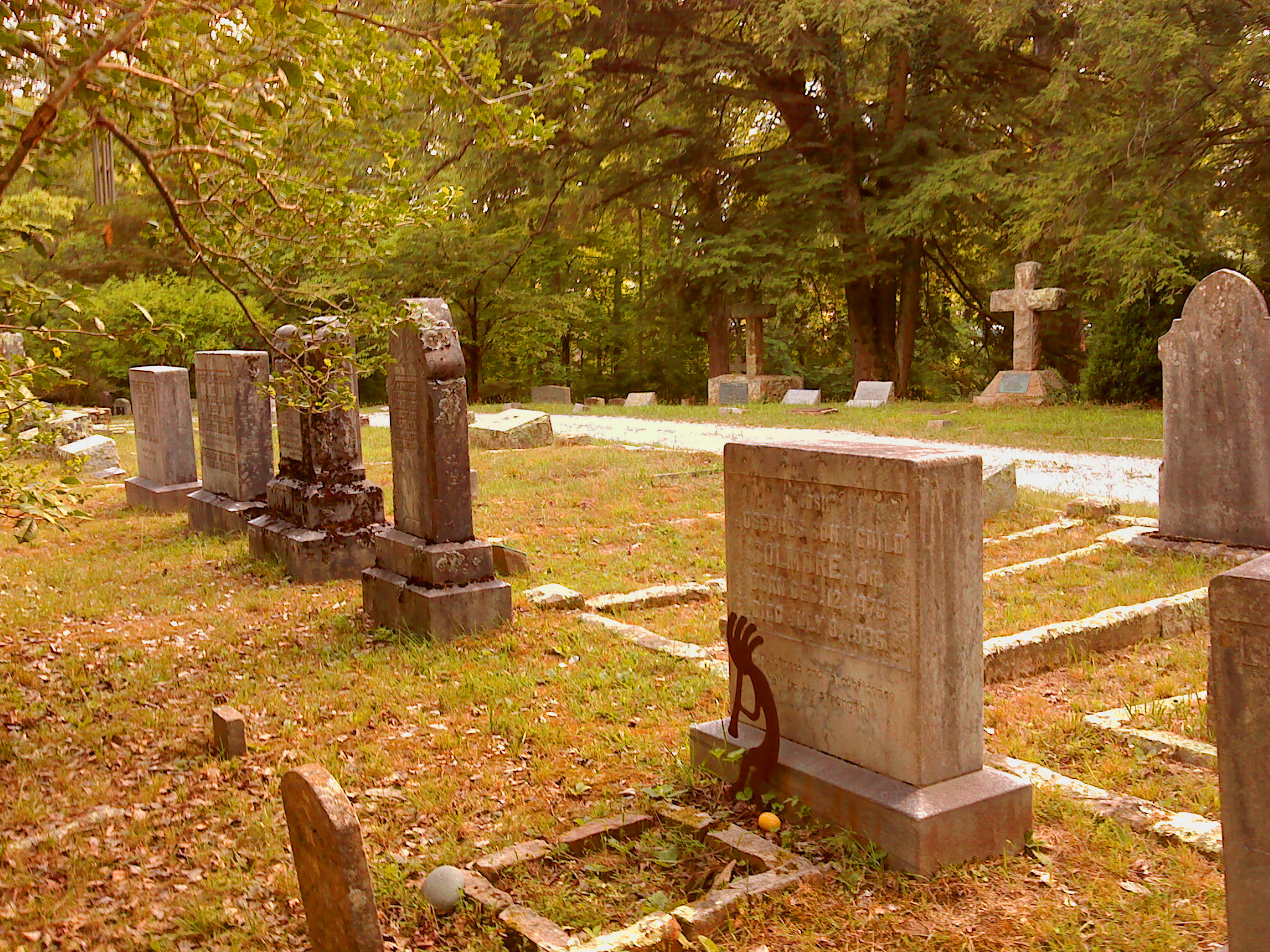
The first thing I should tell you is that I was living on campus, and this campus just happens to be a beautiful rural campus right at the edge of Appalachia.  My access to folklore primary sources was much abetted, and my opportunities to get out in the woods increased a good bit.  Secondly, my dorm was immediately across from a beautiful old cemetery.  As you can probably guess, I spent a good bit of my time there.  Here are some photos of the amazing graves and other funerary décor found in the old boneyard.The graves here date back to around the mid-nineteenth century, so they aren’t incredibly old, but many of them are gorgeous.  And they are certainly older than lots of other cemeteries in the area.

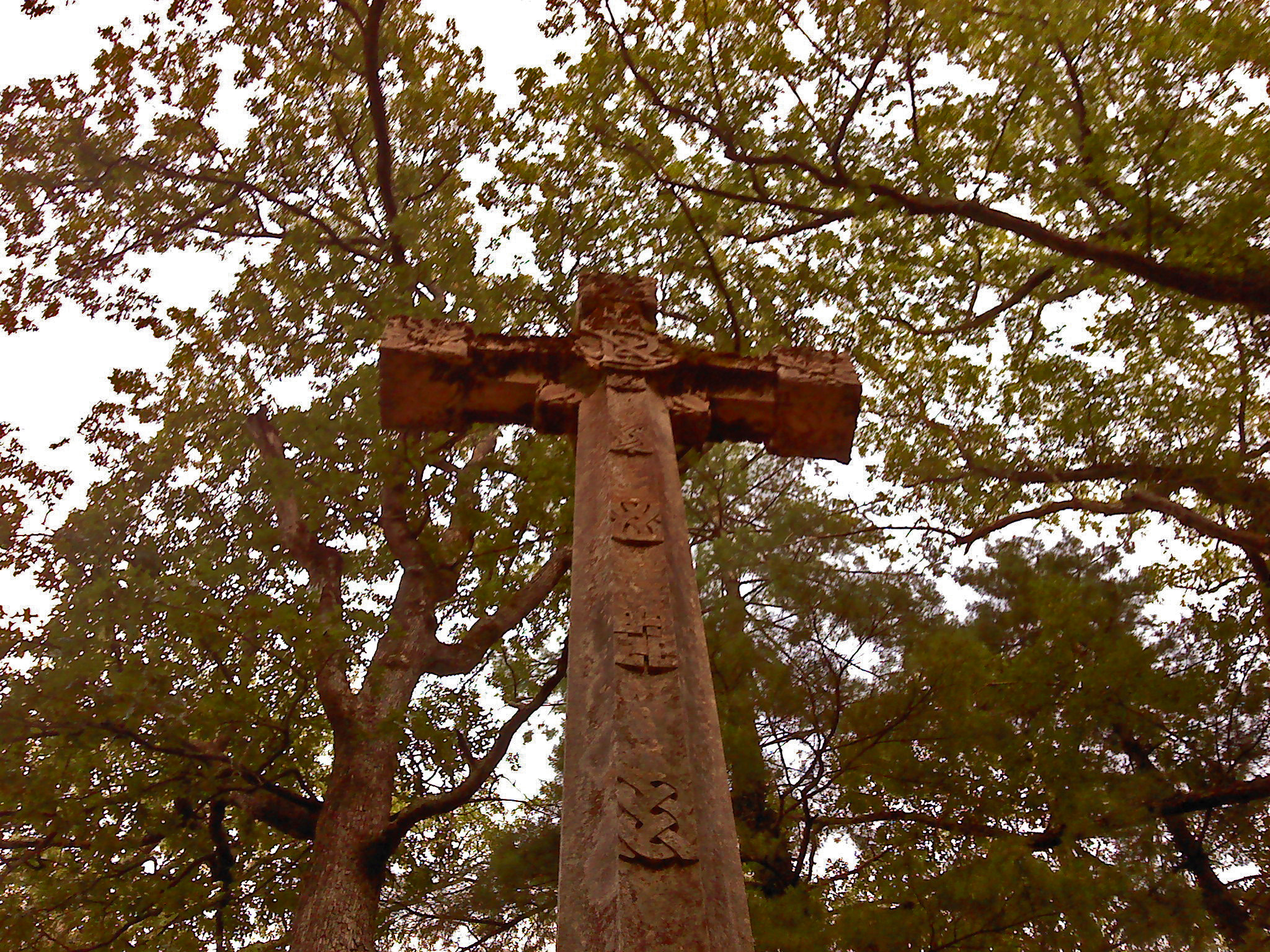
This also happens to be a religious school, so there are plenty of beautiful crosses here, too.  Since it’s as close to Appalachia as it is, the cemetery has a strong Celtic influence in the stonework.

The time I spent here mostly involved taking late night (or often midnight) walking tours of the area.  Among all those graves and under a very starry sky, it was pretty amazing.  If you’re wondering whether or not I encountered “anyone,” though, I have to say the answer is no.  I did bring offerings of food and whiskey several times, leaving them near the small side gate rather than any specific grave (since I wasn’t trying to contact anyone in particular, that made sense to me).  Wildlife abounds near this cemetery, so I often heard things wandering out in the dark just beyond the light’s cast.  I even occasionally met other folks taking late night constitutionals among the headstones.

Since I wanted to do well in my schoolwork, I also made up a potent little mojo bag, which I carried in my pocket.  I anointed it daily with either Crown of Success oil or some local whiskey, depending on what seemed appropriate for the day.  As far as I can tell, it worked magnificently (though I’m still waiting to get final grades back…mojo don’t fail me now!).  I may outline just how I made this specific mojo bag later this week in case there are other students looking for a little “oomf” in their studies.

Of course, a huge portion of my time was dedicated to reading completely non-magical texts (Paradise Lost, vast quantities of Shakespeare, a number of Restoration-era authors like Swift, Pope, and Dryden, etc.), but I also had time to work my way through a few magically inclined books as well.  I’ll be posting some reviews of those as time permits this coming week, so stay tuned for those.

The beautiful natural surroundings of the school also afforded ample opportunities to get outdoors.  Though the heat was stifling some days, trees always provided comforting shade and occasional mountain breezes helped cool me off, too.  So many of the plants that grow in that area have magical connections:  elder, sumac, sweet gum, passionflower, poke berries, and blackberries all grow wild.  I did some harvesting, particularly a good bunch of sassafras, so I’ll try to get some info up on that at some point, too.

Last, but certainly not least, I also had long drives to and from school on the weekends, so I filled up my iPod with lots of witchy podcasts and caught up on some of my favorites.  I also got to hear some new ones (at least new to me) that were excellent.  If you haven’t checked out Pagan Hooligans yet, it’s a great show and the hosts are a lot of fun.  They’re recording their adventures in paganism from day one, and it’s really a refreshing perspective!  I’ve also started really listening to and enjoying Iron Powaqa Radio, which has a decidedly sassy side and always makes me smile.

So that was my summer in a nutshell, I suppose.  I’m going to be trying to get back in the swing of regular posts as soon as possible, and hopefully there will be another podcast up fairly soon, too.  Until then, thank you all for your patience and support!  Feel free to post, email, discuss, and generally share your own New World Witchery here, and we’ll look forward to hearing from you!  Thanks for reading!

All the best, and be well,

-Cory

Podcast Special – Spellcasting Greatest Hits

-SHOWNOTES FOR SPECIAL – SPELLCASTING GREATEST HITS-

Summary
This mid-hiatus special is all about successful spellcasting.  We discuss our most effective spells, our favorite techniques, and some of the philosophy and mechanics of potent magical practice.

Play:

Download:  New World Witchery – Podcast Special – Spellcasting Greatest Hits

-Sources-
*The Lucky Mojo page on “Honey Jars” contains great information on this lovely little family of spells.
*Here are a few pages on lost item spells, particularly the St. Anthony charm mentioned by Cory.
*John George Hohman’s Long Lost Friend contains the Pow-wow spells mentioned in this show.
*The Encyclopedia of 5000 Spells, by Judika Illes, contains many wonderful spells, and is a book we both turn to often.

Music
“Grifos Muertos” by Jeffery Luck Lucas, from his album What We Whisper, on Magnatune.com

Blog Post 70 – Elder

I’ve been noticing a lot of the elder trees blooming in my neck of the woods lately, so I thought I might take a stab at sharing some information on that particular plant.

Elder is a tree that has a long history with humanity.  Its uses are broad, including medicinal, culinary, and magical aspects.  Generally speaking, elder comprises anything in the genus Sambucus, with species names like nigra, canadensis, peruviana, etc. depending on region and appearance.  Elders can be very shrubby, or full-grown trees reaching up to 25 feet tall.  They have white flowers which bloom in the summer in bunches called corymbs (these are very prominent, so much so in fact that I felt compelled to write a blog post on them).  The blue-black berries, which appear in late summer and early fall, are a foodstuff used in everything from jams to vinegars.  The shoots of the elder have even been used as toys.  According to Botanical.com:

“The popular pop-gun of small boys in the country has often been made of Elder stems from which the pith has been removed, which moved Culpepper to declare: ‘It is needless to write any description of this (Elder), since every boy that plays with a pop-gun will not mistake another tree for the Elder.’ Pliny’s writings also testify that pop-guns and whistles are manufactures many centuries old!”

Medicinally, elders different parts have different uses (a quick note:  I am not a medical professional.  Please seek professional medical advice before using any plant medicinally).  The flowers have been used in tisanes to help alleviate all manner of ailments: sore throats, swollen tonsils, flu symptoms, etc.  The cooled elder tea could also be used topically on sunburns or to alleviate sore eyes.  The leaves of the elder can be used as a poultice or turned into an unguent to treat bruises, cuts, and abrasions.  The bark can be used as a potent purgative, though the inner bark is better for this than the outer.

As food, elder berries are most commonly consumed as elderberry jam.  They can also be turned into a syrup, and made into a delicious cordial for the adults in the crowd.  A sweet and slightly spicy wine can also be made from the berries, which seems to be very popular among the brew-it-yourself crowd.  I remember an old herbal book of mine which also contained a recipe for drinks like elderberry fizz and elderberry flip, which are essentially cocktails made from either the wine or the cordial.

Magically, elder has appeared in many cultures with many different purposes.  Some of the Old World magical associations with elder include:

  • Driving away evil spirits (Russian)
  • Magically removing fever (Czech)
  • Protection against witchcraft (English)
  • Good luck at weddings (Serbian)
  • Preventing theft (Sicilian)
  • Bad luck if burned (Romany)

The Danes believe that furniture made from elder wood is haunted by a spirit called Hylde-Moer (or “Elder Mother”), who may bear a connection to Mother Holle in Teutonic mythology.

On this side of the Atlantic, elder shows up in several systems.  John George Hohman’s Long Lost Friend recommends frying elder leaves with tobacco leaves in butter to make a healing salve.  In hoodoo, elder is used primarily for protection.  Hung in a bag near the entrance to the home, elder wood and flowers prevents intruders from coming in.  When mixed with the potent devil’s shoestring herb, it can prevent any unwanted guest from getting close to your home.  Catherine Yronwode’s Hoodoo Herb & Root Magic recommends elder as part of a Law-Keep-Away spell:

“Determine how many ways there are to enter the place where you conduct your business, and for each way, cut an elder stick five inches long, and get a small piece of John the Conqueror root.  On each elder stick carve five notches, one-half inch apart, then cut a sharpened point on each stick.  About fifty feet down each path leading to the place, drive a hole into the ground.  Put a piece of John the Conqueror root at the bottom of the hole, followed by an elder stick, pointed end down, with all the notches facing North.  It is said that no law officer will walk or drive over those elder pegs”  (HHRM p.90).

Yronwode also recommends drawing a circle around oneself with an elder branch and making a wish.  If you try this out, I’d love to hear your results!

There are probably dozens of other things I’m missing about elder, but hopefully this is a good start.  If you have uses of elder or experiences with the plant you’d like to share, please feel free to do so!

Thanks for reading,

-Cory

Blog Post 69 – Charmed Again


Today I’m going to add to Blog Post 67’s charm list and look at a few other simple, word-based spells.  Most of these are rooted in Pow-wow practices, but they are also found throughout other systems as well.  A caveat before I begin, however:  do not take these charms in place of medical advice.  They have their uses and are worth learning, but I am not a medical professional and you should not construe these bits of folk life as prescribed physiological recommendations.  If you get burned or are bleeding badly, seek professional help.

Okay, now on to the charms!

Dealing with Enemies

Overcoming an Enemy (Pow-wow)
This charm to gain advantage over someone who is trying to bully you comes from Hohman’s text, and again I have had little occasion to use it but I rather like the poetry of it:

A CHARM TO GAIN ADVANTAGE OF A MAN OF SUPERIOR STRENGTH.
I [name] breathe upon thee. Three drops of blood I take from thee: the first out of thy heart, the other out of thy liver, and the third out of thy vital powers; and in this I deprive thee of thy strength and manliness.

This particular spell veers very close to a curse, though it also falls into a “self-defense” category, I think.  You don’t, of course, get the three drops of blood from them, though I imagine if you could it would make this spell something much more powerful and possibly much more dangerous.

Healing Charms

Blood-stopping Verse (Pow-wow, Granny Magic, Mountain Magic)
This may be one of the best known mountain charms.  When spoken, this little spell stops a bleeding wound (a non-critical one that is…serious wounds require medical attention!).  There are a few variations on it, and the rules change a bit from person to person, but the words are pretty much the same:

“And when I passed by thee, and saw thee polluted in thine own blood, I said unto thee when thou wast in thy blood, Live; yea, I said unto thee when thou wast in thy blood, Live.”

Those of you who are Bible-savvy probably know this already, but this is simply a passage from Ezekiel 16:6.  It is similar, though not the same as, Psalmic magic (see below).  This charm is mentioned in The Red Church by Chris Bilardi, and has also been featured on Dave Tabler’s excellent Appalachian History blog.  The passage of this charm is typically supposed to be from male-to-female, though it seems there are ways around this restriction (such as “telling” the charm to an inanimate object while someone else in the room is listening).  As to effectiveness, all I can say is that I’ve used it three times and all three times it has worked.

Another Blood-stopping Charm (Pow-wow)
Here’s a different blood-stopping verse from Hohman’s Long Lost Friend:

TO STOP BLEEDING.
I walk through a green forest;
There I find three wells, cool and cold;
The first is called courage, p. 34
The second is called good,
And the third is called stop the blood.

Hohman actually lists about half-a-dozen blood-stopping charms, so I highly recommend looking into his book for more information on the topic.

Stopping Burns (Pow-wow, Mountain Magic)
Here are two charms used to help heal burns and alleviate the pain associated with them (both from Hohman):

HOW TO CURE A BURN.
Three holy men went out walking,
They did bless the heat and the burning;
They blessed that it might not increase;
They blessed that it might quickly cease!

+ + +

(The “+++” means that you make the sign of the cross with your hand over the burn three times)

ANOTHER REMEDY FOR BURNS.
Clear out, brand, but never in; be thou cold or hot, thou must cease to burn. May God guard thy blood and thy flesh, thy marrow and thy bones, and every artery, great or small. They all shall be guarded and protected in the name of God against inflammation and mortification, in the name of God the Father, the Son, and the Holy Ghost. Amen.

I’ve used the first of these charms a couple of times, and noticed a temporary effect.  The pain may not go away entirely but it’s a lot less and the burns didn’t scar, so that might be a good sign.  Or a placebo effect of some kind.  But I leave it up to you to figure it out for yourself.

Psalms (Curanderismo, Pow-wow, Hoodoo, Mountain Magic, most American folk magic systems)

Finally, I thought I’d list a few Psalm fragments which can be written and carried or spoken aloud in times of need.   I personally LOVE Psalmic magic.  You can feel free to use the whole Psalm or just the pertinent portions depending on your spell, but I highly recommend this method of magic.  The Bible, I seem to find more and more, is just loaded with magic, if you know where to look.  And almost no one questions you if you happen to say or write a Bible verse.  Of course, if you have problems with Judeo-Christian religion, this might not be the course for you.  You can find a great list of Psalms and their uses in the Appendix to Chris Bilardi’s The Red Church, the Curious Curandera’s Library Page, and the Lucky Mojo site has a good list, too.

Here’s a sample of Psalms as charms:
Headaches Psalm 3 – “Thou, O LORD, art a shield for me; my glory, and the lifter up of mine head”
Protection & PeacePsalm 22 – “be not thou far from me, O LORD: O my strength, haste thee to help me” (This is the Psalm Jesus sang upon the cross)
Against EnemiesPsalm 35 – “Contend, O GOD, with those that contend with me”
Success & Good FortunePsalm 65 – “Thou crownest the year with thy goodness; and thy paths drop fatness”
Safe TravelsPsalm 121 – “I will lift up mine eyes unto the hills, from whence cometh my help”

The topic of Psalm magic could be a post in itself, or a book even.  Several books, actually.  In fact, there are plenty of wonderful books on this subject, and I recommend tracking them down if you can.

That’s it for today’s charmed life.   If you have any charms to share, please feel free to do so!

Thanks for reading!

-Cory

Podcast 11 – Magical Tools

-SHOWNOTES FOR EPISODE 11-

Summary
Today we announce the upcoming break due to Cory’s grad school (don’t worry, we’ll be back sooner than you think!).  Then we talk about magical tools in American witchcraft, and we have our WitchCraft and Spelled Out segments.

Play:

Download:  New World Witchery – Episode 11

-Sources-
Mules & Men, by Zora Neale Hurston – mentioned in the show
Lucky Mojo site – particularly rabbits’ feet, gator parts, and raccoon bones
Hoodoo Root & Herb Magic, by Catherine Yronwode – lots of info on magical curios
Mojo:  Conjure Stories, by Nalo Hopkinson – the book I’m reading now which I mentioned when discussing gator heads

Promos & Music
Title music:  “Homebound,” by Jag, from Cypress Grove Blues.  From Magnatune.
Promo 1 – Iron Powaqa
Promo 2-  Witches’ Brewhaha

Blog Post 63 – Black Pepper

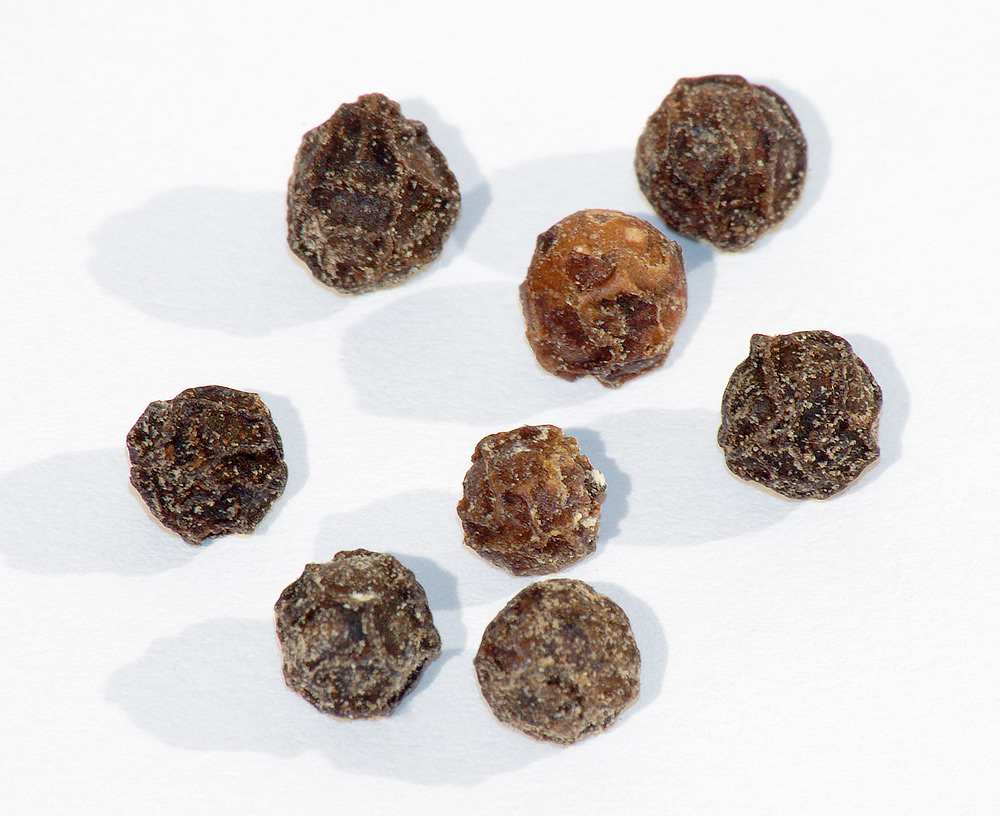
Today I thought I’d take a brief look at a magical ingredient which most everyone has on hand:  Black Pepper.  There are many uses for this dried fruit of the Piper nigrum plant.  Of course it’s valued for its ability to enhance food with a bit of heat, but it also has medicinal properties, and is very common in hoodoo practice as well.

Botanical.com lists the black peppercorn’s medicinal properties as being a febrifuge (fever reducer) and a stimulant and carminative.  For those with enflamed throats or ailments of the uvula, the site recommends using an infusion of black peppercorns as a gargle, and also suggests using the herb for constipation and urinary troubles.

In Appalachian practice, Granny women would sometimes use an infusion of black pepper to help induce labor in an expectant mother, because of its stimulatory nature.  They might also have the mother “snuff” or “quill” black pepper for the same results:

“Snuffing entailed having the mother sniff black pepper…from a plate placed under her nose; quilling involved blowing the same substances directly into the mother’s nostrils or throat with a goose quill, reed, or rolled piece of paper.  Either way, the objective was to cause a violent sneezing attack that would induce labor” (Folk Medicine of Southern Appalachia p.130).

In hoodoo, the black peppercorn is used primarily to harm or protect.  It’s often added to things like Hot-Foot powders or crossing tricks to facilitate an uncomfortable “heat” in the target’s life.  Catherine Yronwode also notes that black pepper can be used to stave off a jinx, particularly one which has been stepped in:

“To shield yourself from anyone doing these things [poisoning you through the feet via powder or other foot-track magic]…sprinkle black pepper powder or a mixture of black pepper and Fear Not to Walk Over Evil Powder in your shoes.  It is said that your track will be invisible or invulnerable to harm, and even if someone does throw for you or lift your foot track, they won’t be able to affect you in any way” (HHRM, p.53).

She also mentions that black pepper can be mixed with salt and thrown after someone when they leave your home to prevent them from ever returning or doing you harm.  Since salt and pepper are rather easy to come by in most homes, doing a spell like this is simple, and because the ingredients are so common most people don’t think twice about seeing them on the ground.  In fact, a light sprinkling of these ingredients would probably go unnoticed even in a busy apartment complex, and would be easily vacuumed up later, which makes a spell like this good for the urban root worker or witch (in my opinion, of course).  I’d combine it with the practice of leaving a broom behind the door just to double up the protection from unwanted visitors, too.

There are several potent curses which can be levied using black pepper, too.  Catherine Yronwode’s Hoodoo Herb & Root Magic book has an excellent entry on these, so I’ll not rehash everything in her entry here.  I will say that the spell she mentions involving a black candle and 99 peppercorns taken to a crossroads sounds particularly nasty, and would be well worth learning, if only to have an idea how to undo it should someone do it to you.

That’s it for today!  I wish you all a wonderful weekend.  Please don’t forget to vote in our polls, too!  They’ll be open through the weekend, and you can find them in Blog Post 61 or at the top right of the sidebar.  Thanks for voting, and as always, thanks for reading!

-Cory

Podcast 10 – Urban Conjure and an Interview with Rootworker Stephanie Palm

-SHOWNOTES FOR EPISODE 10-

Summary
In this episode, we share some thanks with our listeners and readers.  Then, we have an interview with urban rootworker Stephanie Palm.  We finish things up with our WitchCraft and Spelled Out segments

Play:

Download:  New World Witchery – Episode 10

-Sources-

Interview
Music City Mojo – The online store for our guest, Stephanie.   It features products and services as well as contact information.

WitchCraft
Drag Me to Hell – We mention this comedy/horror movie as a source of button-lore.

Magic Spelled Out
Lucky Mojo Freezer Spells – This has a good, concise history of the “Shut Your Mouth” tongue/freezer spells.

Promos & Music
Title music:  “Homebound,” by Jag, from Cypress Grove Blues.  From Magnatune.
Promo 1 – Witchery of One
Promo 2- Standing Stone and Garden Gate Podshow
Promo 3 – Inciting a Riot (a custom-made promo from wunderkind and friend of NWW, Fire Lyte!)

Blog Post 42 – Five-finger Grass

Catherine Yronwode calls this “the most popular green, leafy herb in hoodoo” (HHRM, p. 95).  It’s known by several names, including Cinquefoil and Tormentil (which is actually a particular species in the broader genus of Potentilla, which also includes Five-finger Grass).  This herb, which is not actually a grass, is one of the best to keep around.  It’s fairly easy to grow from seed, or from root cuttings as it is a rhizome.

The value of this herb has been known for a long time.  Sir Francis Bacon noted that it seemed to attract a particular type of wildlife, saying “The toad will be much under Sage, frogs will be in Cinquefoil” (The Works of Sir Francis Bacon, p. 548).  John George Hohman mentions it in his The Long Lost Friend, saying “If you call upon another to ask for a favor, take care to carry a little of the five-finger grass with you,

and you shall certainly obtain that you desired” (Hohman, #14).

This particular herb is a very positive one.  It’s used for protection because of its hand-like shape (imagine a hand held up to halt evil in its tracks), but also in love spells, money and luck workings, and even travel magic.  Here are some of the basic ways to use it:

  • Take a pinch of cinquefoil and put it behind a mirror (in the space between the mirror and its backing).  Then hang the mirror where it faces your front, or main, door.  A landlord or debt collector will be unable to force you from your home, and anyone coming to see you will be predisposed to show you kindness.
  • Carried with Comfrey Root and Lodestone in a black bag and dressed with Commanding Oil, it prevents you from getting lost in your travels (this spell is from Catherine Yronwode, HHRM, p. 95)
  • According to Judika Illes’ Encyclopedia of 5000 Spells, burning Cinquefoil as incense before bed will let you dream of your lover
  • Mixed with Deer’s Tongue and Calamus root and powdered, it can be used to dress love letters in order to encourage loving thoughts from your intended.
  • Putting a pinch of the grass in your wallet or purse will keep you lucky with your money, helping you to spend it wisely, find good bargains, and have luck when you risk it at games of chance.
  • Add it to a mojo bag with a Lucky Hand Root and an Alligator Foot or Rabbit Foot charm, then feed the bag with Hoyt’s Cologne or another lucky scent for help when you’re playing cards.
  • Made into a strong tea and used as a floor wash (or combined with another floor treatment like Chinese Wash) Five-finger Grass will remove curses put upon your household.  You can also add other protective herbs like Rue or Rosemary to help with this.

Botanical.com mentions that the herb has also had reputed healing qualities ascribed to it for quite some time.  In days of yore, it was used to heal aches and sores (esp. those which were ulcerous, such as sores in the mouth), and also to help ease coughs.  Today, they say that “the dried herb is more generally now employed, for its astringent and febrifuge properties.”

You can grow or buy this herb, and it’s definitely a good one to have around your front door (remember the protective qualities; it might even keep the Jehovah’s Witnesses away!), if there’s a sunny spot for it—it prefers full sun and does well in rock gardens.  It’s got very pretty little yellow flowers, similar to a strawberry plant’s.  However you get it, I definitely recommend having it on hand if you are going to be doing hoodoo for luck or money.  Or any number of other spells, for that matter.  I hope you’ve enjoyed this herb, and this week’s posts!

Thanks for reading!

-Cory