Blog Post 49 – Snakes

I hope you’ve got your good boots on today, because we’re getting into the tall grass and looking for snakes!  Snakes have had a place in magical lore for a very long time.  In Ancient Greece, Artemis and Apollo were sometimes associated with snakes.  Apollo was famous for slaying the great serpent Python (see Ovid’s Metamorphoses, Book I), and his priestesses were ever afterwards known as the Pythia.  Artemis, offended by King Admetus’s oversight of an offering due her, filled his bed with serpents.  In Vodoun tradition, the Creator figure is a great serpent, Damballah.  Stories of creation and snakes seem to go hand in hand across many cultures.

In the New World, snakes have a mixed significance.  On the one hand, the biblical story of Eden in Genesis lays a lot of the blame for humanity’s disobedience on the serpent in the garden.  At the same time, humanity would be without knowledge without the snake, so there’s more than one way to look at the story.  However, if you ask many Christians today who the snake was, they will answer “the Devil” or “Satan,” so for all intents and purposes, mainstream culture takes a fairly negative view of these slithering creatures.  That does not mean, however, that all snakes are viewed as little devils, and many folks actually like them.  Farmers like snakes because they keep rodent populations down in barns and fields, for example.

In magic, snakes are one of the most potent animals you can use.  There are several different magical traditions surrounding snakes or their various parts and pieces.  Catherine Yronwode notes that “the blood, eggs, heads, flesh, sheds, and skins of all species of snakes are used in jinxing and crossing” and the manufacture of various hoodoo mixtures, like Goofer Dust or Live Things In You poisons (HHRM p. 186).  She also mentions that the sheds can be used to calm one’s mind.  Other hoodoo-related uses of snake sheds and bones include situations where cunning might be needed, or for luck and power.  In this last case, rattlesnake bones and rattles are often used.  Musicians who wish to play well and win contests often keep a rattle with their instruments, according to Yronwode.

In the case of the Live Things In You curse, powdered snake parts—usually eggs or sheds—are mixed into a victim’s food.  The target then feels as though the creature is wriggling around in his body, causing him pain and distress, as well as the feeling that he might be going crazy.  You can read more about this kind of baleful working in Superstitions & Folklore of the South, by Charles W. Chestnutt, at the University of Virginia website.

Vance Randolph recorded several bits of magical lore concerning snakes in his Ozark Magic & Folklore:

  • To cause a rain, a snake could be hung belly-up on a fence (p. 30)
  • Burning shoes in the fireplace will drive away snakes (p. 68)
  • Snake-skin soaked in vinegar is applied to boils to reduce them (p. 101)
  • Snake-bites treated by doctors will always ache on the anniversary of the bite (p. 159)

Randolph also mentions the snake-handling “Holy Roller” churches sometimes found in rural areas of the South.  These churches base their practice on an admonition in Mark 16: 17-18:   “And these signs shall follow them that believe; In my name shall they cast out devils; they shall speak with new tongues; They shall take up serpents; and if they drink any deadly thing, it shall not hurt them; they shall lay hands on the sick, and they shall recover” (KJV).

A final tale from the Ozarks concerns a family that had a secret method of dealing with snakes:

“Miss Jewell Perriman, of Jenkins, Missouri, tells me that her Uncle Bill had a secret method of curing snake bite, and people came from miles around for treatment. Uncle Bill belonged to a family of which it was said ‘them folks don’t kill snakes.’ This is very unusual in the Ozarks, where most people do kill every snake they see. When a large copperhead was found in the Perriman house, Uncle Bill caught it with the tongs, carried it out into the orchard, and released it unharmed. His cure for snake bite was known in the family for at least a hundred years…The secret is lost now, for Uncle Bill is long dead, and his son died suddenly without issue. All that Miss Perriman knows of the snake-bite cure is that the snake must not be injured, and that Uncle Bill had a strip of ancient buckskin in which he tied certain knots as part of the treatment. She showed me the buckskin. It was about half an inch wide, perhaps twelve inches long, carefully rounded at the ends. Three knots had been tied in it, one in the middle and one at either end” (Randolph, Ozark Magic & Folklore, p. 159).

Wouldn’t you love to know what that secret was?  I sure would!

I suspect that snakes will always have a place in magical lore.  They have the ability to slide between upper and lower worlds easily.  Some can kill with a bite, but also provide useful services to us in many ways.  They seem to show up everywhere in the world (except Ireland…but that’s a completely different subject) and they always connect to something primal in us: fear, knowledge and gnosis, or even sexuality.  I’ll be keeping my good boots on when dealing with them, but I definitely have a particular love for these critters.

Thanks for reading!

-Cory

Blog Post 48 – Comparing Tales

Greetings everyone!  On Podcast 8, I mentioned two stories which share remarkable similarities.  I was speaking of a story in the W. B. Yeats collection Fairy & Folk Tales of the Irish Peasantry, specifically a story called “The Witches’ Excursion” (I incorrectly called it something like “James and the Red Cap” on the podcast…my apologies to Yeats and anyone who went poring over that tome looking for that non-existent title).  For comparison, I cited the tale “Greasy Witches,” in The Granny Curse, by Randy Russell.  You can read most of that story here, on Google Books (though I can’t guarantee how long that much of the book will remain free to read).  Briefly, I thought it might be fun to go over a few of the similarities and commonalities found in these tales, for the sake of seeing how Old World witch lore migrates and transforms in the New World.

In the Appalachian version, the cabin is located on Roan Mountain.  In this case, I think that the “roan” referred to could be tied into the “red” of the red cap being used to induce magical flight in the Yeats tale.  Or, “roan” could be a variant on “rowan,” which is a mountain ash tree (which derives its name from its red berries, and thus could still have the “red” connection).  The rowan tree is loaded with magical significance—some of the most potent anti-witchcraft charms are crosses made from rowan twigs bound with red thread.  However, it could also be used to make magical tools as well, such as wands or staves.  Oh, I should also point out that Roan Mountain is actually a real mountain on the Tennessee/North Carolina border.  (Side note:  would there be any interest in me doing a sort of “Witch’s Travel Guide” to various parts of the US?  Places with strong witch lore or with a history of magical activity, perhaps?  Comment/email and let us know!)

There’s a strong indication that the Dobbs sisters use a powerful sleeping draught on Riley the same way that Madge and her cohorts attempted to drug James in the Irish version of the story.  I’m not sure if I’d prefer my witch-administered pharmaceuticals via nightcap or squirrel soup, though.

The unguent used in both stories seems to be, basically, a flying ointment.  In the version from Yeats, I would lean towards a mixture that uses amanita muscaria, but I base that almost entirely on the fact that the “red cap” is a key feature of the tale.  It’s not unthinkable that such entheogens  would grow on Roan Mountain, but it is a bit less likely.  In both stories, the mixture is activated by the recitation of a short, rhyming phrase, which seems to be a common enough way to trigger witch-flight in many stories.  In some tales, the non-witch makes a mistake, it causes some sort of comic misfortune, like being lifted up and dropped to the floor unexpectedly.

An interesting difference between the two tales comes during the heavy drinking portion of the tale (don’t all interesting things come during the heavy drinking portion of the tale?).  In the Irish story, Red James never tries to go home once he starts drinking—he just passes out.  Riley, in the American version, does try to leave (which is when he notices his body “felt like feathers or fur,” a sure sign of shape-shifting.  Another difference worth noting is that in the Old World version, James knows his witch-lore and remains silent while in flight, but in the “Greasy Witches” variant, Riley has to say additional magical words while in flight to follow the Dobbs sisters.  I’ve had a gifted witch tell me that when making a profound crossing like this, silence is better, and I trust that idea.   But there’s clearly some flexibility, too.

The stories end quite differently, with Riley finally having to do what the witches have been manipulating him into doing the whole time:  marrying one of them.  Red James faces no such fate, but merely gets his red cap back and flies off at the last possible moment, avoiding his hanging in dramatic fashion.  But they do both get away, and both with a little magical aid from witchcraft.  It’s nice to know we witches are good for something other than breaking-and-entering, right?

I’m interested in your opinions on these tales.  Is it all just metaphorical hedgewitchery?  Do you think these sorts of events might have happened?  And most importantly, do you think that as these stories evolve, anything is being lost or gained in the process?  I personally love how much alike they are, but I also find myself pausing over the differences, too.  What about you?

Thanks for reading!

-Cory

Blog Post 47 – Fairy Tale Resources

For this week’s final post, I’m giving you a list of books, stories, websites, and other resources which you can use to dig into folklore and fairy tale magic a bit further.  It’s not comprehensive, but just a few things to scout for at libraries and book stores, and which have something to say about magic without being tucked into the “New Age” section.

Books

Haints, Witches, & Boogers, by Charles E. Price – This book is chock-full of neat ghost stories, plus a few witch tales and some bits about magic in the Appalachian region.  It definitely focuses more on the paranormal than the purely “fairy” aspects of things, but it also gives you locations for each of the stories, so you’d be able to visit them and connect the tale to a particular place, which I like.

Fairy & Folk Tales of the Irish Peasantry, by W.B. Yeats – So why am I including this book on a blog about American fairy tales?  Well, if you look at these stories, and then look at fairy tales from the Appalachians (or anyplace where Irish immigrants settled), you’re going to see uncanny similarities.  This book provides a lot of good stories about “fairy doctoring,” too, a practice which resembles the root work, shamanism, and witch doctoring found in North America.

The Granny Curse and Other Ghosts and Legends of East Tennessee, by Randy Russell – This is another one that is focused mostly on ghosts, but also has some really wonderful stories about magical beings, too.  “Greasy Witches” is especially worth noting, because it is one of those stories that parallels an Irish tale found in the Yeats collection I previously mentioned.

Silver Bullet, by Hubert J. Davis – I discussed this book in Tuesday’s post, but I will reiterate that this is a book worth getting if you can.  The stories are all sourced to their original tellers (mostly American sources east of the Mississippi) and provide a good overview of witchcraft in America (non-religious witchcraft, that is).  Definitely worth scouting for at used bookstores.

Favorite Folktales from Around the World, by Jane Yolen – Again, not one specifically devoted to America, though there are several Native American stories here.  What I like is that this book is a lot like North America in that it takes many disparate cultures and mixes them all together by common thread.  If you’re looking for stories about magic, check out the sections “Not Quite Human,” “Shape Shifters,” and “Fooling the Devil.”  They all have lots to say about witchcraft, without ever actually having to tell you that’s what they’re about.

Grimm’s Fairy Tales, by Jacob and Wilhelm Grimm – If you like fairy tales, you probably already have this.  If you don’t, you should, in my opinion.  Just try to find an unabridged copy, as there have been numerous versions which “clean up” some of the scarier bits of the stories (where the witchy stuff lies, usually).

Spooky America Series,  by S.E. Schlosser – This may be one of my favorite book series ever.  S. E. Schlosser also runs a great website devoted to American folklore which will give you a good idea what her books are like.  There are individual books for multiple American regions, including Spooky South, Spooky New England, and Spooky Southwest, as well as titles on individual states like Spooky New York or Spooky California.  I love this work, and while it is somewhat more focused on ghost stories, there are plenty of tales about magic, witches, and mystical beings to be found.  I cannot recommend this series highly enough.

I’m not mentioning Vance Randolph’s Ozark Magic & Folklore in detail here because I think I’ve said a lot about it already.  But it is also worth reading for witchy folklore (albeit in less of a “story” format).

Websites

Sur la Lune – This is one of my favorite sites for fairy tales.  It contains annotated versions of classics like Snow White and Red Riding Hood, with references to variant versions and symbolism interpretation.  It doesn’t have just tons of stories, but there are at least a couple dozen of the best, and they’re wonderful.  Plus, the art on the site is gorgeous.

Nursery Rhymes:  Lyrics, Origins, and History – I referenced this site a few times in the post on Mother Goose, and it’s certainly a site worth checking out.  It has little historical or folkloric notes on each of the rhymes it presents, as well as the words to the rhyme and some accompanying illustration.

Faerie Magick – This site, hosted by Fiona Broome, a paranormal researcher and enthusiast of the unseen, has a lot of interesting information on different kinds of fairies.  Most of what she writes, she relates back to folklore, which is a big plus for me.

That’s it for this week!  I hope you’ve enjoyed this little foray in to folklore.  I’ll probably come back to this topic eventually, so if you have any questions or topics you’d like to know more about, please leave a comment or email us and I’ll be happy to try and work them in next time around.

Thanks for reading!

-Cory

Blog Post 45 – Witches

Stories about witches in the New World are plentiful.  Early historical accounts of witch trials in America show that the belief in witchcraft was widespread throughout the colonies, though the degree to which each colony acted on those beliefs varied quite a bit (see Blog Post 3 and Blog Post 6 for some good background on these).

Often, it seems that the stories about witches that appeared in the New World were linked to Old World roots.  Tales of witch-flights in the Appalachians parallel similar stories from the British Isles.  German stories about witches casting spells on hunters’ guns show up in the Ozarks.  In general, many of these stories can be broken up into a few key categories:  how to become a witch, what witches do, and how to deal with witches.

How to Become a Witch

There are several different ways a person (usually a woman in folklore) becomes a witch.  The act of initiation usually involves a pledge of some kind to a dark figure—usually the Devil, though I would argue that this “Devil” is something other than Satanic.  But I digress, and will address this topic further in another post.  In Vance Randolph’s excellent book, Ozark Magic & Folklore, he outlines how the mountain folk thought a witch was initiated:

“Some parts of the witches’ routine are well known, even to people who deny all acquaintance with such matters. The trick of reversing the Lord’s Prayer is a case in point… When a woman decides to become a witch, according to the fireside legends, she repairs to the family buryin’ ground at midnight, in the dark of the moon. Beginning with a verbal renunciation of the Christian religion, she swears to give herself body and soul to the Devil. She removes every stitch of clothing, which she hangs on an infidel’s tombstone, and delivers her body immediately to the Devil’s representative, that is, to the man who is inducting her into the ‘mystery.’  The sexual act completed, both parties repeat certain old sayin’s, terrible words which assemble devils, and the spirits of the evil dead and end by reciting the Lord’s Prayer backwards.  This ceremony is supposed to be witnessed by at least two initiates, also nude, and must be repeated on three consecutive nights.  After the first and second vows the candidate is still free to change her mind, but the third pledge is final. Henceforth the woman is a witch and must serve her new master through all eternity” (Randolph pp. 266-67)

In Appalachia, another witch-making process is described in Foxfire 2:

“JIM EDMONDS:  I heard about a man—a witch said he’d make a witch out a’him if he followed him.  They come to this door and th’witch said ‘Hi-ho, hi-ho!  In th’keyhole I go.’  He went on in and got all he wanted.

Th’old witch came and said, ‘Hi-ho, hi-ho! Out th’keyhole I go,’ and went on out.

Th’old man came and thought he’d do what th’other did and said, ‘Hi-ho, hi-ho!  Up th’high hole I go,’ and fell t’th’floor!

You just had t’pay no ‘tention t’witches.  They can put a spell on you, but they can’t turn you into a witch if you pay them no mind.”  (p. 355)

Hubert J. Davis, in his astoundingly good compilation of American witch-lore entitled The Silver Bullet, outlines another method of becoming a witch:

“’Fust, he’d [the potential witch] have to climb to the top of the highest knob on Witch Mountain and tote either a black cat or a black hen.  Then, he’d have to find the Indian graveyard at the place nigh where two Indian trails cross.  There, he’d have to draw a big ring in the dust ‘bout fifteen feet acrost, and dance in this circle each morning at break of day for eight mornings in a row.  Then, on the ninth morning, he’d have to put one hand on the top of his head and ‘tother on the sole of his foot and say ‘ I give all betwixt my two hands to the Devil…Then the Devil comes…and nips him on the shoulder so hit bleeds.  Then, the Devil tells him to wet his finger in the blood and sign an X to this pact…the Devil will same some magic words over the cat or the hen and change hit into an imp [another name for a familiar]” (Davis pp.14-15)

Various other methods of becoming a witch are recounted in these texts, too, including firing a gun nine times at a full moon, shooting at the rising sun and watching to see if it “bleeds,” or simply being taught the ways of the witch by a family member of the opposite sex.  On this last point, I will note that the writers generally say cross-gender transfer of information is de rigeur, and just because one learns the spells and ways of a witch doesn’t make one an initiate of witchcraft.

I think I should point out that Sarah at Forest Grove did an amazing blog post on initiation recently which I recommend reading.  Particularly because I think there are some pretty strong parallels between the folklore I’m presenting here and the steps towards initiation she mentions in her post.  Let me know what you think, though.

What Witches Do

Having a witch in the neighborhood was a mix of good and bad for early settlers.  On the one hand, witches tended to be able to make potions and counter-charms to help with curses and bad luck, among many other talents.  But on the other hand, a local witch meant that there was a good chance your livestock would end up cursed or dead or both.

A common curse witches could use involved bewitching cattle so that they would not produce milk.  Or rather, the only person who could milk the cow was the witch—she would usually use an axe-handle or an old rag tied to a fence post held over a bucket.  She’d squeeze the object, and milk would pour out, while the cow’s udders slowly drained in a distant pasture.  In one of the stories from The Silver Bullet called “No Milk on Saturday,” Hubert Davis recalls a story about a witch who put a spell on a cow so it would only give bloody milk.  The cow’s owner consulted a witch doctor (see “Dealing with Wicked Witches” below) and figured out how to reverse the curse, eventually.

Witches also had the power to curse people.  One of the main methods of performing such a curse involved the creation of a “witch ball.”  This was a little ball made of black hair from a dog, cat, horse, etc. and wax, which was then thrown or “shot” at the target.  If the victim didn’t get magical remediation immediately, the witch ball could lead to his or her death in fairly short order.  From Ozark Magic & Folklore:

“I have been told of another Ozark witch who killed several of her enemies by means of a “hair ball” just a little bunch of black hair mixed with beeswax and rolled into a hard pellet. The old woman tossed this thing at the persons whom she wished to eliminate, and they fell dead a few hours later. It is said that the fatal hair ball is always found somewhere in the body of a person killed in this manner. In one case, according to my informant, the little ball of combings was taken from the dead girl’s mouth” (Randolph pp.271-272).

Some of the many other sinister tasks a witch might do included bewitching butter churns or soap tubs, causing them to fail to produce any butter or soap.  They could also summon storms and blight crops, as well.  In Randolph’s work, he mentions that one witch ruined a tomato crop by simply drawing a circle inscribed with a cross in the dirt, then spitting in the center.

Of course, the witch could also shapeshift, turning into her animal self easily and slipping off to Sabbaths, into the homes of innocent farmers and their families, or into the bed of a lover while her husband dozed dumbly in bed.  Common shapes for witches included the ubiquitous black cat, the hare, mountain lions, and dogs.  There are plenty of stories about a hunter being unable to shoot a particular animal until he manages to get a silver bullet in his gun.  Then, he mortally wounds the beast, which gets away, and later hears that some local woman is lying in bed missing a hand or a foot—the very part shot off by the hunter!

I’ll refrain from offering too much commentary here on these ideas (though I will be revisiting them at a later date), but I would like to say that many of these common elements have a place in modern witchcraft, albeit not a literal one.  Understanding these stories metaphorically, or understanding the basic kernels of practical witchcraft embedded in these tales, is an exercise worth the undertaking for an aspiring New World witch.

Dealing with Wicked Witches

Randolph makes a key point in his text on Ozark magic that many clairvoyants, mediums, card readers, conjure men, etc. get called “witches” by outsiders, but the Ozark resident made a distinction between them.  Witches were almost always nefarious in purpose, according to Randolph, though he himself revealed that out of nearly two dozen witches he’d interviewed, almost twenty of them reported working against evil rather than for it.

In the Old World, these counter-cursing magical folk were often known as fairy doctors, cunning folk, or pellars.  In the New World, these names sometimes surface, but just as often, they are called witch doctors or conjure folk (which is confusing when you realize that hoodoo and witchcraft cross cultural boundaries in many places, and thus this term may have had different meanings to different people).  In a Works Project Administration report about Tennessee, the folklorist makes the following observation:  “Cunjur [sic] doctors will sell you ‘hands’ or ‘tobies’ enabling you to detect witches and ward off their spells” (Ch. 14, par. 19).  Here, the line between hoodoo (or “cunjur”) and what is typically thought of as European witchcraft is heavily blurred, and the magic of one is used to affect the magic of the other.

Undoing the harm caused by a witch could involve a number of different techniques.  In Hubert Davis’s work, he talks about how the unfortunate farmer with the bloody milk dealt with his problem:

“Steve milked his cow, brought the milk into the cabin and put it in a big flat pan.  Then, he went out on a ridge and cut three birch withes and tied them together.  He built a big fire under the pan of milk and, as it boiled, he flailed as much milk as he could out of the pan into the fire with the birch withes.  As the milk burned with a blue-green flame, Steve saw Granny Lotz’s face in the flames and he knew that it was indeed she who had witched the cow” (Davis p.35)

In the case of a bewitched butter churn, placing a piece of silver under the cursed object would stop the magic sometimes, or burning some of the butter with hot coals would do the trick too.  Other curse-breaking methods included using witch bottles to reverse a curse and shooting an image of the witch with a silver bullet.  This last method could theoretically kill the witch, and often was performed in the nick of time (at least as far as the folklore goes), just before a witch could complete a particularly nasty curse.  Other methods of removing a witch’s curse involved “scoring her” above her eyes, or making her bleed on her forehead.  If that happened, or if you could make her see her own blood in some cases, her powers would be broken.

Another common enchantment involved the bewitching of a hunter’s gun.  A hunter who normally did well would suddenly find he couldn’t hit a thing he aimed at.  In many cases, an elaborate ritual had to be performed to remove such an bewitchment.  As Foxfire informant Jim Edmonds relates:

“Old Billy Jesse claimed he was a witch.  Ol’Gran’daddy couldn’t shoot a thing.  Somebody put a spell on his gun.  He went over to Billy Jesse t’take th’spell off.  He lived in what they call Bitter Mountain Cove.  Told him he wanted him t’take th’spell off him.  Somebody had witched his gun.

So Billy loaded that gun and went t’every corner of th’house and shot sayin’, ‘Hurrah fer th’Devil!’  Run t’every corner and shot—never did load it but once—hollerin’, ‘Hurrah fer th’Devil!’

Billy then said, ‘Now th’next thing you will see will be a great covey of quail.  Now don’t you shoot at nothin’.  Then th’next thing you see will be a big buck.  You can kill him.  Just shoot nothin’ else.

Gran’daddy done just like he told him, and here come a big drove a’birds.  He just held still.  He went on and there was this big ol’ buck.  Shot and killed him.  Th’spell was off his gun.” (Foxfire 2, p.333)

All of this folklore may just be storytelling.  Or it may be a way of hiding secrets in plain sight.  Or it may be to-the-letter true, for all I know.  But at the very least, I know that I enjoy these stories.  And personally, I get a lot out of them that isn’t just related to campfire entertainment.  Though I don’t mind mixing s’mores and witchcraft, should the occasion call for it.

Okay, a long post today, but hopefully a useful one!  Thanks for sticking with it, and as always, thanks for reading!

-Cory
Blog Post 43 – Fairies in the New World

The old dwarf Moggo before a pile of wood, telling the little boys that if they did not have it all split into small faggots by the time he returned to dinner, he would put them in a pot and boil them both up.

Hello readers and listeners.

First of all, I know I’m not posting much this week.  Unfortunately, I’ve had a lot to do with my day job, plus a number of other projects to work on (such as my garden).  I’m hoping to be back to daily or near-daily posting again by next week, but I hope you’ll understand if I wind up with some gaps here and there.  I really appreciate all of you who read our little site here.  I hope it continues to be worth visiting.

Now, onto the topic of the day!  I was listening to Jay O’Skully’s latest podcast (check him out if you haven’t yet—he’s quite excellent), which is all about fairies.  That got me to thinking about the role of fairies in the New World.  My first impression was that most of what we conceive of as “fairy tales” come from Old World sources, and that any stories about the Good People on this side of the Atlantic would likely have been imported.  While we certainly have our share of imported tales, I found out that we also have plenty of reason to think the Fair Folk are alive and well all around us.

There are several Native American tales which relate the adventures of fairies (or misadventures with them, in some cases).  Some of these stories don’t explicitly use the word “fairy” to describe the magical people of whose adventures they tell.  For example, there’s a Cherokee legend about “Little People,” who never get called “fairies,” though there is a reference to brownies in the version I read.  They are described thusly:

“The Little People of the Cherokee are a race of Spirits who live in rock caves on the mountain side. They are little fellows and ladies reaching almost to your knees. They are well shaped and handsome, and their hair so long it almost touches the ground. They are very helpful, kind-hearted, and great wonder workers. They love music and spend most of their time drumming, singing, and dancing. They have a very gentle nature, but do not like to be disturbed. “

Other Native American stories do use the word “fairy” when discussing the diminutive otherworldly beings which inhabit the forests, mountains, and waterways of America.  From the Ojibway legend, “The Star Maiden”:

“The Ojibways were a great nation whom the fairies loved. Their land was the home of many spirits, and as long as they lived on the shores of the great lakes the woods in that country were full of fairies. Some of them dwelt in the moss at the roots or on the trunks of trees. Others hid beneath the mushrooms and toadstools. Some changed themselves into bright-winged butterflies or tinier insects with shining wings. This they did that they might be near the children they loved and play with them where they could see and be seen.

But there were also evil spirits in the land. These burrowed in the ground, gnawed at the roots of the loveliest flowers and destroyed them. They breathed upon the corn and blighted it. They listened whenever they heard men talking, and carried the news to those with whom it would make most mischief.

It is because of these wicked fairies that the Indian must be silent in the woods and must not whisper confidences in the camp unless he is sure the spirits are fast asleep under the white blanket of the snow. ”  (from American Indian Fairy Tales, by Margaret Compton, 1907)

There are also plenty of stories from European settlers who brought fairy tale traditions with them, but then found those tales shaped by the new landscape around them.  I’ve already mentioned the little gnome-like men Henry Hudson is supposed to have encountered during his waterway explorations in Blog Post 3.  New England teems with fairy lore, from what I gather.  There’s an excellent book called The Fairies in America by preacher Spencer Wallace Cone (I haven’t found a hard copy yet, but the e-book is available through that link).  This collection of two very elaborate fairy tales includes all the wonderful elements found in Old World stories, with some nice New World twists.  One of my favorites involves two brothers—one kind and loving, the other hard and hateful—who have been saved by a fairy only to find that she must give one of them up to a mysterious Man in Black (I’ll leave witchy implications aside for the moment, there).  She tries to argue the man out of his claim, but he responds with something that struck me as quaintly American:

“’Ho! ho!’ laughed the dark man; ‘our fair mistress of the Diamond Lake has turned lawyer. I know no distinctions, madam…’”

Something about hearing a fairy accused of being “turned lawyer” just makes me smile.

Famous fairy tales were reshaped by their New World surroundings, too.  “Jack and the Beanstalk” has many iterations in the Appalachian mountains, for example.  Some of the changes involve Jack (who is a folk hero figure in many Southern folktales) stealing the giant’s gun and a golden blanket instead of a harp and a golden-egg laying hen.  There are even versions where Jack and his mother are killed by the beanstalk falling on them when they chop it down.  Oh, and I know that a giant isn’t exactly a fairy to some folks, but because he’s a powerful non-human creature inhabiting an otherworldly locale accessible only by magical means, I’m letting it slide here. 🙂

Okay, I’m going to stop here for now, but this is definitely not the end of this topic (though I may wait a few posts before returning to it).  Let me know what you think, and if you have any fairy tales set in the areas around you which you’d like to share I’d love to hear them!

Thanks for reading!

-Cory

Podcast 7 – Weather Magic and Lore

-SHOWNOTES FOR EPISODE 7-

Summary
Today we’ll look at some weather folklore and magic.  Then, we’ll be introducing two new sections:  WitchCraft with Laine, and Magic Spelled Out with Cory.

Play:

Download:  New World Witchery – Episode 7

-Sources-
Main Topic
The Foxfire BookSpecifically the chapter on weather lore
Smoky Mountain Weather Lore – With some interesting weather folklore from the Appalachians
Buying the Wind by Richard Dorson
Grimoire for the Green Witch, by Ann Moura
Dog Predicting Earthquake – http://www.youtube.com/watch?v=1MFzcl-kZHo&feature=related
And of course, weather lore provided by our wonderful listeners!

WitchCraft
“Knitting Witchcraft” by Olivia O’Meir, in Llewellyn’s 2007 Magical Almanac
The Knitter’s Book of Yarn, by Clara Parkes
knittingdaily.com
theanticraft.com
ravelry.com

Magic Spelled Out
Earth Power, by Scott Cunningham
Encyclopedia of 5000 Spells, by Judika Iles

Promos & Music
Title music:  “Homebound,” by Jag, from Cypress Grove Blues.  From Magnatune.
WitchCraft Intro: “Down on the Farm” by Chubby Parker
Magic Spelled Out Intro: “Evil Devil Woman Blues” by Joe McCoy
Promo 1 – Witchery of One (Hooray!  Jay’s back!)
Promo 2- Pennies in the Well

Blog Post 42 – Five-finger Grass

Catherine Yronwode calls this “the most popular green, leafy herb in hoodoo” (HHRM, p. 95).  It’s known by several names, including Cinquefoil and Tormentil (which is actually a particular species in the broader genus of Potentilla, which also includes Five-finger Grass).  This herb, which is not actually a grass, is one of the best to keep around.  It’s fairly easy to grow from seed, or from root cuttings as it is a rhizome.

The value of this herb has been known for a long time.  Sir Francis Bacon noted that it seemed to attract a particular type of wildlife, saying “The toad will be much under Sage, frogs will be in Cinquefoil” (The Works of Sir Francis Bacon, p. 548).  John George Hohman mentions it in his The Long Lost Friend, saying “If you call upon another to ask for a favor, take care to carry a little of the five-finger grass with you,

and you shall certainly obtain that you desired” (Hohman, #14).

This particular herb is a very positive one.  It’s used for protection because of its hand-like shape (imagine a hand held up to halt evil in its tracks), but also in love spells, money and luck workings, and even travel magic.  Here are some of the basic ways to use it:

  • Take a pinch of cinquefoil and put it behind a mirror (in the space between the mirror and its backing).  Then hang the mirror where it faces your front, or main, door.  A landlord or debt collector will be unable to force you from your home, and anyone coming to see you will be predisposed to show you kindness.
  • Carried with Comfrey Root and Lodestone in a black bag and dressed with Commanding Oil, it prevents you from getting lost in your travels (this spell is from Catherine Yronwode, HHRM, p. 95)
  • According to Judika Illes’ Encyclopedia of 5000 Spells, burning Cinquefoil as incense before bed will let you dream of your lover
  • Mixed with Deer’s Tongue and Calamus root and powdered, it can be used to dress love letters in order to encourage loving thoughts from your intended.
  • Putting a pinch of the grass in your wallet or purse will keep you lucky with your money, helping you to spend it wisely, find good bargains, and have luck when you risk it at games of chance.
  • Add it to a mojo bag with a Lucky Hand Root and an Alligator Foot or Rabbit Foot charm, then feed the bag with Hoyt’s Cologne or another lucky scent for help when you’re playing cards.
  • Made into a strong tea and used as a floor wash (or combined with another floor treatment like Chinese Wash) Five-finger Grass will remove curses put upon your household.  You can also add other protective herbs like Rue or Rosemary to help with this.

Botanical.com mentions that the herb has also had reputed healing qualities ascribed to it for quite some time.  In days of yore, it was used to heal aches and sores (esp. those which were ulcerous, such as sores in the mouth), and also to help ease coughs.  Today, they say that “the dried herb is more generally now employed, for its astringent and febrifuge properties.”

You can grow or buy this herb, and it’s definitely a good one to have around your front door (remember the protective qualities; it might even keep the Jehovah’s Witnesses away!), if there’s a sunny spot for it—it prefers full sun and does well in rock gardens.  It’s got very pretty little yellow flowers, similar to a strawberry plant’s.  However you get it, I definitely recommend having it on hand if you are going to be doing hoodoo for luck or money.  Or any number of other spells, for that matter.  I hope you’ve enjoyed this herb, and this week’s posts!

Thanks for reading!

-Cory

Blog Post 40 – Dirt Dauber Nest

With warmer days just around the bend, lots of our little insect friends are getting out and about.  One of the insects I least liked before studying hoodoo was the wasp (having wandered into a nest of them once while trying to get newborn kittens out of a barn, I feel I had some justification for my squeamishness about them).  However, hoodoo has given me a new appreciation of at least one kind of wasp:  the dirt (or mud) dauber.

This relatively harmless little black wasp (colors vary a bit, but most of the ones I’ve seen have been dark brown to black) likes to build its nests in long “pipes” from mud it gathers near puddles.  This has earned the wasp the occasional nickname of “pipe organ wasp,” and its nest is usually described as a pipe organ nest.  While the dirt dauber is a keen predator, often hunting spiders which it paralyzes and brings back to its nest for food, it seldom stings people unless provoked.  Though I don’t recommend provoking them.

However, if you can find an abandoned mud dauber nest, it’s well worth collecting it and keeping it in a sealed jar (just in case it’s not as abandoned as you thought) or plastic container.  Often, individual tubes may be abandoned and can be harvested for use as long as you’re careful not to bother any of the more active tubes.

In folk magic, these nests have all sorts of uses.  Once you’ve powdered the nest—an easy task since it crumbles readily—you can add it to hot foot workings, break-up spells, good luck hands, business drawing blends, and lots more.  Harry Middleton Hyatt lists several uses of dauber nest in his work, including:

  • Carrying around a bit of nest in your wallet or purse to draw money and luck (Vol. 2, p.1552)
  • Adding it to a vinegar jar with a couple’s name paper (names written crossing each other, of course) and red pepper and beef gall in order to break them up (Vol. 2, p. 1513)
  • Adding it to a Hot Foot working and placing it someone’s shoe to drive them off (Vol.2 , p. 1505)
  • Mixing it with Graveyard Dirt and Sugar in order to help heal a marriage (the wasps are one of the few where the male wasp stays at the nest to guard it, thus ensuring that the “family” is safe and united, which is probably why the dauber is associated with a faithful marriage) (Vol. 2, p. 1325)
  • Adding Dauber Nest to Graveyard Dirt and throwing it on train tracks to kill someone (there’s more to it than this, of course, but I’d rather not get too into that here) (Vol. 2, p. 1089)

Catherine Yronwode mentions many spells involving Dauber Nest in her book, including spells to destroy an enemy, control an errant husband, and draw new customers to a business.  This last spells involves mixing the nest with Grains of Paradise and sprinkling the powder around the business, as high as you can.  According to Yronwode, because daubers build their nests up high, it symbolizes success.

As a final bit of folklore, if you happen to have daubers building nests on your front porch, leave them there.  They will bring peace and protection to the home, and it can be fun to watch them build their nests on a summer day over a glass of iced tea.

Thanks for reading!

-Cory

Blog Post 39 – Angelica Root

Since we talked about the very masculine High John yesterday, today I thought we’d look at its feminine “counterpart,” Angelica.  The main plant bearing this name is Angelica archangelica, appropriately enough, and it has strong associations with angels and holiness.  It is often associated with the Archangel Michael, and has much of his same protective power.

Culpepper, in his medieval herbal manual, writes of this herb:  “To write a description of that which is so well known to be growing in almost every garden, I suppose is altogether needless; yet for its virtue it is of admirable use” (Culpepper 8).  This plant has been grown commonly for hundreds of years, for its medicinal, culinary, and magical properties.  It’s one of the common flavorings found in liqueurs such as Chartreuse and it has a highly aromatic quality that runs from root to leaf.

Botanical.com describes it thusly:

“The roots of the Common Angelica are long and spindle-shaped, thick and fleshy – large specimens weighing sometimes as much as three pounds – and are beset with many long, descending rootlets. The stems are stout fluted, 4 to 6 feet high and hollow. The foliage is bold and pleasing, the leaves are on long stout, hollow footstalks, often 3 feet in length, reddish purple at the much dilated, clasping bases; the blades, of a bright green colour, are much cut into, being composed of numerous small leaflets, divided into three principal groups, each of which is again subdivided into three lesser groups. The edges of the leaflets are finely toothed or serrated. The flowers, small and numerous, yellowish or greenish in colour, are grouped into large, globular umbels. They blossom in July and are succeeded by pale yellow, oblong fruits, 1/6 to a 1/4 inch in length when ripe, with membraneous edges, flattened on one side and convex on the other, which bears three prominent ribs. Both the odour and taste of the fruits are pleasantly aromatic.”

The root of the plant has potent estrogen-like compounds, which is likely one reason it has a strong connection to women.  It’s also supposed to be good for helping to break fevers and expel disease, particularly diseases of the lungs.

Magically, this plant is female, through and through.  That’s not to say men can’t use it, of course.  I bound up an Angelica root in white linen and placed it beneath our bed when my wife was pregnant to protect her and the developing baby (all turned out quite well, by the way).  But Angelica is renowned for its power to protect women and undo harmful magic.  Some of the various spells one can do with Angelica include:

  • Carrying the root to protect from harm (in general)
  • Women can carry the root, along with a picture of St. Michael the Archangel, to protect from unwanted advances (or worse) from men
  • Dress Angelica root with Blessing oil (or just olive oil over which prayers have been said, such as Psalm 23) in order to protect a newborn baby (place the anointed root in a white cloth under the baby’s bed).
  • Ground Angelica root can be mixed with salt and another protective herb, like rue, rosemary, or sulfur (not an herb, I know, but I think you follow me) and kept in a small white mojo bag to guard against hexes.  Alternatively, the mixture can be sprinkled across doorways or mixed into an Uncrossing floor wash to remove jinxes placed on one’s household.
  • A strong tisane (or tea) of the root can be made and used to sprinkle a new home or a home where negative spiritual activity has occurred in order to make the home calm and peaceful.

Additionally, Cathreine Yronwode mentions that “Angelica stem candied in sugar is an old fashioned treat said to keep children healthy” and that “When buying Angelica, be aware that its occasional alternate name Masterwort more truly belongs to Imperatoria ostruthium…Also, Hercules Club, a plant in the Aralia family, is called Angelica Tree by some, but is not related to Angelica” (Yronwode 30).

Thanks for reading!

-Cory

Blog Post 38 – High John

Howdy all!

I hope you had a great weekend!  This week, I’m going to be focusing on herbs, roots, and curios used in various American magical practices.  I’m starting with one of the most common and most important roots in hoodoo:  High John the Conqueror.

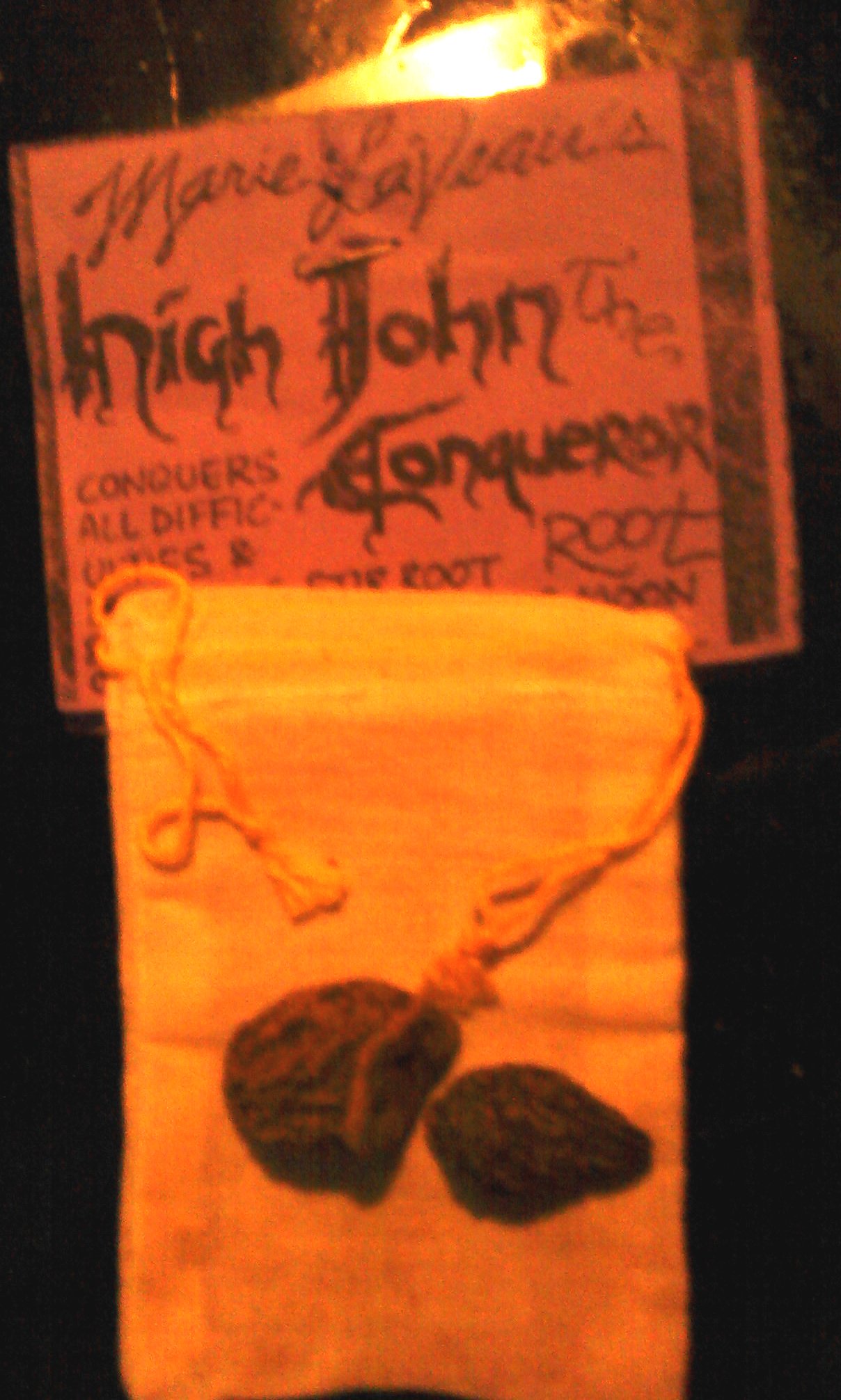
This shriveled root is part of the Ipomoea genus, and is a relative of the Morning Glory.  Its resemblance to a shrunken testicle has made it a powerful symbol of potency and virility.   I consider it to be one of the quintessential hoodoo herbs (which is the reason I included it in my “hoodoo kit” post).  Catherine Yronwode says of the root in her Hoodoo Herb and Root Magic book, “ A person possessing a John the Conqueror Root will never be long without money or a lover and will be extremely lucky in games of chance and business” (HHRM p. 111).

Some of the most common ways to use this root are to put it into a jar of neutral oil (such as safflower or olive) and let it sit for a few weeks, occasionally shaking the jar.  The resulting oil (which will have little to no smell and to which you should add some vitamin E or tincture of benzoin to prevent rancidity) can be used to anoint anything that needs more power.  Rubbed on your hands and feet, it adds personal power to everything you do.  Rubbed on money kept in your wallet, it helps you be more successful in luck and business endeavors.  Rubbed (very lightly) on the penis, it restores male virility and enhances sexual prowess.

Another key way to use this root is to keep a whole root in your pocket, either by itself or wrapped in a red cloth bag as a mojo hand.  Fed regularly (once a week at least) with whiskey or the High John Oil I just described, it keeps you empowered and potent at all times.  According to the lore, money comes easier, luck favors you, love finds you, and sex is better than ever.

You can also add John the Conqueror (by the way, you say it “John the Con-ker”) chips or oil to other mojo hands to increase their potency as well.  I like to add them to success and business workings, because they tend to work faster and require less finagling on my part after my initial efforts.

The High John root has appeared in pop culture several times, too.  Whenever hoodoo comes up in songs, a mention of this root is seldom far behind.  For example, in the Allman Brothers Band remake of Willie Dixon’s “Hoochie Coochie Man,” radio audiences of the 70’s heard the lyrics:

“Got a John the Conquerer root and got some mojo too,
We got a black cat bone, we’re gonna slip it to you.”

Considering the libertine behavior the singer boasts of elsewhere in the song, having a little magic keeping his virility charged certainly seems like a good idea (I’ll address the black cat bone reference in another post).  Muddy Waters (who worked with Willie Dixon quite a lot) also recorded a blues song featuring the hoodoo charm, entitled (appropriately) “My John the Conqueror Root.”

There are lots of places to find this root on the web, and if you have a local botanica of some kind, they will also likely carry this curio.  I highly recommend anyone looking into American magic familiarize him/herself with High John.  Who couldn’t use a magical boost from such a potent little root?

Thanks for reading!

-Cory